
India gains a foothold in a changing defence market
India has confirmed exports of its Akash air-defence system to Tajikistan and Turkmenistan, adding two Central Asian customers to a programme whose first overseas buyer was Armenia. The announcement, made by Defence Secretary Rajesh Kumar Singh, marks a step in India’s effort to sell more domestically developed military equipment abroad and gives it a new presence in a region long supplied mainly by Russia.
Contents
- India gains a foothold in a changing defence market
- What does the Akash system do?
- Why are Central Asian states seeking alternatives?
- China is building a parallel presence
- What India gains from the exports
- Russia retains leverage despite its export decline
- The next test is support, not just sales
- The Bottom Line
The deals come as Central Asian governments seek more room to manoeuvre among outside powers. Russia remains deeply connected to the region through trade, military agreements and longstanding political ties, while China has expanded its role as an investor and arms supplier. India’s entry adds another option, though the details of its contracts remain undisclosed.
Singh said Armenia had acquired multiple Akash batteries, followed by exports to Tajikistan and Turkmenistan. Neither Central Asian government has publicly commented on the sales. Indian officials have not disclosed the number of systems, contract values, delivery schedules or the configurations supplied.
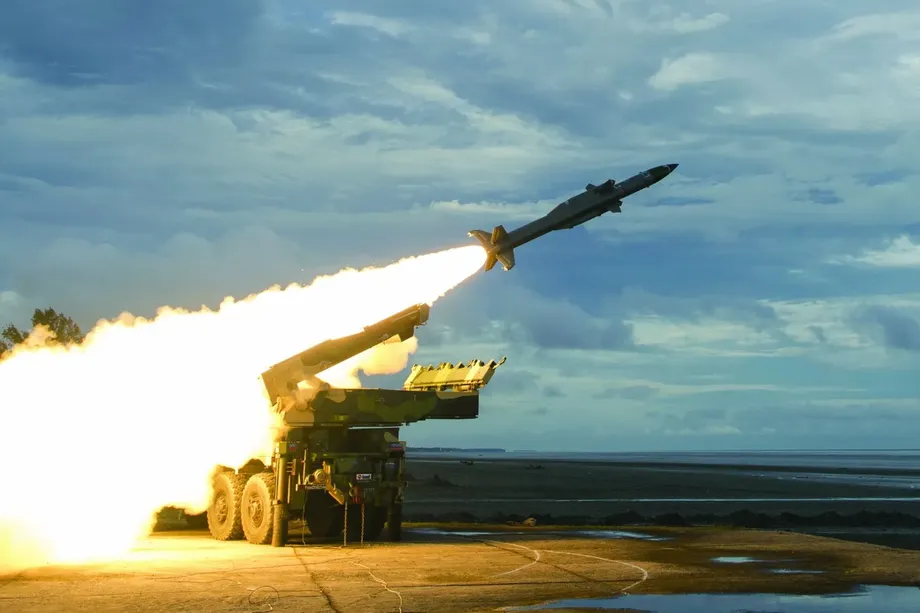
Akash is a ground-based system designed to detect and engage incoming aircraft and other aerial threats. Its export is more than a sale of missiles: an operational air-defence system also depends on radars, launchers, command equipment, trained crews, maintenance and a continuing supply of parts. Those links can shape a buyer’s defence relationships for years.
What does the Akash system do?
Developed by India’s Defence Research and Development Organisation (DRDO), Akash is a short-range surface-to-air missile system. Indian defence sources describe it as capable of engaging targets such as fighter aircraft, helicopters, drones and cruise missiles. The Defence Ministry gives the system an operational range of about 4.5 to 25 kilometres and an altitude range extending to 20 kilometres. Other descriptions put the original system’s maximum engagement range at around 25 to 30 kilometres, reflecting differences in the variant and the figures used.
The system uses radar and command guidance to track a target and direct the missile during an engagement. Its electronic counter-countermeasure features are intended to help it operate when an adversary attempts to disrupt radar or communications through jamming. Akash can track multiple targets, though the precise engagement capacity depends on system configuration.
DRDO developed the system for India’s armed forces, and production is led by Bharat Dynamics Limited, with Bharat Electronics Limited involved in electronics and associated systems. India approved Akash exports in 2020. Singh says production has stabilised, with orders continuing from India’s military as overseas interest grows. Reliable domestic production can reassure buyers that missiles, spare parts and technical support will remain available.
Newer variants include Akash Prime and Akash-NG, which are intended to bring upgraded sensors and other performance improvements. The longer range often cited for Akash-NG, up to about 50 kilometres, applies to that newer programme, not automatically to the systems sold to Tajikistan and Turkmenistan. India has not identified the export configurations.
Why are Central Asian states seeking alternatives?
Russia’s military and commercial role in Central Asia has not disappeared, but the war in Ukraine has exposed risks in relying heavily on a single supplier. Wartime demands and disruptions have affected Russia’s capacity to deliver arms abroad. Stockholm International Peace Research Institute data cited in the supplied research put Russia’s major arms exports 64 percent lower in 2021–25 than in 2016–20, with its share of global exports falling from 21 percent to 6.8 percent.
That shift does not mean the region has abandoned Russian equipment. Tajikistan, a member of the Russian-led Collective Security Treaty Organization (CSTO), remains closely linked to Moscow and has received Russian military assistance, including S-300 air-defence systems. Russia also maintains a military presence in the region and operates Kant airbase in Kyrgyzstan.
Turkmenistan follows a different course. It declares itself permanently neutral and is not a CSTO member. It has diversified purchases among suppliers including China, Türkiye and Italy. Its growing Chinese inventory includes systems such as the FM-90, KS-1A and FD-2000. At least 10 Chinese FK-2000 missile-and-gun vehicles were also visible during a military parade in Ashgabat in September.
The presence of several suppliers can help governments avoid depending on one country for every military need. It can also create new complications. Equipment from different countries may use distinct radar, communications and command systems, and ownership of several weapon types does not by itself ensure they can share information or operate as one network. Turkmenistan has not said whether its Indian and Chinese systems will be integrated.
For a buyer, diversification is therefore a balance between greater choice and more demanding logistics. Training, maintenance, ammunition stocks and compatibility all matter alongside the purchase price. A system that cannot be sustained or coordinated with other defences may provide less value than its advertised capabilities suggest.
China is building a parallel presence
India’s exports arrive amid a wider contest for defence relationships, not a simple handover from Russia to a new dominant supplier. China has made inroads through arms sales and economic ties. Uzbekistan has emerged as an operator of China’s J-10CE combat aircraft, with official footage showing at least six jets and reports of an order for 24. The aircraft combines modern avionics with a price and delivery proposition that can appeal to countries seeking alternatives to Russian equipment.
China’s influence also extends beyond weapons. It is Uzbekistan’s leading trading partner and a major investor, while Chinese state enterprises are involved in major infrastructure plans, including the China-Kyrgyzstan-Uzbekistan railway. Such projects could strengthen regional transport links and make Uzbekistan a more important transit hub.
Turkmenistan’s Chinese air-defence systems show how the region’s procurement choices are already overlapping. Akash could add another layer to its defences, but public information does not establish how the system will fit operationally with Chinese equipment. The distinction matters: a country may diversify suppliers while still facing technical and logistical challenges across its armed forces.
India’s sales also have a wider strategic context. New Delhi has sought closer economic and defence ties across Central and Southeast Asia as it responds to China’s growing influence around its periphery. Analysts sometimes describe this effort as a “Necklace of Diamonds” strategy, a set of partnerships and access points intended to counterbalance China’s regional reach. The Akash deals are consistent with a broader effort to build relationships, though India has not publicly described these specific exports as part of a military plan against China.
What India gains from the exports
The sales support India’s ambition to move from being a major arms importer toward becoming a more substantial exporter. Singh has described Akash as a success for India’s domestic missile industry and said further international orders may follow. The system’s export record, together with continuing orders from India’s armed forces, gives New Delhi a reference point when approaching other potential customers.
India is also presenting price and supply reliability as advantages. Rahul Wankhede, a research analyst at the Manohar Parrikar Institute for Defence Studies and Analyses, has said domestic production and Indian military orders could reassure buyers about replenishment, training and support. A relatively affordable system may appeal to countries seeking capable air defence without the cost of some Western alternatives.
The Akash programme took decades to develop. Work began in the 1980s, when Indian engineers sought to build a system combining missiles, radar and ground infrastructure into a coordinated defence capability. The export version of that effort is therefore a test of more than the missile itself: India must show that it can deliver complete systems, provide long-term service and meet foreign customers’ schedules.
Akash is part of a wider export push that includes the BrahMos supersonic cruise missile and other Indian-made platforms. BrahMos has attracted interest in Southeast Asia, including from the Philippines, with further agreements or proposed sales reported in the region. These systems serve different roles: Akash is designed to defend against aerial threats, while BrahMos is an offensive strike weapon. Together, they illustrate India’s effort to market more complex military technology, though each export requires its own political and technical arrangements.
Russia retains leverage despite its export decline
Russia’s shrinking arms exports have created openings for competitors, yet its place in Central Asia remains substantial. The region’s countries share trade links, transport routes and labour migration ties with Russia. A 2023 estimate cited by regional analysts put Russia-Central Asia trade at about US$44 billion, roughly one-third of the region’s total trade turnover.
Military ties add another layer. The CSTO includes Kazakhstan, Kyrgyzstan and Tajikistan, and Russia maintains bases, equipment links and regular security contacts across the region. These arrangements are not easily replaced by a new missile purchase. A state may buy from India or China while continuing to rely on Russia for training, maintenance, border security or other military support.
That is why new arms deals should be read as diversification rather than proof that Russia has lost its influence. Central Asian governments can use procurement to widen their choices, seek better prices and reduce dependence in specific areas. At the same time, suppliers gain relationships that can last beyond the initial contract.
India may be a comparatively comfortable additional partner for some governments. It is not a CSTO rival and has longstanding defence ties with Russia, including cooperation on the BrahMos programme. Analysts have argued that Moscow could view Indian sales as less threatening than a shift toward Western military systems. China, by contrast, may see India’s presence near its western frontier as competition for influence in a region where Beijing has invested heavily.
The next test is support, not just sales
India’s claims of stable production and continued domestic orders address one concern for prospective buyers: whether a supplier can provide equipment and replacements after a contract is signed. The longer test will be the quality of training, maintenance, spare-parts delivery and technical assistance. These commitments can determine whether an export becomes a durable partnership or a one-time transaction.
The Akash systems could also lead to interest in other Indian products, including radars and artillery, but there is no public confirmation of further purchases by Tajikistan or Turkmenistan. Expanding into additional categories would require India to demonstrate the same delivery capacity across different technologies.
For Central Asian governments, a broader supplier base offers more bargaining power but demands careful planning. Different weapons may need separate maintenance chains, specialist training and software support. If systems cannot exchange radar tracks or coordinate engagements, commanders may have to manage them through separate procedures. Those details are especially important in air defence, where warning and response times can be short.
The Akash exports mark a visible expansion of India’s defence presence, while China’s aircraft and air-defence sales demonstrate that regional competition is already active. Russia remains a major security partner despite its reduced arms-export capacity. Central Asian governments are testing how far they can diversify without losing the advantages of established relationships.
The Bottom Line
India has confirmed Akash exports to Tajikistan and Turkmenistan, after Armenia became the system’s first overseas customer.
Contract values, delivery schedules, quantities and export configurations have not been disclosed.
Turkmenistan already operates multiple Chinese air-defence systems, but interoperability with Akash has not been confirmed.
Russia’s arms exports have fallen sharply, while its trade, military agreements and political ties in Central Asia remain significant.
India’s sales add another supplier to a region where governments are balancing Russian ties with growing Chinese and Indian roles.