
Avaza meetings connect water quotas with a wider regional warning
Central Asian water officials approved withdrawal limits for the Amu Darya and Syr Darya for the 2026–2027 season outside the main crop growing period, as Uzbekistan pressed for better measurements, less waste and sustained dialogue with Afghanistan. The decisions at the Interstate Commission for Water Coordination's 95th meeting in Avaza, Turkmenistan, on October 7 preceded a presidential appeal for joint action at the same venue on October 8, 2026.
Contents
- Avaza meetings connect water quotas with a wider regional warning
- What the seasonal agreement covers
- Why the Kerki measurements matter
- Chardara received more water than forecast
- Digital accounting is progressing, but its status needs care
- Afghanistan dialogue and competing canal estimates
- Uzbekistan prepares for the Aral Sea fund chairmanship
- The test is implementation, not another declaration
- Clean air proposals sit alongside industrial expansion
- The next milestones
- Key Points
The immediate agenda included a concrete problem: inconsistent flow measurements at the Kerki gauging station on the Amu Darya. Officials also reviewed Kazakhstan's report that 3.69 billion cubic meters had entered the Chardara reservoir during the 2026 growing season, exceeding the forecast by 840 million cubic meters. Those details put measurement and coordinated reservoir management at the center of a debate often framed simply as a shortage of water.
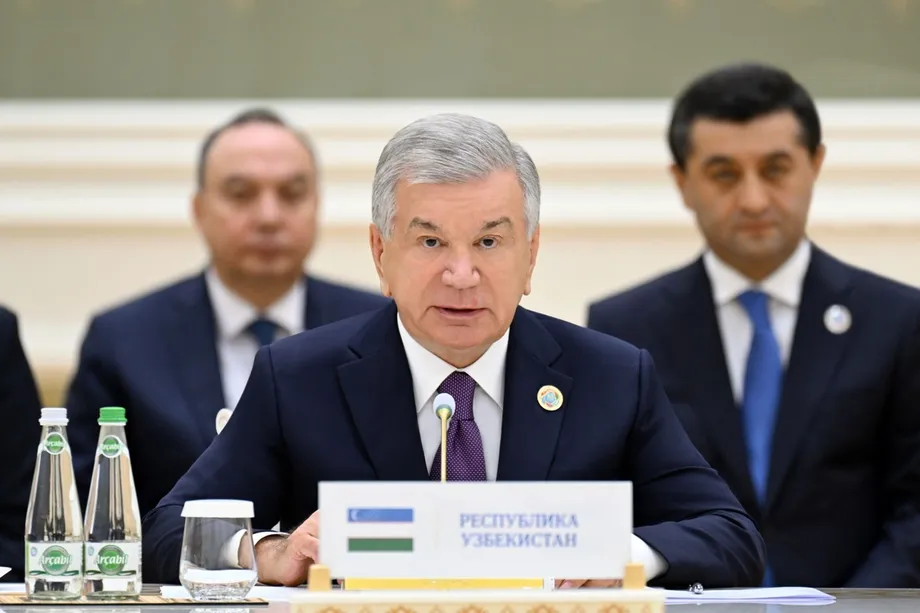
Uzbek President Shavkat Mirziyoyev, speaking at the eighth Consultative Meeting of the Heads of State of Central Asia and Azerbaijan, connected water scarcity to economic development. His official presidential address called for digital monitoring, irrigation modernization and wider adoption of technologies that save water.
Mirziyoyev described the pressures facing the region:
Water scarcity is becoming an increasingly serious constraint on the development of Central Asia. The climate is changing, the population is growing, and the pressure on agriculture and infrastructure is increasing.
The two meetings produced different kinds of outcomes. Water officials approved seasonal management decisions and signed a protocol. The president outlined a broader program whose financing, technical specifications and implementation dates were not set out in his speech.
What the seasonal agreement covers
The water commission brought together representatives from Uzbekistan, Turkmenistan, Kazakhstan and Tajikistan, along with the heads of the Amu Darya and Syr Darya basin management associations. Uzbekistan's delegation was led by Water Resources Minister Shavkat Khamraev.
Participants reviewed water availability, use and compliance with withdrawal limits during the 2026 growing season. They then approved limits for the following period and projected operating schedules for reservoir cascades, meaning linked reservoirs whose releases must be coordinated along a river.
Withdrawal limits govern how much water users may take from the river system. Reservoir schedules address when water is stored or released. Both matter because an agreed volume alone does not establish whether water reaches users at the time they need it.
The numerical country allocations were not disclosed in the accounts of the agreement. That prevents a comparison of national shares or an assessment of whether any country received a larger or smaller allowance than before. The parties agreed to hold the commission's 96th meeting in Uzbekistan, but no date was specified.
Why the Kerki measurements matter
At Kerki, officials examined discrepancies in recorded water discharge even when river levels were identical. Discharge measures the volume passing a point over time, rather than simply the height of the water. Matching water levels do not by themselves settle what the correct flow calculation should be.
The commission instructed specialists to investigate the discrepancies and ensure accurate measurements. The reports did not identify the cause, establish the size of any error or say that water had been deliberately misreported.
This matters for the separate discussion on proportional allocation among users along the upper, middle and lower Amu Darya. If participating countries do not trust the measurements, they cannot reliably determine whether an agreed share has been delivered. Officials therefore discussed modernizing gauging stations, exchanging information quickly and consulting when river conditions change.
Chardara received more water than forecast
Kazakhstan's Ministry of Water Resources and Irrigation described conditions in the Syr Darya basin as stable during the 2026 growing season. It reported that approximately 3.69 billion cubic meters entered Chardara reservoir in Kazakhstan's Turkistan region.
That was 840 million cubic meters above the initial forecast. Subtracting the excess gives a forecast of approximately 2.85 billion cubic meters, meaning actual inflow was about 29.5 percent higher than expected. The comparison shows why seasonal operating decisions need updated observations rather than forecasts alone.
For the 2026–2027 period outside the main growing season, inflow into Chardara was projected at approximately 10 billion cubic meters. That is a forecast for a different period, not a measured annual total or a guarantee of water available for withdrawal.
The favorable growing season result at one reservoir does not contradict Mirziyoyev's warning about regional scarcity. It describes a particular location and season. The president's concern covers the wider pressure from climate change, population growth, agricultural demand and losses in water distribution networks.
Digital accounting is progressing, but its status needs care
The commission supported continued work on automated water accounting in the Syr Darya basin. Such systems can collect and transmit measurements electronically, helping countries compare withdrawals and river flows more quickly. They still depend on accurate instruments and agreed measurement procedures.
Reports differ slightly on the planning stage. One describes an automation plan approved in August 2026 and continued implementation work at the October meeting. Other accounts say officials approved the process of preparing a plan. These descriptions establish support for automation, but do not establish that a complete basin system is operating.
Mirziyoyev's wider proposal combines digital monitoring with physical improvements to irrigation networks and technologies that reduce water use. Better accounting can show where water goes; repairing distribution infrastructure and changing irrigation practices address how much is lost or consumed. The speech provided no numerical savings target or construction schedule.
Afghanistan dialogue and competing canal estimates
Mirziyoyev placed dialogue with Afghanistan within the regional water agenda. His official speech referred to Afghanistan, without naming a particular canal or prescribing a negotiating format. The Uzbek president said:
This dialogue should be continuous and substantive, with due consideration given to the interests of all countries in the region.
The call comes as the Taliban authorities build the Qosh Tepa canal in northern Afghanistan to take water from the Amu Darya. Uzbekistan has advocated Afghan participation in regional water management mechanisms and has reportedly offered technical assistance to reduce losses from the project.
Published estimates of the canal's potential effect differ sharply. One account puts a possible reduction in Amu Darya flow at 15 to 20 percent; an older account describes a potential reduction of half. Neither establishes a common measurement point, time period or calculation method. The figures should therefore be treated as competing estimates, not a settled prediction.
No agreed canal withdrawal figure, verified effect on water supplies in Uzbekistan and Turkmenistan, or date for the proposed Afghan dialogue was announced in the speech. The uncertainty makes information exchange central to the proposed talks, rather than a detail to be addressed after an agreement.
The region also has a separate example of water tensions turning violent: deadly clashes between Afghanistan and Iran in May 2023 over Helmand River water sharing. That dispute concerns a different river and does not establish that conflict over the Amu Darya is inevitable.
Uzbekistan prepares for the Aral Sea fund chairmanship
Uzbekistan will assume the chairmanship of the International Fund for Saving the Aral Sea in 2027, according to Mirziyoyev's October 8 address. He pledged more effective work by the fund, new environmental projects and additional funding, without naming projects or financial commitments.
The president presented the incoming role as a responsibility:
Starting next year, Uzbekistan will assume the chairmanship of the International Fund for Saving the Aral Sea. We regard this role as a great responsibility.
The water commission also reviewed tasks agreed at summits of the fund's founding states and the work of its scientific information center and executive bodies. That connects the coming chairmanship to existing institutions, rather than to a newly announced organization.
Mirziyoyev called for full implementation of the Decade of Practical Action for the Rational Use of Water Resources in Central Asia. His address did not specify the initiative's start and end dates or measurable delivery targets.
The test is implementation, not another declaration
The emphasis on practical results addresses a concern voiced in earlier assessments of regional water management. Akram Umarov, an associate professor at the University of World Economy and Diplomacy in Tashkent, described the gap between discussion and action:
Water inefficiency is dramatic, and water waste is huge in the region.
Umarov added:
There are lots of talks but there is no implementation.
Those comments came in an earlier assessment, not a response to the October 2026 decisions. The new seasonal agreement demonstrates continuing coordination, but it does not by itself establish that irrigation losses have fallen or that automated monitoring is complete.
Earlier reporting also connected agricultural pressure to renewed investment in Uzbek cotton after an international boycott lasting 11 years ended. That history adds context to the president's warning about agricultural demand, but no new crop acreage, production target or water demand estimate accompanied the Avaza announcements.
The practical distinction is between agreed rules and demonstrated results. Approved limits, dependable gauges, functioning accounting systems and verified reductions in losses are separate steps. The October meetings addressed all four, but disclosed firm decisions mainly on seasonal limits and reservoir schedules.
Clean air proposals sit alongside industrial expansion
Mirziyoyev also proposed starting the International Consortium Clean Air of Central Asia with a pilot environmental modernization program for industrial zones, agricultural clusters and transport hubs. The address identified those locations as places where the environmental burden is especially high, but did not name sites, pollutants, budgets or a launch date.
The proposal sits beside plans for closer industrial cooperation, joint investment support and integrated transport networks. The official Uzbek text of the address also records Uzbekistan's offer to host the first meeting of a proposed Council for Infrastructure Development.
The president proposed coordinating energy generation, storage and energy corridors through a Joint Concept for Low Carbon Energy Potential. He also suggested shared computing infrastructure based on connected national data centers and a regional atlas of professions and skills in demand.
These proposals broaden the water discussion: the same speech calls for expanding economic activity while reducing environmental pressure. It does not, however, assign water requirements to the proposed industrial projects or set environmental conditions for their approval. Those connections will need to be made through subsequent planning and investment decisions.
The next milestones
The 2026 agreements form a sequence of reservoir coordination, automation planning and wider political commitments. The principal dates are:
- May 2026: Tajikistan, Uzbekistan and Kazakhstan agreed on the Bahri Tojik reservoir operating schedule for June through August.
- August 2026: A reported decision backed development of automated water accounting along the Syr Darya.
- October 7, 2026: The water commission met in Avaza and approved seasonal withdrawal limits and projected reservoir schedules.
- October 8, 2026: Mirziyoyev called for joint action on water, climate and air pollution at the leaders' meeting.
- December 2026: The UN Water Conference is scheduled in Abu Dhabi.
- 2027: Uzbekistan is due to assume the Aral Sea fund chairmanship.
- March 2027: The 11th World Water Forum is scheduled in Riyadh.
Water officials discussed preparations for both international gatherings. The commission's next meeting in Uzbekistan is another expected milestone, although its date remains unspecified.
The unresolved issues are concrete: country allocation figures, the findings of the Kerki investigation, the delivery schedule for automated accounting, funding for irrigation improvements and arrangements for Afghan participation. Publishing those details would make it possible to assess progress beyond the commitments announced in Avaza.
Key Points
- Central Asian officials approved Amu Darya and Syr Darya withdrawal limits for the 2026–2027 period outside the main growing season.
- Specialists were instructed to investigate inconsistent discharge measurements at Kerki.
- Chardara received 3.69 billion cubic meters during the 2026 growing season, about 29.5 percent above forecast.
- Mirziyoyev called for digital monitoring, irrigation modernization and sustained water dialogue with Afghanistan.
- Estimates of the Qosh Tepa canal's potential effect differ and are not directly comparable.
- Uzbekistan will chair the International Fund for Saving the Aral Sea in 2027.
- Funding, project schedules and several technical details remain unspecified.