
Five missing as damage spreads along the river
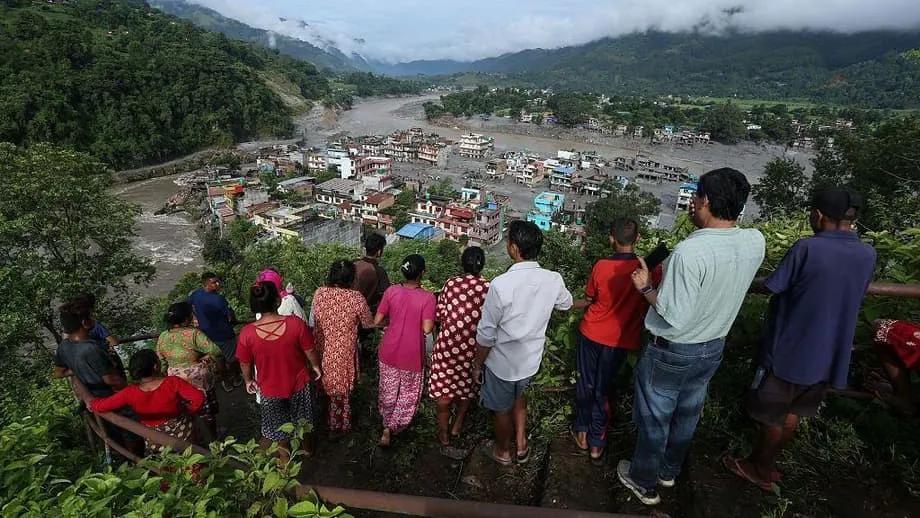
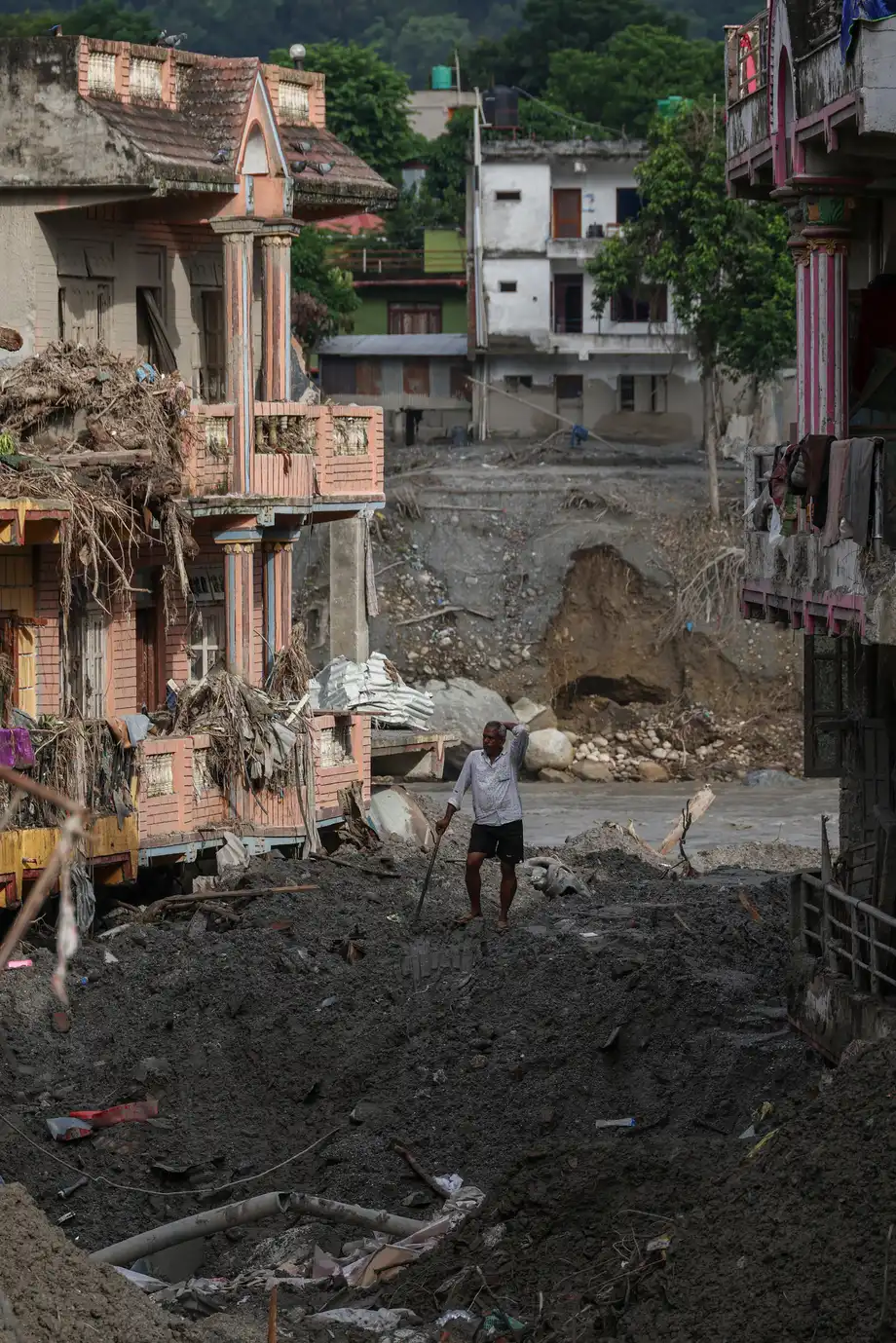
Five people were missing and 82 had been rescued by Sunday evening after a sudden flood carrying mud, rocks and debris tore through settlements along Nepal's Budhi Gandaki River. The National Disaster Risk Reduction and Management Authority's preliminary assessment recorded 45 houses completely damaged, 27 partly damaged, and damage to two road bridges, two suspension bridges and three hydropower projects.
Contents
- Five missing as damage spreads along the river
- Where did the flood begin?
- Warnings began before the Army reconnaissance
- Missing people and rescue totals differ
- Homes and a school swept away
- Destroyed bridges cut access on both banks
- Hydropower construction suffers major losses
- Recorded shaking does not establish an earthquake
- Warnings, shelter and medical readiness
- Officials press for relief and safe reconstruction
- Key Points
The flood struck northern Gorkha before dawn and spread downstream into Dharche, Aarughat and neighbouring Dhading. Homes, a school, construction camps and river crossings were swept away or damaged. No deaths had been confirmed in the initial updates, but the subsequent reports of missing people meant the human toll was still unresolved.
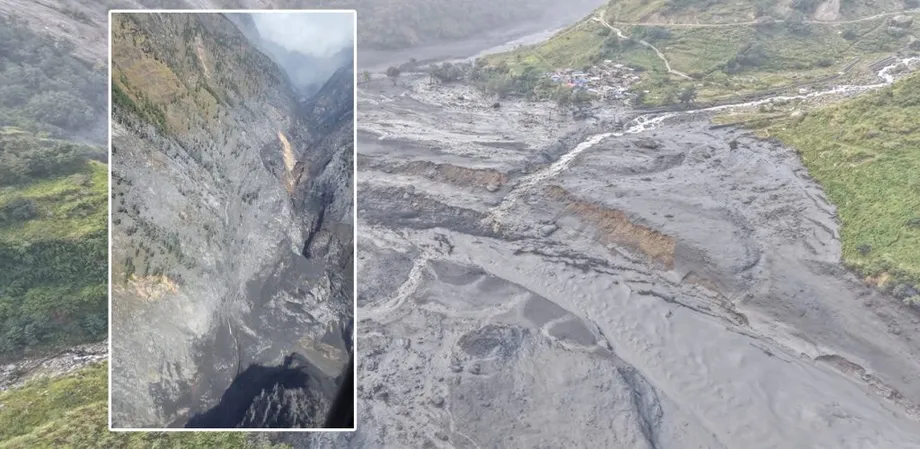
A landslide that temporarily blocked a river or tributary, followed by the sudden release of trapped water, is the leading preliminary explanation. The Nepal Army identified a blockage near Filim in Chum Nubri Rural Municipality Ward 3. Other accounts placed the initial disturbance farther upstream, around Ungilung Khola and Syār Khola in Ward 6. A team of three specialists, including geologists, was dispatched with a drone to investigate.
The distinction matters because locating the original blockage will help establish whether unstable debris or trapped water still threatens communities below it. Authorities had not announced a final finding on the flood's origin, and warnings extended beyond the damaged settlements to communities along the Budhi Gandaki and Trishuli rivers.
Where did the flood begin?
The Army received information at 5:55 a.m. that the Budhi Gandaki was blocked and sent a reconnaissance team from its Bangsing security post shortly after 6:15 a.m. The team confirmed a dry landslide at Filim. Aerial images showed debris in a deep, narrow gorge and what appeared to be a landslide along its edge.
A dry landslide is a slope collapse that occurs without rainfall being the immediate trigger. If fallen rock and soil obstruct a channel, water can collect behind the debris. When that temporary barrier fails, the released water can carry the material downstream in a destructive surge.
Other observations point to a tributary route. Sushil Thapa, managing director of Times Energy, said an aerial inspection indicated that the flood travelled from Ungilung Khola through Syār Khola into the Budhi Gandaki. The Syār confluence is approximately five to seven kilometres upstream of Filim, with the Ungilung confluence another five to seven kilometres farther along Syār Khola.
Thapa described the main Budhi Gandaki above the confluence as flowing normally during the inspection. Chum Nubri chair Nima Lama separately identified a blockage on Chumche Khola, while other local accounts placed a landslide between Kharong and Ungjulung. Prime Minister Balendra Shah described a landslide between Lokpa and Chumling. These accounts do not establish one agreed location or sequence, so the Filim finding should not be treated as a final explanation of the entire event.
Warnings began before the Army reconnaissance
The reported times show that warnings and evacuations were already underway before the Army's inspection. Gorkha Chief District Officer Dhirendra Kumar Mishra said authorities received word of a major flood at 4:35 a.m. Dharche chair Lakshman Gurung said residents had received an early warning around 3:30 a.m. and were moved to safer ground.
Aarughat chair Raju Gurung described warnings from upstream and evacuations supported by security personnel and public announcements. His account placed receipt of information around 5 a.m. but evacuation from about 4:30 a.m. That sequence is inconsistent as stated and needs clarification. The different times also concern different communities and agencies, rather than necessarily marking the same stage of the flood.
- About 3:30 a.m.: Dharche's chair said an early warning prompted residents to move to safety.
- 4:35 a.m.: Gorkha's chief district officer said authorities received news of the flood.
- 5:55 a.m.: The Army received information that the Budhi Gandaki was blocked.
- 6 a.m.: The disaster authority sent response alerts to 221 responders across six districts, according to the prime minister.
- Shortly after 6:15 a.m.: An Army reconnaissance team left the Bangsing security post.
- About 7:30 a.m. and 10 a.m.: Aarughat's chair said the Soti bridge and a lower river crossing, respectively, were swept away.
- Sunday evening: Government updates reported missing people, expanded rescue operations and preliminary damage totals.
Flood Forecasting Division expert Binod Parajuli initially estimated that the flood could take about three hours to reach Aarughat. That was a forecast intended to support warnings, not a confirmed measurement of its eventual travel time.
Missing people and rescue totals differ
The disaster authority's evening assessment identified five people missing in the Ungilung area of Chumchet, Chum Nubri Ward 6: two women and three men. Prime Minister Shah also reported five missing and said search operations were being intensified.
A separate local account gave a higher figure. Resident Dipesh Lama said 10 people were out of contact, five from Ungilung Goth and five from three houses in Dhaune. That account has not been reconciled with the authority's five-person total. Being out of contact does not by itself establish that someone has died, particularly where communications and access have been damaged.
Rescue figures also changed across updates. The initial account described an Army helicopter rescuing six people from Jagat. Shah later said 48 people had been rescued, including 12 employees of the hydropower project under construction at Salleri. The disaster authority's evening assessment gave a total of 82, including nine foreign nationals, rescued using four Army helicopters. These figures should not be added together because they may include the same people.
According to the prime minister, 437 security personnel were deployed: 127 from the Nepal Army, 133 from Nepal Police and 177 from the Armed Police Force. Four Army helicopters were assigned to the affected area, while another 50 police disaster response personnel were held ready for deployment.
Homes and a school swept away
Chum Nubri deputy chair Laxmi Gurung identified Ghattékhola, Payun, Salleri and Jagat Bagar as areas suffering major damage. The building of Vikas Primary School at Ghattékhola was reported swept away, and Jagat Bagar was described as devastated. Residents fled toward hills and forests, in some cases without time to collect clothes or food.
Gandaki Province Health Ministry's preliminary assessment recorded the loss of Ram Bahadur Gurung's house at Sirdibas and flooding in another house. At lower Machhikhola, it listed floodwater entering five to seven houses and five to seven temporary structures. Earlier figures had put both categories at eight. At Salleri, the ministry placed 20 to 22 houses at risk.
Farther downstream, Aarughat chair Raju Gurung said approximately 50 houses in Shanti Bazaar were inundated. He also reported flooding affecting 10 to 15 houses and a hotel at Soti. Across the river in Dhading, Tripurasundari deputy chair Devraj Dharel said roughly 60 to 65 houses and temporary shelters in Vishalnagar were swept away.
Those local estimates cannot be combined into a reliable total. They distinguish between inundation, complete destruction and structures at risk, and may use different definitions of houses and temporary shelters. The disaster authority's evening count of 45 completely damaged and 27 partly damaged houses amounts to 72 damaged houses, but it does not explain how that figure relates to the larger Vishalnagar estimate.
The authority also recorded damage to 34 livestock sheds, 12 pig enclosures or sheds, and three vehicles. A complete assessment of losses had not been announced.
Destroyed bridges cut access on both banks
Two suspension bridges were reported swept away: the old crossing between Nyakchet and Sirdibas, and the bridge linking Machhikhola with Kerauja. The iron road bridge at Soti, connecting Aarughat wards 2 and 3 and providing access toward Manbu, was also lost.
At Nayapul in Aarughat Ward 9, the Gorkha side of the three-section bridge connecting Aarughat with Dhading was washed away. The Health Ministry described damage to one section and said the road was completely blocked. Later local accounts described damage on the Dhading side as well, while Aarughat's chair described the crossing as completely swept away. These descriptions differ in the extent of structural loss, but agree that traffic could no longer use the bridge.
The disruption compounds an existing access problem. A previous Bhotekoshi flood had swept away the Trishuli crossing at Phurkekhola near Malekhu, forcing travellers toward Dhadingbesi to use rural alternatives. The loss of the Aarughat crossing now blocks another route linking Dhading and Gorkha.
Teams including the heads of the Department of Roads and the Department of Local Infrastructure were sent to assess alternative access and the possibility of installing Bailey bridges. These are prefabricated steel bridges that can provide temporary crossings. Shah said preparations had begun for one at Aarughat, but no installation or reopening date was announced.
Hydropower construction suffers major losses
The flood damaged the camp and structures of the 341 MW Budhi Gandaki hydropower project under construction at Salleri. Times Energy's account described its main camp, buildings and construction equipment as swept away. The prime minister also reported losses involving the construction camp, equipment, nearby houses, electricity poles and a telephone tower.
There are differences in the preliminary descriptions of the powerhouse. The initial account identified it with the Budhi Gandaki project in Dharche Ward 3, while the Health Ministry's assessment called it the Sahaj Urja powerhouse and placed it in Chum Nubri Ward 3. The ministry reported seven to eight nearby houses swept away, compared with eight to 10 in another early account. The facility's identity, administrative location and associated house losses need clarification.
The flood also swept away a Bailey bridge built for the 14.15 MW Dobhan Khola hydropower project. The disaster authority counted three hydropower projects as damaged, but the third was not identified in the detailed descriptions.
For the construction sites, the immediate damage extends beyond buildings. Lost crossings and damaged roads obstruct access for workers, equipment and repairs. No confirmed financial loss estimate, revised construction timetable or full engineering assessment was announced.
Recorded shaking does not establish an earthquake
Residents in the upper area reported feeling the ground shake before the flood. A reported record from EarthScope's Kakani station showed a vibration signal between 22:40 and 22:45 UTC on Saturday. Nepal is five hours and 45 minutes ahead of UTC, placing that interval at 4:25 to 4:30 a.m. Sunday.
The account describing the signal instead gave the Nepal time as approximately 3:45 p.m. That conversion is inconsistent with the stated UTC interval. The correct conversion places the reported signal close to the early morning flood alerts, but timing alone does not establish what caused the shaking or whether it preceded the initial slope collapse.
Senior seismologist Dr. Mukunda Bhattarai said the National Earthquake Monitoring and Research Centre had no earthquake recorded in Nepal during the preceding 24 hours. Disaster authority executive chief Dr. Dharmaraj Upreti said consultations with geologists likewise found no newly recorded earthquake in Gorkha or nearby areas.
A seismometer measures ground motion, which can come from falling rock, a landslide or a powerful flood as well as an earthquake. A recorded vibration therefore does not automatically indicate movement on a geological fault. Geologist Dr. Lok Bijay Adhikari said the shaking could resemble that associated with the earlier Rasuwa–Bhotekoshi disaster, but further study was needed.
Senior hydrologist Binod Parajuli said no rainfall had been recorded in the upper Budhi Gandaki. Early possibilities included a dry landslide or an avalanche. Upreti also compared the flood's appearance with the earlier Rasuwa–Bhotekoshi event. Neither the resemblance nor the absence of recorded rain establishes an identical cause, and no confirmed finding of a glacial origin had been announced.
Warnings, shelter and medical readiness
Shah said the disaster authority sent alerts at 6 a.m. to 221 responders in Gorkha, Dhading, Tanahun, Chitwan, eastern Nawalparasi and western Nawalparasi. He also said approximately 200,000 warning text messages were issued in two rounds to people in Gorkha, Dhading and downstream toward Benighat in Chitwan. The number of messages does not necessarily equal the number of distinct recipients.
Upreti identified Sirdibas, Jagat, Yari, Tatopani, Machhikhola, Soti, Arukhet and Aarughat as areas at risk. Alerts also extended toward Tanahun, Muglin and Chitwan. Residents were urged to stay in safe places and avoid damaged or dangerous bridges and roads.
In Tripurasundari, displaced families were initially sheltered in vacant or unfinished houses and provided communal meals. The local government planned to use Kamala Devi and Sile Devi school buildings for the following few days, then build temporary shelters. A health camp was operating for displaced people in the Aarughat area.
The provincial Health Ministry said facilities at Filim, Salleri, Jagat and Machhikhola stood at higher elevations and were at comparatively lower risk. District rapid response teams in Gorkha, Lamjung and Tanahun, along with provincial hospital emergency medical teams, were placed on standby.
Officials press for relief and safe reconstruction
National Assembly Chair Narayan Prasad Dahal urged immediate search, rescue, relief and safe relocation. Parliamentary special committee chair Ganesh Parajuli called for continuous river level monitoring, timely warnings and coordinated rescue by ground and air. The committee requested shelter, clean drinking water, food, clothing, medical care, sanitation and psychological support, with priority for children, older people, pregnant women, people with disabilities and those who were ill.
Former prime minister Baburam Bhattarai visited Aarughat Bazaar and Shanti Bazaar on Sunday and met Gandaki Province Energy Minister Phanindra Devkota, district officials and local representatives. He called for immediate relief and rehabilitation, and for reconstruction to be coordinated with the Budhi Gandaki project and the Benighat–Aarughat–Ruila Bhanjyang road. Former prime minister Sher Bahadur Deuba urged riverside residents to move to safety and asked Nepali Congress members to assist rescue and relief.
The priorities now are to locate the missing people, maintain safe shelter and restore essential access and services. The technical investigation must also establish the flood's origin and assess any remaining blockage or unstable slopes. No deadline for its findings, final damage assessment or bridge restoration was announced.
Key Points
- Five people were missing in the disaster authority's evening assessment; a separate local account reported 10 out of contact.
- The authority reported 82 rescues, including nine foreign nationals, using four Army helicopters.
- A landslide blockage followed by a sudden release is the preliminary explanation, but accounts differ on the location.
- The evening assessment recorded 45 completely damaged houses, 27 partly damaged houses and damage to four bridges and three hydropower projects.
- Loss of the Soti and Aarughat crossings disrupted access; preparations for a temporary Aarughat bridge had begun.
- No earthquake was recorded by Nepal's monitoring centre, and the reported vibration signal requires further investigation.
- Search operations, downstream warnings, relief work and technical assessments remained underway.