
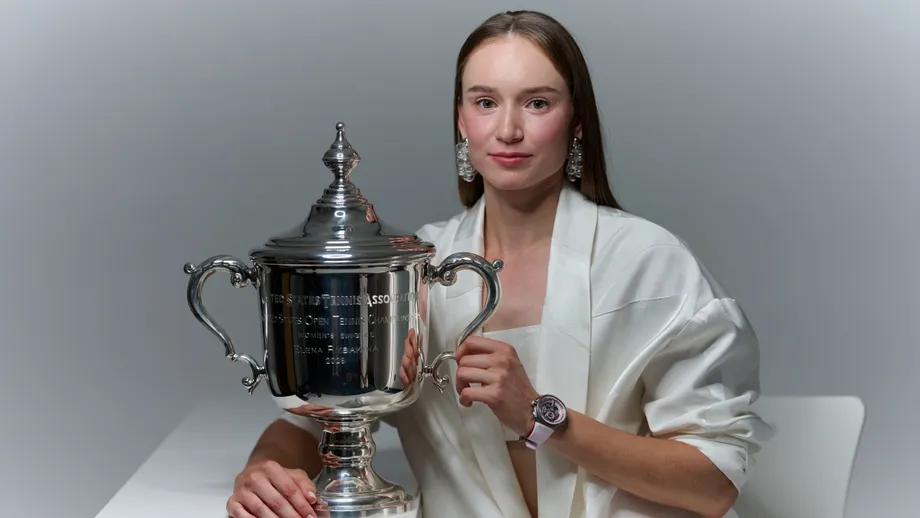
A New Champion and a Historic Ranking Milestone
Elena Rybakina defeated Aryna Sabalenka 6-4, 5-7, 6-2 at Arthur Ashe Stadium in New York to win her first US Open title and complete a season that brought Kazakhstan its first No. 1 player in the WTA singles rankings. The final lasted two hours and 21 minutes, with Rybakina closing the match with her 12th ace.
Contents
- A New Champion and a Historic Ranking Milestone
- How Rybakina Won the Final
- An Injury Cloud Before New York
- The Quarterfinal That Secured No. 1
- A Ranking Breakthrough Later in Her Career
- Two Major Titles Mark a Season of Recovery
- Sabalenka Loses the Title and the Top Position
- Presidential Recognition in Kazakhstan
- The Sequence of the Breakthrough
- Key Points
The victory gave the 27 year old her third Grand Slam singles title, following Wimbledon in 2022 and the Australian Open in January 2026. Her reported ranking total after the tournament was 9,901 points, ahead of Sabalenka on 7,875 and Jessica Pegula on 7,265. That left Rybakina 2,026 points clear of Sabalenka, a substantial margin at the start of her first spell at the top.
The ranking breakthrough and the championship were separate achievements. Rybakina had already secured enough points to become No. 1 by reaching the semifinals, regardless of her results in the remaining rounds. She then defeated Coco Gauff and Sabalenka to turn that mathematical certainty into a title run.
There are discrepancies in the reported chronology. The initial account places the final on September 13 and describes the win over Zheng Qinwen as a semifinal. Detailed tournament accounts instead identify Zheng as her quarterfinal opponent and Gauff as her semifinal opponent. Those accounts describe the final as taking place on Saturday, which would be September 12 in 2026. The ranking release is identified as Monday, September 14.
The distinction matters because the Zheng victory secured the ranking, while the later matches secured the trophy. Reports agree on the final score, match duration and the central achievement: Rybakina ended Sabalenka's 99 consecutive weeks at No. 1.
How Rybakina Won the Final
Rybakina took the opening set despite landing only 27% of her first serves. She broke Sabalenka to move ahead 3-2, then maintained her advantage to take the set 6-4. Her success with such a low first serve percentage showed that her groundstrokes and ability to compete behind her second serve were central to the early lead.
The second set produced a different pattern. Rybakina's first serve percentage improved to 61%, yet she could not convert two break points. Sabalenka kept the contest close and created pressure late in the set. Rybakina saved two set points to hold for 5-5 before Sabalenka broke two games later to win 7-5.
In the deciding set, Rybakina broke for a 2-1 lead and took control. A winning volley secured another break for 5-2, leaving her to serve for the championship. She finished with an ace, repeating the manner in which she had converted match point against Sabalenka in the Australian Open final eight months earlier.
Her reported match statistics included 12 aces, five double faults and three successful conversions from 12 break points. A break point is an opportunity to win a game on the opponent's serve. Converting three of 12 meant a success rate of 25%, but the timing of those breaks was enough to decide the match.
An Injury Cloud Before New York
Rybakina arrived at the US Open after retiring from her Cincinnati quarterfinal against Iga Swiatek. One account identifies the problem as an Achilles injury and says she had only four days of practice before the tournament. No detailed medical diagnosis or recovery timetable was disclosed.
During the trophy presentation, Rybakina described the championship as an unexpected outcome after those physical concerns.
I've been dealing a little bit with injury, but somehow everything aligned on my side... I was coming here for the last 10 years, and it was never successful. Nothing close to that, and it's just incredible. I'm falling in love with New York more and more.
Her run began without the lengthy matches that would later define its closing stages. She defeated No. 13 seed Naomi Osaka in the fourth round and reached the quarterfinals without dropping a set. From there, she had to recover from losing the opening set against both Zheng and Gauff before facing Sabalenka.
The Quarterfinal That Secured No. 1
Rybakina's 3-6, 6-1, 6-4 victory over Zheng was the decisive ranking result. Entering the tournament, she needed to reach the semifinals to guarantee that she would pass Sabalenka. Had she lost earlier, Sabalenka, Pegula or Gauff could have taken the top position by winning the title.
Zheng made that threshold difficult to reach. Rybakina said she struggled initially with the sun and shadows in Arthur Ashe Stadium after playing her previous matches later in the day. Zheng earned her only service break of the match to lead 5-3 and went on to win the first set.
Rybakina responded by taking the second set in 38 minutes. The third remained close until a Zheng double fault gave her a 5-4 lead. Rybakina then served out the match, reaching the US Open semifinals for the first time and securing her place at the top of the rankings.
After that victory, Rybakina explained why she was keeping her attention on the tournament rather than celebrating the ranking immediately.
It's just a number right now and of course I'm in the semis so my goal is to win the tournament.
Zheng's own run was a major recovery story. The 2024 Olympic champion had fallen to No. 121 after elbow surgery and had to qualify for the main draw. She overcame a 5-0 deficit in the deciding set against Madison Keys and another 5-0 deficit in the opening set against Swiatek. Her quarterfinal appearance guaranteed a return to the top 60.
A Ranking Breakthrough Later in Her Career
Rybakina became the 30th woman to reach No. 1 in WTA rankings history. The reported age comparison puts her at 27 years and 89 days on September 14, making her the second oldest woman to debut in the position, behind Angelique Kerber, who was 28 years and 238 days old in September 2016.
That comparison separates the timing of a first major title from the timing of sustained ranking leadership. Rybakina won Wimbledon in 2022, but her rise to No. 1 came four years later. Rankings reflect points accumulated across tournaments rather than the result of a single final, which explains why her position was already secure before she faced Sabalenka.
The reported standings also show Pegula 610 points behind Sabalenka and 2,636 behind Rybakina. The championship therefore left Rybakina with both the leading position and a points cushion. It did not guarantee how long she would remain there, since later results and the expiry of previously earned points can change the order.
Two Major Titles Mark a Season of Recovery
The US Open was Rybakina's third title of 2026 and the 14th of her career. Alongside her Australian Open and US Open victories, she reached the finals at Indian Wells and Toronto. Those results show that her rise was supported by performances beyond the four Grand Slam tournaments.
The contrast with the previous year is sharp. In 2025, she had failed to advance beyond the fourth round at any major. In 2026, she won the first and last Grand Slam events of the season and reached the top of the rankings.
With Wimbledon, the Australian Open and the US Open in her collection, Roland Garros is the only major singles title she has yet to win. Winning all four different majors at some point in a career is known as completing a career Grand Slam. Her New York victory moved her one tournament title away from that distinction, without establishing any timetable for achieving it.
Her three most recent victories over Sabalenka came in championship matches: the WTA Finals in the previous autumn, the Australian Open in January and the US Open. Rybakina narrowed their career meeting record to eight wins against 10 defeats, leaving Sabalenka ahead despite those recent losses in finals.
Sabalenka Loses the Title and the Top Position
Sabalenka entered the final as the top seed and the champion of the previous two US Opens. Defeat ended her bid for a third consecutive title and left her without a Grand Slam trophy in a season for the first time since 2022.
Her ranking reign also stopped just short of another milestone. At 99 consecutive weeks, she was one week away from becoming the sixth woman to hold No. 1 for 100 consecutive weeks. Rybakina's quarterfinal result had already settled that outcome before the final began.
In her press conference after the match, Sabalenka said she intended to turn the disappointment into further work on her game rather than treat the ranking change as a reason to alter her approach.
When you go out there, you have a target on your back. It doesn't matter if you're No. 1, 2, 3, 4, whatever it is. I'll just keep working hard and improving my tennis and my level. Hopefully I will win some more tournaments.
The final demonstrated how close the rivalry remained. Sabalenka forced a third set after losing the first, while Rybakina produced the decisive breaks and serving finish. Their season ended with Rybakina holding both major finals they contested in 2026.
Presidential Recognition in Kazakhstan
Kazakhstan Tennis Federation president Bulat Utemuratov described Rybakina's achievement as "a tremendous victory for Elena and a historic day for Kazakhstan's tennis." President Kassym-Jomart Tokayev also congratulated her after she secured the ranking, with a congratulatory message reported on September 10.
On September 28, Tokayev met Rybakina and awarded her the Barys Order, third degree, for her sporting achievements and contribution to the development and promotion of tennis in Kazakhstan. He praised her conduct on and off the court and linked her success to children's interest in the sport.
At the meeting, Tokayev described the example he believed her victories were setting for young people.
After your victories, our children are taking an interest in tennis, enrolling in sections in large numbers and wanting to become champions themselves. You set a positive example for our children, and this is very important. Our children should engage in sports, as it is crucial for their future.
No enrollment figures accompanied that statement, so the scale of any increase in participation is not established. Rybakina thanked Tokayev for his support, said she was proud to represent Kazakhstan and expressed her determination to continue pursuing strong results.
The Sequence of the Breakthrough
The ranking milestone, tournament victory and national recognition unfolded across several dates. The chronology below distinguishes the detailed match account from the conflicting date given for the final.
- January 2026: Rybakina defeated Sabalenka in the Australian Open final.
- Before the US Open: She retired against Swiatek in Cincinnati amid injury concerns.
- September 9: The Wednesday quarterfinal victory over Zheng secured a semifinal place and guaranteed the No. 1 ranking.
- September 10: She was scheduled to face Gauff in the semifinal; a presidential congratulatory message was also reported that day.
- September 12 or 13: Reports differ on the final date. Rybakina defeated Sabalenka 6-4, 5-7, 6-2.
- September 14: The scheduled Monday ranking release marked the start of her No. 1 tenure.
- September 28: Tokayev met Rybakina and awarded her the Barys Order, third degree.
No next tournament date or further injury assessment is specified. The immediate sporting achievement is settled in these accounts, while the conflicting final date requires confirmation against the tournament record.
Key Points
- Rybakina won her first US Open and third Grand Slam singles title.
- She became Kazakhstan's first WTA singles No. 1 and the 30th woman to hold the position.
- Her quarterfinal win over Zheng secured the ranking before the championship match.
- She defeated Sabalenka in both the Australian Open and US Open finals in 2026.
- Sabalenka's consecutive reign at No. 1 ended after 99 weeks.
- Tokayev awarded Rybakina the Barys Order, third degree, on September 28.
- Reports disagree on whether the US Open final took place on September 12 or 13.