Two Pakistani Trainees Open a New Chapter for Tiangong
Muhammad Zeeshan Ali and Khurram Daud have arrived in Beijing to train for China's Tiangong space station, becoming the first foreign nationals selected to participate in missions aboard the orbiting laboratory. One of the two Pakistani candidates is expected to join a Shenzhou flight as early as late 2026, taking on scientific work as a payload specialist.
Contents
- Two Pakistani Trainees Open a New Chapter for Tiangong
- How Pakistan's Spaceflight Agreement Took Shape
- What the Mission Means for Pakistan
- Satellite Partnerships Reach Africa and South America
- Lunar Samples Become Shared Scientific Resources
- Mars and Solar Missions Offer Further Roles
- A Laboratory and Association Build Deep Space Networks
- Two Lunar Networks Take Shape
- Why Cooperation With the United States Is Restricted
- The Costs of a Divided Space Economy
- Who Gains Access to an Orbiting Laboratory?
- Key Points
Their arrival coincides with the 11th China Space Day and the 70th anniversary of China's space programs. On April 24, 2026, Beijing used those celebrations to present a wider message: its growing capabilities in human spaceflight, satellite services and exploration of the Moon and Mars should create opportunities for international partners.
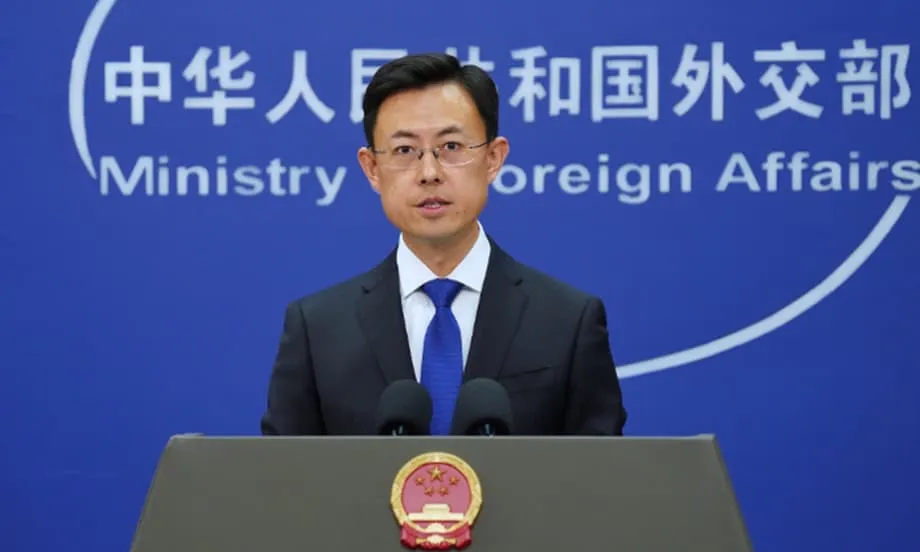
Chinese Foreign Ministry spokesperson Guo Jiakun addressed that position at a regular press conference on Friday. He described space exploration as a shared undertaking and rejected its treatment as a contest between major powers.
Space is not an "arena" of major-power rivalry, and China will continue to work with all parties to build an open "friend circle" in space and advance the common cause of mankind's exploration of outer space.
The Pakistani training program gives that diplomatic message a concrete form. China is offering another country access to a working space station while building a broader network that includes satellite cooperation in Africa, environmental monitoring in South America and international participation in lunar research.
Those partnerships are developing alongside a competing network led by the United States. The Artemis Accords and the International Space Station partnership form part of Washington's approach, while China is expanding its International Lunar Research Station and agreements with countries across the Global South. The central issue is increasingly who can participate, under which rules and through which partnerships.
How Pakistan's Spaceflight Agreement Took Shape
Pakistan's Space and Upper Atmosphere Research Commission, known as SUPARCO, and the China Manned Space Agency signed a comprehensive cooperation agreement in February 2025. It established the framework for Pakistani participation in China's human spaceflight program and began a process involving nearly a year of bilateral negotiations.
Ali and Daud passed demanding selection procedures that sought strong academic qualifications and physical endurance. The final candidate pool included experienced pilots and people holding doctorates in fields related to aerospace. Their arrival at the China Astronaut Research and Training Center, also referred to as the Astronaut Centre of China, moves the program from selection into preparation for a possible flight.
The candidates will serve as reserve astronauts while learning how Tiangong's three modules and the Shenzhou spacecraft operate. Both must complete training and assessments before one is chosen for a future mission. A payload specialist is responsible for scientific experiments and equipment rather than piloting the spacecraft.
The planned research covers materials science, fluid physics, life sciences and biotechnology. Microgravity, the condition aboard an orbiting station in which objects appear almost weightless, allows researchers to examine how materials, liquids and living systems behave differently from those on Earth. The program identifies potential applications in climate change mitigation, food security and industrial innovation.
The main dates connect the agreement, astronaut preparation and a further Pakistani role in lunar exploration:
- February 2025: SUPARCO and the China Manned Space Agency signed the agreement establishing Pakistan's participation in China's human spaceflight program.
- April 24, 2026: The arrival of Ali and Daud in Beijing coincides with China's 11th Space Day and the 70th anniversary of its space programs.
- Late 2026: One Pakistani candidate is expected to fly aboard a future Shenzhou mission, subject to training and assessments.
- 2028: A Pakistani lunar rover is planned for the Chang'e-8 mission.
What the Mission Means for Pakistan
Prime Minister Shehbaz Sharif has presented the astronaut mission as a reflection of the "enduring Pakistan-China strategic partnership." During a meeting with the two candidates at the Prime Minister's Office, he connected their preparation with a new achievement for Pakistan.
I am confident that you are going to write a new chapter in Pakistan's history.
Sharif also said the mission would add "new dimensions" to relations between the two countries. He described that ambition through the image of their friendship extending into space.
Pakistan and China's friendship is ready to reach for the stars and touch the heights of the sky.
Pakistan's participation offers access to human spaceflight without requiring the country to invest billions of dollars in its own launch capabilities. The mission has been described as a "high-tech shortcut" to sending a Pakistani into space, while the planned Chang'e-8 rover extends the partnership beyond Earth orbit.
China has not given an exact launch date or announced which of the two candidates will fly. The immediate step is their training and assessment, with late 2026 identified as the earliest expected flight period.
Satellite Partnerships Reach Africa and South America
Somalia is among the countries entering new satellite cooperation arrangements with China. A recent Memorandum of Understanding was signed at the NewSpace Africa Conference in Libreville between China's Land Satellite Remote Sensing Application Center and Somalia's Ministry of Communication and Technology.
The agreement focuses on Earth observation, meaning the use of satellites to collect information about conditions on the ground. Its intended applications include environmental monitoring and development decisions based on data. It is part of a wider set of Chinese satellite cooperation agreements with African countries.
Tiangong also carries a cultural element of that relationship: ten paintings by African teenagers are displayed aboard the station. Chinese officials describe the display as part of an inclusive approach that gives cultural exchange a place alongside technical cooperation.
Brazil provides an example of a much longer partnership. The China-Brazil Earth Resources Satellite program has operated for decades, supplying information used to monitor and protect the Amazon rainforests. Its work connects space technology with environmental preservation and resource management.
These projects fit within the Belt and Road Initiative's space information corridor and the Global Development Initiative. China links satellite infrastructure with development projects on the ground, offering partner countries bundled services in telecommunications, surveillance and navigation. The practical value of those partnerships often lies in information and services used on Earth, rather than in sending people into orbit.
Lunar Samples Become Shared Scientific Resources
Seven institutions from six countries received authorization in April 2025 to study lunar samples returned by China's Chang'e-5 mission. The participating countries were France, Germany, Japan, Pakistan, the United Kingdom and the United States.
Chang'e-5 brought back 1,731 grams of lunar material. Analysis of those samples has led Chinese scientists to identify two previously unknown minerals, magnesiochangesite-(Y) and changesite-(Ce). The International Mineralogical Association has officially approved and classified both.
The minerals became the seventh and eighth new lunar minerals identified globally in returned samples. Their discovery illustrates why collecting material from another world matters: researchers can study its composition directly, rather than relying solely on observations made from a distance.
The participation of institutions from the United States also shows that international access to Chinese scientific resources can continue alongside restrictions affecting cooperation between the two countries' space agencies. In this case, the shared resource is lunar material available for scientific study.
Mars and Solar Missions Offer Further Roles
The China National Space Administration has announced that Tianwen-3, its mission to return samples from Mars, will carry five international cooperative payloads. Launch is scheduled for around 2028. A payload is an instrument or package carried by a spacecraft to perform a particular task.
Selected projects include the Mars PEX spectrometer, led by the Committee on Space Research, which will search for traces of life. A spectrometer examines the signals associated with substances to help researchers identify what is present.
The Macau University of Science and Technology is contributing a Mars molecular ion composition analyzer. The Chinese University of Hong Kong is contributing a laser heterodyne spectrometer intended to detect water isotopes in the Martian atmosphere. Isotopes are forms of the same element that differ in mass, giving scientists another way to investigate the materials they observe.
China has also released opportunities for international cooperation on Xihe-2, a solar observation mission, inviting partners to work together on solar science. The invitation accompanies Beijing's pledge to make ten large scientific projects and facilities accessible to researchers around the world.
The Chinese Meridian Project is already part of that wider scientific access. It has served 267 organizations across 18 countries. Alongside the lunar samples and planned Mars instruments, it gives China's cooperation agenda a research dimension that reaches beyond astronaut exchanges.
A Laboratory and Association Build Deep Space Networks
The Deep Space Exploration Laboratory, known as DSEL, was established in 2022 in Hefei, Anhui province. It coordinates Chinese contributions to lunar and planetary science while building international research networks.
The laboratory played a crucial role in the Queqiao-2 relay satellite and Chang'e-6 missions. Chang'e-6 returned humanity's first samples from the far side of the Moon, adding another source of material for lunar science.
DSEL scientists are now studying human settlement of the Moon and developing technologies expected to be tested during Chang'e-7 and Chang'e-8. Those missions are described as steps toward a permanent lunar research base.
In July 2025, China and partner institutions launched the International Deep Space Exploration Association, or IDSEA. It is the first global scientific organization initiated by China that is dedicated to deep space research.
The association has attracted 85 institutional members from more than 30 countries and over 600 scientists from 60 nations. An earlier expectation put institutional membership at 100 by the end of 2025; the membership figure cited for the association remains 85. Its institutional and individual participation provides another route for scientists to work within China's expanding exploration network.
Two Lunar Networks Take Shape
The International Lunar Research Station, or ILRS, is a China led alternative to the United States led Artemis program. Its partners include Russia, Belarus, Egypt, Nicaragua and South Africa, among others. DSEL's work and the new deep space association support the wider effort to develop this lunar research framework.
The Artemis Accords have attracted more than 35 signatories, including Brazil, India and the United Arab Emirates. The two networks show how lunar exploration is becoming a matter of agreements and international alignment as well as spacecraft and scientific instruments.
The term "Competition 2.0 phase" describes this shift toward making rules and building alliances, rather than pursuing science alone. Countries are choosing not just which mission to join, but which partnership will shape their access to space activities.
The parallel development of two separate lunar base programs lacks formal cooperation mechanisms between them. That division has been described as "astropolitical bifurcation," meaning the organization of space exploration into separate political groupings.
China's invitation to developing countries sits within that divided setting. Its partnerships broaden participation while also building an alternative network to the one associated with Washington. The two developments are happening together, making access and strategic competition central parts of the same story.
Why Cooperation With the United States Is Restricted
The United States and China follow contrasting approaches to space engagement. Washington places greater weight on partnerships between government and private companies, while Beijing relies on programs directed by the state.
Since 2011, the Wolf Amendment has prohibited NASA from using federal funds to cooperate with Chinese space entities. That legislative barrier effectively excluded China from participation in the International Space Station and helped prompt Beijing to develop independent capabilities, including Tiangong, and seek other international partners.
Analysts at the Atlantic Council have argued that limited cooperation could benefit both countries despite substantial concerns about military hostility in space. One proposed starting point is a bilateral working group between NASA and the China National Space Administration to prepare for joint rescue operations involving astronauts in distress.
The proposal would build on the 1968 UN Rescue and Return of Astronauts Agreement. Its practical focus is assistance during an emergency, offering a narrower area for coordination than a shared exploration program.
China's Foreign Ministry position paper for the UN Summit of the Future sets out its commitment to "equality, mutual respect, peaceful use and inclusive development" in cooperation in outer space. The paper also opposes the weaponization of space and an arms race there.
The Costs of a Divided Space Economy
Research from TRENDS Research & Advisory highlights the risks of continued fragmentation. It values the global space economy at $546 billion and projects that it will exceed $1 trillion by 2030. Those figures point to growth of more than $454 billion, taking the projected total to more than 1.8 times the cited value.
The research identifies satellite systems with both civilian and military uses, and competing systems of governance, as potential threats to the sustainability of activity in orbit. A satellite service can support ordinary communications or navigation while also having a military application, making the boundary between commercial activity and strategic capability harder to manage.
Both China and the United States are investing in capabilities directed against satellites and in technologies for extracting lunar resources. Those investments raise concerns about the weaponization of space alongside ambitions for scientific and economic development.
Guo's rejection of space as an arena of rivalry addresses that tension. China's stated position favors peaceful use and inclusive development, while its partnerships are growing in an environment shaped by restrictions, military concerns and competing lunar programs.
Who Gains Access to an Orbiting Laboratory?
Wang Yanan, editor in chief of Aerospace Knowledge magazine, says China's extensive collaboration has lowered the threshold for Global South countries to access aerospace technologies. He contrasts that approach with past cooperation models in which some developed nations selected partners with exceptional resources and advanced technology.
Traditional space partnerships have often required substantial domestic capabilities and alignment with Western technological standards. Those requirements have restricted full participation largely to wealthy countries. Beijing is presenting a different route through training, shared infrastructure, scientific access and bilateral agreements.
Pakistan's astronaut program makes that difference tangible. Its candidates can prepare for work aboard an existing station, while its planned lunar rover gives the country another role in exploration without building an independent human spaceflight system.
The International Space Station is approaching its planned decommissioning around 2030. Tiangong may then become the primary orbital laboratory available to countries without their own human spaceflight capabilities. Access to such a station would determine where those countries can conduct experiments that require people working in microgravity.
The Pakistani mission brings that prospect into the present. Ali and Daud are beginning with training, and one may fly as early as late 2026. Around them, China's satellite agreements, shared lunar samples and planned international payloads are extending participation across several kinds of space activity. Whether rival powers can establish rules for coexistence in orbit will help determine how those networks operate alongside one another.
Key Points
- Muhammad Zeeshan Ali and Khurram Daud are the first foreign nationals selected for missions aboard Tiangong. One is expected to fly as a payload specialist as early as late 2026.
- Their arrival coincides with China's 11th Space Day and the 70th anniversary of its space programs on April 24, 2026.
- Pakistan's participation follows a February 2025 agreement between SUPARCO and the China Manned Space Agency. A Pakistani rover is also planned for Chang'e-8 in 2028.
- China's wider partnerships include Earth observation cooperation with Somalia, ten African teenagers' paintings aboard Tiangong and the longstanding China-Brazil satellite program.
- Seven institutions from six countries received authorization to study Chang'e-5 samples in April 2025. Two newly approved minerals became the seventh and eighth identified globally in returned lunar samples.
- Tianwen-3 is scheduled to launch around 2028 with five international cooperative payloads. China is also inviting cooperation on Xihe-2 and access to ten major scientific projects and facilities.
- The International Deep Space Exploration Association has attracted 85 institutional members from more than 30 countries and over 600 scientists from 60 nations.
- China's lunar research network is developing alongside the Artemis program, while the Wolf Amendment continues to restrict NASA cooperation with Chinese space entities.
- Chinese officials advocate peaceful and inclusive space cooperation as military concerns, competing rules and the planned retirement of the International Space Station around 2030 shape future access.