A nuclear timekeeper runs for more than a day
A prototype in Vienna has kept its laser synchronized to thorium nuclei for more than 24 hours without intervention, while an independent team in Beijing has demonstrated a similar clock using a stronger ultraviolet laser and just 1.4 micrograms of thorium 229 to grow one of its crystals. The two results, published in Nature on October 7, 2026, move nuclear clocks from measurements of a promising atomic nucleus to devices that can regulate their own ticking.
Contents
- A nuclear timekeeper runs for more than a day
- What makes thorium 229 different?
- How the crystal corrects the laser
- Two laboratories, different engineering choices
- How precise are the prototypes?
- The crystal still affects the result
- A dark matter search without a detection
- The milestones behind the working clocks
- What must improve before practical use?
- Key Points
The European collaboration, led by Thorsten Schumm at TU Wien and Ekkehard Peik at Germany's national metrology institute, PTB, achieved frequency instability approaching one part in a quadrillion after a day of averaging. The Chinese collaboration, led by Shiqian Ding at Tsinghua University, reported a smaller instability coefficient, indicating about six times better stability under the reported averaging relationship.
Neither prototype has beaten the best optical atomic clocks. The breakthrough is instead that a nuclear transition now supplies the feedback needed to control a working clock. The Vienna team has already used that capability to search for ultralight dark matter, finding no signal but setting limits on some proposed interactions.
In its nuclear clock announcement, TU Wien describes a system that automatically corrects its laser frequency when the response of the thorium nuclei changes. Schumm, a professor at the university's Institute of Atomic and Subatomic Physics, explains the essential goal:
What you really want is a self-stabilizing nuclear clock.
That distinction separates these demonstrations from earlier experiments that excited thorium nuclei or measured their transition frequency while relying on an external clock to stabilize the light.
What makes thorium 229 different?
An optical atomic clock uses a transition between electron energy levels as its frequency reference. A nuclear clock moves that reference into the nucleus, where protons and neutrons can occupy different quantum states. In both cases, the regular oscillations of light provide the ticking, while the chosen transition keeps the laser at the correct frequency.
Most nuclear transitions require far more energy than conventional lasers can deliver. Thorium 229 is the only known nucleus with a transition directly accessible using current laser technology. Its unusually low excited state, called an isomer, lies about 8.4 electron volts above the ground state. That energy corresponds to ultraviolet light near 148 nanometers.
This light falls in the vacuum ultraviolet range, which is difficult to generate and handle. Producing a sufficiently steady, narrow range of laser frequencies at that wavelength was one of the central engineering challenges faced by both teams.
The word nuclear does not mean that the clock runs on a reactor, fission or fusion. Thorium 229 is radioactive, but its decay is not the ticking mechanism. The clock uses laser light to probe a transition inside its nucleus.
Nuclei are more than ten thousand times smaller than atoms and are partly shielded by surrounding electrons. They generally respond less strongly to external electric and magnetic disturbances, offering a route to more stable frequency references. The current experiments also show that embedding nuclei in a crystal does not remove every environmental effect.
How the crystal corrects the laser
Both teams embedded thorium 229 in calcium fluoride crystals and illuminated them with continuous laser light near 148.4 nanometers. When the light matches the selected nuclear transition, the nuclei absorb it. A detector measures the transmitted light, allowing the researchers to determine whether the laser has drifted away from resonance.
An electronic feedback loop then changes the laser frequency to bring it back. The nucleus is no longer merely an object being measured. Its response steers the oscillator that provides the clock signal.
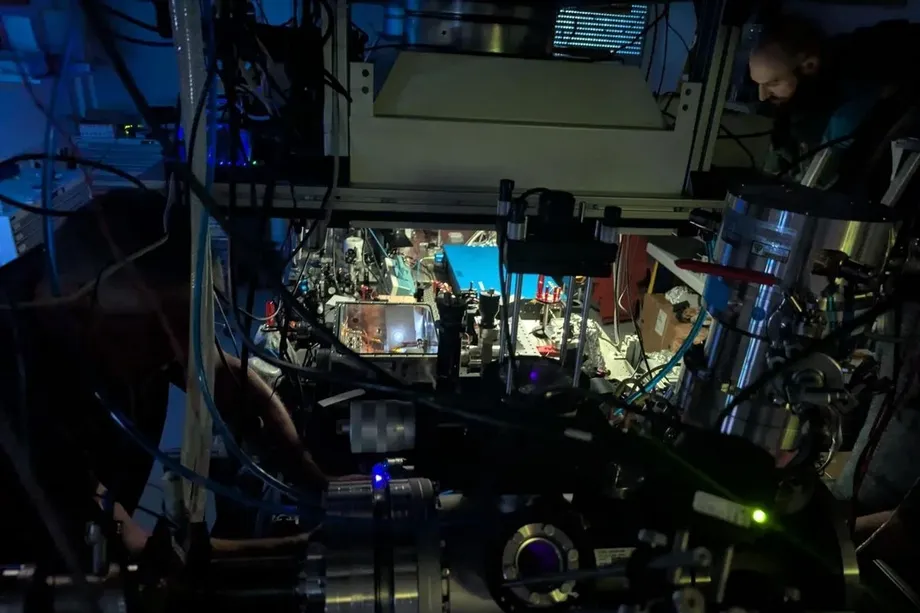
The European team's Vienna clock paper, led by Luca Toscani de Col, describes rapid feedback based on absorption spectroscopy in a crystal only a few millimeters across, operating at room temperature. A separate optical cavity supplies stability over short intervals, while the nuclear transition corrects longer term drift.
Absorption is crucial because waiting for excited nuclei to emit light can be slow. The Vienna paper reports that absorption provides roughly a thousand times more signal photons per second than fluorescence detection. That allows corrections on timescales shorter than the excited state's lifetime and makes faster searches for changes in the transition possible.
Two laboratories, different engineering choices
The European collaboration includes researchers in Germany, Austria and Czechia. The Beijing effort involves Tsinghua University, the Beijing Academy of Quantum Information Sciences and collaborators across China. Beichen Huang leads the author list of the Chinese study.
Vienna used a crystal with a higher thorium concentration, while Beijing compensated for limited isotope supplies with substantially more laser power. The different approaches address the same problem: obtaining enough useful absorption signal to determine how far the laser is from the nuclear resonance.
The Chinese team's Tsinghua clock paper describes a source generating 10 microwatts of ultraviolet light through a process that combines laser fields in cadmium vapor. About 5 microwatts reached the crystal's front surface. The European apparatus used a different nonlinear conversion method involving a strontium tetraborate crystal.
Beijing's improved calcium fluoride crystal was grown from a solution containing only 1.4 micrograms of thorium 229, with activity of 10 kilobecquerels. That activity measures radioactive decays, not clock ticks. The paper describes isotope scarcity as leaving almost no room for repeated attempts to optimize crystal growth.
Shiqian Ding, a physicist at Tsinghua University, says the independent demonstrations strengthen confidence that the clock concept works across different technical designs:
worked independently and reached operating thorium-229 nuclear clocks at the same time, using different experimental approaches. I think this is very encouraging because it shows that the concept is robust and not dependent on one particular technical implementation.
Both groups intend to improve their systems and combine lessons from the two approaches. More nuclei and more usable ultraviolet light could provide a stronger signal together than either advantage alone.
How precise are the prototypes?
The Vienna paper reports fractional frequency instability of 3 × 10^-12 divided by the square root of the averaging time in seconds. The Chinese paper reports 5 × 10^-13 under the same form of scaling. Dividing those coefficients gives six, the basis for the comparison between the two clocks.
Frequency instability describes how much a clock's rate fluctuates during measurement. Averaging can reduce random fluctuations. Accuracy asks a different question: how closely the measured frequency matches the correct value after biases are accounted for. Repeatability asks whether another run, or another crystal, gives the same result.
Dolores del Campo Maldonado, director of the Mechanical Magnitudes and Engineering Division at the Spanish Metrology Center, identifies the Chinese clock's better stability over short intervals and the Austrian experiment's comparison with a ytterbium clock as distinct strengths. Neither finding establishes superiority over the best atomic clocks in every measure.
Reports differ in their translations into accumulated time error. TU Wien gives approximately one second in 30 million years for the Vienna prototype, based on precision near 10^-15. Another account gives about one second in 3 million years for the European clock and 19 million years for the Chinese device. An earlier description of the Chinese result placed its instability near one part in 10 trillion after a day, whereas the final paper reports averaging to the 10^-15 level over its measured interval.
These figures should not be treated as interchangeable guarantees of absolute accuracy. The safest comparisons use the published instability measurements and their averaging conditions. Current optical atomic clocks remain ahead, with reported performance equivalent to one second over tens of billions of years, including a ytterbium example of 23 billion years.
The crystal still affects the result
The Vienna study found that frequencies measured on different days were reproducible only to about 5 × 10^-13, worse than the instability reached during a continuous run. Before each run, the laser had to be realigned, causing it to pass through slightly different regions of the crystal.
Measurements at different positions revealed shifts in the transition's center frequency of up to 1.7 kilohertz. The researchers suspect local strain from uneven crystal structure. Repeating a measurement at the same position produced a reproducible result, supporting the need to control the laser's path through the material.
The Beijing team tested two independently fabricated crystals. Their measured transition frequencies differed by about 560 hertz, corresponding to a fractional difference of 2.8 × 10^-13, with an uncertainty of 0.6 × 10^-13. Both were also consistent, within combined uncertainties, with earlier measurements on other calcium fluoride crystals at JILA in the United States.
The Chinese apparatus controlled temperature fluctuations and used magnetic shielding. Its improved crystal transmitted 7% of the ultraviolet light, compared with about 1% for the earlier crystal. Together with detector changes and a stronger absorption signal, those improvements substantially reduced measurement noise.
Akio Kawasaki of Japan's National Metrology Institute identifies external electric fields as a major source of clock uncertainty. Nuclear transitions offer protection against such disturbances, but the prototype results show why material quality, temperature control and careful assessment of frequency shifts remain necessary.
A dark matter search without a detection
The Vienna team compared its nuclear clock with a ytterbium ion clock at Austria's Federal Office of Metrology and Surveying, using a stabilized optical fiber connection. The experiment searched for periodic variations and slow drifts in their frequency ratio over approximately 23 hours, probing timescales from 20 seconds to about one day.
Some theories predict that ultralight dark matter could cause tiny oscillations in fundamental constants. Nuclear and electronic transitions would respond differently, making a comparison between the two clocks a useful test. No statistically significant periodic signal appeared, and the measured slow drift was consistent with zero.
The absence of a signal allowed the team to restrict possible interactions with photons, the strong nuclear force and quark masses. The photon limits compete with those from leading comparable atomic clocks. For certain strong force and quark interactions, the paper reports sensitivity reaching 10 to 1,000 times further into the tested parameter ranges than earlier atomic clock experiments.
Thorium's advantage comes from its unusual energy balance. Much larger electromagnetic and nuclear contributions nearly cancel, leaving the small 8.4 electron volt transition. A slight change in those contributions could therefore produce a relatively large change in the clock frequency.
José R. Crespo López-Urrutia, a researcher at the Max Planck Institute for Nuclear Physics in Heidelberg, estimates sensitivity to certain hypothetical dark matter effects at almost 10,000 times that of the best optical atomic clocks. That describes potential response to selected effects, not a universal improvement in timekeeping or a detection of dark matter. He disclosed previous collaboration with some author groups, but no direct involvement in these studies.
The Vienna paper also cautions that the precise sensitivity factors cannot yet be calculated because some nuclear parameters remain unknown. Its findings constrain particular models and interactions, rather than all possible forms of dark matter.
The milestones behind the working clocks
The latest results followed years of work to establish the excited state's existence, locate its energy and develop suitable lasers. Schumm says his team has worked toward a nuclear clock since 2008. Peik and Christian Tamm proposed the thorium clock approach in 2003.
- 2016: Researchers demonstrated the thorium isomer's existence through its decay process, according to the Vienna paper's historical account.
- September 12, 2019: TU Wien described two experiments refining knowledge of the transition, before a working clock existed.
- April 2024: The TU Wien and PTB collaboration drove the thorium nuclear transition directly with laser light.
- Autumn 2024: Researchers coupled a thorium excitation apparatus to a conventional optical atomic clock.
- 2025: Continuous ultraviolet laser sources and absorption measurements enabled sustained probing of the transition.
- October 7, 2026: The two Nature studies reported operating nuclear clocks with feedback.
TU Wien's 2019 milestone announcement details an indirect measurement using thorium ions produced by uranium 233 decay. About 2% populated the excited state. Passing the ions through graphene neutralized them, and the energy of subsequently emitted electrons helped establish the nuclear state's energy.
A separate experiment in Japan used intense synchrotron X rays to populate a much higher nuclear state, which then decayed mainly into the desired isomer. These were steps toward locating and measuring the transition, not working clock demonstrations.
A quantA academic overview credits Schumm's group with determining the transition energy to 12 decimal places and developing ultraviolet excitation through high harmonic generation. It describes prototype construction as an engineering phase within the quantA Cluster of Excellence and an ERC Synergy Project. The new feedback demonstrations advance beyond that earlier stage.
What must improve before practical use?
The immediate priorities are stronger and more stable lasers, better detectors, and purer, more uniform crystals. Vienna needs to improve reproducibility between runs. Beijing is exploring better host materials and a possible thorium ion clock, which would isolate nuclei more thoroughly but be technically harder to build.
Reports also give different resonance widths. Peik describes a measured width of 30 kilohertz, while the Vienna paper uses approximately 100 kilohertz in its clock performance analysis. The Chinese paper reports 27 kilohertz for its selected transition in the improved crystal. These measurements should not be collapsed into a single width. All are far broader than the expected natural nuclear resonance, indicating room for improvement.
Potential uses include satellite navigation, telecommunications, synchronized data transfer and surveying. TU Wien's 2024 applications statement also describes measuring Earth's gravitational field through the way gravity changes clock rates, with possible uses in mineral searches and studies of plate tectonics. Its reference to earthquake prediction is a prospective application, not a demonstrated capability.
Daniel de Mercado, a physicist at the Spanish Center of Metrology, explains that precise transition measurements can test whether observed values differ from theoretical predictions. Such differences could point toward unknown interactions. For the present prototypes, that research role is more immediate than replacing clocks in everyday infrastructure.
Del Campo considers accuracy beyond 10^-19 a potential future advantage, but doubts nuclear clocks will be ready to influence a possible redefinition of the second in 2030. No confirmed deployment deadline or scheduled replacement of existing time standards accompanies these demonstrations. The next task is to prove that improved devices can combine low instability, reproducible frequencies and well understood accuracy.
Key Points
- Independent European and Chinese teams reported working thorium nuclear clocks in Nature on October 7, 2026.
- Both clocks use ultraviolet absorption in thorium containing calcium fluoride crystals to correct their laser frequencies.
- The Vienna prototype operated without intervention for more than 24 hours.
- The Chinese clock's reported instability coefficient is six times smaller than the European clock's.
- Neither prototype yet surpasses the best optical atomic clocks.
- Vienna's dark matter search found no signal but restricted selected theoretical interactions.
- Crystal uniformity, laser power and reproducibility remain central challenges before practical deployment.