
A 57 Centimeter Fossil With a Different Flight History
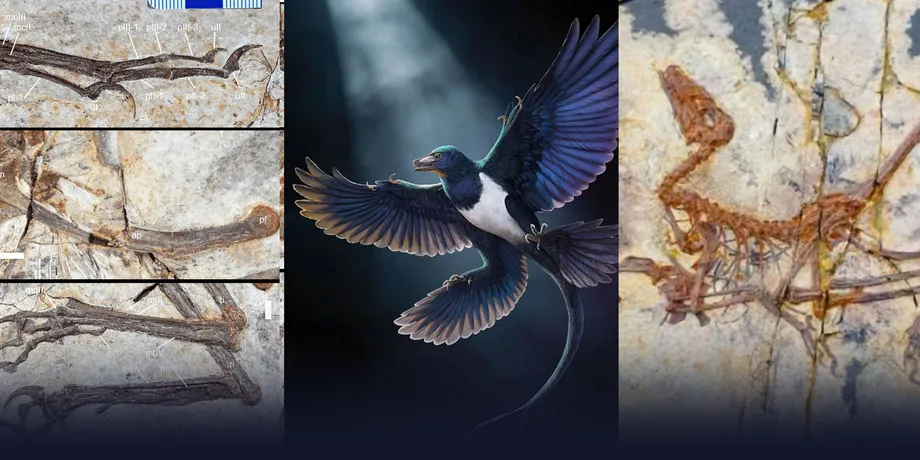
A feathered dinosaur from the Jiufotang Formation in northeastern China is providing new evidence that birds and some of their closest dinosaur relatives assembled the anatomy associated with flight in different evolutionary sequences. The specimen, named Norellraptor barsboldi, measures 57 centimeters long and preserves a complete skeleton with some feather impressions.
Contents
- A 57 Centimeter Fossil With a Different Flight History
- From a Farmer's Discovery to a Named Species
- Why Norellraptor Is a Distinct Species
- What Microraptorines Reveal About Aerial Movement
- Similar Features, Different Sequences
- Three Explanations Put to the Test
- Bone Growth Adds an Age Check
- How Other Scientists Read the Findings
- What the Fossil Does Not Yet Settle
- Key Points
The most revealing result comes from comparisons across the dinosaur family tree. Researchers reconstructed 194 anatomical changes along the microraptorine branch, the group to which Norellraptor belongs. Of these, 57 also appeared in the lineage leading to birds. That is about 29.4%, rounded to 30% in descriptions of the findings. Similar features, however, emerged in different orders in the two groups.
In microraptorines, finger bones shortened before later changes involving the fusion of wrist and hand bones and the lengthening of the breastbone. In the bird lineage, those changes followed the opposite sequence. The researchers argue that this difference supports independent assembly of flight anatomy, rather than inheritance of the same apparatus or evolution guided by an identical developmental pattern.
Xuri Wang and coauthors describe the fossil and their analysis in a Nature Communications study published on September 29, 2026. The research involved scientists from the Chinese Academy of Geological Sciences and Hebei Geo University, alongside international colleagues, including researchers from Italy and Slovakia.
The conclusion concerns how features associated with aerial movement evolved across related groups. It does not establish that this particular animal could perform sustained powered flight. That distinction separates the evidence preserved in its bones from the broader evolutionary interpretation.
From a Farmer's Discovery to a Named Species
A local farmer discovered the fossil in Jianchang County, Liaoning province, and donated it to the museum at Hebei Geo University in 2023. The study identifies its locality more precisely as Lamadong Town in western Liaoning and places it in the Lower Cretaceous Jiufotang Formation.
The rock beds are described as approximately 120 million years old. This is more specific than the broad Early Cretaceous interval, roughly 145 million to 100 million years ago, used in some descriptions of the discovery. The broad interval identifies the geological period, rather than a precise age measurement for the individual fossil.
The specimen is catalogued as 130108-MHGU-F4281 and serves as the holotype, the reference specimen against which the newly named species is defined. Although some descriptions call the skeleton nearly complete, the scientific paper describes it as complete, with only moderate displacement of the bones around the limb girdles.
The known sequence of events spans geological time and recent research:
- Early Cretaceous: the animal lived in what is now western Liaoning, with its remains preserved in the Jiufotang Formation.
- 2023: the fossil was donated to the museum at Hebei Geo University.
- September 29, 2026: the study describing Norellraptor barsboldi and its evolutionary significance was published in Nature Communications.
Why Norellraptor Is a Distinct Species
The name honors two paleontologists whose work helped establish the close relationship between birds and dinosaurs. Norellraptor refers to American paleontologist Mark Allen Norell, while barsboldi recognizes Mongolian paleontologist Rinchen Barsbold. The paper credits both with exceptional contributions to the study of dinosaurs with birdlike anatomy.
The classification rests on a distinctive combination of skeletal features, rather than feathers alone. These include an unusually large opening in the snout region, a gently curved pubic bone with a small projection at its lower end, and specific differences in the teeth, wrist, feet and limb proportions.
Comparisons distinguish Norellraptor from several other microraptorines, including Microraptor, Changyuraptor, Wulong and Zhongjianosaurus. Against Zhongjianosaurus, for example, the paper identifies a proportionally shorter tail and breastbone, as well as a shorter and more slender forelimb relative to the hindlimb.
What Microraptorines Reveal About Aerial Movement
Microraptorines were small predatory dinosaurs closely related to birds. Descriptions of the group place their weight around one kilogram, although that is not a measured body mass for the Norellraptor specimen. Hundreds of microraptorine specimens have been found, giving researchers a substantial fossil record for comparing anatomy.
Some members preserve long feathers on both the forelimbs and hindlimbs. This arrangement has led researchers to investigate whether they glided, flew under their own power, or used different forms of aerial movement. The study describes adaptations for movement through the air in at least some members of the group, rather than assigning identical abilities to every species.
Microraptorines and birds both belong to Paraves, the larger group containing birds and their closest dinosaur relatives. Within it, microraptorines belong to the dromaeosaurid dinosaurs, while the bird lineage is known as Avialae. Their close relationship makes similarities informative, but also creates a difficult question: which features came from shared ancestry, and which evolved separately?
Exceptional preservation helps address that question. Other microraptorine fossils contain detailed feathers and even remnants of gut contents. Norellraptor contributes a particularly complete skeleton and evidence from bone tissue, allowing researchers to consider both its evolutionary position and its stage of growth.
Similar Features, Different Sequences
The comparison found 57 shared features among 194 reconstructed anatomical changes in the microraptorine lineage. Examples described in accounts of the research include wing feathers, hook shaped toe bones and a forearm bone longer than the upper arm bone. The scientific paper presents the approximately 30% overlap as independently acquired similarities with the bird lineage.
The figures require care. They refer to anatomical changes reconstructed across an evolutionary branch, not 194 separate demonstrations of flying ability in Norellraptor. Nor does the 30% figure measure how much of a bird's flight system this dinosaur possessed.
The central test was the order of acquisition. Shortening the fingers early and consolidating the wrist and hand later represents a different sequence from strengthening those structures before reducing the fingers. The researchers found consistent differences between the microraptorine and bird lineages in the sequence of features associated with flight.
This is why the fossil matters beyond adding another feathered species to the record. Similar endpoints can conceal different evolutionary histories. By locating Norellraptor among microraptorines that branched off later in the group's evolution, the team gained another reference point for reconstructing how those histories unfolded.
Three Explanations Put to the Test
The study addresses three competing explanations for the similarities between microraptorines and birds. One proposes that an early paravian ancestor already possessed a rudimentary capacity for flight. Birds and microraptorines would then have inherited and developed it, while other relatives subsequently lost it.
A second explanation proposes independent origins. Under this model, similar demands associated with aerial movement produced comparable features in separate branches. Such independent evolution of similar traits is called convergence. Close relatives can show convergence even though they also share many features inherited from a common ancestor.
The third explanation concerns shared developmental constraints. Even if aerial adaptations arose separately, inherited patterns of growth might have guided the two lineages toward similar anatomy in a recurring sequence. This would make their resemblance partly a consequence of a shared developmental process, rather than the same completed flight apparatus.
The researchers tested that third possibility by asking whether the assembly sequence repeated across the two branches. Their reconstruction indicates that it did not. Combined with the bone growth evidence, the result supports separate evolutionary routes shaped by different selective pressures. It challenges a specific explanation for the resemblance, without removing the common ancestry of birds and microraptorines.
Bone Growth Adds an Age Check
The team examined the radius, one of the forearm bones, to estimate the animal's age. Its tissue contained two distinct lines of arrested growth, marks left when bone growth slows or pauses. These marks offer a record of growth cycles, but the earliest parts of that record can be lost as the interior of a bone is remodeled.
Two preserved lines and the beginning of a further growth zone indicate at least two years after hatching. The researchers considered that estimate too low because the relatively thin outer bone surrounding a large internal cavity suggested that an earlier zone had been completely removed. They therefore estimated a minimum age of three years.
The specimen was still growing when it died. At the same time, fusion in its lower leg and foot bones, together with the smooth surfaces of its long bones, supported a stage beyond early youth. Those observations show why size alone would be an unreliable measure of maturity.
Norellraptor falls between other specimens used in the comparison: the immature Wulong bohaiensis holotype and a Sinornithosaurus specimen were estimated to be under two years old, while the adult Changyuraptor yangi holotype was at least five years old. These are ages of particular fossils, not fixed lifespans for their species. Accounting for them helps avoid mistaking differences in maturity for evolutionary differences.
How Other Scientists Read the Findings
Michael Pittman, a paleobiologist at the Chinese University of Hong Kong, interpreted the findings as further evidence for separate origins of flight among feathered dinosaurs:
The study provides important new evidence that further supports the hypothesis that flight evolved multiple times among feathered dinosaurs, including at least once among microraptorines and at least once among birds,
His assessment places the result within a growing argument for multiple origins, rather than treating one fossil as a complete resolution of the debate. The distinction matters because the researchers reconstruct evolutionary sequences from anatomy and relationships, not from direct observations of extinct animals in flight.
Neil Gostling, an evolutionary developmental biologist at the University of Southampton, was struck by how many changes in the microraptorine lineage were not shared with birds. Describing the range of evolutionary routes explored by these animals, he said many species:
were exploring all of the avenues open to them
His response draws attention to the differences as well as the similarities. The 57 overlapping traits support a comparison between the groups, while the remaining changes and the contrasting sequence suggest that neither branch should be treated as a simple substitute for the other.
What the Fossil Does Not Yet Settle
Norellraptor strengthens the case that microraptorines assembled adaptations for aerial movement separately from birds. It does not provide a direct demonstration of how this individual moved through the air, how far it could travel, or whether it could sustain powered flight. The preservation of some plumage and a detailed skeleton leaves those functional questions distinct from the evolutionary analysis.
The proposed role of different selective pressures also remains an interpretation, rather than a measurement of the exact environmental demands acting on each lineage. Further fossils and evidence about skeletal growth are needed to test how widely the reconstructed pattern applies among dinosaurs closely related to birds. No specific date for a follow up study or new fossil analysis has been announced.
The strongest contribution is the combination of evidence: a precisely identified fossil, an age estimate based on bone tissue, and a comparison of the order in which anatomical changes appeared. Together, these show why possessing similar structures is not enough to establish that two groups reached them through the same evolutionary process.
Key Points
- Norellraptor barsboldi is a feathered dinosaur represented by a 57 centimeter skeleton from the Jiufotang Formation in western Liaoning, China.
- A local farmer discovered the fossil, which was donated to Hebei Geo University in 2023.
- The study was published in Nature Communications on September 29, 2026.
- Researchers reconstructed 194 anatomical changes in the microraptorine lineage; 57, about 30%, also appeared in the bird lineage.
- Features associated with flight emerged in different orders in microraptorines and birds, supporting independent evolutionary assembly.
- Bone tissue suggests the specimen was at least three years old and still growing when it died.
- The findings do not establish the precise flying ability of Norellraptor itself.