A New Decade for Brunei's Financial Sector
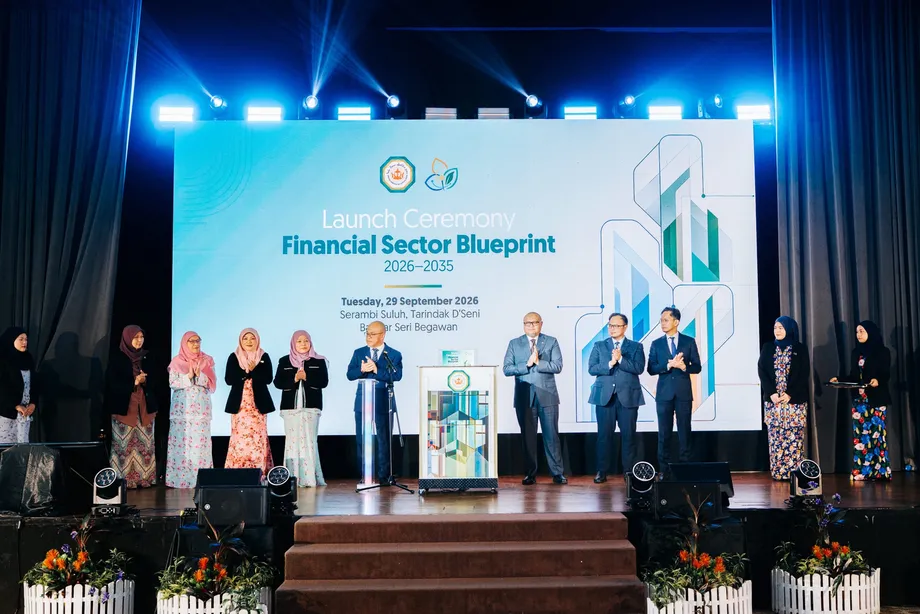
Brunei Darussalam launched its Financial Sector Blueprint 2026–2035 on September 29, 2026, with bank financing to businesses at BND6.2 billion, twice its 2016 level, and total financial system assets standing at BND25.9 billion in 2025. The second blueprint sets the direction for a sector that contributes approximately six per cent of gross domestic product but still needs deeper capital markets, wider access to financing and faster digital adoption.
Contents
- A New Decade for Brunei's Financial Sector
- What the Growth Figures Show
- Three Goals Within a Stability Framework
- Access to Finance and Consumer Protection
- Sustainability and Islamic Finance
- Payments, Credit Data and Cybersecurity
- What Carries Over From the First Blueprint
- A Slower Economy Shapes the Challenge
- Who Must Turn the Plan Into Action
- Milestones and Measures Still Needed
- Key Points
The launch took place at Dewan Serambi Suluh, Tarindak d'Seni, in Bandar Seri Begawan. Dato Seri Setia Dr Haji Abdul Manaf bin Haji Metussin, Coordinating Minister for Economic Policies, Minister of Economy, Trade and Industry, and chairman of the Brunei Darussalam Central Bank board, inaugurated the plan.
Published by Brunei Darussalam Central Bank (BDCB), the Financial Sector Blueprint places monetary and financial stability at the centre of development. Its three strategic thrusts cover a progressive and innovative financial sector, sustainability through finance, and modern financial infrastructure supported by technology.
The plan supports Wawasan Brunei 2035, the country's national development vision, and the Economic Blueprint. Its practical challenge is to turn the financial sector's growing resources into investment, business expansion and services that reach more people without weakening financial stability.
What the Growth Figures Show
Total financial system assets grew at an average annual rate of 2.3 per cent over the past decade, reaching BND25.9 billion in 2025. Business financing reached BND6.2 billion in the first half of 2026. Because that figure was twice the 2016 level, the earlier financing total was approximately BND3.1 billion.
The comparison suggests that financing to businesses expanded faster than financial assets during the period. The figures have different reporting dates and coverage, however: one measures financing by banks, while the other measures assets across the financial system. They should not be treated as a precise lending share.
The sector's contribution to GDP increased from an average of 5.6 per cent a decade earlier to approximately six per cent, a rise of 0.4 percentage points. That is a larger economic role, although the change is more modest than the doubling of business financing.
Abdul Manaf described the sector as having strong capitalisation, ample liquidity and improving asset quality. Capitalisation refers to the financial cushion available to absorb losses, while liquidity concerns the ability to meet payment demands. Asset quality reflects, among other things, how reliably borrowers repay their financing.
In his keynote address, the minister warned against treating those strengths as a reason to slow reform:
We cannot afford complacency.
He identified stronger private sector growth, deeper capital markets, better business access to financing and accelerated digital adoption as priorities for the next phase.
Three Goals Within a Stability Framework
BDCB sets out three goals for the new blueprint: safeguard monetary and financial stability, drive development that anticipates future needs, and prepare the financial ecosystem for change. Its stated vision combines resilience and innovation with sustainable economic growth and inclusive social wellbeing.
The first strategic thrust seeks a more diverse and responsive financial ecosystem. It brings market development, financial inclusion, innovation and financial literacy into the same agenda. This connects the supply of financial products with the ability of households and businesses to understand and use them.
The second thrust integrates environmental, social and governance principles, known as ESG, and risks related to sustainability into financial activity. The third addresses the infrastructure that allows services to operate securely and efficiently, including payments, technology adoption and institutional capabilities.
Stability is therefore a condition for all three thrusts, rather than a separate objective to be considered after expansion. The blueprint presents growth and innovation as activities that must proceed alongside sound regulation and secure systems.
Access to Finance and Consumer Protection
Under the first thrust, BDCB plans to promote digitalisation, strengthen financial literacy and improve consumer protection. The intended result is financial services that are more accessible, efficient and inclusive, alongside markets that provide a wider range of opportunities.
Financial literacy matters because access alone does not ensure that a customer understands a product's costs, risks or repayment obligations. Consumer protection addresses the conduct of institutions providing those products. Together, these priorities link greater use of financial services with the quality of the customer experience.
BDCB's fair treatment requirements for financial consumers are scheduled to apply from March 2027. That is a concrete regulatory milestone near the start of the blueprint period. It gives financial institutions a nearer deadline than the plan's 2035 endpoint, although the launch details do not set out the requirements in full.
For businesses, the financing total shows increased support but does not establish how that support is distributed. No breakdown is given between large companies and small or medium enterprises, or between established borrowers and firms seeking finance for the first time. Those distinctions will matter when assessing whether access has widened.
Sustainability and Islamic Finance
The sustainability thrust calls for ESG principles and risks related to sustainability to be integrated across Brunei's financial sector. BDCB identifies ethical investment practices and responsible management as aims, aligning financial activities with the national sustainability agenda and international practices.
Abdul Manaf identified renewable energy and other projects related to sustainability as potential financing opportunities. The approach extends beyond funding individual projects: it also asks financial institutions to consider environmental, social and governance issues when evaluating investments and managing risk.
For an average reader, ESG means looking at factors such as environmental exposure, treatment of people and the quality of organisational oversight alongside conventional financial considerations. Incorporating those factors into finance can affect how institutions assess the durability of a business or investment.
The blueprint also prioritises Brunei's position in Islamic finance. The first blueprint had recommended developing Islamic capital markets, encouraging corporate sukuk issuance and building Islamic fund management activities. Sukuk are investment certificates structured according to Islamic finance principles, commonly used to raise financing through arrangements linked to assets or economic activity.
These earlier recommendations provide a foundation for the new plan's market development and ethical investment agenda. They are not evidence that every proposed market or product has already been established, nor does the launch announce a specific new sukuk issue or sustainability fund.
Payments, Credit Data and Cybersecurity
The infrastructure thrust focuses on digital payment systems, interoperability and cybersecurity. Interoperability means that different payment services or systems can work together, allowing users to transact across platforms rather than remain confined to separate networks.
The first blueprint supported the expansion of digital payments, including the launch of tarus. BDCB also modernised infrastructure through the Automated Clearing House and Central Securities Depository. A clearing house processes payment instructions between institutions, while a securities depository records holdings and supports the transfer of securities.
The Credit Bureau Score and Collateral Registry were established to improve access to credit. Credit information helps lenders assess repayment risk, while a collateral registry records claims over assets pledged to secure financing. These mechanisms address information and legal certainty, both of which can affect lending decisions.
The FinTech Regulatory Sandbox and Mekar FinTech Innovation Centre were other developments associated with the first blueprint. A regulatory sandbox allows financial innovations to be tested under defined regulatory conditions. The new plan builds on these foundations while pairing further technology adoption with stronger cyber resilience and security.
What Carries Over From the First Blueprint
The 2016–2025 blueprint used five broad pillars: monetary and financial stability, competitive financial institutions and services, modern infrastructure, international integration, and human capital development. The new framework groups its priorities into three strategic thrusts, retaining stability as the central principle.
The earlier recommendations included maintaining the Currency Interchangeability Agreement with Singapore and the currency board framework. They also covered stronger supervision, international regulatory standards, clearer product disclosures, domestic sukuk market development and financial workforce skills.
Several of those priorities continue in the new plan through financial literacy, market development, technology capabilities and secure infrastructure. However, recommendations in the earlier document should be distinguished from completed measures. Its discussion of a securities exchange, for example, does not establish that an exchange is operating.
BDCB signed 26 memoranda of understanding with regional and international partners over the past decade. The first blueprint also addressed ASEAN integration and regional payment connectivity, making international cooperation an established part of the development programme rather than a new departure.
A Slower Economy Shapes the Challenge
Brunei's economy recorded average annual growth of 0.7 per cent between 2016 and 2025. The non oil and gas sector grew by an average of 2.7 per cent annually, supported by major foreign direct investment projects. That is a difference of two percentage points, illustrating stronger growth outside the country's traditional energy activities.
The Asian Development Bank's September 2026 outlook forecasts GDP growth of 1.2 per cent in 2026 and 1.9 per cent in 2027. The 2026 forecast was reduced from 1.8 per cent in July, a downward revision of 0.6 percentage points.
These projections provide a restrained economic setting for the blueprint's ambitions. More financial capacity does not automatically produce more investment: businesses also need viable projects and sufficient demand to justify borrowing. The plan's focus on diversification therefore links financial development to the wider task of expanding private economic activity.
The launch theme, Progress under Pressure – Opportunities amid Global Strains, reflected geopolitical tensions, shifting supply chains, evolving energy markets and rapid technological change. Abdul Manaf argued that uncertainty could also create opportunities for innovation, resilience and sustainable growth.
Who Must Turn the Plan Into Action
BDCB Managing Director Hajah Rashidah binti Haji Sabtu said the blueprint builds on shared aspirations and the progress already achieved. She described financial sector development as a continuing process requiring sustained effort to remain competitive, respond to new developments and stay aligned with national priorities.
The plan was developed through engagement with government agencies, academia, business associations, the financial industry and other stakeholders. Abdul Manaf called for participation from regulators, businesses, investors, educational institutions and the wider community, alongside government and financial institutions.
The launch included a dialogue on ASEAN's changing global economy, moderated by Allen Lai, managing director of Confer Sdn. Bhd. Participants were BDCB Deputy Managing Director for Monetary Operations, Development and International Affairs Awang Mardini bin Haji Eddie; Islamic Financial Services Board Deputy Secretary General Abdullah Haron; and ASEAN Secretariat Finance Integration Division senior officer Renz Calub.
A separate panel examined resilience, innovation and sustainable growth. Moderated by BDCB Executive Director Dk. Sri Joedianna binti Pg. Haji Mohammed, it brought together representatives of the Economic Planning and Statistics Department, Standard Chartered Brunei, Takaful Brunei, BIBD Securities and National Insurance Bhd. Their participation connected the agenda to economic planning, banking, insurance and investment services.
Milestones and Measures Still Needed
The blueprint establishes policy directions, but the launch account gives no numerical targets for financial inclusion, digital payments or financing to small and medium enterprises. That limits the ability to judge progress against a defined endpoint in those areas. It does not establish that every initiative in the full blueprint lacks a measurable target.
The distinction between a strategic plan and its implementation measures is central. Asset growth and business financing provide useful starting figures, but they cannot alone show whether services become more inclusive, payment systems work better together or consumers receive fairer treatment.
The key dates place the new strategy alongside the achievements of its predecessor and the next regulatory milestone:
- 2016–2025: The first financial sector blueprint guided regulatory, market and infrastructure development.
- 2025: Total financial system assets reached BND25.9 billion.
- First half of 2026: Bank financing to businesses reached BND6.2 billion.
- September 2026: The Asian Development Bank forecast growth of 1.2 per cent for 2026 and 1.9 per cent for 2027.
- September 29, 2026: BDCB launched the 2026–2035 blueprint in Bandar Seri Begawan.
- March 2027: BDCB's fair treatment requirements for financial consumers are scheduled to apply.
No further implementation deadlines or indicator publication dates are specified in the launch details. The next task is to translate the three strategic thrusts into actions whose results can be assessed, while preserving the monetary and financial stability on which the plan rests.
Key Points
- Brunei's second financial sector blueprint covers 2026–2035 and supports Wawasan Brunei 2035.
- Its three thrusts address innovation and inclusion, sustainability through finance, and modern financial infrastructure.
- Financial system assets reached BND25.9 billion in 2025 after average annual growth of 2.3 per cent.
- Bank financing to businesses reached BND6.2 billion in the first half of 2026, twice the 2016 level.
- Digital payments, financial literacy, consumer protection, Islamic finance and cybersecurity are priorities.
- Fair treatment requirements for financial consumers are scheduled to apply from March 2027.
- The launch details do not provide numerical targets for inclusion, digital payments or financing to small and medium enterprises.