Seven Weeks That Will Test Bali's Price Controls
Bali's inflation control team has marked out seven weeks, from 10 December 2026 to 31 January 2027, as the window when prices on the island are most likely to climb. The stretch covers Christmas and New Year, known in Indonesia as Nataru, and runs into Galungan and Kuningan, the Balinese Hindu holidays that fall in January 2027 and bring a second wave of demand for food, fruit and temple offerings.
Contents
- Seven Weeks That Will Test Bali's Price Controls
- Why the Inflation Math Leaves Almost No Room
- An Island That Serves Four Times Its Own Population
- Some Food Stocks Would Last Less Than Two Weeks
- 377 Market Operations, and a Warning About Aiming Them Right
- Chillies From Neighbouring NTB and Gardens at Home
- A Fuel Shortage That Pushed Prices Up in October
- Consumers Are Still Optimistic, Just Less Than in September
- Cheap Markets Head North, and Traders Get a Warning
- The Calendar the Province Is Watching
- Key Points
The Regional Inflation Control Team, or TPID, met on Wednesday 25 November 2026 at the governor's office in Denpasar. Achris Sarwani, who heads Bank Indonesia's Bali office, told the meeting that the island must serve its own residents and a visiting population several times larger at the same time.
Bali is very distinctive compared with other places. The character of our economy makes controlling inflation here not as easy as elsewhere.
The figures behind that remark are stark. Bali is home to between 4.5 million and 5 million people, Achris said, while tourist arrivals from outside the island can approach 20 million a year. That works out at roughly four visitors for every resident, all of them buying meals, transport, fuel and supplies in the same markets as local families.
Why the Inflation Math Leaves Almost No Room
Bank Indonesia's Bali office puts cumulative inflation from January to October 2026 at 2.74 percent. Against a target ceiling of 3.5 percent for the year, that leaves 0.76 percentage points of room for November and December, and the price pressure of the holiday season has barely begun.
Our room to move to keep ourselves inside the target is already very thin.
The statistics agency's Bali branch measures prices differently, and its October reading was harsher: 3.87 percent higher than in October 2025, above the 3.5 percent ceiling. The two figures track separate things. The 2.74 percent counts how much the price level has risen since December 2025, while the 3.87 percent compares October with the same month a year earlier, a method that captures a full year of increases rather than ten months of them.
Bali's difficulty is not one runaway price. It is the shape of an economy where a small resident base absorbs a huge floating population, so a queue at a market in Denpasar or a surge of demand in Ubud moves the island's index further than the same event would move a province of similar size without tourism.
An Island That Serves Four Times Its Own Population
Bank Indonesia's surveys show how directly tourism feeds into household expectations. Bali's economy kept growing strongly through the third quarter of 2026, carried by a recovering tourism sector, more trade and services activity and household consumption, which remains the largest engine of the provincial economy.
The province has spent the past year trying to change the mix of visitors, not just the number. Bali recorded about 29 million tourist visits in 2024, including 6.333 million foreign arrivals, and in January 2026 Governor Wayan Koster's administration put forward the bank statement plan to screen foreigners by their savings and travel plans. That debate was about spending power and strained infrastructure. The warning from Bank Indonesia's Bali office adds a more immediate concern: the same visitors who fill hotels also fill food stalls, fuel queues and markets, and the island's price index has to absorb all of it.
Demand of that scale does not arrive evenly. It concentrates in the south around Denpasar, Kuta and the airport, then spills along the coasts and into the hills. Each cluster pulls food, fuel and staff from the same supply lines, so a busy week in one resort area is felt in the wholesale market that serves several others.
Some Food Stocks Would Last Less Than Two Weeks
Demand is only half of the equation. Achris said Bank Indonesia had checked supply against a food balance sheet compiled with the National Food Agency, known as Bapanas, and the result showed several commodities with thin cover. Some stocks, he said, would meet demand for less than two weeks.
The meeting did not name every commodity in that category. What the statistics agency's Bali branch has documented is which prices are driving the index: chillies have repeatedly ranked among the top contributors to inflation on the island, a pattern that turns a single poor harvest or a slow truck route into a visible jump in the cost of a household's daily cooking.
Perishable goods are the weak point in any food balance sheet. Rice, cooking oil and sugar can be stored and shipped in bulk, while chillies, tomatoes and leafy vegetables move from farm to market in days and lose value if a ferry is delayed or a road is cut. For an island that brings in a large share of its food from Java, Lombok and further away, that gap between planting and the dinner table is where holiday demand hurts most.
377 Market Operations, and a Warning About Aiming Them Right
Bali has already run about 377 market operations across its districts, the meeting heard, selling staples below the going rate to hold the index down. The question for the weeks ahead is where the next round lands.
Achris used his remarks to press for precision, naming three ways an intervention can miss its mark.
When we carry out interventions to handle this, we must not get it wrong. Not the wrong commodity, not the wrong place, not the wrong time.
Picking the wrong commodity means subsidising something that is not driving prices, such as rice in a month when the shortage is in chillies. Picking the wrong place means selling cheaply in districts where prices are already stable while a market across the regency line pays double. Picking the wrong time means arriving after the holiday peak, when the damage to household budgets has already been done.
The logistics agency Bulog's Bali branch and the provincial agriculture department sat in the same room, which matters for how quickly stock can be moved from a warehouse to a market square. A market operation is only as fast as the trucks and cold storage behind it.
Chillies From Neighbouring NTB and Gardens at Home
Deputy Governor I Nyoman Giri Prasta told the same meeting that chillies had been the heaviest single item in Bali's recent inflation and that supply had improved after the province turned to its eastern neighbour.
What has been quite heavy for inflation started with the need for chillies, but this has eased very well. Why? We have been working with the West Nusa Tenggara government.
West Nusa Tenggara, known as NTB, sits directly east of Bali across the Lombok Strait, and its farms can reach Balinese wholesale markets by road and ferry within a day. The arrangement does not remove the risk. It shifts part of the reliance onto a second island's harvest and shipping schedule, which is why the deputy governor also pushed production at home.
Giri said households across Bali had begun growing chillies in their yards, using varieties that mature fast and produce within weeks, cutting dependence on bought supplies for everyday cooking. He framed food that Bali produces itself, plus incentives for farmers, as core provincial policy, and said the weather outlook had been discussed with the meteorology agency, BBMKG Region III Denpasar, whose forecasts shape when farmers plant.
For food needs, first we have to produce from Bali itself. The provincial government's programme for keeping inflation in check includes giving incentives to farmers in the fields.
A Fuel Shortage That Pushed Prices Up in October
Fuel sat behind part of the increase. Giri linked the rise in Bali's inflation to a shortage of subsidised fuel in October 2026, when queues formed at filling stations and deliveries of goods slowed in several areas. Bank Indonesia's consumer survey recorded the same disruption, noting that fuel availability and distribution problems had affected mobility and household perceptions over the short term.
The fuel price increase is one of the things that will show up as higher inflation, but as for people's needs, their purchasing power has the ability, I think that is not a problem.
Transport is a large cost line in an island economy where goods arrive by truck and ferry and visitors move constantly between the airport, hotels and beaches. A fuel disruption reaches prices twice: once through the direct cost of diesel and petrol, and again through the price of every item that has to be driven to a market.
Consumers Are Still Optimistic, Just Less Than in September
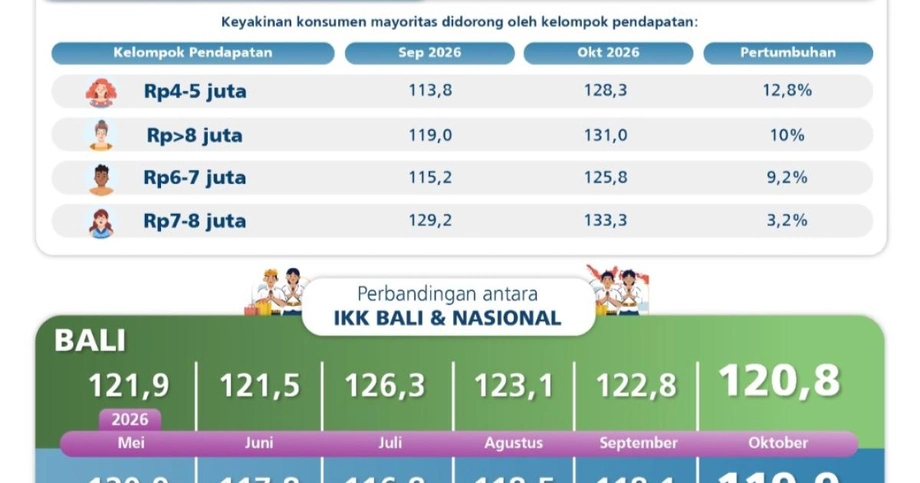
Households have not stopped spending. Bank Indonesia's consumer confidence index for Bali stood at 120.25 in October 2026, above the 100 level that separates optimism from pessimism and above the national reading of 119.90. The index had slipped from 122.75 in September, when the peak tourist season and a run of conferences and exhibitions were still under way.
Achris described tourism as the anchor of that confidence.
The continued strength of consumer optimism is inseparable from tourism activity, which remains the main support of Bali's economy. The high mobility of domestic and foreign tourists keeps driving accommodation, food and drink, trade and transport. This helps preserve the outlook for people's incomes and business activity.
Spending groups told a more detailed story. Consumers who spend between 4 million and 5 million rupiah a month became the most confident, with their index up 12.8 percent compared with September, followed by those spending more than 8 million rupiah a month at 10 percent and those in the 6 million to 7 million rupiah band at 9.2 percent. Formal workers scored 123.9 and informal workers 115.9.
Both halves of the index moderated. The current economic conditions index fell 1.62 percent to 113.30, pulled down by how people judged job availability compared with six months earlier, at 120.50, alongside income at 116.0 and purchases of durable goods at 103.5. The consumer expectations index dropped from 130.33 to 127.17, with expected job availability at 125.0 and expected business activity at 126.0.
Cheap Markets Head North, and Traders Get a Warning
Where the intervention lands matters as much as its size. Giri said the subsidised markets would be spread more evenly across the island, reaching northern Bali, including Buleleng and its neighbours, where distance from the main tourist belt often leaves households paying more for the same goods.
Enforcement will sit alongside the price work. Giri said market operations would involve the Bali police food control team, and he warned traders against setting prices on their own terms.
In the field, no one should raise prices however they please. I think we can keep this in Bali because we already have a very strong and integrated system.
Denpasar drew particular attention because it carries the province's largest turnover of trade and money. Giri said district teams had been asked to report back so the province could evaluate conditions, and that regency and city governments across Bali had been invited into the meeting to guard prices in their own areas.
The Calendar the Province Is Watching
The weeks ahead have fixed points that leave little time for a slow response.
- October 2026: a fuel shortage disrupts distribution across parts of Bali and feeds into prices.
- January to October 2026: cumulative inflation reaches 2.74 percent, leaving 0.76 percentage points under the 3.5 percent ceiling.
- 25 November 2026: the provincial inflation team meets at the governor's office with Bank Indonesia, the statistics agency, the meteorology agency, the agriculture department and Bulog.
- 10 December 2026: the seven weeks of alert begin.
- Late December 2026: the Christmas and New Year travel peak.
- January 2027: Galungan and Kuningan fall inside the same window, adding ritual and family demand.
- 31 January 2027: the alert period ends.
Several details stayed open after the meeting. The full list of commodities with less than two weeks of stock was not disclosed. No schedule has been published for the next rounds of market operations, and no list of the districts and household groups they will target. Bank Indonesia's Bali office said it would keep working through the provincial and district inflation teams on market operations, price monitoring for strategic commodities, local food supply and smoother distribution.
Bank Indonesia also continues to optimise the mix of monetary, macroprudential and payment system policy to keep the rupiah stable, control inflation and support sustainable growth.
What the seven weeks will decide is narrower than the national inflation debate and far more concrete. A family in Buleleng will either find chillies and cooking oil near October prices through the holidays or will not, and the answer depends on whether the next few hundred market operations land on the right commodity, in the right place, at the right time.
Key Points
- Bank Indonesia's Bali office expects price pressure for seven weeks, from 10 December 2026 to 31 January 2027, covering Christmas, New Year, Galungan and Kuningan.
- Bali has 4.5 million to 5 million residents and absorbs up to about 20 million arrivals from outside the island a year.
- Cumulative inflation from January to October 2026 was 2.74 percent, leaving 0.76 percentage points under the 3.5 percent ceiling, while the statistics agency's reading for October was 3.87 percent higher than a year earlier.
- A food balance sheet compiled with the National Food Agency shows some commodities with less than two weeks of stock.
- About 377 market operations have been held across Bali, with more planned and precision on commodity, place and timing urged.
- Chillies are a top inflation contributor, with supply partly covered by cooperation with West Nusa Tenggara and by household gardens.
- Consumer confidence was 120.25 in October 2026, down from 122.75 in September but above the national 119.90.