A December start for broader regional trade rules
The China-ASEAN Free Trade Area 3.0 Upgrade Protocol will enter into force on December 1, 2026, bringing digital commerce, green industries and supply chain cooperation into a trading relationship worth $982.3 billion in 2024.
Contents
- A December start for broader regional trade rules
- How the agreement reached this point
- Nine areas connect border rules with newer industries
- Digital trade brings payments and online sales into focus
- Electric vehicles and clean energy shape green cooperation
- Supply chains, customs and safety checks work together
- Smaller businesses and development support get dedicated attention
- A major trading relationship gains another framework
- Key Points
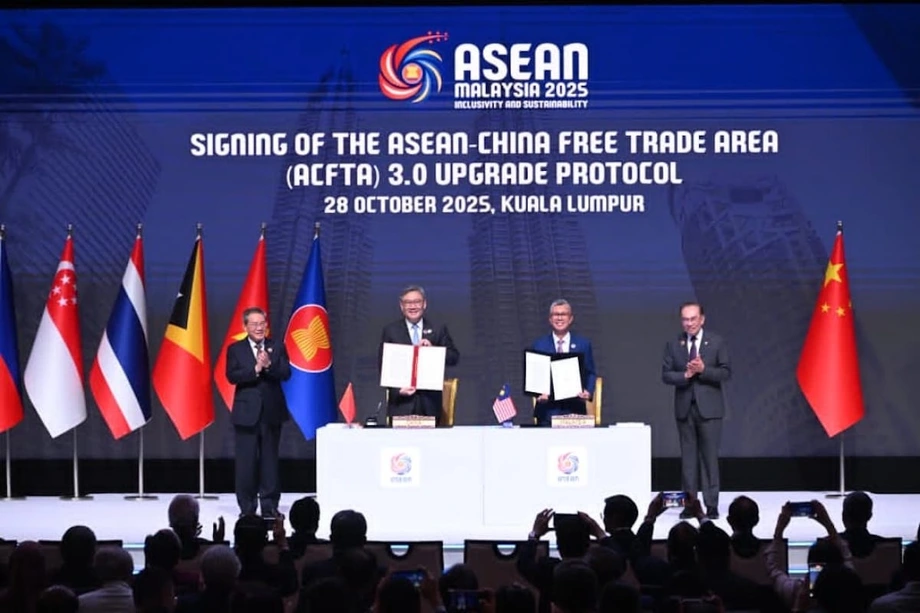
China and the Association of Southeast Asian Nations signed the protocol in Kuala Lumpur on October 28, 2025. Chinese Commerce Minister Wang Wentao and Malaysia's Minister of Investment, Trade and Industry, Tengku Zafrul Aziz, signed on behalf of the two sides, with Chinese Premier Li Qiang, Malaysian Prime Minister Anwar Ibrahim and other ASEAN leaders witnessing the ceremony.
The upgrade covers nine areas. Alongside digital and green economic cooperation, it addresses customs procedures, product standards, food and agricultural safety, competition, consumer protection, smaller businesses and economic and technical cooperation.
For businesses, the agreement broadens attention beyond tariffs, the taxes charged on goods crossing borders. Selling to another country also involves payment systems, safety checks, paperwork and connections between factories and suppliers. Those practical arrangements are central to the new framework.
China's Ministry of Commerce set out the scope and approval process in its protocol signing announcement. The ministry said domestic ratification would follow the signing, meaning each side would complete the procedures required at home before the agreement could take effect.
The December date moves the upgrade from negotiation toward implementation. Detailed schedules for individual measures and arrangements for businesses to use them have not been specified in the announcement of that date.
How the agreement reached this point
China and ASEAN began building their free trade area in 2002. Version 1.0 was fully implemented in 2010, while the Version 2.0 upgrade was signed in 2015 and came fully into effect in 2019. The latest protocol extends that existing relationship into more areas of economic activity.
Negotiators held nine formal rounds and more than 120 working group meetings during the latest upgrade process. Substantial completion in October 2024 preceded the announcement that negotiations had been fully completed in May 2025.
- November 2022: Negotiations for the 3.0 upgrade began.
- October 2024: Negotiations were substantially concluded.
- May 20, 2025: A special meeting of China-ASEAN economic and trade ministers announced full completion of negotiations.
- September 2025: The two sides began domestic procedures connected with signing and approval.
- October 28, 2025: Ministers signed the protocol in Kuala Lumpur ahead of the 28th China-ASEAN Summit.
- December 1, 2026: The upgrade will enter into force.
The completion of trade negotiations in May 2025 settled the negotiating stage, while leaving formal signing and domestic approval to follow. The timeline explains why an agreement described as completed in 2025 has a later starting date for its legal operation.
Nine areas connect border rules with newer industries
The Ministry of Commerce lists nine areas in the upgrade: the digital economy; the green economy; supply chain connectivity; standards, technical regulations and conformity assessment procedures; sanitary and phytosanitary measures; customs procedures and trade facilitation; competition and consumer protection; micro, small and medium enterprises; and economic and technical cooperation.
Some of those names describe everyday problems in technical language. Conformity assessment means checking whether a product meets the required standards, through activities such as testing or certification. Sanitary and phytosanitary measures concern food safety and the protection of animal and plant health.
A producer shipping food abroad may need both customs clearance and health documentation. A manufacturer selling electrical equipment may need to show that its products satisfy safety requirements. The upgrade addresses these kinds of procedures alongside newer fields such as digital payments and clean energy cooperation.
The ministry describes the broader aim as building a regional market with shared rules and more resilient production networks. In practical terms, the agreement connects how goods move across borders with how businesses make, market and sell them.
Digital trade brings payments and online sales into focus
Digital economic cooperation includes infrastructure, mobile electronic payments and commerce across borders. The agenda also covers cooperation involving artificial intelligence and other advanced digital technologies.
A business selling online to customers abroad depends on more than a website. It needs a way to receive payment, process orders and connect sales with delivery. Cooperation on digital infrastructure and payment systems therefore matters to the ordinary steps between a customer placing an order and a seller receiving the money.
China-ASEAN cooperation also places the upgrade alongside closer coordination with the ASEAN Digital Economy Framework Agreement, a separate regional initiative concerning the digital economy. The two tracks put digital rules and services within a wider effort to connect regional markets.
Chinese Foreign Ministry spokesperson Guo Jiakun has identified artificial intelligence, the digital economy, energy security, connectivity and poverty reduction as areas where Beijing wants deeper cooperation with ASEAN. His stated priorities show how the trade upgrade fits into a broader diplomatic agenda, extending from commercial transactions to infrastructure and development.
Electric vehicles and clean energy shape green cooperation
The green economy provisions focus attention on cooperation involving electric vehicles, clean energy and related projects. Electric vehicles appear in both the digital and green agendas because their development combines manufacturing, software, batteries and energy systems.
China and ASEAN businesses are already cooperating in electric vehicles, digital technologies, renewable energy and green agriculture. The protocol creates an additional framework for governments to support cooperation in these fields through their trade relationship.
The connection between green industries and supply chains is particularly direct. Producing an electric vehicle involves bringing together components, technology and manufacturing capacity. Moving those inputs between countries links the green agenda to customs procedures, product standards and transport connections.
For ASEAN economies seeking to develop their industries, cooperation can involve participation in more stages of production. For Chinese businesses, the same framework supports closer links with regional partners and markets. The practical value will depend on the projects companies pursue and the measures governments implement.
Supply chains, customs and safety checks work together
Supply chain connectivity is one of the protocol's nine areas. A supply chain is the network of businesses and transport links that carries a product from raw materials through manufacturing to the customer. When production takes place in several countries, border procedures become part of the factory's operating schedule.
Customs cooperation addresses the official processes for moving goods across borders. Standards and testing procedures address whether those goods meet the importing country's requirements. Food, animal and plant health rules provide another set of checks for agricultural trade.
These subjects sit together in the upgrade because a shipment can encounter several requirements during the same journey. A food exporter, for example, must arrange transport, prepare customs documents and satisfy health requirements. Coordinating those processes can make trade more predictable for businesses handling repeated shipments.
Physical infrastructure remains part of the wider relationship. The China-Laos Railway and Cambodia's Sihanoukville Special Economic Zone are existing examples of transport and industrial cooperation linking regional economies. The protocol adds work on trade rules and procedures to a relationship already supported by railways, factories and industrial zones.
Smaller businesses and development support get dedicated attention
Micro, small and medium enterprises have their own place in the upgrade, alongside competition and consumer protection. That gives smaller firms and the conditions under which they sell goods a specific role in the agreement's scope.
For a small exporter, navigating payments, product testing and customs paperwork can require a substantial share of its staff time. The protocol brings these connected subjects into a common cooperation framework, with practical relevance for firms seeking customers beyond their home markets.
Competition policy concerns how businesses compete, while consumer protection concerns the treatment of buyers. Including both extends the trade agenda to the conditions inside markets, as well as the movement of goods between them.
The economic and technical cooperation chapter also provides for support to ASEAN countries at lower levels of development. Countries need officials, institutions and technical capacity to put trade arrangements into practice. Development cooperation connects the agreement's ambitions with the ability of participating economies to carry them out.
A major trading relationship gains another framework
China-ASEAN trade reached $982.3 billion in 2024, a seventeenfold increase from 2002, when the process of building the free trade area began. That puts the value of annual exchanges close to $1 trillion before the latest upgrade takes effect.
By the October 2025 signing, China had been ASEAN's largest trading partner for 16 consecutive years, while ASEAN had held that position for China for five consecutive years. Those rankings show that the protocol builds on an established commercial relationship.
The Chinese Ministry of Commerce has described the upgrade as complementary to the Regional Comprehensive Economic Partnership, or RCEP. China and ASEAN members participate in that wider regional agreement. CAFTA 3.0 adds a dedicated framework for their own relationship, including cooperation in the digital economy, green industries and supply chains.
The ministry also presents the protocol as a commitment to free trade and a regional market governed by agreed rules. In its signing announcement, the ministry described the intended production network as:
a mutually beneficial, resilient regional industrial and supply chain system.
December 1 is therefore a concrete legal milestone for a much broader economic programme. For businesses and consumers, the changes will take shape through implementation: how governments organise border procedures, cooperate on standards, support digital commerce and turn industrial cooperation into projects.
Key Points
- The China-ASEAN Free Trade Area 3.0 Upgrade Protocol will enter into force on December 1, 2026.
- China and ASEAN signed the protocol in Kuala Lumpur on October 28, 2025, after completing negotiations in May.
- Nine areas cover digital and green economic cooperation, supply chains, customs, standards, health measures, smaller businesses and related policies.
- Digital priorities include infrastructure, mobile electronic payments, online commerce and artificial intelligence cooperation.
- Green cooperation includes electric vehicles and clean energy projects.
- Bilateral trade reached $982.3 billion in 2024, seventeen times its level in 2002.
- The upgrade is intended to complement RCEP and includes economic and technical support for ASEAN countries at lower levels of development.