Ca Mau prepares for a dry season lasting until May
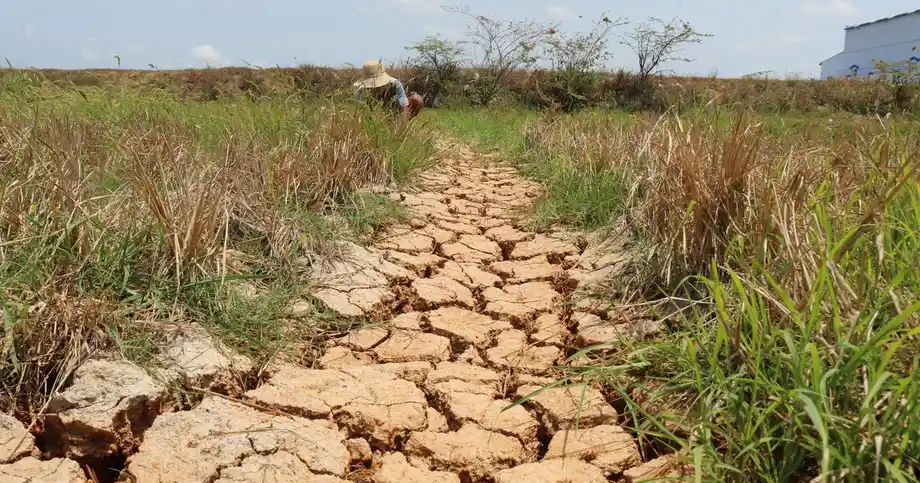
Ca Mau province has prepared an emergency response costing up to 167.026 billion dong as southern Vietnam faces forecasts of prolonged drought, freshwater shortages and saltwater intrusion during the 2026–2027 dry season. Regional forecasters warn that conditions could become harsher than during the destructive drought of 2015–2016.
Contents
- Ca Mau prepares for a dry season lasting until May
- Why forecasters fear a repeat of 2015–2016
- What the Pacific temperature forecasts mean
- Heat may begin early and relief may arrive late
- The dates shaping water and farming decisions
- Less Mekong water gives salt more room to advance
- Rice, orchards and shrimp face different risks
- Ca Mau sets spending thresholds before shortages deepen
- Dong Thap prepares wells, free water and barge deliveries
- Reservoirs, electricity and sudden storms also need attention
- Key Points
Vice Chairman Le Van Su signed Plan 635/KH-UBND, putting household water supplies first and setting out three levels of action as salt moves inland and freshwater reserves shrink. The Government News Portal's account of Ca Mau's response plan identifies Bien Bach, Khanh Lam, Khanh An and Nguyen Phich communes among the places needing priority protection.
The province expects widespread drought, water shortages and salinity problems from November 2026 until around May 2027. Its preparations include checking which households could lose their water supply, assessing storage and delivery capacity, and arranging emergency distribution before shortages become urgent.
Across southern Vietnam, the concern is a combination of less rain, stronger evaporation, lower river flows and a delayed rainy season. Le Dinh Quyet, head of forecasting at the Southern Regional Hydrometeorological Center, expects temperatures to reach 39°C or higher at the peak of the heat in April 2027.
The Ministry of Agriculture and Environment estimates that about 447,000 rural households could face water shortages across the broad region stretching from north central Vietnam to the Mekong Delta. Its agricultural assessment also identifies rice fields, orchards and farms combining rice and shrimp production as vulnerable. The scale of actual damage will depend on rainfall, river flows, available reserves and how effectively water is managed.
Why forecasters fear a repeat of 2015–2016
The 2015–2016 drought and saltwater intrusion affected about 1.63 million hectares, damaged more than 450,000 hectares of rice and left an estimated 210,000 to 600,000 households short of domestic water. Salinity arrived about two months earlier than usual, with the worst conditions occurring in February and March 2016.
During that season, water containing four grams of salt per liter reached roughly 60–65 kilometers inland along the Tien and Hau rivers and 100–110 kilometers along the Vam Co. Those distances show how a shortage of freshwater can carry a coastal problem far into farming districts.
Quyet expects the coming dry season could be more severe. The Department of Hydrometeorology has framed the danger through two scenarios: a high risk situation in which moderate to strong El Niño weakens in early 2027, and a very high risk situation in which very strong conditions continue until the middle of the year.
In the second scenario, prolonged heat, a late rainy season, depleted reservoirs and low Mekong flows would act together. Authorities are therefore preparing for serious disruption while updating their plans as the season develops.
What the Pacific temperature forecasts mean
El Niño is a natural climate pattern involving unusually warm surface water in the central and eastern equatorial Pacific. Changes in ocean temperature affect winds and rainfall far away, including in Vietnam, where strong events often bring hotter weather and reduced rain.
Forecasters track the difference between sea surface temperatures and their historical average in a Pacific monitoring area called Niño 3.4. Vietnamese forecasts use departures above 2°C to describe very strong conditions, sometimes called a super El Niño. The 2015–2016 event peaked at nearly 3°C; Quyet expects the November–December 2026 peak could approach or exceed that level.
The National Center for Hydro-Meteorological Forecasting recorded a Niño 3.4 departure of about 0.5°C in May 2026 and 0.7°C in early June. A May outlook attributed to the US National Oceanic and Atmospheric Administration put the chance of a very strong event at 33%; Vietnamese forecasts in June put it at 60–65%. The national center's seasonal outlook gives a 79% probability of very strong conditions during December 2026–February 2027.
For March–May 2027, the national center assigns a 78% probability to weak or moderate El Niño, 2% to strong conditions and 20% to neutral conditions. Quyet's regional outlook keeps conditions moderate to strong during February–April and places a return to neutral in the second half of 2027. Both outlooks leave southern Vietnam facing a difficult dry season, including after the expected Pacific peak.
Heat may begin early and relief may arrive late
Southern Vietnam could begin experiencing hot weather in late January or early February, with prolonged heat becoming more intense in March and April. The regional outlook places the start of the rainy season around the middle or end of May 2027.
Ho Chi Minh City faces additional heat from its buildings, roads, traffic and commercial activity. Concrete and asphalt absorb and release heat, while densely built districts can retain more warmth than surrounding areas. This urban heat island effect can make central neighborhoods hotter than outlying districts.
The national center expects average temperatures across Vietnam to run about 1–2°C above the historical average during December–February and again during March–May, with larger departures in some places. Vietnam has already recorded its hottest October since observations began in 1961: the October 2026 national average was 26.3°C, or 1.74°C above the reference average.
The central risk is the length of the dry period. A late start to dependable rain means reservoirs, household tanks and irrigation systems must supply water for longer, while hotter conditions increase evaporation.
The dates shaping water and farming decisions
Provincial preparations and seasonal forecasts point to several periods when pressure on water supplies could increase. Local salinity measurements will determine when individual canals, intakes and farms need to change their operations.
- September 30, 2026: The Ministry of Agriculture and Environment sent the prime minister an assessment of drought and salinity risks and proposed stronger national response measures.
- November 11, 2026: Dong Nai issued a directive to protect water for households, production and hydropower as its rainy season was expected to end around the middle of November.
- Late December 2026: The Southern Institute of Water Resources Research expects a high tide to carry saltwater 30–40 kilometers into Mekong river mouths and 40–45 kilometers into the Vam Co system.
- January–February 2027: Southern Vietnam and the Central Highlands are forecast to receive little rain. Dong Thap aims to finish harvesting its winter–spring rice during February.
- March–April 2027: Heat and salinity are expected to intensify, with the institute placing the salinity peak around these months.
- May–June 2027: Authorities will watch the arrival of rain, recovery of freshwater supplies and inflows to major hydropower reservoirs, especially on the Da River system.
Ca Mau expects its main drought threat to continue until around May. The ministry says shortages in parts of the north central and south central coastal regions could last until July or August.
Less Mekong water gives salt more room to advance
The Ministry of Agriculture and Environment forecasts Mekong Delta river inflows at 15–20% below average. Freshwater flowing toward the sea normally helps hold saltwater back. When that flow weakens, tides can push salty water farther upstream.
The ministry expects intrusion of 50–70 kilometers along Mekong estuaries and 110–130 kilometers along the Vam Co. The Department of Hydrometeorology gives a Vam Co range of 90–125 kilometers for the boundary containing four grams of salt per liter, alongside 85–90 kilometers on the Cua Tieu and 70–80 kilometers on the Ham Luong. The ministry's broad estuary estimate and the department's forecasts for a specified salinity level provide different planning measures.
Rainfall forecasts across the Mekong Basin add to the concern. The national center expects lower basin rainfall to be 30–60% below average in January, followed by little rain in February. March rainfall could be 20–50% below average in the lower basin, and April rainfall could be 20–50% below average across the entire basin.
Water availability also depends on upstream withdrawals and reservoir operations. The Department of Hydrometeorology identifies these pressures alongside rainfall in its more severe scenario. The delta already faces longer lasting strain from sinking land and rising seas, which increase the difficulty of maintaining dependable freshwater supplies.
Rice, orchards and shrimp face different risks
The ministry estimates that 85,800 hectares of winter–spring rice, 120,000 hectares of rice and shrimp farms, and 45,000 hectares of fruit orchards could be threatened. The Department of Hydrometeorology gives a broader risk estimate of more than 350,000 hectares of winter–spring rice, compared with the ministry's 85,800 hectares across named provinces and cities.
The ministry recommends harvesting the 2026 autumn–winter rice crop early and bringing forward planting of winter–spring rice in areas exposed to salinity. In Dong Thap, the goal is to finish harvesting during February so that the crop's flowering and ripening stages avoid the expected salinity peak.
Perennial crops face a different problem because losing a mature tree can mean losing years of production. Meteorological and hydrological expert Nguyen Ngoc Huy recommends matching irrigation to the water actually available and prioritizing tree survival over a large harvest.
Huy described that priority when discussing orchards and plantations in the Central Highlands and Mekong Delta:
In the context of increasing water shortages, preserving trees is more important than trying to maximise output in the coming season.
Shrimp farms also need freshwater reserves. Huy says salinity around 25 parts per thousand can make growth and moulting difficult even for black tiger shrimp, which tolerate salty conditions. He recommends that a farmer with four ponds consider using three for production and keeping one for freshwater storage.
Ca Mau sets spending thresholds before shortages deepen
Ca Mau's official plan ties its three response levels to the inland reach of water at four parts per thousand salinity and the size of the freshwater deficit. Its lowest level has an estimated cost of 500 million dong, covering monitoring, warnings and careful water use when salinity remains within 25 kilometers and supplies broadly meet demand.
The second level applies when the salinity boundary reaches beyond 25 kilometers and up to 50 kilometers, with freshwater shortages of 30–50%. Cumulative spending rises to 38.142 billion dong for measures including freshwater storage, water regulation, protection of production and forest fire prevention.
The most severe level covers intrusion beyond 50 kilometers and up to 90 kilometers, together with freshwater deficits above 50%. Its cumulative budget is 167.026 billion dong, including spending under the earlier levels. Emergency measures include tankers, barges, temporary supply stations and temporary barriers to retain freshwater.
The province directs agencies to prepare immediately. If at least one indicator crosses a threshold, or an urgent household shortage develops, the agriculture and environment department must propose early action. Officials must count vulnerable households and give priority to disadvantaged families and other vulnerable residents.
Ca Mau also identifies land subsidence, infrastructure safety and forest fires as concerns, including in northern Ca Mau and the U Minh Ha forest area. Water management must therefore protect homes and essential services as well as crops.
Dong Thap prepares wells, free water and barge deliveries
Dong Thap's severe response scenario identifies 481,847 people and 161,496 hectares of agricultural land as potentially affected. The province is planning for salinity comparable to the 2019–2020 dry season, with water containing one gram of salt per liter potentially reaching about 75 kilometers inland on the Cua Tieu–Tien route by February 2027.
The province's preparations include testing 25 reserve wells and two supplementary pumping stations. It also plans 30 public taps and 58 tanks, each holding two cubic meters, at 16 locations in the east where residents could collect water free of charge.
If raw water supplies run out, the Tien Giang Water Supply Company plans to bring water from upstream by barge, with an estimated 450,000 cubic meters over three months. That is an average of 150,000 cubic meters a month.
Authorities will monitor salinity and water levels from January through May, operate gates according to actual conditions, and prepare temporary barriers. The projected cost of the response works is 59.75 billion dong. From June, the plan calls for reopening freshwater intakes when river salinity falls below 0.3 grams per liter so fields can be flushed and prepared for the next crop.
Reservoirs, electricity and sudden storms also need attention
The ministry identifies drought risks across 1.3 million hectares in the Central Highlands and 428,000 hectares in southeastern Vietnam, largely involving perennial crops outside irrigation systems. Coastal reservoirs in central Vietnam are forecast to finish the rainy season holding only 70–80% of their designed capacity.
Lower inflows to hydropower reservoirs could coincide with greater electricity demand during prolonged heat. The Department of Hydrometeorology has singled out Da River inflows in May–June 2027 for close monitoring. Its severe scenario also includes increased wildfire risk in central Vietnam, the Central Highlands and the southeast.
Dry seasonal conditions can still include short bursts of dangerous weather. The national center expects fewer storms and tropical depressions than usual during December–May, while warning of thunderstorms, lightning, hail and strong gusts. Heavy rain can fall intensely in a small area even when the season's total is low.
Brief cool mornings are also possible. Quyet expects strong northern cold air outbreaks in late December and January could lower temperatures below 20°C in Bien Hoa and Thu Dau Mot, and below 17°C in Ta Lai. Such changes can occur within a season that is warmer than average.
The practical instruction from weather authorities is to combine seasonal planning with forecasts covering the next one to three days. For households, that means securing safe water early. For farmers and reservoir operators, it means adjusting planting, irrigation and releases to measured supplies as the dry season unfolds.
Key Points
- Southern Vietnam faces early heat, scarce rain and a potentially delayed rainy season during the 2026–2027 dry season.
- Regional forecasters warn drought could exceed 2015–2016 severity, especially if very strong El Niño persists into the middle of 2027.
- The ministry forecasts Mekong Delta inflows 15–20% below average and possible rural water shortages affecting about 447,000 households across a wider region.
- Ca Mau's response plan prioritizes household water, with cumulative spending of up to 167.026 billion dong.
- Dong Thap is preparing reserve wells, free public water points and possible deliveries of 450,000 cubic meters by barge.
- Earlier rice planting, freshwater storage and careful reservoir operation are central to reducing losses.