A crop introduced to help farmers becomes a lasting burden
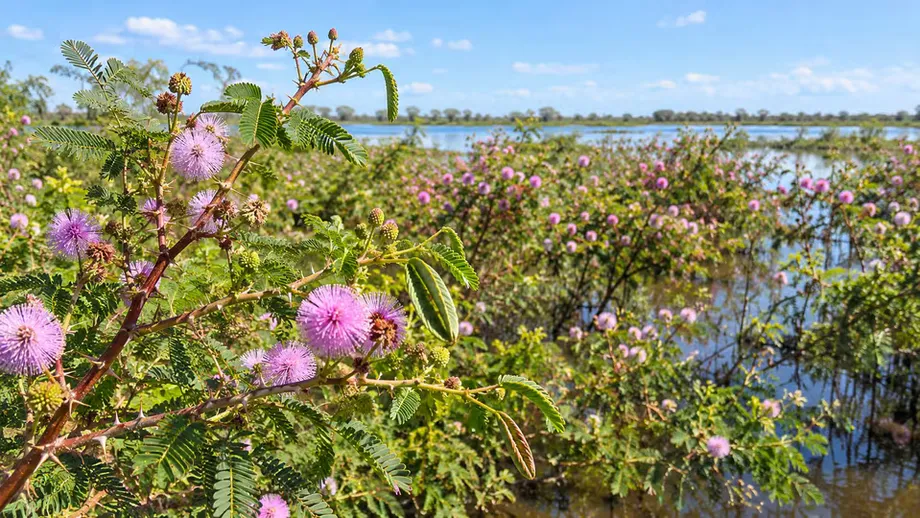
Farmers on the Mekong floodplains spend an average of 11 days per hectare each year clearing giant mimosa, according to a scientific review published in May 2023. The shrub can produce up to 220,000 seeds per plant annually, and some seeds can lie dormant in soil for 26 years. Clearing the branches is often just the beginning.
Contents
- A crop introduced to help farmers becomes a lasting burden
- How giant mimosa spread beyond the fields
- Why the shrub is so difficult to contain
- What farmers lose to the invasion
- What the Thai bird study actually found
- Water depth and marshes also shape bird survival
- Evidence from Africa shows the scale of habitat change
- The hidden help beneath the roots
- Why removal needs years of follow-up
- Key Points
Giant mimosa, known scientifically as Mimosa pigra, arrived in Thailand from Indonesia in 1947 as a cover crop and green manure. Farmers use cover crops to protect soil and green manure to add plant material that feeds it. A plant brought in for those purposes eventually spread along riverbanks and across floodplains.
The journal Plants published the 2023 scientific review, which places giant mimosa among the world's 100 worst invasive alien species. It reports that the shrub has been present in the Mekong River Basin since the 1970s and has spread across more than 30% of its floodplain areas. The review draws that estimate from earlier research rather than a new survey conducted in 2023.
The costs reach beyond lost farmland. Dense, thorny stands obstruct irrigation, restrict access to water and replace more open vegetation. Research at Bung Boraphet, a wetland in central Thailand, also connects vegetation invaded by mimosa with fewer large wading birds.
That bird study offers a more detailed picture of the damage. Mimosa was one of several pressures affecting wildlife, alongside changing water conditions, settlement growth and the loss or rearrangement of habitat. Its findings point toward managing the wetland as a whole while tackling the invasive shrub.
How giant mimosa spread beyond the fields
Tropical America is giant mimosa's native home. Outside that range, people have introduced it as an ornamental plant, a cover crop and green manure, while contaminated seed has provided another route. It has become established in Australia, parts of Africa and Asia.
Thailand's recorded introduction in 1947 explains one entry point. Genetic research cited in the review indicates that the country received the species more than once. Multiple introductions gave the plant additional opportunities to establish itself.
The history stretches across decades:
- 1947: Giant mimosa was introduced to Thailand from Indonesia for use as a cover crop and green manure.
- 1970s: The species was present in the Mekong River Basin.
- 1980 to 1981: Two species of beetle that feed on its seeds were released in Thailand and became established.
- 2003 to 2014: Researchers monitored resident waterbirds at Bung Boraphet as the surrounding landscape changed.
- 11 May 2023: Plants published its review of the species' invasion mechanisms and management.
Floodplains suit the shrub's ability to grow in tropical conditions that alternate between wet and dry seasons. Its hairy seed pods can float in streams and floodwater, or attach to animals and agricultural vehicles. Water and movement between fields can therefore carry the next infestation beyond an existing stand.
Why the shrub is so difficult to contain
Giant mimosa can reach reproductive maturity within six to eight months. It grows into heavily branched thickets up to six metres tall, with prickles along its stems. Dense stands block light from reaching the ground and make passage difficult for people and animals.
Seed production adds another advantage. Alongside the estimate of up to 220,000 seeds per plant annually, the review records studies finding between 2,000 and 45,000 seeds per square metre in topsoil beneath the canopy. This buried store is called a seed bank: seeds remain in the ground until conditions allow them to germinate.
Some seeds survive because their hard outer coats keep water out. The review records dormancy lasting as long as 26 years. In an Australian example, 109 seedlings per square metre were still emerging ten years after a stand covering 250 hectares had been cleared.
Cutting also leaves a second route back. Giant mimosa can regrow from the base of its stems, and young stubble in a cited study reached 2.5 metres tall within 12 weeks. Managers face both living plant parts left after removal and seeds already buried beneath them.
What farmers lose to the invasion
Rice fields and other croplands lose usable space when mimosa thickets spread into them. Blocked irrigation systems create another problem: farmers must keep water moving as well as keep the crop area clear.
The review's estimate of 11 clearing days per hectare annually comes from research on cultivated Mekong floodplains near Kratie, Cambodia. At that rate, maintaining five affected hectares would require 55 days of clearing each year. The calculation shows how a recurring weed problem can consume time needed for planting, tending crops and harvesting.
Livestock also lose grazing areas, and dense growth can block their access to water. The review records reduced fishing production near invaded floodplains, adding another livelihood to the list of activities affected.
Changes to water movement extend the problem beyond individual farms. The review describes reduced flows and increased silt accumulation in invaded areas, with floodplains turning into scrubland. When dense woody vegetation replaces a more open wetland, access to land and water changes together.
What the Thai bird study actually found
Bung Boraphet lies in Nakhon Sawan province on the Chao Phraya floodplain, in a different river basin from the Mekong. Covering approximately 212 square kilometres, it is Thailand's largest freshwater wetland and supports fishing, water supply, agriculture and flood control.
A waterbird population study published in Tropical Conservation Science examined resident birds there from 2003 through 2014. Researchers used repeated boat surveys, conducted monthly in the first two years and every 15 days from 2005 onward, and analysed 28 species with sufficient records.
Resident waterbirds declined by 27% over the study period. Ducks suffered the largest decrease, at 56%, while large waders declined by 25% and vegetation gleaners by about 8%. Fish eaters and small waders fluctuated seasonally but maintained stable populations across the period.
The landscape analysis covered 2001 to 2014. Vegetation dominated by giant mimosa increased by 81%, while the area covered by waterbodies fell by 31%. Human settlements and fish farms each expanded by 27%.
The researchers found fewer large waders in areas with vegetation invaded by mimosa. Their analysis also connected different bird groups to different environmental pressures. The 27% decline describes the resident bird population across Bung Boraphet; the specific mimosa finding concerns large waders and invaded vegetation.
Water depth and marshes also shape bird survival
Small waders and vegetation gleaners became less abundant when average water depth rose above about 1.8 metres. Small waders include birds such as plovers and stilts. Vegetation gleaners, including jacanas and swamphens, find food among wetland plants.
Water depth changes where these birds can reach food and use habitat. Fish eaters responded to another feature: they were more abundant when dissolved oxygen exceeded 5.5 milligrams per litre. Dissolved oxygen is oxygen held in the water, which fish and other aquatic animals need.
Marsh areas were associated with greater abundance of ducks, large waders and vegetation gleaners. Expanding human settlements were associated with fewer vegetation gleaners. The researchers recommended preserving critical marsh habitat, maintaining suitable water depth and quality, removing invasive species and restricting new settlement beside wetlands.
Bung Boraphet's results give managers local evidence for those actions. The authors recommended testing the findings at other sites before applying them across larger landscapes. For the Mekong, the practical lesson is to investigate how mimosa interacts with water conditions and habitat use at each affected wetland.
Evidence from Africa shows the scale of habitat change
Zambia's Kafue floodplains provide another example of rapid expansion. The 2023 review records giant mimosa covering two hectares by 1980, 100 hectares by 1986 and 2,500 hectares by 2003. Those figures represent an increase to 1,250 times the initial area over 23 years.
The review also cites a comparison of 20,000 birds in native vegetation areas with 314 in areas invaded by mimosa, alongside a 50% reduction in the number of bird species. The comparison concerns different habitat areas, while the Thai study followed changes over time at one wetland.
Giant mimosa displaced previously dominant grasses in the Kafue floodplain. Its dense canopy limits light beneath the shrub, while thorny growth restricts animal movement and access to the waterfront. These changes help explain why replacing open wetland vegetation with thickets can alter which animals use an area.
The hidden help beneath the roots
Giant mimosa's success also involves organisms living around its roots. The review describes partnerships with rhizobia, bacteria that help plants obtain nitrogen. Nitrogen is a nutrient plants need to grow, and these bacteria convert nitrogen from the air into forms their host can use.
Studies cited in the review found that giant mimosa can maintain these partnerships under flooded conditions. Research in Taiwan and Australia identified bacterial partners with strong nitrogen fixing activity, offering a possible explanation for vigorous growth outside the plant's native range.
Fungi associated with the roots can also help the shrub obtain water and nutrients. These relationships are called mutualism because both partners benefit. They add to the advantages of fast growth, abundant seeds and relatively few natural enemies in some invaded regions.
Laboratory studies found that mimosa leaf material and extracts suppressed germination or growth in several other plants. This chemical interaction is called allelopathy. The review suggests that decomposing litter could release growth suppressing substances into soil; annual litterfall was estimated at 758 grams per square metre. The precise chemicals responsible for the effects remained unresolved in the research reviewed.
Why removal needs years of follow-up
Herbicides are the primary control method described in the review, with applications to foliage, cut stumps or soil. Mechanical approaches include hand removal, cutting, bulldozing and pulling down larger stands. The choice depends partly on the size and location of the infestation.
Fire has mixed effects. Plants may regrow from their stem bases after burning, and heat can stimulate seeds in the soil to germinate. Mechanical and chemical treatments also require attention to the native plants and animals sharing the site.
Biological control uses selected natural enemies to attack the weed. Thailand's two established bean weevil species feed on mimosa seeds. In Australia, a moth whose larvae bore into stems, Carmenta mimosa, became one of the more successful agents, weakening plants and reducing seed production.
Results from a treatment programme covering 128 hectares support combining methods. Single treatments were ineffective, while combinations of herbicides, fire, crushing and biological control cleared thickets more effectively and encouraged competing native vegetation to establish.
The review describes sustained control for at least seven years as necessary in one management example to prevent regeneration from buried seeds. Other observations, including seedlings appearing a decade after clearance, show why inspection and follow-up remain part of the work. Small outlying infestations also need attention because they can grow while efforts concentrate on the largest stands.
For farmers and wetland managers, success means more than removing visible shrubs. It means returning to catch regrowth, reducing new seed production and restoring vegetation that can occupy the cleared ground. Giant mimosa's history turns a seemingly simple clearing job into a commitment lasting many growing seasons.
Key Points
- Giant mimosa entered Thailand from Indonesia in 1947 for agricultural use; genetic research indicates multiple introductions.
- A 2023 review cites earlier research reporting invasion across more than 30% of Mekong floodplain areas.
- Research near Kratie, Cambodia, puts annual clearing work at an average of 11 days per affected hectare.
- Plants can produce up to 220,000 seeds annually, and some seeds remain dormant for 26 years.
- At Bung Boraphet on the Chao Phraya floodplain, resident waterbirds declined by 27% from 2003 to 2014. Large waders were less abundant in vegetation invaded by mimosa.
- Combined control methods and repeated follow-up offer better prospects than a single treatment.