A climate project under scrutiny
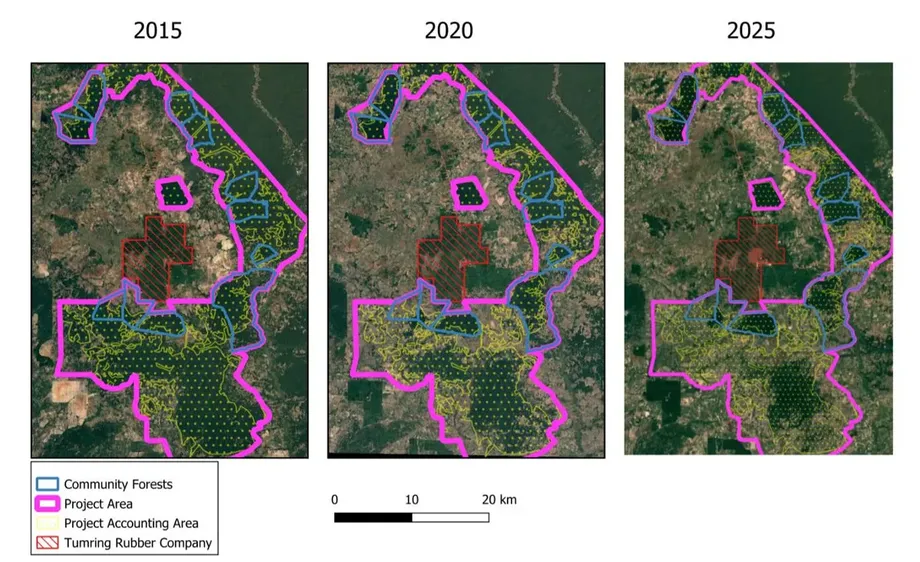
South Korea's forest agency says its Cambodia pilot achieved a target of cutting 650,000 tonnes of carbon dioxide emissions. Researchers examining the Tumring project describe a much darker picture: farmers reporting threats and property seizures, and satellite analysis showing that roughly 80% of the forest present at the start of their study disappeared from the project's southern section between 2015 and 2025.
Contents
- A climate project under scrutiny
- What South Korea says it funded
- Farmers describe threats and seizures
- Forest loss measured across different areas
- Why plantation boundaries matter
- Patrol funding and limits on community action
- Credits, revenue and a disputed chronology
- Keo Seima shows why land rights need attention
- What the forest agency says happens next
- Key Points
The allegations include testimony from Bopha, a farmer identified by a pseudonym, who said she was eight months pregnant when forestry officials and soldiers threatened her with arrest at a cassava farm in O Kantrok village in February 2024. She said she fell and was injured while fleeing, then lost her unborn baby several days later.
The investigation was commissioned by the climate group Plan 1.5 and conducted by researchers from the Mekong Research and Policy Center and the University of California, Berkeley's Carbon Trading Project. It assessed projects supported by the Korea Forest Service in Cambodia, Myanmar and Laos. The Cambodia investigation included interviews with 80 farmers and 12 community forest managers, alongside satellite imagery and statistical analysis.
The dispute matters beyond one forest. South Korea plans to obtain 9 million tonnes of its international emissions reductions toward its 2030 climate target through overseas forest projects. Tumring brings together two questions central to that plan: how much forest protection the money buys, and what happens to people living and farming where conservation rules are enforced.
What South Korea says it funded
The Korea Forest Service's REDD+ programme overview lists the Cambodia pilot as covering 41,196 hectares in Sandan and Santuk districts of Kampong Thom province from 2015 to 2022. It describes the project as its first pilot to complete the full process leading to carbon credit issuance.
REDD+ rewards efforts to reduce emissions from deforestation and forest degradation, alongside forest conservation and management. Trees store carbon. When forests are cleared or damaged, some of that carbon enters the atmosphere. A forest carbon project estimates how much destruction would have happened without its activities, then calculates the emissions it says those activities prevented.
A carbon credit generally represents one tonne of carbon dioxide equivalent, a common unit for measuring climate pollution. The estimated level of destruction without the project is called a baseline. Because it describes an alternative future, the baseline and the measurement of actual forest change are central to the credit calculation.
The agency lists community activities including bamboo craft training, soap making, tree planting and supplying cookstoves. It also describes selling credits, establishing a trust fund and reinvesting proceeds in the project. Its biodiversity inventory lists 64 bird species, 25 mammal species and two amphibian species, including two endangered bird species and nine endangered mammal species.
Farmers describe threats and seizures
Bopha said about 10 people, including local forestry personnel and soldiers, approached while she was working. Her account places the confrontation in February 2024, after the Korean pilot formally ended. Forest protection activities have continued through a joint trust fund financed by carbon credit sales.
A farmer aged 62 from the same village described a confrontation in 2019. He said he had moved there to farm and earn money for his wife's medical treatment. Forestry personnel and soldiers came to his home, took rice, clothing and farm tools, and dismantled the house, according to his testimony.
The farmer said subsequent seizures included a motorcycle and a walking tractor, with property losses exceeding $2,000. Other residents told researchers they fled or hid when forestry officials arrived because they feared arrest or confiscation.
The researchers argue that enforcement concentrated on restricting small farmers while commercial logging and large rubber plantations continued to drive forest destruction. Their recommendations include an independent investigation into alleged human rights abuses and a review of credits whose conservation results they question.
Forest loss measured across different areas
The recent investigation examined Tumring using satellite imagery and statistical models covering 2015 to 2025. Its finding that about 80% of the original forest disappeared applies to the southern section it analysed. Researchers also traced clearing around a rubber concession during the 2000s and its spread east toward Prey Lang forest after 2015.
An earlier Scientific Reports study, published in 2022, provides a broader comparison. It found that the Tumring project area lost 37.6% of its forest cover between 2001 and 2021, while the surrounding central study region, including a buffer zone, lost 37.9%. Tumring's average annual forest loss rate during 2016 to 2021 was 5.4%.
Those measurements cover different periods and geographic areas. The southern section's loss during 2015 to 2025 and the project area's loss during 2001 to 2021 describe different parts of the same conservation challenge.
Project size also varies across the published descriptions. The Korean agency lists 41,196 hectares for its bilateral pilot, while a 2021 investigation described the wider Tumring REDD+ project as exceeding 67,000 hectares along the southwestern edge of Prey Lang Wildlife Sanctuary.
The 2021 investigation found more than 37% of forest in the area it assessed had been damaged or destroyed in the six years after the project began. It recorded forest loss of 8.76% in 2020 and 8.3% during the first half of 2021, linking clearing to industrial rubber, cassava and cashew plantations.
Why plantation boundaries matter
The 2022 academic study found that 85% of Tumring's boundary adjoined unprotected land with high deforestation or economic land concessions. Only 15% bordered Prey Lang Wildlife Sanctuary. Economic land concessions are areas of state land allocated to companies for activities such as industrial agriculture.
The study traced a moving frontier of forest destruction. Clearing first surged in concessions south of Tumring, then in other nearby areas, before rising within Tumring and Prey Lang. Roads and infrastructure serving concessions opened access to forests that had previously been harder to reach.
Across Cambodia, the researchers found a strong statistical relationship between the area under concessions and deforestation during 2000 to 2021. Their analysis also found that forest loss within concessions tracked loss in neighbouring protected areas.
Cambodia suspended new economic land concessions and ordered some existing concessions revoked in 2012 under Order 01BB. The academic study found concession area fell from approximately 2.1 million hectares in 2012 to around 1.6 million hectares from 2014 onward. Forest loss slowed after its peak years but continued at a substantial rate.
For Tumring, this geography makes enforcement priorities consequential. Restricting a farmer's field affects that household immediately. Protecting the wider forest also requires action against the roads, timber markets and plantation expansion through which clearing spreads across project boundaries.
Patrol funding and limits on community action
Community patrol teams interviewed for the 2021 investigation reported receiving an average of $38 per patrol, compared with a stated allowance of $50 for a team of five. The amount received was $12, or 24%, below that allowance.
A representative of the O Dauntry community forest said a larger team was needed to cover the forest properly and that an adequate patrol could cost five times the existing allowance. Teams described patrolling once or twice a month because money barely covered food and fuel.
Ouch Leng, head of the Cambodia Human Rights Task Force and winner of the 2016 Goldman Environmental Prize, led that field investigation, supported by the Korean Federation for Environment Movement and the Biodiversity Foundation. He described an active trade in valuable timber:
"It's not a secret that expensive timber from endangered species in Cambodia is actively traded on the black market. REDD+ project isn't stopping that at all," says Ouch Leng.
Community monitoring also faced restrictions in the wider Prey Lang landscape. Authorities banned patrols by the Prey Lang Community Network in early 2020. In February 2021, environment officers detained five environmental defenders, including Ouch Leng, who were investigating illegal logging.
In June 2021, the US Agency for International Development redirected funding away from Cambodian government entities under its Greening Prey Lang project. Its statement cited continuing illegal logging, inadequate prosecution and the targeting of local communities and civil society partners.
Credits, revenue and a disputed chronology
The recent investigation records 645,413 tonnes of credits issued for the Cambodia project, of which 522,843 tonnes were sold for $2,857,503. Those figures mean approximately 81% of issued credits were sold, at an average of about $5.47 per tonne.
The Korea Forest Service describes the pilot as achieving a rounded target of 650,000 tonnes. Its website dates verification and credit issuance to September 2020. The 2021 investigation, citing Verra's registry, dates issuance of credits for 2015 to 2019 to August 24, 2021. The academic study places issuance in 2018 and the first sales in 2021. The exact issuance chronology remains unresolved.
The project's verification approval notice provides a reference for checking that chronology: it links to the Verra Registry record for project VCS/1689 and says the registry approved the project's verification report on 03 September 2020. The notice says the Project Management Unit (PMU), supported by carbon developer Wildlife Works Carbon, provided inputs to independent carbon verifier S&A Carbon to complete the VCS and CCB accuracy assessment report required by Verra Registry. At the time of the notice, the PMU was consulting and negotiating with the Korea Forest Service on how the verified credits should be shared and used. The approval date establishes a verification milestone but does not by itself resolve the conflicting issuance dates.
South Korea's recent funding figures show $4,971,362 spent through September of the reporting year on overseas pilot activities across Indonesia, Cambodia, Myanmar and Laos. That is a programme figure covering several countries, while the $2.86 million in sales concerns Cambodia's credits.
The Korea Forest Service says the Cambodian pilot ended in 2022 and that forest protection now continues through the joint trust fund. The transition gives credit revenue an ongoing role: proceeds from past claims of avoided emissions are helping pay for present conservation activities.
The key milestones span more than a decade:
- 2015: Tumring REDD+ begins, alongside the Korea Forest Service pilot in Cambodia.
- 2019: A farmer later interviewed by researchers says officials dismantled his home and seized belongings.
- 2021: An investigation documents extensive clearing, and the academic study dates the first credit sales to this year.
- 2022: The Korean pilot formally ends; protection continues through a trust fund.
- February 2024: Bopha says she is threatened during enforcement and injured while fleeing.
- 2015 to 2025: Satellite analysis tracks forest change examined in the recent investigation.
Keo Seima shows why land rights need attention
The 2022 academic study found stronger forest protection results at Cambodia's Keo Seima and Southern Cardamom REDD+ projects than at neighbouring protected areas. Both reduced their average deforestation rates by about 50% after their projects began. Tumring performed better than two of the four surrounding protected areas assessed.
Keo Seima, a different project run by Cambodia's Ministry of Environment and the Wildlife Conservation Society, also faces complaints from Indigenous Bunong communities about land access and enforcement. It began in 2010 and has directed just over $1 million in carbon revenue toward community infrastructure since 2018.
At Pu Kong village, residents described being prevented from farming land they sought to include in communal ownership. Authorities approved 262 hectares for communal ownership, compared with 462 hectares requested in 2020. A community protected area established in 2019 overlapped 128 hectares identified for the village's communal title.
Global Forest Watch data cited in the investigation showed that the Sre Preah Community Protected Area had lost 70% of its forest cover, mostly since 2015, with more than 350 hectares cleared in 2023. This local loss occurred within a project whose broader forest performance had compared favourably with nearby protected areas in the earlier academic analysis.
The Wildlife Conservation Society acknowledged dozens of arrests involving Indigenous or local residents and 44 land tenure grievances since 2017, saying it actively mediated 17 cases. It said the project improved community life and sought to maintain access to customary farmland. Minister Say Samal rejected allegations concerning pressure on Pu Kong representatives to withdraw land claims.
Communal titles give Indigenous communities collective ownership of homes, farmland and culturally important forests. Only 40 such titles had been awarded among Cambodia's more than 450 Indigenous communities. For families practising farming that leaves fields fallow to restore soil, the amount and location of recognised land directly shape their ability to grow food.
What the forest agency says happens next
The Korea Forest Service says activities are agreed between the two governments and that, although Korean public money supports the work, the partner government directly carries out the main activities. It says equipment used in unauthorised logging may be confiscated.
The agency says that if human rights violations are confirmed, it can send an official letter to Cambodia to establish the facts and discuss institutional improvements through bilateral consultations. Researchers are calling for an independent investigation, alongside reconsideration of credits with uncertain conservation benefits.
South Korea's plan to obtain 9 million tonnes of international reductions through forests makes these decisions relevant to its national climate accounting. For residents around Tumring, the immediate stakes are more personal: access to fields, the security of their homes and possessions, and whether protection activities also protect their rights.
Key Points
- Researchers report threats, property seizures and alleged abuses around the Korea supported Tumring forest project.
- Satellite analysis found about 80% forest loss in the southern section studied during 2015 to 2025.
- The Korea Forest Service says its Cambodia pilot achieved a target of reducing 650,000 tonnes of carbon dioxide emissions.
- The recent investigation records $2.86 million in revenue from sales of 522,843 tonnes of credits.
- The pilot ended in 2022, while conservation activities continue through a joint trust fund.
- Researchers seek an independent abuse investigation and a review of disputed carbon credits.