Record heat warnings expose the limits of emergency aid
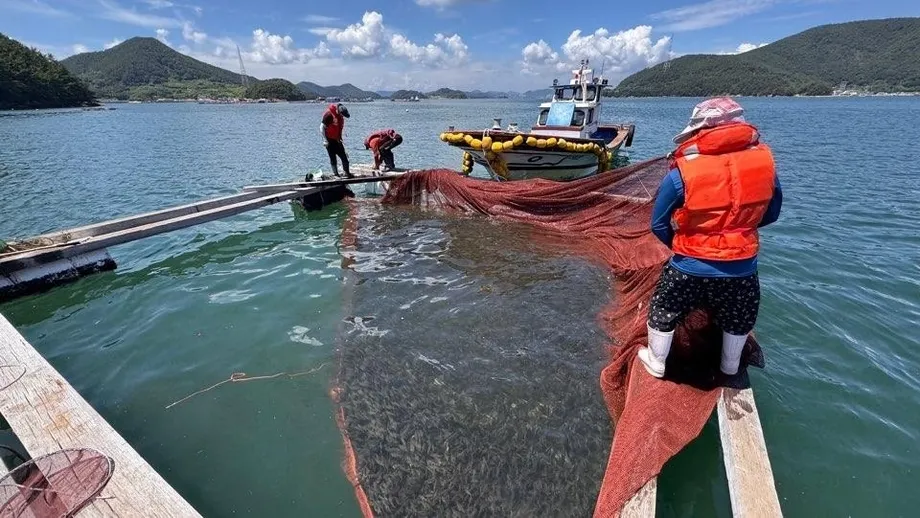
South Korea has lost 17,466,000 farmed fish to high water temperatures, equivalent to 4.7% of the total number being raised, as heat warnings reached a record 27 of the country's 35 monitored sea areas. The losses have intensified calls to examine whether more fish farming should move onto land, where water temperature and oxygen can be controlled.
Contents
- Record heat warnings expose the limits of emergency aid
- How a summer emergency stretched into September
- Pohang's losses grew despite oxygen and cooling support
- North Gyeongsang passed its previous record
- South Gyeongsang faces recovery across 425 households
- What moving fish farming onto land would change
- Relocation support still points toward the sea
- Research puts the losses in a longer warming trend
- Forecasting could give farmers more time to act
- Key Points
The warning footprint covered about 77% of the monitored areas. Its reach exceeded both the seven areas recorded in the previous year and the 24 recorded in 2024. Farms faced prolonged exposure after special heat alerts began in mid July, despite a government response plan prepared in June.
The government increased the provision of response equipment by 62% compared with the previous year and expanded early harvesting and emergency releases. Those measures still left farmers facing mass deaths, lost stock and the expense of restarting production.
Regional figures show how the damage accumulated. South Gyeongsang Province recorded 27.69 billion won in losses across 425 farming households. On the eastern coast of North Gyeongsang Province, fish deaths reached 3,226,215, exceeding the region's previous record in 2024.
The policy debate now reaches beyond oxygen supplies and disaster payments. A proposed 5 billion won programme for the following year focuses on moving farms farther offshore and changing the species they raise. Moving production onto land is outside its scope, while basic government research into the suitability of that option for major farmed fish remains absent.
How a summer emergency stretched into September
South Gyeongsang's heat alerts lasted 68 days. The sequence shows that farmers were managing sustained exposure, with warnings spreading through the province before falling temperatures finally brought relief.
- June: The national government prepared its comprehensive response to high water temperatures.
- July 16: Heat advisories began in Sacheon Bay and Gangjin Bay in South Gyeongsang.
- July 27: Those advisories were raised to warnings.
- August 3: A heat advisory expanded along the Pohang coast at 2 p.m., when the recorded water temperature was 27.3 degrees Celsius.
- August 24: Warnings covered all South Gyeongsang sea areas.
- September 17: North Gyeongsang's coastal alert status shifted to a preliminary alert.
- September 22: The National Institute of Fisheries Science lifted the remaining South Gyeongsang advisories at 2 p.m.
Surface waters along South Gyeongsang's coast exceeded 30 degrees Celsius in late August. By the middle of September, temperatures had fallen to between 24 and 26 degrees. Farmers had already spent weeks trying to keep stock alive.
Pohang's losses grew despite oxygen and cooling support
Pohang's early losses illustrate how quickly a heat emergency can spread. By August 10, the city had recorded about 1,006,000 dead fish at 27 farms following deaths that began on August 4. Starry flounder accounted for more than 630,000 of that total, while olive flounder were also affected.
On August 10 alone, about 190,000 starry flounder died at farms in the city's southern district, causing approximately 635 million won in damage. The city's support included 810 tonnes of liquid oxygen, 1,051 circulation pumps, 38 tonnes of immune supplements, 108 litres of mixed vaccines and ice.
Pohang also planned rapid collection of dead fish to prevent further pollution and a joint fisheries disaster assessment team to establish losses and arrange assistance. Removing carcasses became part of the response alongside efforts to protect surviving stock.
By the end of North Gyeongsang's August 3 to September 17 damage assessment period, Pohang's total had climbed to 3,107,167 dead fish. That represented about 96% of the province's recorded fish deaths. Uljin recorded 77,043 deaths and Yeongdeok 42,005.
North Gyeongsang passed its previous record
North Gyeongsang's total loss of 3,226,215 fish was valued at 3,329,370,000 won. Most were starry flounder. The previous record, set in 2024, was 3,051,610 fish worth 3,141,160,000 won.
The increase was 174,605 fish, or about 5.7%. Provincial authorities attributed the larger toll to prolonged high water temperatures during the summer heat. Farms had received equipment including intake pipes drawing water from deeper layers, chillers, liquid oxygen and circulation pumps.
The province had 96 farms raising 19 million fish. Its recorded deaths were equivalent to roughly 17% of that stock figure, showing how heavily losses were concentrated in this part of the country compared with the national figure of 4.7%.
Local circumstances also affected exposure. Gyeongju's farms shipped all their fish before the heat advisory began and recorded no losses. Ulleung Island had no farms. North Gyeongsang and its municipalities stopped counting heat damage when the alert shifted to preliminary status on September 17, setting the boundary for the regional tally.
South Gyeongsang faces recovery across 425 households
South Gyeongsang recorded losses in five coastal cities and counties: 6,978,000 fish, 1,438,000 abalone and 3,695 culture lines of sea squirts. Sea squirts are marine animals raised on suspended lines, so their losses were recorded in a different unit from fish and abalone.
The province valued the damage at 27.69 billion won. Its initial recovery plan allocated 3.4 billion won in national disaster assistance to 105 farming households that had participated in emergency releases or completed damage assessments, with payment planned before Chuseok. Further assistance was to follow as the remaining assessments finished.
Lee Sang-hoon, director of South Gyeongsang's marine and fisheries bureau, said the province would work with the central government on recovery and business stability. He also described its planned prevention measures:
We will prepare measures to minimise damage, including a shift to species suited to high water temperatures, such as subtropical species, and expanded disaster insurance for farmed aquatic products.
South Gyeongsang also faced a red tide advisory beginning August 27. It lasted 21 days and ended September 17. The province reported no farmed aquatic losses from red tide after increased monitoring and an early response, leaving prolonged heat as the cause of the losses described in its assessment.
What moving fish farming onto land would change
Sea cages expose farmed fish directly to surrounding seawater. When that water becomes too warm, farmers have limited control over the environment their fish occupy. Oxygen and circulation equipment can help manage conditions, while early harvesting reduces the stock left exposed.
A recirculating aquaculture system takes a different approach. Fish are raised in tanks, and the water is cleaned and reused. Reducing the amount of new seawater entering the system gives operators greater control over temperature and oxygen concentration.
Busan's smart aquaculture cluster in Gijang County has demonstrated Atlantic salmon farming on land using this technology. That provides a practical example of controlled production, while the case for other species still depends on developing suitable farming methods and making the economics work.
Rep. Cho Seung-hwan has called for assessments of whether major farmed species could move to land and for broader support for recirculating systems. His argument is that oxygen supplies and recovery assistance have limits when farms repeatedly face the same summer threat.
The Ministry of Oceans and Fisheries and the National Institute of Fisheries Science are not conducting a separate basic study assessing the feasibility or suitability of moving major farmed species onto land. Species suitability and commercial viability therefore remain central decisions for any wider transition.
Relocation support still points toward the sea
Government support for relocating farms has concentrated on moving them at sea. Only one marine farm, in Tongyeong in South Gyeongsang, has been selected for the relocation support programme. No move onto land has taken place through that programme.
The proposed 5 billion won climate adaptation pilot programme for the following year similarly prioritises offshore relocation and changes in farmed species. It excludes relocation onto land. Farmers considering controlled tanks consequently face a different support position from those considering another marine site.
Offshore relocation, species changes and recirculating tanks address different parts of the problem. Moving a cage seeks a more suitable natural environment. Changing species seeks an animal better able to tolerate local conditions. A recirculating system seeks greater control over the water itself.
Research on future damage also points to limits on choosing a new site by temperature alone. Salinity, light, infrastructure and supporting facilities matter. A cooler location still needs the conditions and services required to raise a particular species successfully.
Research puts the losses in a longer warming trend
An academic economic damage study, titled Estimating the economic damage caused by climate change to Korean aquaculture, found that high temperature mass deaths accounted for 53% of the sector's natural disaster damage costs from 2011 to 2021.
Citing National Institute of Fisheries Science figures, the study reported that Korean sea surface temperatures rose by about 1.35 degrees Celsius between 1968 and 2021. That was more than 2.5 times the global increase of 0.52 degrees cited in the paper. Similar warming occurred below the surface, where much aquaculture takes place.
The analysis covered 15 species representing about 84% of aquaculture production volume and 72% of production value. It combined production data from 2017 to 2021 with estimates of the probability that future temperatures would harm each species in each province.
Its reported damage estimates included 689.899 billion won in 2050 under the SSP2–4.5 climate scenario and 1.63013 trillion won in 2100 under SSP5–8.5. Those amounts were equivalent to 32% and 76% of the production value used in the analysis. The scenarios describe different possible courses for development and greenhouse gas emissions, with SSP5–8.5 representing much stronger warming.
Abalone had the highest projected damage cost, combining sensitivity to warmer water with a high unit price. The study also found that risks varied by species and province. Korean rockfish faced substantial projected exposure, while mullet generally had much lower temperature related risks. Its adaptation options included changing locations or species and considering recirculating or flow through systems on land.
Forecasting could give farmers more time to act
A second academic study, published in Frontiers in Marine Science, examined whether more precise local forecasts could give farms earlier warning. Its coastal forecasting benchmark compared 11 models using hourly observations from 30 monitoring stations along the Tongyeong, Geoje and Yeosu coast.
The researchers tested forecasts against later observations as the evaluation moved forward through time. Their models assessed operational temperature thresholds of 26, 28 and 30 degrees Celsius, helping connect predictions to conditions that matter for farms.
A model combining relationships between monitoring sites with patterns over time demonstrated an average advisory lead time of 38 hours during the National Institute of Fisheries Science's regional heat alert period in 2024. Its temperature error increased with the forecast horizon, reaching 0.85 degrees at 72 hours and 1.24 degrees at 168 hours.
For a farmer, 38 hours could provide time to arrange harvesting, prepare oxygen equipment or carry out an authorised emergency release. The practical benefit depends on having staff, equipment and a workable response ready when a warning arrives.
South Korea's recent losses bring those choices together. Earlier warnings can help farmers act sooner; recovery payments can help them restart; changes in species, sites or production systems can alter future exposure. The immediate policy gap is that support favours changes within marine farming while the suitability of moving major species onto land still awaits a dedicated government assessment.
Key Points
- Heat warnings reached a record 27 of 35 monitored sea areas, while 17,466,000 farmed fish died, equivalent to 4.7% of total stock.
- North Gyeongsang recorded 3,226,215 fish deaths, about 5.7% above its previous record in 2024.
- South Gyeongsang's alerts lasted 68 days, with damage valued at 27.69 billion won across 425 farming households.
- A proposed 5 billion won adaptation programme focuses on offshore relocation and species changes, excluding moves onto land.
- Recirculating systems offer control over water conditions, while suitability for major species and commercial viability require assessment.
- A coastal forecasting study demonstrated an average warning lead time of 38 hours during the 2024 regional heat alert period.