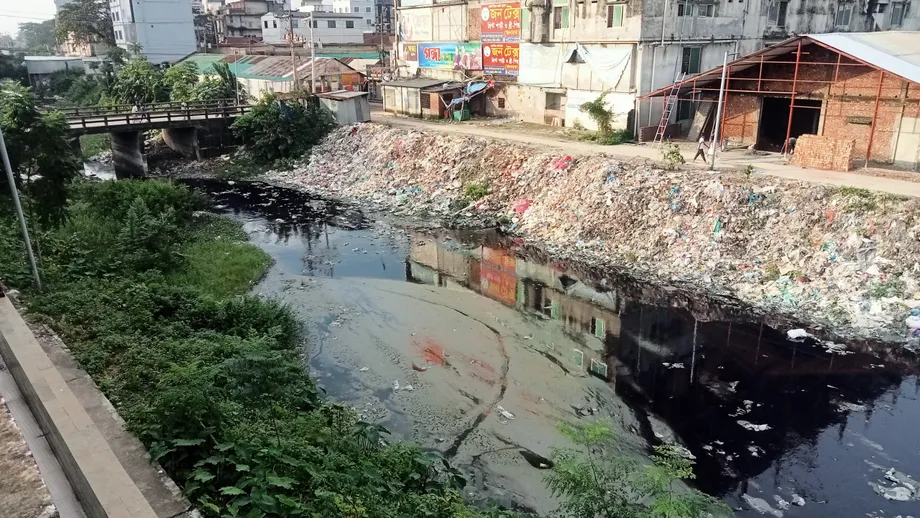

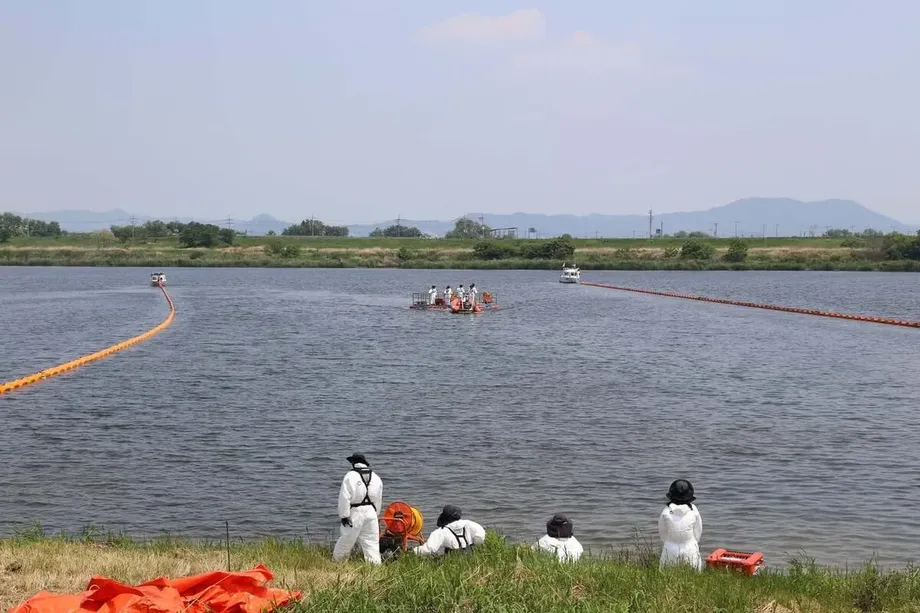
Geum could account for most of the projected deficit
South Korea's Geum River basin, currently rated among the country's most secure water systems, could require 782.4 billion won to address an annual water deficit of 53.67 million cubic metres under a conservative climate planning scenario for 2030. That is the largest regional exposure in a Korea Environment Institute study that challenges where the country should direct its water management spending.
Contents
- Geum could account for most of the projected deficit
- Why the official figures matter
- How the basin priorities could change
- Yeongsan shows the sharpest disagreement
- The 2030 target behind the calculation
- What the climate model can and cannot establish
- A larger bill, but no fixed spending commitment
- Making better use of water before building more
- Key Points
The institute's water management report, authored by senior research fellow Han Hye-jin, estimates annual deficit relief needs of 64.22 million cubic metres across the assessed basins under its conservative UA95 scenario. Addressing those needs would cost approximately 991.9 billion won. Under its efficiency oriented UA65 scenario, the corresponding figures are 38.72 million cubic metres and 617.2 billion won.
The Geum basin alone represents about 83.6% of the UA95 water deficit, calculated from 53.67 million cubic metres out of 64.22 million. Its estimated investment requirement accounts for about 79% of the total. A basin with no projected deficit under the study's business as usual baseline therefore becomes the central concern when climate uncertainty enters the calculation.
The findings do not establish that these shortages will occur. They show how strongly investment priorities can change when planners stop assuming that past water conditions will remain a reliable guide. They also require careful reading: some published accounts give different totals and, for the Yeongsan basin, describe a different direction of change from the official abstract.
Why the official figures matter
The official record identifies the study as Developing Fiscal Estimation Methods for Climate Crisis-Responsive Water Management, published in 2025. Its purpose is to develop a way to estimate future water management costs under climate uncertainty, rather than to provide a single definitive spending forecast.
The report's UA65 and UA95 estimates should be kept separate from the median estimate described in other accounts. UA65 is presented as an efficiency oriented planning case, while UA95 is a more conservative case. They represent different approaches to planning for uncertain water deficits, not separate confirmed outcomes.
Published accounts put the median annual shortage in 2030 at either 33.73 million or 33.74 million tonnes, compared with a baseline of 4.27 million tonnes. That small difference does not change the central comparison: either median estimate is about 7.9 times the baseline. Both are below the official UA65 and UA95 deficit relief figures.
A separate account puts the higher shortage estimate at 68.49 million tonnes and the response cost at 1.16 trillion won. Those figures differ from the official abstract's UA95 totals of 64.22 million cubic metres and approximately 991.9 billion won. The difference is too large to treat as rounding, and the reason is not established.
The units also differ between accounts. The official abstract uses cubic metres, a measure of volume, while reporting uses tonnes, a measure of mass. One cubic metre of fresh water weighs approximately one tonne, so the quantities are broadly comparable. That conversion does not explain the conflicting totals.
How the basin priorities could change
The historical picture placed the largest household and industrial water shortages in the southwest. Figures attributed to the 2023 First National Water Management Master Plan put shortages during the worst historical drought at 4.7 million tonnes for the Yeongsan and Seomjin basins combined, 1.2 million tonnes for the Han, 600,000 tonnes for the Nakdong and 100,000 tonnes for the Geum.
The KEI assessment changes that ordering. Geum has no deficit under the business as usual baseline, but its annual deficit rises to 28.97 million cubic metres under UA65 and 53.67 million under UA95. The estimated investment requirement rises from zero to 422.3 billion won or 782.4 billion won, respectively.
The Han basin also faces a larger funding requirement. The official abstract gives climate scenario costs of 146.4 billion won, compared with 22 billion won under business as usual, an increase of about 6.7 times. Another account gives 168.4 billion won and describes the annual shortage as rising from 570,000 tonnes to 7.21 million tonnes. Those cost estimates should not be presented as interchangeable.
For the Nakdong, reporting describes a rise in annual shortage from 320,000 tonnes to 1.25 million tonnes, with costs increasing from 1.1 billion won to 25.8 billion won. The official abstract does not provide matching Nakdong detail, so those figures cannot be checked against its regional summary.
Yeongsan shows the sharpest disagreement
The official abstract says Yeongsan's water shortages and investment needs decrease under the climate scenarios. Its estimated investment falls from 112.2 billion won under business as usual to 31 billion won under UA65 or 37.1 billion won under UA95. Those figures imply reductions of approximately 72% and 67%, respectively.
That differs directly from an account describing Yeongsan's shortage as rising from 2.19 million tonnes to 4.53 million tonnes and its response cost as increasing from 112.2 billion won to 149.2 billion won. One version describes an improvement; the other describes a larger deficit and a higher bill. The official abstract supports the decrease, while the reason for the conflicting account remains unresolved.
The distinction matters because semiconductor industrial complexes are being built in the Jeonnam and Gwangju area associated with the Yeongsan basin. A lower modelled regional deficit would not by itself establish that every industrial development has an adequate water supply. These estimates concern basin planning and cannot substitute for a specific project's demand assessment.
For Seomjin, reporting gives a smaller increase, from 280,000 tonnes to 360,000 tonnes, with costs moving from 32.8 billion won to 33.6 billion won. The official abstract does not give enough Seomjin detail to verify those numbers or conclude that its shortage necessarily eases. The strongest documented reversal is therefore Geum's emergence as the dominant risk alongside the official estimate of reduced Yeongsan investment needs.
The 2030 target behind the calculation
The baseline shortage is tied to a policy goal: bringing all five assessed basins to water supply safety grade 1 by 2030. The grading system describes how resilient a water supply system is to drought, with grade 1 representing a highly safe condition with almost no shortages.
The reported starting positions vary. Han and Geum are grade 1, Seomjin is grade 2, Nakdong is grade 3, and Yeongsan is described as below grade. The River Basin Water Resource Management Plan sets the target of grade 1 across the five basins.
Even without a climate adjustment, the estimated annual gap in meeting that goal is 4.27 million tonnes. At the reported average daily consumption of 308 litres per person, that is roughly the annual water use of 38,000 people. A median climate estimate of about 33.7 million tonnes is equivalent to the annual use of approximately 300,000 people. These are comparisons of volume, not predictions that those numbers of residents will lose their supply.
The relevant dates and planning milestones are:
- 2023: The First National Water Management Master Plan provides the historical drought shortage figures used in the comparison.
- 2025: KEI publishes the fiscal estimation study, identified in reporting as a December publication.
- May 31, 2026: Published accounts describe the median 2030 shortage and the estimated investment range.
- October 11, 2026: A further account presents detailed basin figures, some of which differ from the official abstract.
- 2030: The target year for grade 1 water supply safety across all five basins.
What the climate model can and cannot establish
The pilot assessment uses one model and two climate pathways, RCP 2.6 and RCP 8.5. RCP stands for Representative Concentration Pathway, a framework for describing different trajectories of greenhouse gas concentrations and their warming effect. RCP 2.6 represents a lower emissions pathway, while RCP 8.5 represents a much higher one.
Accounts of the study describe a median calculation combining the two pathways, with atmospheric carbon dioxide concentrations of approximately 420 parts per million and 940 parts per million by 2100. These long term pathways inform the assessment; the water shortages discussed here are estimates for 2030, not for the end of the century.
The methodological concern is climate driven nonstationarity. In simple terms, the statistical patterns of the past may no longer stay constant. A water system designed around historical rainfall, river flows and drought frequencies may face conditions that its original planning assumptions do not capture.
This helps explain how a basin considered secure today can show a large future deficit in a model. A present safety rating describes performance under the conditions used to assess it. It is not a guarantee that the same supply arrangements will meet the same standard under a changing climate.
KEI cautions that the pilot's method matters more than the precision of its cost estimates. Using one model and two pathways limits how confidently any individual number can be treated as a forecast. The study supports testing a wider range of conditions, rather than treating its largest estimate as an inevitable outcome.
A larger bill, but no fixed spending commitment
The most precise reported baseline investment figure is 168.08 billion won. Climate adjusted investment is reported at 617.18 billion to 991.93 billion won, closely matching the official abstract's rounded figures of 617.2 billion and 991.9 billion won.
Using those figures, the estimated requirement rises to about 3.7 to 5.9 times the baseline. That is a different comparison from the nearly eightfold increase in the median water shortage. Water volumes and response costs do not rise in identical proportions because the cost depends on which measures are used and where.
The assessment reportedly applies response measures sequentially, beginning with the least expensive options. Its totals therefore represent estimated costs of addressing deficits under an assumed sequence of actions. They are not announced appropriations, approved construction budgets or evidence that the government has committed to spend the full amount.
The concentration of UA95 costs in Geum also changes the meaning of the national total. A budget spread according to historical shortage rankings could miss the largest modelled future need. Conversely, a lower estimate for Yeongsan does not justify ignoring its current weak safety rating. Planning has to account for both existing vulnerability and possible changes.
Making better use of water before building more
Han Hye-jin, the senior research fellow responsible for the study, recommends reducing sunk costs and improving adaptability because climate uncertainty is high. Sunk costs are money already spent that cannot readily be recovered, a concern when major infrastructure is built around assumptions that later prove wrong.
Her proposed starting points are demand management, reuse of sewage and wastewater, and reviews of permitted water allocations against actual use. These measures focus on making fuller use of water already secured. She recommends careful consideration of new dams, levees and reservoirs rather than treating construction as the automatic response.
The researchers also call for a national planning framework that can be revised as conditions and evidence change. Their recommendation connects national consistency with the need to assess differences between basins:
"A national standard water management future outlook scenario must be developed, and a national climate-water risk map must be established," the researchers said.
A periodically updated national outlook could give agencies a shared basis for comparing future needs. A climate and water risk map could help identify where those needs are concentrated. The proposals remain recommendations in the study; no adoption date, funding decision or schedule for producing the map is established here.
The central finding is therefore more specific than a prediction of nationwide scarcity. Climate assumptions can shift the geography of water risk and the spending needed to meet an existing safety goal. The official figures point most strongly to Geum, while conflicting regional accounts and the pilot's limited modelling scope make precise forecasts less certain.
Key Points
- KEI estimates annual deficit relief needs of 38.72 million cubic metres under UA65 and 64.22 million under UA95.
- The official cost estimates are approximately 617.2 billion to 991.9 billion won, not the 1.16 trillion won given in another account.
- Geum accounts for about 83.6% of the UA95 deficit and requires an estimated 782.4 billion won.
- The official abstract projects lower Yeongsan investment needs, contrary to an account describing an increase.
- The median reported 2030 shortage is about 33.7 million tonnes, nearly eight times the 4.27 million tonne baseline.
- The pilot uses one model and two climate pathways; KEI cautions against treating its estimates as precise forecasts.
- Researchers recommend better use of existing water, flexible basin planning and a regularly updated national outlook.