
Eight factories inspected, no treatment plants running
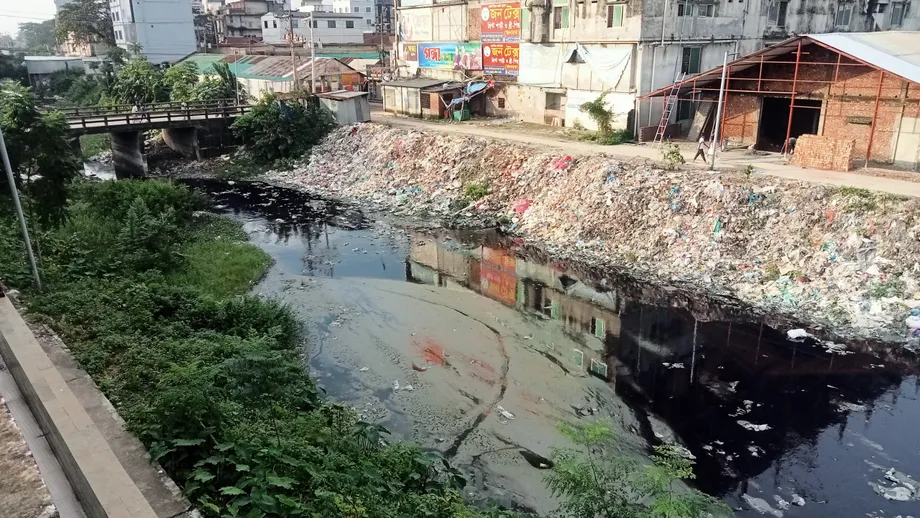
A Tk 6.5 crore project to restore the Haridhoa River in Narsingdi is moving ahead while untreated industrial waste continues to enter its waters. During a recent reporting visit across the three upazilas through which the river flows, eight factories equipped with effluent treatment plants were visited. None of those plants was operating at the time, and waste from several industrial establishments was being discharged directly into the river.
Contents
- Eight factories inspected, no treatment plants running
- Installed equipment is not proof of treatment
- A case against Hajipur Drying
- Residents report illness, but testing details are missing
- Household waste adds to industrial discharge
- Restoration has a deadline and a seasonal pause
- Eviction drives have not cleared both banks
- A trading route through three upazilas
- Monitoring promises face an operational test
- Key Points
The findings expose a gap between installing pollution control equipment and actually using it. Md Badrul Huda, deputy director of the Department of Environment in Narsingdi, said 17 of the 18 industrial establishments along the river have treatment plants. Yet the water remains pitch black and foul smelling, even after monsoon rains brought water back into the channel.
The Water Development Board began the restoration project in August 2025, with completion scheduled for June 2027. About 15 percent of the work has been completed, according to acting subdivisional engineer Humayun Kabir. The project covers excavation, bank protection and landscaping, but continued waste discharge threatens the environmental gains those works are intended to deliver.
For residents, the damage is already personal. People describe itching and other skin problems after entering the water. At Narsingdi Sadar Hospital, resident medical officer Farida Gulshana Kabir said an average of 14 to 16 patients a day receive treatment for illnesses she attributes to river pollution. For traders at Boro Bazar, the river's decline has also meant losing a route that once carried goods and customers into the market.
Installed equipment is not proof of treatment
An effluent treatment plant, or ETP, treats wastewater from industrial production before it is reused or discharged. Its presence at a factory does not establish that wastewater is passing through it, that it is operating properly or that the discharged water meets the required standards.
Government rules require the industries concerned to have treatment plants. Residents and environmental campaigners allege that some factories have installed them mainly to demonstrate compliance or avoid punishment, while continuing to release untreated waste. There are also allegations that plants are switched on for official inspections rather than operated whenever wastewater needs treatment.
The visit to eight factories offers a specific observation: all eight treatment plants were idle when inspected. It does not establish how long each plant had been stopped, whether production was taking place at every facility or how frequently each factory uses its equipment. Nevertheless, the separate observation of waste entering the river directly makes actual treatment, rather than equipment ownership, a central issue.
The eight factories represent about 47 percent of the 17 establishments that Huda said have ETPs. That is a substantial portion of the equipped factories, although the visit was not described as a representative survey. No operating logs, discharge measurements or laboratory results were given to establish how much pollution each establishment contributes.
A case against Hajipur Drying
Huda identified Hajipur Drying as the establishment facing a case after failing to install an ETP despite repeated warnings. His account places the immediate legal action against the one factory he says lacks the equipment, while leaving a separate enforcement question over factories that have plants but do not operate them.
Reports differ on how widespread the absence of equipment is. Some descriptions say many factories beside the river lack ETPs, whereas Huda's specific count is 18 establishments, with all but one equipped. No separate factory inventory establishes which count is correct or whether the descriptions cover the same establishments.
The detailed accounts of Huda's statement consistently describe the Hajipur Drying case as concerning failure to install a plant. No filing date, case number, hearing date or ruling is given. The case therefore should not be treated as a conviction or as evidence that the wider problem of untreated discharge has been resolved.
Residents report illness, but testing details are missing
Residents Rafiqul Islam and Saiful Rahman blame both industrial waste and household rubbish for the river's condition. They say people who enter the water develop itching and skin problems resembling scabies. These accounts describe symptoms and suspected exposure, not confirmed diagnoses for every affected person.
Almas Mia, a resident beside the river in the Putia Bazar area, recalled a time when families bathed in the Haridhoa, used its water for cooking and ate fish caught there. Describing the present conditions, he said:
Now it is impossible even to stand beside this river because of the smell.
Farida Gulshana Kabir's estimate of 14 to 16 patients a day gives a measure of the burden seen at Narsingdi Sadar Hospital. However, no period for that average, breakdown of diagnoses or explanation of how cases were linked to river exposure was given. It should not be converted into an annual total or taken as a count of everyone affected across the district.
The black water and strong smell are visible signs of deterioration, but they do not identify particular chemicals or their concentrations. No water testing results are given for the affected stretches. That limits conclusions about specific contaminants, even as residents' accounts and the hospital doctor's assessment point to a serious public health concern.
Household waste adds to industrial discharge
Industrial wastewater is not the river's only source of pollution. Household rubbish, dirty water from surrounding settlements and waste from markets also enter the Haridhoa. Plastic accumulates along the banks and in the channel, alongside water hyacinth and layers of decaying sludge.
Huda said waste from people's daily activities was adding to the pollution. Boro Bazar businessman Ariful Islam also described a combination of untreated discharges from dyeing, textile and other factories, together with wastewater from homes and markets.
This combination matters for restoration. Stopping factory discharges would address a major reported source of contamination, but it would not prevent households and markets from continuing to dump waste. Excavation can remove accumulated material and improve the channel, yet fresh rubbish can enter the same stretches unless disposal practices change.
Residents also say there are no fish left in the river. That is a local observation rather than the result of a published fish survey. There is no species count or ecological assessment establishing the extent of the loss, but the claim adds another dimension to the decline of a river once used for food as well as transport.
Restoration has a deadline and a seasonal pause
The Tk 6.5 crore budget is equivalent to Tk 65 million. The Water Development Board says the project is intended to improve the environment through renewed excavation, protection of the riverbanks and landscaping. Kabir described it as part of efforts to address climate change.
With about 15 percent completed, roughly 85 percent of the work remains. Kabir said the remaining work would begin when the river's water level starts falling and expressed confidence that it would finish within the scheduled period. No exact date was given for that resumption.
The main dates and reported milestones are:
- 2024 to 2026: Around 60 structures were removed during 10 eviction drives, according to the Water Development Board.
- August 2025: Work began on the Tk 6.5 crore river restoration project.
- Latest reported progress: About 15 percent of project work was complete, with further work dependent on falling water levels.
- June 2027: The scheduled project completion deadline.
The progress figure alone does not prove that the project is behind schedule. Excavation work can depend on river conditions, and no detailed work programme or spending breakdown is given. It does, however, show how much remains to be completed before the deadline.
The described project scope centres on the river channel and banks. It does not establish that the budget also pays for factory treatment operations, household waste collection or a continuous water testing programme. These are distinct parts of the problem, even though each affects whether the river can recover.
Eviction drives have not cleared both banks
Kabir said around 60 structures were evicted in 10 drives between 2024 and 2026. Despite those operations, illegal structures remain along both banks. No total count of the remaining structures or timetable for further removals was given.
The removals show that enforcement has taken place, but their number cannot establish how much riverbank land has been recovered. There are no measurements of cleared area, remaining encroachment or channel width before and after the drives.
Haldhar Das, general secretary of Shushashoner Jonno Nagorik in Narsingdi, has called for both effective operation of ETPs and removal of encroachers. His argument connects two separate pressures: pollution entering the water and structures occupying space that belongs to the river.
A trading route through three upazilas
The Haridhoa stretches about 40 kilometres from Alipura Bazar in Shibpur, passes through Palash and Narsingdi Sadar, and joins the Meghna near the old police station landing at Boro Bazar. Its route once connected settlements and traders to one of the district's busiest markets.
Sailboats and larger vessels brought goods to the market, while buyers also travelled by river. Tausif Ahmed, who says he has worked at Boro Bazar since Bangladesh's independence, recalled how people arrived from distant places carrying merchandise and returned by boat after shopping.
Accounts describe river transport as either stopped or almost stopped. Some specifically identify the dry season as the period when trade by water ceases. What they agree on is that pollution and loss of navigability have stripped the river of its former role as an inexpensive, convenient transport route.
Navigability means whether a waterway is deep and accessible enough for vessels to pass. In the Haridhoa's dry season, parts of the riverbed become exposed sand, while other stretches retain putrid sludge and plastic. The return of water after monsoon rains does not by itself restore a usable route or clean the river.
No cargo volumes, transport cost comparisons or market income figures are given. The economic loss therefore cannot be expressed as a reliable monetary total. The testimony of traders nevertheless documents the disappearance of a service around which local commerce once developed.
Monitoring promises face an operational test
Narsingdi Deputy Commissioner Israt Jahan Keya said the administration was working with stakeholders to protect the district's rivers. She said officials regularly meet industrial leaders, ask them to treat wastewater before discharge and monitor whether their ETPs remain operational.
Huda also said the Department of Environment was watching for untreated industrial waste entering the river. Those assurances sit alongside the finding that none of the treatment plants at the eight visited factories was running. The precise frequency of official inspections and their results were not given.
Several decisions remain unresolved: the outcome of the Hajipur Drying case, the timing of further eviction drives and the date excavation will resume. June 2027 is the firm completion deadline identified for the restoration project. No separate deadline is given for ending untreated discharges.
The central distinction is between restoring the river's physical channel and keeping new pollution out of it. Excavation, bank protection and landscaping address parts of the decline. Whether the Haridhoa regains usable water and a functioning transport route also depends on factories treating their wastewater and surrounding communities no longer using the river for waste disposal.
Key Points
- Eight factories with ETPs were visited; none of the plants was operating at the time.
- The Department of Environment says 17 of 18 industrial establishments along the river have treatment plants.
- Hajipur Drying faces a case over failure to install an ETP despite repeated warnings.
- The Tk 6.5 crore restoration project is about 15 percent complete and is scheduled to finish in June 2027.
- Around 60 structures were removed in 10 eviction drives between 2024 and 2026, but encroachment continues.
- A hospital doctor reports treating an average of 14 to 16 patients daily for illnesses attributed to pollution.
- Industrial waste, household rubbish, plastic and loss of navigability threaten the river's recovery.