
Preparations Begin, but a Sale Is Not Yet Announced
Uzbekistan has begun preparing its $3.42 billion Uzbekistan GTL plant for privatization, with financial audits and an assessment of the sale's economic effects underway. The process concerns a facility built with approximately $2.3 billion in foreign loans backed by state guarantees. Its reported outstanding loan principal stood at $838.2 million on June 16, 2026.
Contents
- Preparations Begin, but a Sale Is Not Yet Announced
- What the Privatization Decree Sets Out
- Why the IPO Announcement Needs Clarification
- Audits Come Before an Offer to Investors
- Debt Is Central to the Transaction
- What the Plant Was Built to Produce
- Higher Output Does Not Yet Establish Profitability
- The Timeline and the Next Disclosures
- Key Points
Sohibjon Murodov, director of the State Assets Management Agency, announced the preparations at an October 8 press conference in Tashkent. He said a privatization concept had been developed, but did not announce a buyer, transaction value or completion date. Preparations for a possible initial public offering, or IPO, have also begun.
The distinction between starting privatization and completing a sale is central to the announcement. Presidential decree PQ-145, signed on April 21, 2025, set out plans to offer the state's entire interest in Uzbekistan GTL for public sale. Its timetable called for professional advisers to be engaged in the third quarter of 2025 and the sale announcement in the second quarter of 2026.
Murodov said the dates in the decree concern the start of privatization work rather than a requirement to complete the transaction within that period. However, the published schedule described in reports also contains specific milestones for advisers and a public sale announcement. The agency has not explained whether those milestones have been completed, revised or replaced by a different timetable.
For potential investors and taxpayers, the immediate issue is therefore less who will buy the plant than what will be offered, how its remaining debt will be treated and what its audited accounts will show.
What the Privatization Decree Sets Out
Uzbekistan GTL is one of 29 large enterprises included in the April 2025 privatization program. The plant belongs to Uzbekneftegaz, and the decree schedules the sale of 100% of its charter capital, meaning the full ownership interest rather than a small portion of the business.
The program calls for public auctions involving international professional consultants. Reports use different descriptions for the GTL sale stage, including a public tender and an international open sale. These terms should not be treated as confirmation of a stock market flotation, which is a separate mechanism.
The broader program also includes proposed sales of 100% of Universal Mobile Systems, 99.7% of UzAuto Motors, 91% of the Uzbek Metallurgical Plant and 75% of Navoiyazot, alongside electricity generation and other businesses. GTL is therefore part of a wider change in state ownership, rather than an isolated disposal.
The decree gave the State Privatization Commission, chaired by Prime Minister Abdulla Aripov, 10 days to approve auction road maps with specific actions. It also introduced a moratorium until 2030 on creating enterprises with state participation. Neither measure, by itself, establishes that the GTL sale has reached the bidding stage.
Why the IPO Announcement Needs Clarification
Murodov said major international organizations had contacted the agency about participating in a potential IPO. An IPO is a company's first public sale of shares. It can distribute ownership among multiple investors, including buyers seeking smaller holdings rather than control of the business.
The agency director described that interest as encouraging, while making clear that participation depended on an offering going ahead:
"This is a good signal for us. If we proceed with an IPO, there will also be investors willing to acquire small stakes in GTL," Murodov said.
There is an unresolved difference between this announcement and the structure described in the decree. Uzbekistan GTL appears in the list of 29 enterprises scheduled for public sale, but not in the separate list of 12 enterprises designated for an IPO or a subsequent public offering.
That does not establish that an IPO is prohibited or that the privatization program has formally changed. It does mean the agency still needs to explain how a possible share offering would fit with the planned sale of the entire ownership interest. No proportion of shares, listing venue, valuation or revised legal framework was announced.
Audits Come Before an Offer to Investors
The current preparations include an audit of Uzbekistan GTL's financial and business operations. Murodov said the agency is examining factors that could harm production or financial performance, with a view to addressing them before the enterprise is offered to investors.
The assessment also extends beyond the plant's own accounts. Officials are reviewing how privatization could affect the economy, business partners, suppliers and customers buying its products. This matters for a facility whose operations connect natural gas supply with several domestic fuel markets.
The review could help establish the conditions under which the company would continue operating after a sale. However, the agency has not disclosed contractual terms for gas supply, product sales or other arrangements that might accompany the transaction. It has also not published the audit's findings.
Current financial indicators were not presented at the press conference. Murodov said the agency would publish them separately through its official social media channels. No release date was given, leaving investors without the financial detail needed to assess profitability, cash generation or the company's ability to service its debt.
Debt Is Central to the Transaction
Approximately $2.3 billion of the plant's $3.42 billion construction cost came from foreign borrowing secured under state guarantees. Banks from China, South Korea and Russia, together with other financial institutions, participated in the financing.
Those loans represented about 67.3% of the stated construction cost. This proportion helps explain why the remaining liabilities are central to privatization: a buyer's assessment of the business cannot be separated from the obligations attached to it.
Figures attributed to Uzbekistan GTL's official website put outstanding principal at $838.2 million as of June 16, 2026. Principal is the underlying loan balance, distinct from interest and other financing charges. That reported balance equals about 36.4% of the original $2.3 billion foreign borrowing figure.
The comparison does not establish how much debt was repaid from operating earnings. A complete explanation would require information on disbursements, repayments, refinancing and any changes in the loans. The principal figure alone also does not disclose interest liabilities, repayment dates or the company's other obligations.
The agency has not said whether a buyer would assume the remaining loans, whether any debt would be restructured before the sale or how the state guarantees would be handled. A transfer of ownership does not, on its own, explain what happens to those guarantees. Their treatment will depend on the financing agreements and transaction terms, neither of which has been disclosed.
What the Plant Was Built to Produce
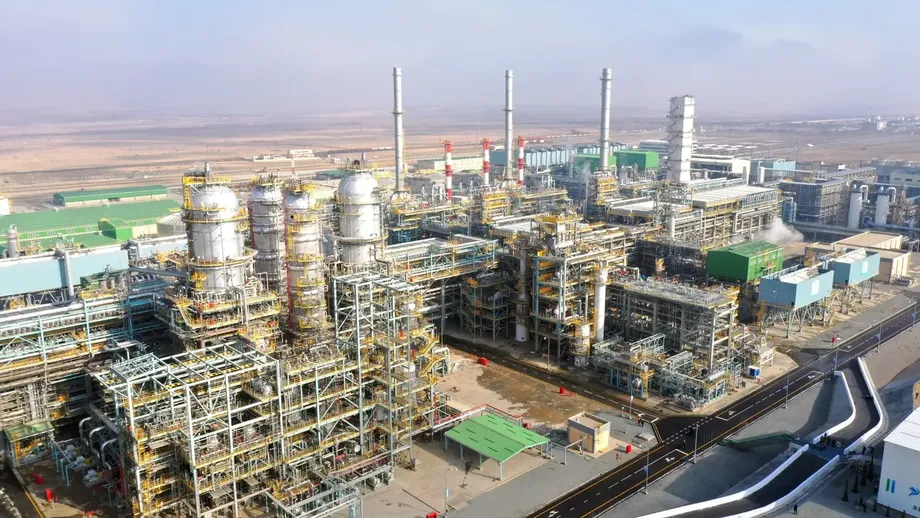
Uzbekistan GTL was commissioned in December 2021 in Guzor district, Qashqadaryo Province, in southwestern Uzbekistan. The complex occupies approximately 135 hectares and was designed to process 3.6 billion cubic meters of natural gas annually.
Its gas to liquids technology converts natural gas into liquid hydrocarbon products. The plant uses methane supplied from the Shurtan Gas Chemical Complex to manufacture synthetic fuels and other petroleum products.
The reported annual design capacities are:
- 724,000 tons of diesel fuel.
- 307,000 tons of aviation kerosene.
- 437,000 tons of naphtha.
- 53,000 tons of liquefied gas.
These product figures total 1.521 million tons, consistent with the rounded description of approximately 1.5 million tons of annual output capacity. Diesel accounts for about 47.6% of the listed total, making it the largest product category by weight.
These are capacity figures, not a statement of actual annual production. Capacity describes what a facility is designed to make under its intended operating conditions. It cannot be used by itself to calculate sales, earnings or the amount of imported fuel displaced.
Higher Output Does Not Yet Establish Profitability
The plant's reported operating performance improved in 2025. According to company figures cited in reports, production reached 102% of the annual target, while output increased by 43% compared with 2024.
Those two measures describe different things. Achieving 102% of a production target means output exceeded the company's plan by 2%. It does not mean the plant operated at 102% of its full design capacity, because the absolute production target was not given.
Similarly, the 43% increase establishes growth from the previous year but does not reveal the tonnage produced in either year. Without those volumes, it is not possible to calculate how close the plant came to its stated annual capacity.
At commissioning, the project was expected to produce more than $1 billion worth of goods annually to replace imports, with investment recovery projected at approximately nine years. Those were forecasts, not verified financial results. Rising output may support the business, but production growth alone cannot establish that the original recovery projection is being met.
Reports also describe a substantial increase in Uzbekistan's diesel imports after GTL began operating. That makes it harder to equate domestic production with a matching reduction in imports. However, no comparable import totals or demand figures are given, so the increase cannot establish whether the plant missed its own targets or whether consumption outpaced additional supply.
The financial audit is therefore the point at which the plant's industrial performance and commercial performance should become distinguishable. Output, sales revenue, operating costs and debt service are related, but they are not interchangeable measures of success.
The Timeline and the Next Disclosures
The project has moved from construction and commissioning into a privatization program, but several stages remain distinct. The main dates and announcements are:
- December 2021: Uzbekistan GTL was commissioned.
- April 21, 2025: Presidential decree PQ-145 established the privatization program, including the planned sale of 100% of GTL.
- Third quarter of 2025: The decree scheduled the engagement of professional advisers for the GTL sale.
- Full year 2025: Reported production reached 102% of target and increased by 43% from 2024.
- Second quarter of 2026: The public sale announcement was scheduled.
- June 16, 2026: Reported outstanding loan principal stood at $838.2 million.
- October 8: Murodov announced that privatization preparations and work on a possible IPO had begun. The year of this press conference is not specified in the reports.
No new deadline was announced for completing the audit, publishing the financial indicators, opening bids or launching an IPO. The agency also did not identify the international organizations that had expressed interest or disclose binding investment commitments.
The next substantive disclosures will need to connect three parts of the process: the decree's planned sale of the full ownership interest, the possible IPO and the treatment of debt backed by state guarantees. Until those details are published, the announcement establishes that preparatory work is underway, not that ownership has changed or a final sale structure has been approved.
Key Points
- Uzbekistan has begun audits and other preparations to privatize its $3.42 billion GTL plant.
- The April 2025 decree schedules the sale of 100% of the company, with a public sale announcement originally planned for the second quarter of 2026.
- Preparations for a possible IPO have also begun, but no share allocation, valuation or offering date has been announced.
- Reported outstanding loan principal was $838.2 million on June 16, 2026. Its treatment in a sale remains undisclosed.
- Production reportedly grew 43% in 2025, but current financial results and audited profitability have not been published.
- No buyer, completed transaction or revised completion timetable has been announced.