
A market reversal puts chip giants under pressure
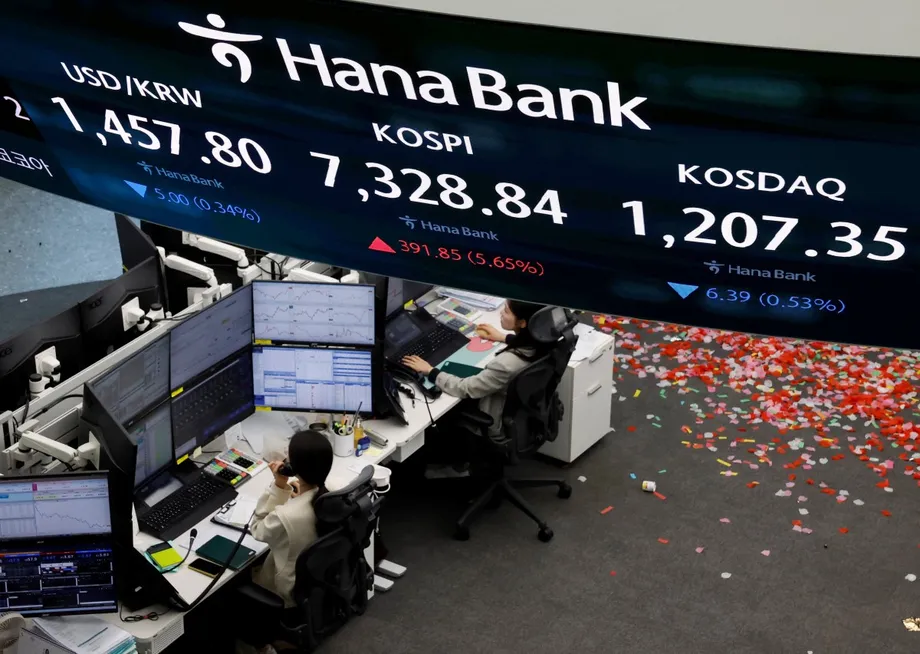
Foreign investors have withdrawn a reported $131 billion from South Korean equities in 2026, while trading turnover has fallen about 70% from its late May peak. The Kospi, which led major global stock benchmarks in the first half, has dropped 22% in the second half as investors reassess a rally built largely around artificial intelligence memory chips.
Contents
- A market reversal puts chip giants under pressure
- Foreign ownership fell even during the rally
- Why two companies matter so much
- Buybacks are ending as earnings lose their pull
- Households retreat after the summer selloff
- Leveraged funds deepen the volatility debate
- Taiwan attracts interest, but also suffered withdrawals
- What the next earnings and inflation readings can show
- The dates behind the change in direction
- Key Points
The reversal in South Korea's $4.3 trillion equity market has exposed its dependence on Samsung Electronics and SK Hynix. Together, the two companies account for more than half the benchmark's weighting, giving their shares an unusually large influence over the direction of the entire index.
October figures show the retreat extending beyond share prices. Foreign ownership of Samsung stood at 46.38% on October 8, its lowest level since January 11, 2008, when the share was 46.35%. Foreign ownership of SK Hynix fell to 49.59%, below the 50% threshold it had maintained since 2023.
Support from corporate purchases is also fading. More recent reports say Samsung completed its share buyback on October 6, while SK Hynix had executed more than 80% of its announced purchases by October 9. Their combined programmes were worth 55 trillion won, or about $41 billion.
The immediate problem is therefore larger than a change in enthusiasm for AI. Overseas investors are selling, households have reduced borrowing and brokerage cash balances, and two major corporate buyers are approaching the end of their purchases. Strong earnings have so far failed to reverse that combination.
Foreign ownership fell even during the rally
Samsung's foreign ownership declined from an early 2026 peak of 52.40% to 46.38% on October 8, a fall of 6.02 percentage points. It dropped below 50% in March, reached the 48% range in May and the 47% range in July. The withdrawal was therefore already taking place while the wider market was still advancing.
SK Hynix followed a similar trajectory. Its foreign ownership fell from 54.64% early this year to 49.59%, a decline of 5.05 percentage points. The latest figure was also 6.82 percentage points below its 2024 level of 56.41%. Across the Kospi electrical and electronics sector, foreign holdings fell from 40.87% at the start of the year to 38.09%.
A separate account puts foreign selling of Kospi shares above 197 trillion won this year. That figure and the reported $131 billion withdrawal should not be treated as two independent pools of selling or added together: their currency, market coverage and measurement periods need to be matched before comparison.
The Korea Exchange provides investor purchase, sale and net purchase fields through its investor trading dataset. Its publication notice says regular session transactions are expected after 3:45 p.m., with final figures including trading outside regular hours expected after 8 p.m. It also warns that information can contain errors or be delayed. The page excerpt does not itself display the annual withdrawal total, so that headline figure remains a reported compilation of exchange data.
Why two companies matter so much
Memory chips are central to the Korean AI investment story. AI systems need memory to hold and move the large quantities of data used in computing, alongside the processors that perform calculations. Investors bought Samsung and SK Hynix as ways to participate in spending on that infrastructure.
The same concentration that helped lift the Kospi now makes it vulnerable to doubts about memory demand, profitability and the length of the industry's boom. When more than half an index rests on two companies, gains elsewhere may struggle to offset selling in those shares.
Phillip Wool, head of portfolio management at Rayliant Global Advisors, said his fund had been reducing Korean AI exposure and held smaller positions in Samsung and SK Hynix than their benchmark weights would imply. He described the challenge facing investors who entered the memory trade late:
The biggest challenge I see for most investors - especially those who only recently got into Korea for the memory chip trade - is that the easy money in that theme has been made,
Hwang San-hae, a researcher at LS Securities, identified another pressure: AI investment leadership is broadening beyond memory into custom chips, components, equipment and cybersecurity. Korea can continue to benefit from AI spending while its memory dominated benchmark attracts less capital than markets with a wider range of businesses.
Buybacks are ending as earnings lose their pull
Samsung and SK Hynix have been important buyers of their own shares. Such purchases can support demand by absorbing stock offered for sale, although they do not guarantee that prices will rise. JPMorgan Chase figures cited in reports indicate that their buybacks accounted for most of the previous month's roughly $23 billion in market buy orders.
The timing now matters. Earlier accounts described both programmes as nearing completion. The more specific October update says Samsung's programme ended on October 6 and SK Hynix was more than 80% complete by October 9. That leaves less remaining corporate demand just as foreign selling persists.
Foreign investors reportedly sold a net amount exceeding 6 trillion won in domestic shares across October 6 to 8. On October 8, the Kospi fell more than 2% to around 6,620 despite Samsung releasing preliminary third quarter results that beat expectations. Samsung's shares also declined despite a reported increase in quarterly operating profit of nearly ninefold.
One account gives Samsung's quarterly operating profit as 107 trillion won, but no official earnings statement here substantiates that amount. The better supported conclusion is narrower: a strong reported earnings improvement did not stop selling. ETF rebalancing and options expiration were also identified as pressures on October 8, making that session more complicated than a simple verdict on profits.
Households retreat after the summer selloff
Retail investors helped power a reported 100% Kospi gain in the first half. Since the July selloff, indicators of household buying capacity have weakened. Korea Financial Investment Association figures cited in reports put outstanding margin loans at about 33 trillion won, compared with a June peak of 38.6 trillion won.
That is a reduction of 5.6 trillion won, or about 14.5%. Margin loans allow investors to buy shares with borrowed money. Falling debt can mean less risk in the market, but repayment may also involve selling shares, reducing demand during the adjustment.
Brokerage cash balances have fallen from nearly 140 trillion won to around 100 trillion won, a decline of approximately 29%. These balances represent money held in brokerage accounts, including funds that could be invested. Their contraction does not show exactly where households moved their money, but it points to a smaller pool of readily available purchasing power.
Reports describe trading turnover as down about 70%, while an October 11 account uses the term trading volume. The measures are different: turnover generally refers to the value traded, whereas volume counts shares. Both descriptions indicate a sharp retreat in activity, but the percentages should not be treated as independently confirmed readings of both measures.
Leveraged funds deepen the volatility debate
Government efforts to direct household savings into domestic equities have become part of the debate over the summer reversal. Reports say regulators accelerated the launch of more than a dozen leveraged ETFs tied to companies including Samsung and SK Hynix. President Lee Jae Myung's administration later held emergency meetings, and regulators introduced measures to curb retail investment in those products.
Leveraged ETFs seek amplified daily returns, often through derivatives and borrowing. The Direxion Daily South Korea Bull 3X Shares, known as KORU, targets three times the daily performance of the MSCI Korea Index, not the Kospi. Daily resetting means its return across several weeks or months need not equal three times the index's return over that period.
KORU reportedly lost about 28% in June and more than 61% in July, yet remained up 43.72% for 2026 at the time of that account. Those figures show how a large earlier rally can coexist with severe subsequent losses. Its reported overnight rise of nearly 8%, while the Kospi fell about 5% at a Monday opening, also involved different trading sessions and different benchmarks.
Jung Eui-jung, head of the Korean Stockholders' Alliance, which has 64,000 members, criticized the government's role in expanding access to leveraged products:
What is particularly ironic is that the government claims it is trying to contain the situation, yet it was the government itself that created this gambling table,
Economist Steve Hanke said the Korean benchmark had become more volatile than Bitcoin, citing a chart he shared. Without the chart's calculation period and methodology, that comparison cannot establish a general ranking. It does, however, reflect the intensity of concern surrounding the market's swings.
Taiwan attracts interest, but also suffered withdrawals
Taiwan's Taiex has gained a reported 70% this year and outperformed the Kospi by approximately 23 percentage points last quarter. Its rally has also been broader: about 10% of index members have at least doubled in price, compared with 4.7% of Kospi constituents. On that measure, Taiwan's share of stocks doubling is a little more than twice Korea's.
Chun-Lai Wu, head of Asia Asset Allocation at UBS Global Wealth Management Chief Investment Office, said the firm preferred Taiwan for tactical AI exposure:
At this point in time, we prefer to express our tactical AI exposure through Taiwan equities, which offer a more complete technology hardware ecosystem and are supported by robust spending plans from major technology companies,
That preference does not mean foreign investors have consistently bought Taiwanese shares. LSEG figures in an August 11 account show Taiwan recorded $22.95 billion in net foreign outflows during July, following roughly $8 billion in June. South Korea recorded $6.26 billion in July, its third consecutive month of outflows.
Across seven Asian markets, July net withdrawals reached $25.48 billion, marking a ninth consecutive month of foreign selling. Taiwan and Korea together accounted for $29.21 billion in withdrawals, more than the regional net total because inflows elsewhere partly offset them. India received $2.12 billion, Thailand $1.46 billion, Indonesia $88 million and the Philippines $69 million; Vietnam recorded about $12 million in outflows.
The contrast is between a later preference for Taiwan's broader AI exposure and substantial earlier selling there, rather than an uninterrupted transfer of money from Korea to Taiwan. BNP Paribas analysts cited concerns about chip demand forecasts, debt repayment and China's Moonshot announcement about inexpensive AI models. HSBC's Herald van der Linde said the bank had upgraded India to neutral within Asia as investors sought diversification.
What the next earnings and inflation readings can show
The October market outlook identifies the week of October 12 to 16 as a test of whether earnings can replace fading buyback demand. It points to US September consumer and producer price releases, oil prices and Federal Reserve comments as near term variables, without giving exact publication times.
US inflation matters because it can influence expectations for interest rates and government bond yields. Higher yields can make shares less attractive relative to bonds and change how investors value future corporate profits. Kiwoom Securities economist Kim Yu-mi warned that renewed price pressure could keep inflation concerns active and increase fluctuations in US bond yields.
Corporate forecasts remain strong, but investors are watching their direction as well as their size. IBK Securities projected third quarter operating profit growth of 243% from a year earlier and 6% from the previous quarter for 151 Kospi200 companies with available estimates. The outlook nevertheless described growth as slowing after its first half peak.
A large increase from a weak comparison period does not necessarily mean profits are accelerating now. That helps explain why impressive annual growth alone may fail to attract buyers. Yuanta Securities Korea analyst Lee Jae-won advised waiting for actual evidence of foreign buying rather than assuming earnings momentum would reverse the flows.
The dates behind the change in direction
The selloff developed over several months, with foreign ownership falling before the index's most visible reversal. The sequence also shows why July's regional withdrawals and October's market comparisons describe different stages rather than contradictory outcomes.
- Early 2026: Samsung foreign ownership reached 52.40%, while SK Hynix stood at 54.64%.
- Late May: Korean trading activity reached the peak against which the subsequent 70% decline is measured.
- June: Outstanding margin loans peaked at 38.6 trillion won.
- July: A sharp selloff weakened retail participation; foreign investors withdrew $6.26 billion from Korea and $22.95 billion from Taiwan.
- October 6: Samsung's share buyback ended.
- October 8: Samsung foreign ownership stood at 46.38%, SK Hynix at 49.59%, and the Kospi fell more than 2% to around 6,620.
- October 9: SK Hynix had completed more than 80% of its announced buyback.
- October 12 to 16: The market outlook identified earnings, US inflation releases and policy comments as the next tests.
Views differ on whether the borrowing adjustment is complete. Research analyst Nicholas Mugalli argued that retail investors were repaying margin debt and institutions were taking a greater role. Lale Akoner, global market analyst at eToro, warned instead that reducing leverage could produce sharp technology and semiconductor swings for months.
Akoner also cautioned that the episode should not be mistaken for a collapse of the AI investment case. South Korea remains among the stronger markets for 2026 because of its earlier gains. What is not yet established is whether fresh institutional and foreign demand can absorb selling once corporate repurchases end.
Key Points
- Reported foreign withdrawals from Korean equities reached $131 billion in 2026, while turnover fell about 70% from its late May peak.
- The Kospi lost 22% in the second half after leading major benchmarks in the first half.
- Samsung and SK Hynix account for more than half the index's weighting, concentrating exposure to the memory chip cycle.
- Samsung ended its buyback on October 6; SK Hynix was more than 80% finished by October 9.
- Margin loans fell about 14.5% from June's peak, and brokerage cash balances declined approximately 29%.
- Taiwan offers broader AI exposure, but also experienced heavy foreign withdrawals in July.
- The next tests are sustained earnings growth, actual foreign buying and the market's ability to absorb selling without major buyback support.