
242 vacancies, a leaked paper and a second journey to Dhaka
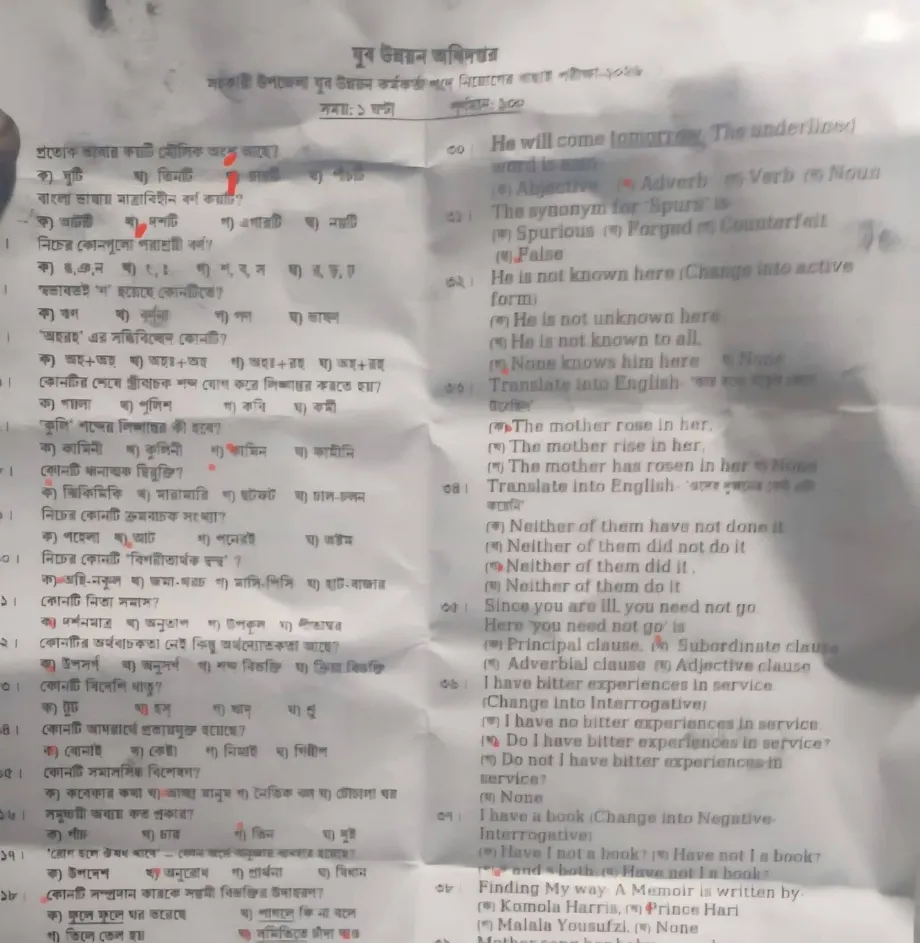
A recruitment examination for 242 assistant upazila youth development officer posts in Bangladesh was postponed shortly before its scheduled 11:00 am start on October 10, 2026, after officials found that questions circulating on social media partially matched the examination paper. About 319,000 candidates were expected at 95 centres across Dhaka. The Department of Youth Development subsequently announced a replacement examination for October 16 at 3:00 pm.
Contents
- 242 vacancies, a leaked paper and a second journey to Dhaka
- What officials confirmed about the circulating questions
- Why candidates describe a much later warning
- Protests spread across the capital
- Travel costs drive demands for compensation
- What the investigation will examine
- Independence becomes part of the dispute
- Applicants seek changes before another examination
- The retest schedule and unresolved figures
- Key Points
The Ministry of Youth and Sports formed a five member investigation committee and ordered it to report within three working days. Its inquiry will examine both responsibility for the alleged leak and negligence in handling the question paper, including preparation, printing and distribution.
For candidates who had travelled from distant districts, the postponement came after money had already been spent on transport, accommodation and food. Some were seated in examination halls. Others said answer sheets had been handed out before officials announced that the test would not proceed.
The disruption quickly spread beyond the examination centres. Candidates blocked roads across Dhaka, demanded compensation and stronger examination security, and protested outside the department's headquarters in Dilkusha, Motijheel. The new date addresses when recruitment can resume, but does not establish how the paper escaped official custody or whether applicants will receive financial assistance.
The posts are in the 11th government pay grade. Using the reported total of 319,000 candidates, there were approximately 1,318 applicants for every vacancy. That level of competition makes equal access to an uncompromised question paper central to the credibility of the selection process.
What officials confirmed about the circulating questions
Allegations that the paper had appeared on social media began circulating on Friday night, October 9. Department administration director DM Atikur Rahman said he saw a Facebook post and that the published portions matched parts of the actual examination paper. His account establishes a partial match, rather than a finding that every question had been published.
Director General Md Motaher Hossain said the department learned of reports about the circulating questions after papers had been delivered to examination centres. He presented postponement as a way to protect the recruitment process from disputed results and avoid financial waste.
Explaining the decision, Hossain said:
The current government believes in transparency. We do not want to publish the results of any examination amid controversy. For this reason, we decided to postpone the examination one hour before it was scheduled to begin.
His account leaves a crucial sequence for investigators to establish: when the questions first appeared online, when responsible officials became aware of them, when the match was checked, and when centres were instructed to stop the examination. Delivery to centres before officials learned of the allegations does not, by itself, identify where the leak occurred.
Why candidates describe a much later warning
Reports differ about the timing of the postponement. Hossain said the decision was taken an hour before the scheduled start. Other accounts place the announcement around 11:00 am, immediately before the examination was due to begin. Those descriptions may concern different moments, the central decision and its communication, but a verified timeline has not been published.
Md Helal, an examinee protesting in Nilkhet, described receiving substantially less warning than the director general's account might suggest:
We came to Dhaka to sit for the exam. Just 30 minutes before it was supposed to start, we were informed that it was postponed due to a question leak,
A candidate from Sylhet said the announcement came about a minute before the start at Siddheswari Girls' College. Faria Ferdous, an MM College student who travelled from Jashore, described cancellation immediately after answer sheets were distributed. Other candidates said approximately two minutes passed between distribution and the announcement.
These were optical mark recognition sheets, or OMR sheets, on which candidates mark answers for machine reading. Their distribution does not necessarily mean question papers were also distributed, although separate accounts from candidates say papers had already been handed out at some centres. Establishing what happened at each centre will help distinguish a delayed warning from an examination that had begun.
Protests spread across the capital
Road blockades were reported at Shahbagh, Manik Mia Avenue, Sat Masjid Road, Nilkhet, Motijheel and near Bangla College in Mirpur. Demonstrations also affected Mohammadpur, Dhanmondi and roads near Khilgaon. Around noon, candidates gathered near the Technical intersection outside Bangla College and at the Aarong intersection near Asad Gate.
Some protesters later moved to the department's headquarters in Dilkusha. Busloads of candidates arrived from Mirpur and other areas, turning frustration at individual centres into a wider demand for an explanation.
Police accounts indicate that roads reopened at different times. Rafiqul Islam, deputy commissioner of Dhaka Metropolitan Police's Tejgaon Traffic Division, described Manik Mia Avenue clearing around 12:50 pm or approximately 1:00 pm. Reports place the start of that blockade between about 11:45 am and noon. Another account records protests there earlier.
Traffic began returning to normal in some areas around 1:00 pm, according to police officials, while a separate account says the Shahbagh blockade continued until 2:00 pm. At Nilkhet, one report describes a shorter interruption of 10 to 15 minutes. These differing local timelines should not be treated as a single reopening time for the entire city.
Commuters also paid a price. Prabir Roy said a motorcycle journey from Dhanmondi to Shahbagh took almost an hour. Private employee Rubel Karim described spending an hour and a half travelling from Dhanmondi to Farmgate, eventually leaving his rickshaw and walking.
Travel costs drive demands for compensation
Candidates' complaints centred on expenditure already incurred before the postponement. Eman Molla travelled from Faridpur to Aziz School and College in Madartek. He said candidates were seated when an invigilator announced the suspension, without explaining the reason at the centre.
Afzal Hossain, another applicant, called for compensation and exemplary punishment for those responsible for the leak. Naima Afroz said many candidates had come from outside Dhaka and wanted the examination held quickly to limit further disruption.
Afroz, an examinee describing the burden on visiting candidates, said:
We came here only to hear about the leak. We demand the exam be held within a day or two.
The October 16 date instead places the replacement test six days after the original appointment. Applicants must decide whether to remain in Dhaka or return home and make another journey. Neither option recovers their initial expenditure. No compensation decision or procedure for claiming reimbursement has been announced in the reported departmental statements.
What the investigation will examine
The Ministry of Youth and Sports established the inquiry through an October 10 office order signed by Deputy Secretary Mohammad Ullah. Detailed accounts of that order identify Additional Secretary Md Mahfuzul Alam Khan, from the ministry's administration division, as convener.
The committee includes representatives from the Youth and Sports Ministry, the Ministry of Public Administration and the Department of Youth Development. A detailed membership account names joint secretaries Mohammad Saiful Islam and Nusrat Ireen, Deputy Secretary Zillur Rahman, and department director AKM Mofizul Islam alongside Khan.
Reports conflict on some appointments. Two initial accounts name the convener as Mahfuzur Rahman and HM Mizanur Rahman respectively, rather than Mahfuzul Alam Khan. Most descriptions of the ministry order identify a ministry administration deputy secretary as member secretary, while another account of a departmental release assigns that role to the department's deputy director. These discrepancies warrant clarification through an authoritative committee roster.
The reported terms of reference require statements from recruitment committee members, officials and employees involved in preparing, printing and distributing the paper, and people inside or outside the institutions who may have assisted the leak. Investigators will also review the circumstances surrounding the incident.
The inquiry's two stated priorities are identifying those involved in the leak and determining whose negligence contributed to it. Investigators will examine how the questions reached social media, who might have benefited and the role of the department's offices. The committee may seek an information technology official to help with technical evidence.
Members reportedly began work on October 10 and planned to collect further records at the department's Motijheel offices the following day. Khan expressed confidence that the report could be submitted within three working days. The instruction sets a deadline measured in working days, but no precise submission date was given.
Independence becomes part of the dispute
Hasnat Abdullah, the Cumilla 4 MP and National Citizen Party's southern region chief organiser, criticised the investigation committee in a Facebook post on October 10. He alleged that people involved in wrongdoing had been assigned responsibility for investigating it and called for the committee to be cancelled.
That allegation is not an established finding. No evidence described in the reports proves that a committee member participated in the leak. Nevertheless, his criticism adds a separate dispute about confidence in the inquiry, alongside the candidates' demands for an impartial investigation.
The committee includes a representative of the department whose recruitment arrangements are under examination. Its stated task extends to officials involved throughout the paper's handling. A credible account of its work will need to distinguish evidence of deliberate disclosure from administrative negligence and explain how responsibility was established.
Applicants seek changes before another examination
A group of protesters announced demands extending beyond a new date. They sought identification and punishment of those involved, permanent exclusion of offenders from future recruitment examinations, compensation for affected applicants and tighter security.
They also proposed preparing at least four sets of question papers and assigning question preparation to an independent institution such as Dhaka University or Bangladesh University of Engineering and Technology. Those proposals are demands from candidates, not measures the department has announced adopting.
Another demand called for at least 10 days' notice of postponements. Such notice could help applicants avoid unnecessary journeys when a problem is known sufficiently early. It cannot guarantee advance warning if evidence of a leak emerges immediately before a test. Here, allegations circulated the previous night, making the timing of verification and communication a central issue.
Protesters threatened stronger demonstrations and a demand for the director general's resignation if their demands were not met within 24 hours. The director general promised legal action against those identified as responsible, while departmental statements said disciplinary action would follow the investigation report. Neither statement names a suspect or specifies a charge.
The retest schedule and unresolved figures
Initial announcements said the examination would take place the following week with a new paper, subject to centre availability, and that candidates would receive details within two to three days. Subsequent departmental statements set October 16 at 3:00 pm. Administration director DM Atikur Rahman confirmed a one hour test running until 4:00 pm, although some accounts continued to describe the schedule as tentative.
The main developments are:
- October 9: Allegations that questions had circulated online emerged during the evening or night.
- October 10: The 11:00 am examination was postponed, candidates protested and the ministry formed its investigation committee.
- October 11: Investigators planned further information collection at the department's offices.
- Within three working days: The committee must submit its report to the ministry.
- October 16: The replacement examination is scheduled for 3:00 pm, with one account confirming a 4:00 pm finish.
Applicants are to receive SMS notifications and an official notice. The promise of a new question paper is distinct from proof that the security failure has been corrected. No detailed account of revised custody, printing or distribution arrangements has been announced.
Participation figures also differ. Several accounts give 319,000 candidates and 95 centres, while others round the numbers to about 300,000 applicants and nearly 100 centres. The original account gives 1,262 applicants per vacancy, which does not match 319,000 divided by 242. The latter calculation gives about 1,318; using 300,000 gives about 1,240. None of these application totals establishes how many people actually reached centres.
The recruitment pressure sits within a much larger employment challenge. An estimate attributed to the World Bank puts annual entry into Bangladesh's labour market at around two million young people. The original account gives a range of two million to 2.2 million entrants and cites Bangladesh Bureau of Statistics unemployment of approximately 2.624 million, without specifying the survey period. These figures describe different measures and should not be treated as a count of people competing for this particular recruitment.
Key Points
- The October 10 examination for 242 posts was postponed after circulating questions partially matched the actual paper.
- About 319,000 candidates were expected at 95 Dhaka centres, though other accounts use rounded totals.
- The replacement examination is scheduled for October 16 at 3:00 pm, with details to be sent by SMS.
- A five member ministry committee must report within three working days on the alleged leak and possible negligence.
- Candidates demanded compensation, punishment of offenders and stronger question paper security.
- The leak's origin, individual responsibility, compensation arrangements and revised security procedures have not been established publicly.