
October brings another 2,193 hospital admissions
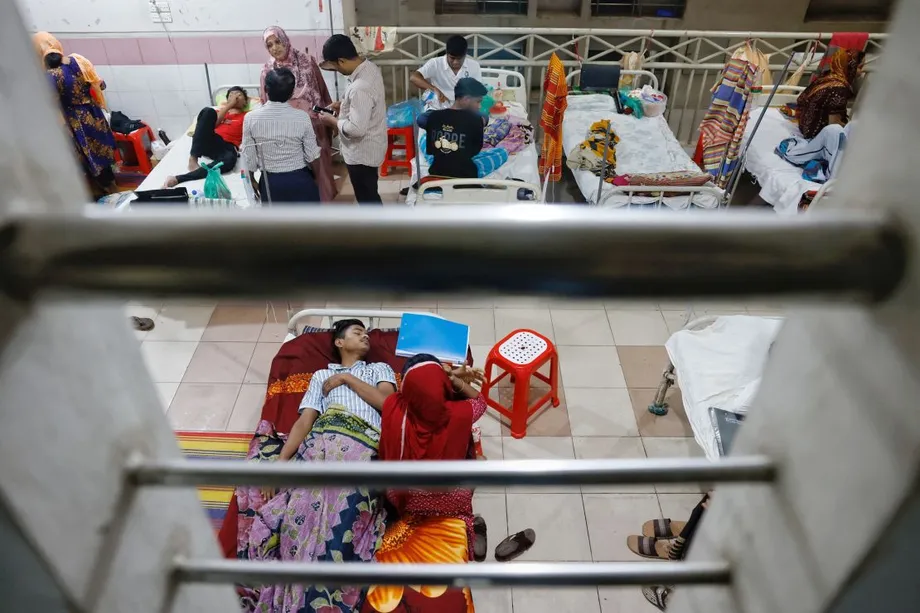
Bangladesh recorded 2,193 new dengue hospital admissions and four more deaths in the latest daily update on October 11, 2026, taking the totals since January to 99,275 admissions and 303 deaths. The outbreak is continuing beyond the usual June to September dengue season, with 58 deaths already recorded in October after 148 in September.
Contents
- October brings another 2,193 hospital admissions
- A sharp reversal after August
- Most admissions are outside city corporation areas
- What the dashboard can and cannot establish
- Why specialists expect transmission to continue
- Heavy spending has not eliminated breeding sites
- Doctors urge treatment before deterioration
- Families face costs while the government defends its response
- A simultaneous measles outbreak adds pressure
- Key Points
The Directorate General of Health Services (DGHS) lists the cumulative figures in its Dengue Dynamic Dashboard, dated October 11. Its geographic tables also show that most recorded admissions have occurred outside city corporation areas, making access to testing, treatment and mosquito control beyond the largest urban administrations central to the response.
The four latest deaths were reported in Khulna division, where two occurred outside city corporation areas, and in Chattogram and Rajshahi divisions, which recorded one each. During the same reporting period, 1,796 patients were discharged, bringing recorded recoveries to 92,803.
The admissions total is now just 725 short of 100,000. These figures count patients admitted to reporting hospitals, rather than every infection in the community. People who do not seek care, receive treatment without admission or remain undiagnosed are not necessarily captured.
Compared with the corresponding period of 2025, when 53,606 cases and 225 deaths were recorded, admissions have increased by 45,669, or about 85.2 percent. Deaths have risen by 78, or about 34.7 percent. The faster growth in admissions does not establish why outcomes have changed, but it shows how much larger the reported hospital burden has become.
A sharp reversal after August
The Bangladesh Red Crescent Society describes an outbreak that initially tracked below the comparable 2025 case count before accelerating late in August. Its September situation update attributes that reversal to a surge associated with the monsoon.
August brought 20,536 admissions, compared with 9,206 in July. That was an increase of 11,330 admissions, or about 123 percent, within a month. The update recorded more than 51,000 cumulative cases and 149 deaths through September 13, followed by continuing rapid transmission.
The progression across the reporting dates shows why the October figures represent a sustained escalation rather than an isolated daily spike:
- July 2026: 9,206 admissions and 36 deaths were recorded.
- August 2026: admissions rose to 20,536, with 43 deaths.
- September 13: cumulative cases exceeded 51,000, with 149 deaths.
- September 14: more than 15,000 cases and 52 deaths had been recorded during September.
- September ended with 148 deaths, the highest monthly toll so far this year.
- October 11: cumulative admissions reached 99,275 and deaths reached 303.
September alone accounted for almost 49 percent of the deaths recorded through October 11. October's 58 deaths already exceed the 43 recorded during all of August, although the current month is incomplete.
Most admissions are outside city corporation areas
The DGHS dashboard records 76,873 admissions outside city corporations and 22,036 within them. The outside total is more than three times the inside total and amounts to roughly 77 percent of the national headline count.
That administrative distinction should not be confused with a simple rural versus urban split. Areas outside city corporations can include towns and other populated communities. Still, the figures demonstrate that a response concentrated on Dhaka's city authorities cannot cover most of the recorded burden.
In the latest daily update, Dhaka division outside city corporation areas recorded 530 admissions. Dhaka North and Dhaka South city corporations recorded 250 each. Other reported figures included 304 in Khulna, 293 in Chattogram and 236 in Barishal.
The geographic tables require caution. The dashboard's inside and outside totals add up to 98,909 admissions, 366 fewer than its national total. Their death totals, 116 and 186 respectively, add up to 302 rather than 303. These gaps do not change the broad geographic pattern, but they prevent an exact division of every case and death between the two categories.
What the dashboard can and cannot establish
Another discrepancy concerns the latest daily death field. The dashboard displays 303 in the field labelled for deaths in the preceding 24 hours, while the daily update reports four new deaths and a cumulative toll of 303. The daily toll should therefore not be read as 303 new fatalities.
The cumulative gender table also contains incomplete totals. It lists 61,636 male cases and 37,395 female cases, which together equal 99,031 rather than 99,275. Recorded deaths comprise 144 male and 155 female patients, adding up to 299 rather than 303.
Within those listed categories, male patients account for about 62 percent of admissions, while female patients account for slightly more than half of deaths. That difference deserves attention, but the tables do not explain it. They provide no basis for attributing it to differences in exposure, care, underlying illness or biological risk.
The latest daily age table is more internally consistent: it totals 1,356 male and 837 female admissions, matching the daily count of 2,193. The largest age group was 26 to 30, with 325 admissions, followed by ages 21 to 25 with 279 and ages 16 to 20 with 273.
Those three groups together accounted for 877 admissions, or about 40 percent of the daily total. This shows a substantial burden among adolescents and younger adults on that reporting day, not their relative risk across the entire population.
Why specialists expect transmission to continue
Khabirul Bashar, a medical entomologist and zoology professor at Jahangirnagar University, warned that transmission would remain high in October and that further infections could follow in November. His warning challenges the assumption that the end of the usual dengue season will bring an immediate decline.
Bashar pointed to stronger mosquito control institutions and more extensive activity in Dhaka than in many other districts. He said inadequate institutional arrangements elsewhere were contributing to continued transmission outside the capital.
He also suggested that previous circulation of the virus in Dhaka could affect transmission patterns. Dengue viruses occur in different types, known as serotypes. Protection following infection with one type does not amount to protection against every other type, so previous exposure should not be treated as a reason to dismiss new symptoms.
Dr Muhammad Nurul Islam, deputy director of Mugda Medical College Hospital, said a second infection could be one possible explanation for rapid deterioration in some children. That is a proposed explanation, not a confirmed cause for the current national pattern. The published figures do not identify which virus types account for the latest admissions or establish why particular patients became severely ill.
Heavy spending has not eliminated breeding sites
Dhaka's two city corporations allocated more than Tk1,037 crore for mosquito control over the past decade, including a combined Tk242 crore in fiscal year 2026. A crore is 10 million taka, making the latest annual allocation Tk2.42 billion.
Despite those allocations, a May survey found Aedes mosquito larvae above the acceptable threshold in 63 of Dhaka South's 75 wards. That represents 84 percent of the wards surveyed. Twenty seven wards were considered highly vulnerable to dengue transmission.
Budget allocations do not show how much was ultimately spent, which methods were used effectively or whether spraying reached the places where mosquitoes were breeding. The survey offers a more direct warning: many wards entered the monsoon with breeding conditions already present.
Bashar recommended finding and removing breeding sites through a search and destroy strategy. Cups, disposable glasses, wrappers, buckets and rooftop containers can hold stagnant water in which mosquitoes develop. Where water cannot be drained or a container removed, larvicides or insect growth regulators can stop larvae from developing into adults.
His recommendation is part of integrated vector management, meaning mosquito control that combines surveillance, breeding site removal and suitable chemical or biological measures. Reports of resistance to commonly used insecticides add another reason to assess whether a chemical works locally, rather than judge a campaign by the volume sprayed.
Bangladesh has reportedly not decided whether to introduce the Qdenga dengue vaccine. No decision date or rollout schedule has been announced in these updates. Vaccination therefore cannot be presented as an immediate component of the current response.
Doctors urge treatment before deterioration
Dengue has no specific antiviral treatment, but timely medical care can address dehydration and severe complications. Medicine specialist Dr ABM Abdullah warned that some patients were developing serious complications and shock within one or two days.
Shock occurs when circulation becomes inadequate to supply the body's organs. Dengue can also cause fluid to leak from blood vessels, making careful monitoring and treatment important. Abdullah urged people with fever to seek medical advice promptly, especially children, older people, pregnant women and patients with cancer or liver disease.
He advised adequate fluids and prompt medical attention for vomiting, difficulty eating or diarrhoea. He also cautioned against taking painkillers without medical advice. Nurul Islam urged patients to take symptoms seriously even before a diagnosis is confirmed and to follow a physician's instructions on monitoring, tests and medicines.
Public health expert Dr Mushtaq Hossain called for testing in areas with many infections and appropriate care at district, upazila and secondary hospitals. Upazilas are administrative areas below the district level. He said effective mosquito control could take two to three years to reduce infections, making prevention of deaths an immediate priority while longer term control work continues.
Families face costs while the government defends its response
The spread beyond Dhaka also creates a financial burden when seriously ill patients must travel to facilities with more experienced staff or intensive care. Treatment costs can rise alongside transport expenses and lost earnings.
Dr Syed Abdul Hamid, a professor at the University of Dhaka's Institute of Health Economics, cited a 2023 study estimating family expenses of Tk7,000 to Tk12,000 for dengue treatment in public hospitals and Tk50,000 to Tk100,000 in private facilities. These are earlier estimates, not a current national price survey.
Recent family accounts illustrate the range of expenses. Tea stall owner Mohammad Liton described spending Tk15,000 during his three year old daughter's illness while keeping his shop closed. Salma Afrose said four days of private intensive care for her 13 year old son cost Tk140,000. Those individual experiences cannot establish an average, but they show how a short illness can disrupt household finances.
Hamid proposed a national health fund to help hospitals provide medicines, saline and tests without charging patients. The proposal has not been described as an adopted programme.
Health Minister Sardar Md Sakhawat Hossain defended the government's response when asked whether it had failed to control dengue:
I do not think the government has failed.
The minister said medical teams were following treatment protocols, cleanliness drives were taking place every Saturday, and authorities were using spraying against adult mosquitoes and tablets against larvae. He also cited population density and water collecting in places such as rooftop flowerpots. Those statements describe the measures underway; the continued admissions show that transmission has not yet been brought under control.
A simultaneous measles outbreak adds pressure
Health authorities also reported seven more deaths involving symptoms resembling measles and more than 1,200 new symptomatic infections. Since mid March, deaths linked to the outbreak have reached 1,162, including 104 confirmed measles deaths.
Symptomatic cases total 205,028, while confirmed cases stand at 22,421. These categories must remain separate: a suspected case or death is not the same as a confirmed measles diagnosis, and the larger totals should not be described as entirely confirmed.
The crisis follows the July measles surge, when reported suspected and confirmed cases exceeded 120,000 and hospitals were already struggling with large numbers of sick children. The latest figures indicate a continuing burden alongside dengue, though differences in reporting categories limit a precise comparison.
The Health Ministry has immunized around 20 million children in response, alongside routine vaccinations and a campaign launched in late September to reach children who missed doses. That reported number does not establish that every child has completed the required vaccination schedule or that transmission has stopped.
For dengue, the next concern identified by specialists is continued transmission through October and possibly November. No firm peak date, vaccine introduction deadline or timetable for a national decline has been announced. The immediate priorities described by doctors and entomologists are earlier care, accessible testing and sustained removal of mosquito breeding sites.
Key Points
- Bangladesh recorded 99,275 dengue admissions and 303 deaths through October 11, 2026.
- The latest daily update reported 2,193 admissions, four deaths and 1,796 discharges.
- Admissions were about 85 percent higher than the corresponding 2025 total; deaths were about 35 percent higher.
- September recorded 148 deaths, followed by 58 during the first 11 days of October.
- Most listed admissions occurred outside city corporation areas, although some dashboard totals do not reconcile.
- Specialists warned of transmission continuing into November and urged prompt treatment and better mosquito control.
- The concurrent measles outbreak has recorded 1,162 linked deaths, including 104 confirmed measles deaths.