October 15 decision advances a treatment first approved in 2018
Japan's health ministry advisory panel endorsed full marketing authorization for Nipro's spinal cord injury treatment Stemirac on October 15, advancing a product that entered clinical use under a conditional approval lasting seven years. The panel accepted new evidence on effectiveness and other aspects of the treatment, opening the way for a formal decision by the health minister.
Contents
- October 15 decision advances a treatment first approved in 2018
- What Japan required before granting early access
- How cells from a patient's bone marrow are used
- What happened in the original 13 patients
- Why a better injury grade can mean different things
- How the later comparison was designed
- Why approval attracted criticism
- Who the treatment was designed to reach
- What safety monitoring involves
- Key Points
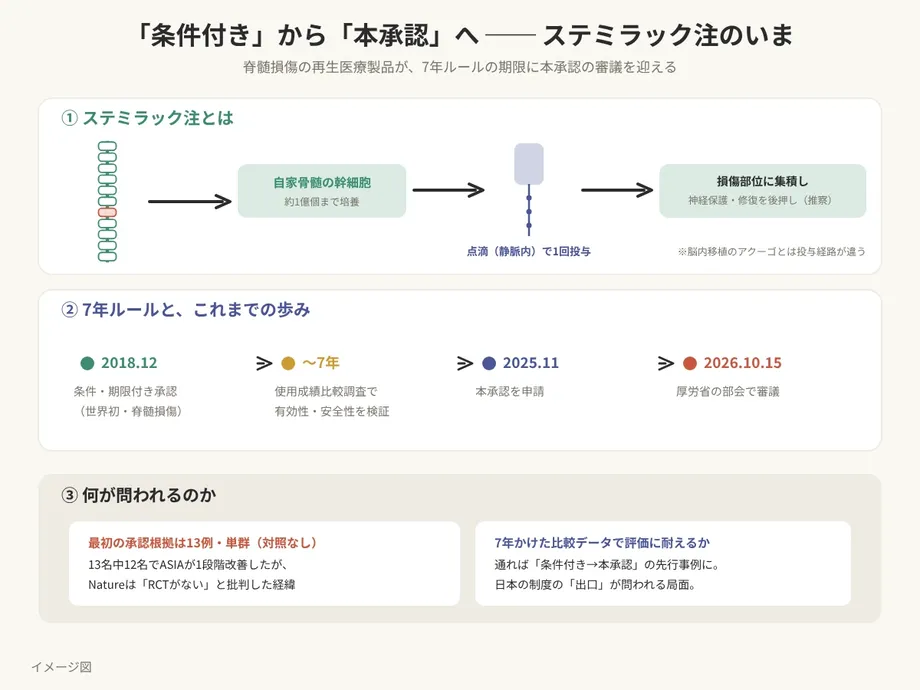
Stemirac uses cells collected from a patient's own bone marrow, grown outside the body and returned through an intravenous drip. Nipro developed it with researchers at Sapporo Medical University, including Professor Osamu Honmou. The treatment is intended to improve neurological symptoms and physical function after traumatic spinal cord injury.
The panel described Stemirac as the first regenerative medicine product in Japan to advance from conditional approval with a time limit toward full approval. For patients, the immediate significance is the prospect of a treatment moving beyond its temporary regulatory framework. Stemirac was already available under that framework and covered by Japanese health insurance.
The October 15 endorsement is an advisory step, with ministerial authorization expected afterward. The year of that meeting, the date of the final ministerial decision and the numerical results of the newer evaluation were not specified in the announcement details. The regulatory history and published study results nevertheless explain why the decision matters: Japan initially allowed access while requiring Nipro to gather stronger evidence during clinical use.
What Japan required before granting early access
The Ministry of Health, Labour and Welfare's 2018 deliberation report records a committee decision on November 21, 2018, recommending conditional approval for seven years. The Pharmaceuticals and Medical Devices Agency, or PMDA, concluded that Stemirac was expected to provide some benefit and had acceptable safety in relation to that expected benefit.
PMDA also required further evaluation because the clinical evidence was limited. The approval framework, applied under Article 23-26 of Japan's law governing pharmaceuticals and medical devices, allowed treatment to begin while the manufacturer collected evidence for a later approval application.
Two central conditions accompanied that access. Treatment had to take place under an experienced spinal cord injury specialist at a facility capable of handling emergencies, and every treated patient had to be included in the evaluation required before reapplication.
The main milestones show how the treatment moved from an initial application to the latest panel endorsement:
- June 29, 2018: Nipro submitted its initial application for marketing approval.
- November 21, 2018: The ministry committee recommended conditional approval with a seven year limit.
- December 28, 2018: Conditional marketing approval was granted.
- February 20, 2019: A ministry draft guideline set out patient selection, treatment and facility requirements.
- January 20, 2020: A petition to the health minister requested withdrawal of the approval and a return to clinical trials.
- October 15: The ministry panel endorsed full approval, with ministerial authorization expected to follow.
How cells from a patient's bone marrow are used
Stemirac contains mesenchymal stem cells, often shortened to MSCs. These cells can release substances that influence inflammation and support other cells. The word autologous, used in the product description, means that the cells come from the same person who receives the treatment.
Nipro's manufacturing process begins with collection of bone marrow fluid and peripheral blood. The cells are then grown and multiplied outside the body. The original approved method specified an intravenous dose of 50 million to 200 million cells, subject to a maximum dose based on body weight.
The proposed action involves several processes. Cells may gather near damaged spinal tissue, release substances that help protect nerves and regulate inflammation. The ministry's guideline also describes a possible contribution from cells developing into nervous system cells. Together, these actions are intended to limit further damage and support recovery.
Animal experiments reviewed by PMDA helped explain how cells delivered into a vein might reach the spinal cord. In one rat experiment, labeled cells were visible at and around the injury a week after infusion. Another experiment found approximately 5.5% of administered rat MSCs at the injury site. PMDA accepted the manufacturer's explanation of how the cells moved through the body, while noting that the precise mechanism attracting them to the injury remained unclear.
What happened in the original 13 patients
The ministry's draft optimal use guideline, presented on February 20, 2019, describes the Phase II study that supported initial approval. It involved 13 adults at one medical center, with a median age of 54 and an age range of 21 to 66. All had traumatic injuries to the cervical spinal cord, the section in the neck.
Seventeen people initially entered registration, and 13 met the subsequent requirements and received treatment. The study was open label, meaning patients and clinicians knew which treatment was given. It also had no control group receiving standard care alone.
The main measure was improvement of at least one grade on the American Spinal Injury Association Impairment Scale, or AIS, by approximately 220 days after injury, compared with the assessment immediately before treatment. Twelve of 13 patients improved by at least one grade, a proportion of 92.3%.
The starting groups were small: six patients had AIS grade A, two had grade B and five had grade C. Five of the six patients starting at A improved by at least one grade, as did both patients starting at B and all five starting at C. Three of the 13 patients, or 23.1%, improved by at least two grades.
PMDA considered those results promising enough to support conditional access. Its review also identified natural recovery and rehabilitation as factors that could contribute to improvement, and called for comparison with patients receiving standard treatment.
Why a better injury grade can mean different things
AIS grades describe the amount of movement and sensation preserved after spinal cord injury. Grade A is the most severe category, with no motor or sensory function preserved in the lowest sacral segments. Grade B includes preserved sensation without the motor function needed for a motor incomplete classification. Grades C and D include increasing levels of preserved motor function, while grade E indicates normal findings on the scale.
A change from A to B can therefore represent recovery of sensation. A change from A to C includes recovery of motor function. PMDA used this difference when designing the later evaluation: for patients starting at grade A, it wanted improvement of at least two grades as the main outcome.
Everyday independence was assessed separately using the Spinal Cord Independence Measure, known as SCIM-III. This scale awards up to 100 points across self care, breathing and bladder and bowel management, and mobility. Those activities matter directly to how much assistance a person needs.
The original trial recorded an average SCIM-III increase of 27.2 points across all 13 patients. Results varied greatly by starting severity: the average increase was 3.3 points for grade A patients, 9.5 for grade B and 62.8 for grade C. PMDA reported improvement in this measure in 12 patients, while one patient starting at grade A improved in neither AIS nor SCIM-III.
The difference between the measures shaped the regulatory follow up. PMDA requested both neurological assessments and measures of daily function, so that an improvement on an injury scale could be considered alongside changes in practical independence.
How the later comparison was designed
Nipro's conditional approval explanation describes a comparative survey of people who received Stemirac and eligible people who did not. The manufacturer presents the survey as the means of checking effectiveness and safety before seeking full approval. The page describes the conditional approval stage rather than announcing the October 15 decision.
The principal outcomes focus on patients aged 20 to 70 with traumatic cervical spinal cord injury. For those starting at AIS grade A, the survey measures the proportion improving by at least two grades. For patients starting at B or C, it measures improvement of at least one grade.
The comparison runs from an assessment six to eight weeks after injury to an assessment around day 180, with an allowance of 30 days on either side. This differs from the original trial's main assessment around day 220. The later design therefore uses its own starting point, follow up period and severity groups.
PMDA originally said a randomized comparison, in which treatment groups are assigned by chance, would be preferable. Random assignment helps create groups with similar starting characteristics. The agency accepted a prospective comparison with eligible untreated patients as a practical alternative after Stemirac became available, while requiring efforts to make the groups comparable and the assessments objective.
Why approval attracted criticism
A January 2020 petition addressed to then health minister Katsunobu Kato asked for Stemirac's conditional approval to be revoked and for the product to return to clinical trials. The petition argued that 13 patients and the absence of a control group left too much uncertainty about the contribution of treatment, natural recovery and rehabilitation.
The petition also challenged the suggestion that substantial recovery was unlikely among patients classified as AIS A. It cited research documenting improvement under standard care and requested tighter rules for the conditional approval system, including greater transparency and restrictions on deadline extensions.
Orthopedic surgeon Hiroshi Kawaguchi revisited the issue in a January 2026 perspective, published online on January 7. He discussed trial design, outcome assessment and the risks of commercial treatment under public reimbursement before sufficiently strong evidence has accumulated.
Kawaguchi's article reflects a continuing dispute about how quickly patients should gain access and how convincingly benefits should be measured. PMDA's original decision pursued early access with mandatory follow up; the criticism called for stronger comparative evidence before commercial use. The October 15 endorsement makes the results of that follow up central to understanding the treatment's regulatory progress.
Who the treatment was designed to reach
The original approved indication covered traumatic spinal cord injury in patients assessed as AIS A, B or C. PMDA restricted the indication to traumatic injury because the trial involved that population. The original study also provided no experience in patients starting at AIS D.
The 2019 draft guideline recommended initially concentrating use on AIS A patients, citing limited manufacturing capacity and the assessment of benefit in that group. Its collection schedule targeted bone marrow aspiration within 31 days after injury, taking the patient's condition into account, followed by infusion as soon as manufacturing was complete.
For families, those requirements mean that assessment, collection, manufacturing and transfer between hospitals need coordination early after injury. In the original trial, actual infusions occurred between 43 and 54 days after injury. The treatment pathway also included rehabilitation and arrangements for continued care after transfer.
The scale of need in Japan is substantial. PMDA's 2018 review cited at least 100,000 people living with spinal cord injury and about 5,000 new patients annually; later estimates accompanying the approval news put annual injuries at about 6,000 and the number living with lasting effects above 200,000. The eligibility rules and early collection schedule determine which patients can enter the treatment pathway.
What safety monitoring involves
The original study recorded no deaths or other serious adverse events. Two patients developed anemia attributed to blood collection, and one experienced pain at the bone marrow puncture site. PMDA described those events as nonserious and required continued collection of safety information.
The ministry's draft guideline described collection of approximately 50 milliliters of bone marrow fluid and a total of 960 milliliters of peripheral blood during manufacturing preparation. It warned that collection could be particularly demanding for children, people with low body weight and patients who already had anemia. The original trial involved adults.
Hospitals were required to provide clean collection facilities, intensive care capability, rehabilitation arrangements and rapid responses to complications. The guideline called for monitoring breathing and vital signs during and after infusion because intravenous cell products can carry risks including blood clots and blockage of blood vessels in the lungs. It also addressed allergic reactions and infection risks.
Stemirac's move toward full approval marks progress through the regulatory process established in 2018. For patients and clinicians, the practical priorities remain specialist assessment, a clear explanation of expected benefits and risks, coordinated rehabilitation and continued attention to functional outcomes.
Key Points
- A Japanese health ministry panel endorsed full approval of Stemirac on October 15, with ministerial authorization expected afterward.
- Nipro and Sapporo Medical University developed the treatment using cells from each patient's own bone marrow.
- Japan initially granted conditional approval in December 2018 with a seven year limit and mandatory follow up.
- In the original study, 12 of 13 adults improved by at least one AIS grade, and three improved by at least two grades.
- The later evaluation compared treated patients with eligible untreated patients and used different outcomes according to injury severity.
- The original indication covered traumatic spinal cord injury assessed as AIS A, B or C, with treatment at suitably equipped specialist facilities.