Two hospitals share control of a surgical robot
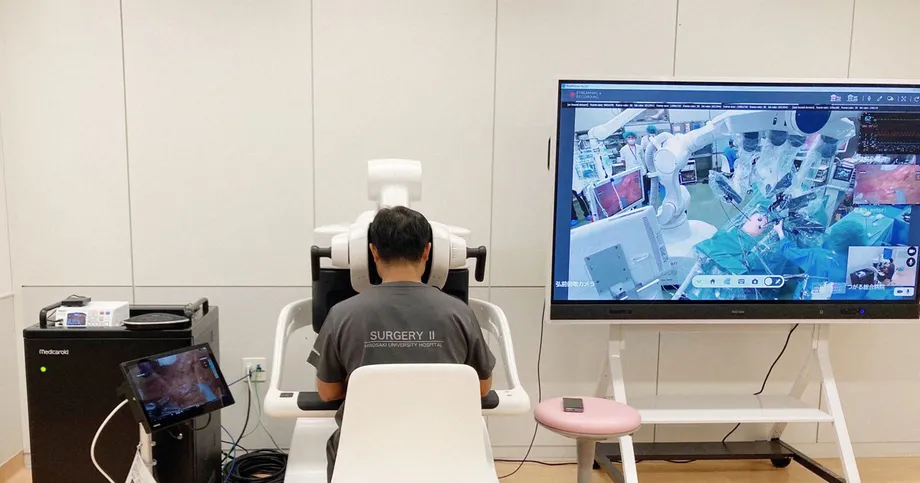
Five patients with colorectal cancer have undergone operations involving doctors at two hospitals about 30 kilometers apart in Aomori Prefecture, in what Hirosaki University and the Japan Surgical Society describe as Japan's first clinical use of remote robotic surgical assistance. The study began in August, connecting Hirosaki University Hospital in Hirosaki with Tsugaru General Hospital in Goshogawara.
Contents
- Two hospitals share control of a surgical robot
- What happened between August and October
- How remote assistance works in the operating room
- Earlier research tested a connection over 150 kilometers
- Why a fast connection needs a clear picture
- Five years of hinotori testing examined delays and congestion
- What happens when the connection fails
- Local doctors remain essential to the model
- The goal is treatment closer to home
- Key Points
A surgeon in the operating room controlled a hinotori surgical robot, developed by Kobe based Medicaroid Corp., while a supervising surgeon at the other hospital helped by remotely operating the same machine. The doctors worked together to remove tumors. The university and the society said all five operations had been completed safely.
The immediate goal is to bring specialist skills to hospitals where experienced surgeons are harder to find. Further operations are planned through March to assess safety before the organizers seek regulatory approval for the necessary equipment and coverage under Japan's national health insurance system.
Masaki Mori, a Tokai University professor who heads the Japan Surgical Society's committee promoting remote surgery, explained the purpose at a press conference at Hirosaki University.
Our primary goal is to eliminate regional disparities in surgical treatment,
Mori said the society hopes to bring remote robotic surgery into practical use in about two years. That is a target, while the next steps are further clinical evaluation, equipment approval and arrangements for insurance coverage. The Aomori procedures move the technology into patient care after earlier Japanese research examined robot control, communication delays and recovery from network failures.
What happened between August and October
Hirosaki University and the Japan Surgical Society announced the start of clinical use on October 8, before presenting details at an October 14 press conference. Coverage published on October 15, 2026, described the participating hospitals as about 30 kilometers apart.
The sequence shows how the announcement followed operations already performed, rather than marking the start of a future trial:
- August: The first operation took place and the clinical study began.
- October 8: Hirosaki University and the Japan Surgical Society announced the start of Japan's first clinical application of remote robotic surgical assistance.
- October 14: The organizers presented details and said five patients had undergone operations safely.
- Through March: Further operations are planned to assess safety before applications for equipment approval and national health insurance coverage.
The study description identifies patients with digestive tract cancers as its target group. The five completed operations involved colorectal cancer, meaning cancer in the colon or rectum. The public announcement did not give detailed figures for complications, recovery times or longer term cancer outcomes.
How remote assistance works in the operating room
The hinotori robot links a surgeon's controls to instruments used during an operation. In this study, a communication connection between the hospitals allowed a doctor at the other location to operate the robot while assisting the surgeon beside the patient.
The arrangement combines local care with specialist guidance from a distance. A doctor remains in the operating room, and the remote participant can contribute through the robot rather than giving spoken instructions alone. Both doctors are involved in the same procedure.
Local staff also carry out physical tasks that current surgical robots cannot manage by themselves. A separate academic review of hinotori validation identifies instrument changes, camera lens cleaning and suction as functions that still require people beside the patient. Remote assistance therefore depends on the operating room team as well as the distant surgeon and the communication system.
Earlier research tested a connection over 150 kilometers
Researchers working with Hirosaki University previously studied remote robot operation between Hirosaki University Hospital and Mutsu General Hospital, 150 kilometers apart. Their commercial network study, supported by the Japan Agency for Medical Research and Development, examined whether ordinary commercial fiber connections could support reliable remote control.
That field experiment used a robot being developed by Riverfield Inc. Twelve surgeons performed manipulation exercises: six had experience in robotic surgery and six had experience in general surgery but none in robotic surgery. They moved bars between numbered holes and used two instruments to grasp and pull a marked string.
The earlier connection covered five times the distance of the current hospital pairing: 150 kilometers compared with about 30 kilometers. Its focus was controlled tasks rather than operations on patients, allowing researchers to measure performance under several network conditions.
The authors concluded that the commercial communication network they tested could support remote surgery technology. They also set out limits to the experiment: it measured delays in image signals rather than control signals, included a small group of surgeons and used a fixed order of network tests that could affect performance as participants gained practice.
Why a fast connection needs a clear picture
The Hirosaki and Mutsu experiment found an average communication round trip of 4 milliseconds on lines with guaranteed bandwidth and 10 milliseconds on a connection whose speed depended on network conditions. A millisecond is one thousandth of a second. Round trip time measures how long a signal takes to travel to its destination and back.
Surgeons also need to see what the instruments are doing. The researchers measured the delay from the camera capturing an image to that image appearing on the surgeon's display, called glass to glass time. This averaged 92 milliseconds on guaranteed lines and 95 milliseconds on the other connection.
Camera processing, video compression, transmission, decompression and display response all contribute to that delay. The equipment processing accounted for much more of the measured image delay than the network journey itself.
A guaranteed connection carrying 5 megabits per second suffered packet loss and reduced image quality. Packets are small pieces of digital information; losing some can remove details from the picture. The authors recommended at least 10 megabits per second for the system they tested. Task error counts showed no statistically significant difference between network conditions, but some surgeons found the pictures on the 5 megabit connection difficult to see.
The recommendation ties connection capacity to a particular robot and video system. A hospital planning remote assistance needs enough capacity for its own equipment, along with stable delivery of both pictures and control commands.
Five years of hinotori testing examined delays and congestion
Kobe University, Medicaroid and NTT DOCOMO conducted more than 30 remote session evaluations between 2020 and 2025. Takuto Hara and colleagues brought those findings together in a hinotori validation review examining communication performance, robot safety, staff coordination and legal requirements.
The review describes technical and operational testing of hinotori, separate from the five cancer operations in Aomori. Under optimized conditions, a standalone 5G network using Sub6 frequencies achieved a round trip delay of approximately 100 milliseconds while transmitting video. Standalone 5G uses a dedicated 5G core network, while Sub6 refers to frequencies below 6 gigahertz.
Network congestion was another major test. Without quality of service controls, competing traffic of 200 megabits per second caused packet loss and poorer video. With those controls enabled, transmission stayed stable even when competing traffic exceeded 1 gigabit per second, equivalent to 1,000 megabits per second.
Quality of service means giving priority to important traffic, in this case surgical images and robot commands. The tests show why a network's advertised speed is only part of the engineering task: the surgical connection must keep working when other users are sending data.
Surgeons could complete tested tasks at delays of up to 180 milliseconds, although accuracy in fine movements began declining beyond 120 milliseconds. The review describes the 2022 Japanese Remote Surgery Guidelines as setting an end to end latency requirement of no more than 100 milliseconds, alongside secure connections and backup arrangements.
What happens when the connection fails
Hinotori validation included simulated disconnections at routers and 5G devices. The robot entered a safe standby mode, stopping instrument movement without unintended motion. In many test scenarios, restoring the network connection returned control without a system reboot.
Backup communication paths were tested through a virtual private network, or VPN, which provides a protected connection between locations. During simulated failures, the VPN reconnected within 5 to 11 seconds. The safety arrangements also included a local operator who could take control through a second cockpit, the console used to operate the robot.
Seconds matter during an operation, so stopping the robot and keeping a capable team beside the patient are central parts of the design. The review describes safety as a combination of automatic standby, backup connections, equipment monitoring and people able to intervene.
The validation trials used a closed network architecture to keep surgical video, commands and other data isolated from the public internet. Monitoring tools watched network equipment for problems such as sudden packet loss or delayed video frames. These were features of the validation program; the Aomori announcement gave a simpler description of the communication link used for its clinical operations.
Local doctors remain essential to the model
Hara and colleagues identify Article 20 of Japan's Medical Practitioners Act as a legal requirement for a physician to be present at the patient's location. Their review describes supervised remote assistance, with a distant surgeon supporting a local team, as a legally permissible transitional model.
The Aomori study follows that basic arrangement: a surgeon beside the patient operates with support from a doctor at the other hospital. The clinical work can help evaluate how this collaboration functions during actual cancer surgery while the organizers pursue the approvals needed for wider use.
The review also stresses communication between people. A distant surgeon relies on audio and video to coordinate with staff, see the operating field and follow changes during the procedure. Clear task assignments and emergency procedures are part of making the system usable, alongside reliable robot controls.
In the earlier Riverfield experiment, surgeons experienced in robotic surgery completed the task requiring both hands faster and with less instrument movement than those without that experience. Technology can carry a specialist's actions across a network, while training and familiarity still shape how well those actions are performed.
The goal is treatment closer to home
Hirosaki University and the Japan Surgical Society want remote assistance to reduce the expense and inconvenience of traveling for surgery. Their stated concern is both a shortage of surgeons and an uneven distribution of specialists, which can leave regional hospitals with less access to advanced surgical skills.
A hospital able to receive remote support could draw on an experienced surgeon elsewhere while treating its patient locally. The hinotori review also describes remote mentoring as a way to help less experienced surgeons work more safely and efficiently during validation sessions. That gives the approach a possible training role as well as a role in individual operations.
The practical demands remain substantial. Hospitals need the robot, suitable communication capacity, secure connections, backup arrangements and trained medical and technical staff. The earlier commercial network study describes a balance between communication reliability and cost, with more robust services generally costing more.
The planned operations through March are the next stated step. Equipment approval and national health insurance coverage would then help determine how the service could be offered and paid for beyond the study. Mori's ambition of practical use in about two years gives the project a goal, while the current achievement is five completed cancer operations involving surgical teams at two Aomori hospitals.
Key Points
- Five patients with colorectal cancer underwent remote assisted robotic surgery at hospitals about 30 kilometers apart in Aomori.
- Hirosaki University and the Japan Surgical Society describe the study as Japan's first clinical application of this approach.
- A local surgeon and a remote supervising surgeon worked with Medicaroid's hinotori robot.
- Further operations are planned through March before applications for equipment approval and national health insurance coverage.
- Earlier research tested image delays, network congestion, backup connections and safe robot stopping during simulated failures.
- The society hopes for practical use in about two years, aiming to reduce regional gaps in surgical care.