Taiwan expansion meets a rush for AI memory
Micron has opened its second advanced packaging and testing facility in Taichung, adding a crucial step in the production of memory for artificial intelligence systems as customers secure most of its expected 2027 supply of high bandwidth memory, or HBM.
Contents
- Taiwan expansion meets a rush for AI memory
- Why the Taichung facility matters
- Four locations, different jobs and schedules
- The milestones to watch
- Investment has accelerated sharply
- Customers are booking years ahead
- Smaller circuits and faster factory movement
- Taiwan pairs advanced processors with memory
- Other memory makers are expanding too
- Key Points
The October 15, 2026 inauguration brings together two major developments: a new facility scheduled to begin HBM production in mid October, and an expansion across four Taiwan manufacturing locations. Micron Taiwan Chairman Donghui Lu said cumulative investment in Taiwan exceeded NT$1.6 trillion by June 2026, with about half invested during the preceding four years.
Customer commitments are strong, although Micron has clarified the scope of those bookings. Most of its companywide HBM supply for calendar 2027 has finalized customer agreements. The company clarified that some output from the second Taichung facility remains outside those contracts, qualifying the initial description of the new plant's entire 2027 capacity as sold out.
Taichung is the packaging center of a wider network. Taoyuan and Tongluo in Miaoli County are expanding wafer manufacturing, while Tainan is adding wafer testing capability. Together, these projects address several steps needed to turn silicon into working memory for AI computers.
For customers building AI systems, the practical issue is how quickly those steps can expand together. More memory circuits need matching capacity to stack, connect and test them before they can become finished products.
Why the Taichung facility matters
Micron converted existing warehouse and conventional manufacturing space in Taichung's Houli area into the second advanced packaging facility. Work began in 2025, and President Lai Ching-te said at the inauguration that the facility had been completed in just over a year.
HBM combines several DRAM memory chips in a vertical stack. Tiny connections passing through the silicon, called through-silicon vias, allow the layers to exchange data. The resulting product can move large amounts of information quickly, helping powerful AI processors receive the data they need.
Packaging is therefore a central part of making HBM. The chips must be stacked and connected precisely, then tested to check that the finished memory works. Expanding wafer production alone would leave another part of the manufacturing chain needing more capacity.
Taichung is already Micron's largest manufacturing base in Taiwan, combining advanced DRAM manufacturing with HBM production and packaging. Lu said Micron's share of the area used in the Houli park had increased from about 23% in 2013 to about 73%, illustrating how much its local footprint has grown.
Four locations, different jobs and schedules
Micron's four projects are advancing at different stages. Taichung's production start, Tongluo's expected product shipments and Tainan's equipment installation each mark a different point between preparing a building and delivering usable memory.
Taoyuan's Fab 11E broke ground on July 30, 2026. Operations are expected around 2028, with earlier scheduling placing the start between late 2027 and early 2028. The building is designed for extreme ultraviolet lithography, or EUV, which uses very short wavelengths of light to form tiny circuit patterns on silicon.
Taoyuan's design also accommodates future High-NA EUV equipment, a more advanced form of the technology intended to create finer patterns. Lu said a new building was needed because older facilities had limits involving floor strength, equipment height and maintenance space.
Tongluo's P5 acquisition was completed on March 16, 2026. The site has about 300,000 square feet of existing cleanroom space, and Micron plans another fabrication building with about 270,000 square feet. Its September 30 earnings remarks placed full scale product shipments from Tongluo on track for mid 2027.
Tainan is being adapted from a former AUO display facility. The first equipment arrived in early September 2026. A warehouse about 11 meters high is being converted into three levels of cleanroom space, mainly for wafer testing. Micron has not announced a production or shipment date for that operation.
The milestones to watch
Micron's expansion stretches from acquisitions and construction in 2026 to expected operations in 2028. The sequence shows why additional supply will arrive in stages rather than all at once.
- March 16, 2026: Micron completed its acquisition of Tongluo P5.
- July 30, 2026: Construction began on Taoyuan Fab 11E.
- Early September 2026: Equipment installation began at the converted Tainan facility.
- October 15, 2026: Micron inaugurated the second Taichung advanced packaging and testing facility, with HBM production scheduled for mid October.
- Mid 2027: Full scale product shipments are expected from Tongluo.
- Around 2028: Taoyuan Fab 11E is expected to begin operations.
Tongluo illustrates the work between acquiring a factory and supplying customers. Equipment began moving in less than two weeks after the transfer, and Lu said more than 100 machines, approaching 200, had arrived by the October briefing. Existing equipment and utility lines still needed removal or modification to accommodate Micron's processes.
Taichung and Tainan also rely on conversion rather than entirely new construction. Tainan's change from display manufacturing to memory testing requires changes to electricity, water, gases, chemicals and wastewater infrastructure. Existing buildings provide a starting point, while the technical work determines when they can contribute to shipments.
Investment has accelerated sharply
Lu said about half of Micron's cumulative Taiwan investment of more than NT$1.6 trillion came during the previous four years, roughly matching investment over the preceding quarter century. At the October 15 ceremony, Lai cited a lower cumulative figure of more than NT$1.4 trillion over three decades.
Micron's latest NT$1.6 trillion figure describes its accumulated spending in Taiwan through June 2026. A separate estimate put the current Taiwan capacity expansion at more than NT$85.1 billion. The figures cover different periods and spending categories: decades of investment in the first case and a current expansion program in the second.
An earlier i-stock company statement put Micron's Taiwan investment above US$30 billion as of June 2024. The logistics supplier also described a December 25, 2024 ceremony for a third Taichung office building, with full completion expected by May 2025, alongside plans to expand HBM manufacturing and research.
Micron now employs more than 15,000 people in Taiwan, according to Lu. Its activities extend beyond production to research, product development, laboratories and sales. The Taiwan team includes employees from 34 countries, and the company is recruiting through university partnerships while providing opportunities for assignments in the United States, Japan and Singapore.
Customers are booking years ahead
Micron says customers have signed strategic agreements lasting three to five years, with some extending to 2031. Most of its 2027 HBM supply is covered by finalized contracts, and the company says those contract prices are higher than in 2026.
Micron expects memory supply to be tighter in 2027 and 2028 than in 2026. Its outlook also puts HBM demand growth ahead of conventional DRAM through 2028. These are company forecasts, while the signed agreements show how customers are responding now by securing supply further into the future.
HBM development increasingly involves designs tailored to particular computing systems. Micron says it is working with TSMC, Intel, NVIDIA and AMD on technical integration, including packaging technologies that connect memory with powerful processors. Development of HBM4 and HBM4E, future generations of the product, is also progressing, according to the company.
Longer agreements give customers a clearer supply schedule and give Micron more visibility when planning expensive factories and equipment purchases. The challenge remains execution: the company must bring wafer manufacturing, packaging and testing capacity into service at the pace its customers require.
Smaller circuits and faster factory movement
Micron's manufacturing upgrades run alongside its building projects. Lu said recent advanced DRAM generations, including 1α, 1β and 1γ, have often been introduced first in Taiwan after development. The 1γ generation is Micron's first DRAM process to use EUV.
Micron says 1γ increases memory bit density per wafer by more than 30% compared with 1β. In simple terms, a wafer can contain more memory capacity. The eventual volume of finished products also depends on how many wafers a factory processes, how many chips work correctly and how much packaging capacity is available.
The earlier i-stock statement described a planned increase in Micron's monthly HBM output from 20,000 to 60,000 wafers, a threefold target. It also relayed CEO Sanjay Mehrotra's ambition to exceed a 20% HBM market share in the following year. Those were earlier targets; the October 2026 expansion announcements focus on the facilities and customer commitments supporting the next stage.
I-stock said its renewed collaboration with Micron would introduce automated storage, sorting, guided vehicles and robots, while connecting factory and business management systems. Such equipment moves materials between production steps and tracks their location, an operational requirement as more facilities and processes come into service.
Taiwan pairs advanced processors with memory
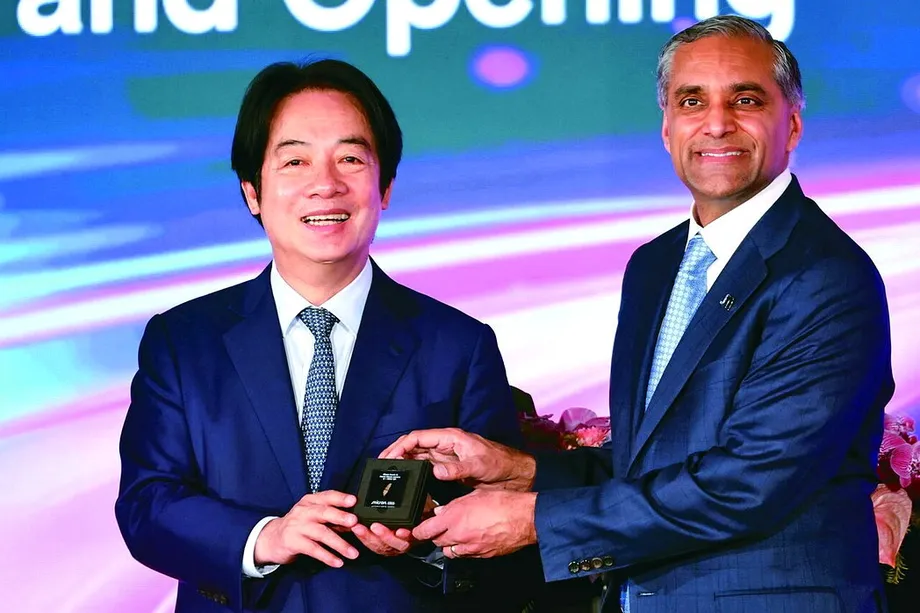
President Lai Ching-te used the Taichung inauguration to connect Micron's investment with Taiwan's wider role in AI computing. He pointed to TSMC's advanced chip manufacturing and packaging capabilities alongside Micron's memory expansion.
Lai, speaking as Taiwan's president at the ceremony, described the relationship between AI demand and the island's manufacturing capabilities:
The more the world needs AI, the more it needs Taiwan
TSMC manufactures advanced logic chips and provides CoWoS packaging, which connects computing chips and memory within a sophisticated package. Micron supplies the memory technology and is expanding its ability to manufacture, stack and test it. Their presence in Taiwan puts several essential parts of AI hardware production within the same industrial network.
Lai said Micron had received support under the Ministry of Economic Affairs' A+ Industrial Innovation R&D Program for HBM research in Taiwan. He also said the government's three major investment incentive programs had been extended through 2027, with financing and services intended to help businesses address land, water and electricity needs.
The expansion creates demand for equipment, materials, precision components and automation. Micron's conversions also show the variety of work involved, from modifying factory utilities to installing production tools and developing the packaging processes required for successive memory generations.
Other memory makers are expanding too
Taiwan's memory investment extends beyond Micron. An industry estimate places announced expansion spending at more than NT$674.4 billion as companies respond to demand for different types of memory.
Nanya Technology plans to begin production at Fab 5A in the second half of 2027, targeting 30,000 monthly wafer starts in 2028 and 35,900 in 2029. A wafer start means a wafer entering the manufacturing process. The targets imply an increase of 5,900 wafers a month, or about 19.7%, between those two years.
Nanya also received approval on October 1 for a 3D wafer packaging and testing facility at Pingtung Science Park. The project will use through-silicon vias and wafer stacking for high performance memory. Its HBM generation, specifications, investment amount and construction and production schedules have not been announced.
Winbond plans to expand its Kaohsiung factory from 15,000 to 24,000 wafers a month, an increase of 60%. Construction of another facility is scheduled to begin in January 2027, followed by equipment installation in January 2029 and mass production at the end of that year.
Macronix is investing NT$37.8 billion in single-level cell NAND flash and embedded multimedia card memory, with additional capacity expected in 2027 and monthly production of wafers measuring 12 inches projected to exceed 30,000. These projects serve different memory markets, while Micron's Taichung opening directly expands the packaging chain for HBM used in AI systems.
Key Points
- Micron inaugurated its second Taichung advanced packaging and testing facility on October 15, 2026.
- Most companywide HBM supply for 2027 is contracted, while some output from the new Taichung plant remains outside finalized agreements.
- Cumulative Taiwan investment exceeded NT$1.6 trillion by June 2026, with about half invested in four years.
- Taoyuan, Tongluo, Taichung and Tainan are expanding different parts of wafer manufacturing, HBM packaging and testing.
- Tongluo shipments are expected from mid 2027, followed by Taoyuan Fab 11E operations around 2028.
- Micron expects tighter memory supply in 2027 and 2028, with some customer agreements extending to 2031.