A potential second major customer after Google
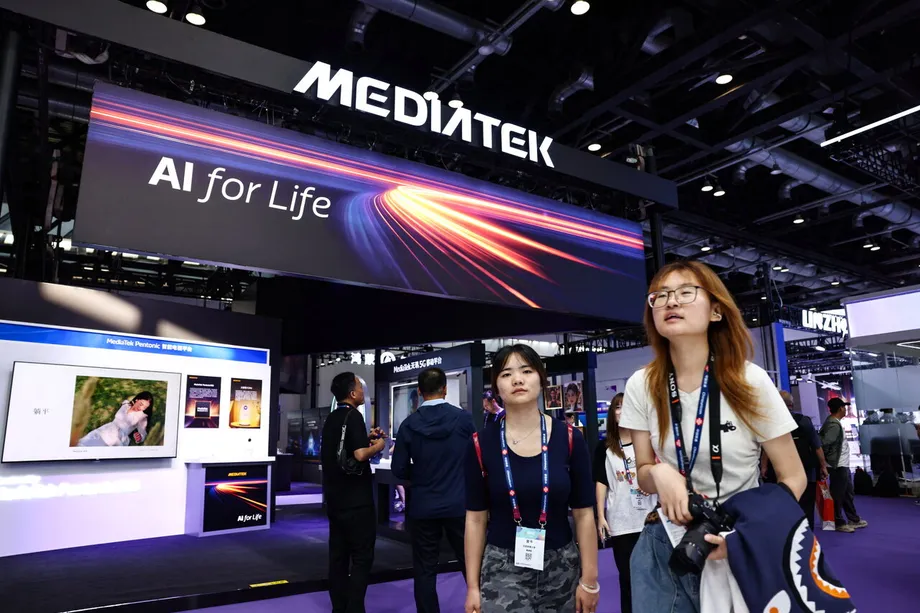
ByteDance, the owner of TikTok, is in advanced talks to buy custom data center chips from Taiwan's MediaTek, potentially adding another supplier to an artificial intelligence expansion that could involve up to $70 billion in capital spending in 2026.
Contents
- A potential second major customer after Google
- Why ByteDance is looking for more suppliers
- What a custom AI chip actually does
- MediaTek brings its mobile experience to data centers
- The $12 billion ambition behind the talks
- Why memory and packaging matter as much as processors
- Connecting chips into a working AI system
- ByteDance's spending could rise again in 2027
- The business case depends on demand for AI services
- Key Points
The discussions, described by people familiar with the negotiations and reported on October 15, concern application specific integrated circuits, or ASICs. These are chips designed around a particular customer's computing needs. If an agreement is completed, ByteDance could become MediaTek's second major customer for these AI chips after Alphabet's Google.
MediaTek expects about $2 billion in AI chip revenue this year and is targeting 15% of an estimated $80 billion market next year. Those figures put the possible ByteDance contract at the center of a much larger ambition: turning expertise developed for mobile phones into a substantial data center business.
The companies have not announced a completed agreement. The purchase quantity, contract value, chip specifications and delivery schedule remain undisclosed. ByteDance did not immediately comment, while MediaTek representatives declined to comment.
Why ByteDance is looking for more suppliers
ByteDance is expanding its hardware purchases as it builds AI services around models such as Seedance and seeks growth beyond its established social media businesses. More users generating videos or interacting with chatbots means more computing work inside its data centers.
US export restrictions limit access by Chinese companies, including ByteDance, Alibaba and Tencent, to the most advanced AI chips from suppliers such as Nvidia. Chinese manufacturers, including Huawei, cannot meet all the demand, leaving large buyers searching for additional sources.
ByteDance has also reportedly reached a similar agreement with Qualcomm this year to procure millions of AI chips. A MediaTek agreement would add another route for obtaining processors designed around its own infrastructure, rather than relying on a single supplier.
Custom chip partnerships can be permitted under US export restrictions when the computing capabilities involved stay within applicable limits. For ByteDance, the practical task is to secure enough usable computing capacity while meeting those requirements.
What a custom AI chip actually does
An ASIC is built for a defined set of tasks instead of serving as a broadly adaptable processor. For an AI company, the design can be matched to the calculations its models perform, the memory they need and the electricity available in its data centers.
MediaTek's data center platform describes two ways of working with customers: designing a processor around their needs or integrating their own accelerator technology and other designs into a finished chip. The company uses XPU as a broad label for its AI accelerator processors.
AI infrastructure handles two main jobs. Training teaches a model by processing large amounts of data. Inference runs the trained model when a person asks a chatbot a question or requests a generated video. Both require computing power, but the balance between speed, memory and electricity use can differ.
A custom design lets a buyer make choices around those workloads. MediaTek presents this approach as a way to improve useful AI output for each watt of electricity and each dollar spent. The commercial attraction is straightforward: a company serving enormous numbers of requests can benefit from even modest savings on each one.
MediaTek brings its mobile experience to data centers
MediaTek, based in Hsinchu, has a market value of around $210 billion, making it Taiwan's largest company after Taiwan Semiconductor Manufacturing Co. Its move into data centers puts it into closer competition with Qualcomm and Broadcom while reducing its dependence on mobile phones.
The company says its experience producing mobile processors at high volumes helps it improve manufacturing yields and refine designs for advanced processes. Yield means the share of manufactured chips that work properly, an important factor in production costs.
MediaTek says it has completed more than 10 tape outs on N3 technology and more than two on N2, with its first A14 test chip scheduled to tape out later this year. A tape out is the point at which a completed chip design is sent for manufacturing. N3, N2 and A14 identify generations of semiconductor process technology.
MediaTek also points to its experience running mobile chips at low voltages. In a data center, reducing a processor's electricity needs can help control operating costs and fit more useful computing work within a facility's power supply. Achieving that while preserving speed requires coordinated work on circuits, chip design and manufacturing.
The $12 billion ambition behind the talks
MediaTek's target of 15% of an $80 billion market translates to about $12 billion in annual sales. That is six times the approximately $2 billion in AI chip revenue it expects in 2026, illustrating the scale of the expansion it is pursuing for 2027.
A large customer such as ByteDance could support that growth by placing substantial orders and spreading chip development costs across more units. Google already gives MediaTek a major customer in custom AI chips; ByteDance would broaden that customer base if the negotiations produce a contract.
Nvidia reportedly announced a $3.5 billion investment agreement with MediaTek in September, adding financial support to the Taiwanese company's expansion. MediaTek's official technology description also identifies a separate connection with Nvidia: participation in the NVLink Fusion ecosystem for linking custom processors into larger computing systems.
The competitive picture therefore includes both rivalry and cooperation. MediaTek wants to win custom chip business against other designers while building systems that can connect through technology supplied by a leading AI computing company.
Why memory and packaging matter as much as processors
MediaTek's technical plans extend beyond the part of a chip that performs calculations. Its platform combines computing components, memory interfaces and fast connections, with advanced packaging bringing those pieces together.
High Bandwidth Memory, or HBM, places stacked memory close to an accelerator so that large volumes of data can move quickly. An AI processor needs a steady supply of data to stay busy, much as a busy kitchen needs ingredients delivered fast enough to keep its cooks working.
MediaTek describes 2.5D packaging, which places computing and memory components beside one another on a connecting base, and 3.5D integration, which adds more complex arrangements including vertical stacking. Shorter connections between components can reduce the energy and time needed to move data.
These capabilities show the breadth of the systems MediaTek is seeking to sell. Its official platform describes configurable technology across many customer needs, while the prospective ByteDance arrangement centers on chips customized for the Chinese company's data centers.
Connecting chips into a working AI system
MediaTek describes the server rack, rather than an individual chip, as a key unit of AI computing. A rack brings processors, memory, networking, power and cooling together. Its useful performance depends on how well all those parts work as a system.
Through NVLink Fusion, MediaTek says its custom processors can connect into Nvidia's ecosystem using NVLink C2C, with systems extending through computing trays and switching equipment. It also describes connections through InfiniBand and Ethernet, technologies used to move data across larger computing installations.
MediaTek and Microsoft have developed a proof of concept for an active optical cable using MicroLED light sources and the MOSAIC architecture. The companies are exploring ways to move data using light while reducing power use and extending connection distances. MediaTek says further miniaturization and preparation for mass production are part of that work.
Networking matters because AI systems often divide work among many processors. If those processors spend too much time waiting for information from one another, adding more chips delivers less benefit. MediaTek's strategy addresses that problem alongside the design of the processors themselves.
ByteDance's spending could rise again in 2027
ByteDance is considering capital spending of as much as $70 billion in 2026, more than double its spending in 2025, to expand data centers and other AI infrastructure. Capital spending covers investments in assets such as servers and facilities that a company expects to use over time.
The company could increase that figure to $100 billion in 2027 if economic and business conditions are favorable. Moving from $70 billion to $100 billion would represent a further increase of about 43%, although both figures describe possible spending levels.
ByteDance reportedly secured a $30 billion loan in September to support its investment program. The financing, supplier negotiations and spending plans form a sequence of steps toward a larger AI operation:
- Earlier in 2026: ByteDance reportedly agreed to procure millions of AI chips from Qualcomm.
- September 2026: ByteDance secured a reported $30 billion loan, while Nvidia announced a reported $3.5 billion investment agreement with MediaTek.
- October 15, 2026: Advanced discussions over MediaTek custom chips became public.
- 2027: ByteDance could raise annual capital spending to $100 billion, subject to economic and business conditions.
The business case depends on demand for AI services
ByteDance's investment push is aimed at strengthening its position in chatbots and video generation while expanding its reach overseas. Seedance faces competition from Alibaba's Happy Horse, Kuaishou's Kling AI and Google's AI products.
For users, infrastructure spending affects how much demand a service can handle and how quickly it can respond. For ByteDance, the challenge is to turn that computing capacity into services people use often enough to justify the expense. Custom chips offer a way to shape the cost of running those services at scale.
MediaTek faces a related commercial task: converting its chip designs and system technology into delivered products and revenue. Confirmation from the companies, manufacturing milestones such as tape out, foundry capacity bookings and disclosed contract terms would provide concrete measures of progress on the proposed arrangement.
Key Points
- ByteDance is in advanced talks to buy custom MediaTek chips for its data centers.
- A completed deal could make ByteDance MediaTek's second major custom AI chip customer after Google.
- MediaTek expects about $2 billion in AI chip sales in 2026 and targets a market share equivalent to about $12 billion in 2027.
- ByteDance is considering up to $70 billion in capital spending in 2026 and potentially $100 billion in 2027.
- MediaTek's technology plans combine custom processors, advanced memory, packaging and connections across server racks.
- The proposed chip agreement has not been publicly confirmed by either company.