A 1.67 trillion won decision over four rivers
Removing 12 of the 16 weirs built across South Korea's Han, Nakdong, Geum and Yeongsan rivers would deliver benefits greater than the costs, according to government commissioned economic studies. Estimates drawn from research conducted between 2019 and 2026 put two central parts of river restoration, upgrading water intake facilities and dismantling weirs, at a combined 1.6724 trillion won.
Contents
- A 1.67 trillion won decision over four rivers
- Why water intake upgrades cost more than removal
- What the 12 favorable assessments actually cover
- The larger economic model and its limits
- Why the headline total is not a full project budget
- Funding plans show how much remains unfinished
- Algal toxins could change the benefit calculation
- Drought protection and research methods face scrutiny
- Government review and local deadlines are different
- The Bottom Line
The larger expense is not demolition. Intake and pumping station improvements account for 976.8 billion won, compared with 695.6 billion won for removing the structures covered by the combined estimate. Those improvements would allow farms, households and businesses to continue drawing water when river levels fall after gates are opened or weirs are removed.
The economic case is substantial, but it is not a final government decision. At a parliamentary audit on October 6, 2026, Climate, Energy and Environment Minister Kim Sung hwan said the government was conducting a separate formal assessment, including an economic evaluation. He distinguished that process from a working group report that had recommended removal or opening.
The dispute now turns on more than whether restoration produces a positive financial calculation. Environmental groups say the studies leave out serious risks from toxic algal blooms. Critics question the valuation methods, future drought protection and the independence of the research. Different estimates also cover different facilities, years and types of expenditure, making apparently similar totals difficult to compare.
For residents dependent on river water, the practical issue is the order of events: intake facilities must work at lower water levels before operations change. A favorable economic assessment does not, by itself, establish that every locality is ready.
Why water intake upgrades cost more than removal
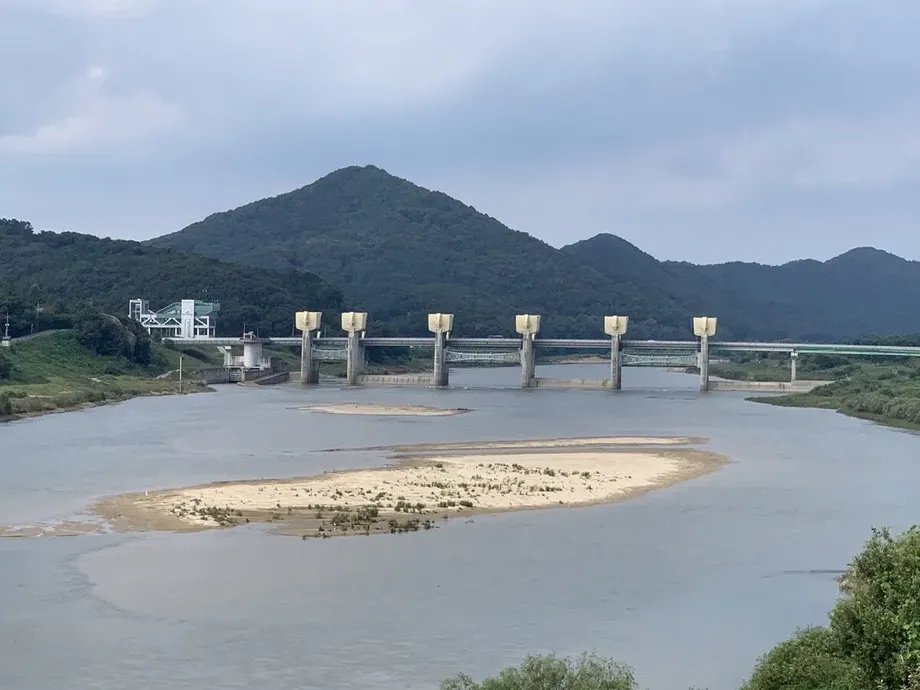
A weir is a barrier across a river that raises the water level upstream. The Four Major Rivers project under former president Lee Myung bak placed water intake openings at elevations suited to the managed levels behind the weirs. When those levels drop during drought or gate opening, some facilities cannot draw water reliably.
Lowering or modifying the intake openings therefore serves two connected purposes: it makes water supplies less dependent on a high river level and makes wider gate opening or removal possible. The estimated 976.8 billion won cost is about 1.4 times the combined demolition estimate.
The ministry's February 2026 Study on Measures to Restore the Four Major Rivers assigns 450.2 billion won to intake and pumping improvements under the environment portfolio. Of that amount, 390.5 billion won remained to be spent. Facilities under the Ministry of Agriculture, Food and Rural Affairs account for another 526.6 billion won, including 494.1 billion won in future expenditure.
Together, those figures put outstanding spending at 884.6 billion won. Subtracting that from the total indicates that 92.2 billion won had already been spent within this accounting framework. The estimate excludes improvements at nine privately operated intake and pumping facilities.
Whether to count these upgrades as restoration costs is disputed. Environmental organizations argue that they should be excluded from the economic assessment. The climate ministry has sought to include them, while the former Environment Ministry previously described intake improvements as a water supply reliability measure independent of decisions on permanent opening or removal. That distinction matters because changing which costs belong to a project can change its calculated economic return.
What the 12 favorable assessments actually cover
The 2019 economic study of the Geum and Yeongsan rivers found a benefit to cost ratio of at least one for removing Sejong and Gongju weirs on the Geum and Juksan weir on the Yeongsan. A ratio above one means that the estimated benefits exceed the estimated costs; a ratio of one means they are equal.
The December 2021 study of the Han and Nakdong rivers found favorable removal ratios for nine of their 11 weirs. Gangjeong Goryeong and Changnyeong Haman, both on the Nakdong, fell below one. Combined with the three favorable cases on the Geum and Yeongsan, that produces the headline figure of 12 out of 16, or 75%.
The Han results were strongest: Ipo recorded a ratio of 5.49, Gangcheon 3.50 and Yeoju 2.50. On the Nakdong, the figures were Nakdan 2.12, Gumi 1.68, Chilgok 1.63, Dalseong 1.32, Hapcheon Changnyeong 1.20 and Sangju 1.09. Gangjeong Goryeong scored 0.93 and Changnyeong Haman 0.51.
Those differences argue against treating every structure as economically identical. They also do not mean that the two lower scoring weirs must remain unchanged: permanent gate opening is a separate option requiring assessment.
There is an important accounting disagreement over demolition. One account assigns the 2021 estimate of 565.9 billion won to removing the nine favorable Han and Nakdong weirs. The detailed account of the same study describes that amount as the cost of dismantling all 11. The combined 695.6 billion won demolition figure therefore should not be treated as an undisputed, precisely defined construction budget.
The larger economic model and its limits
The Korean Association of Public Finance prepared the 2021 Han and Nakdong study for the Environment Ministry. It modeled restoration during 2022 to 2024, followed by what the study described as 37 years of effects during 2025 to 2062. These were analytical assumptions, not evidence that restoration happened on that timetable.
For removing all 11 weirs, the study estimated benefits of 2.8722 trillion won against costs of 1.6967 trillion won, producing a ratio of 1.69. The difference is 1.1755 trillion won in estimated net benefits. The Han river package scored 3.63, compared with 1.20 for the Nakdong.
Water quality improvements contributed 1.4955 trillion won, about 52% of total benefits. Aquatic ecosystem improvements added 802.5 billion won, and lower maintenance costs added 508.5 billion won. Flood control improvements were valued at 56.9 billion won and recreation at 8.7 billion won.
These are valuations of expected social benefits, not cash receipts that would automatically enter the government budget. Their reliability depends on the methods, populations and future conditions used in the model.
The distribution of households helps explain the regional results. The study counted 12.43 million households in the Han basin and 5.51 million in the Nakdong basin, a difference of about 2.3 times. Water quality benefits were nevertheless higher on the Nakdong, at 839.8 billion won against 655.7 billion won on the Han. Ecosystem benefits were higher on the Han, at 448.8 billion won against 353.7 billion won. The population receiving a benefit can affect its monetary value as much as the physical improvement itself.
Why the headline total is not a full project budget
The 1.6724 trillion won estimate combines intake improvements with demolition costs drawn from different years. It does not cover every category included in the broader 2021 economic assessment, and it is not a single updated budget for all four rivers.
In the Han and Nakdong model, water use measures cost 834.7 billion won. These included intake modifications and work on wells affected by lower groundwater levels. Demolition accounted for 565.9 billion won, while the loss of small hydropower production was valued at 287.2 billion won. Reduced groundwater use added 7 billion won in losses, and longer travel times after the loss of vehicle crossings added 1.8 billion won.
The demolition work itself included dismantling concrete, installing temporary barriers to keep construction areas dry, removing gates and hydropower facilities, and paying for design and supervision. Lost electricity production and longer journeys are economic costs rather than the same kind of expenditure as a construction contract.
The Geum and Yeongsan demolition estimate rose from 89.8 billion won in 2019 to 129.7 billion won in the 2026 account, an increase of 39.9 billion won, or about 44%. The Han and Nakdong figure still comes from 2021 and may also require revision for inflation.
Reports differ on the dating of the 129.7 billion won estimate. It is described as a 2026 update in one account, while lawmaker Kim Wi sang's office described its individual components, Sejong at 16.6 billion won, Gongju at 77 billion won and Juksan at 36.1 billion won, as based on a 2019 investigation. That inconsistency needs clarification before the figure can serve as a firm funding baseline.
Funding plans show how much remains unfinished
Figures supplied to Kim Wi sang, a People Power Party member of the National Assembly's climate, energy, environment and labor committee, identified 180 intake and pumping facilities needing improvements: 131 on the Nakdong, 25 on the Yeongsan, 18 on the Han and six on the Geum.
In the October 2025 account, 12 facilities were complete. Excluding those and nine private facilities, the remaining improvements were estimated at 941.259 billion won. That differs from the February 2026 estimate of 884.6 billion won still to be spent. The figures come from different reporting dates and scopes, and no reconciliation has been established.
Facility counts also differ. One account says 12 of 180 had been improved and 168 remained, while other descriptions put the upgrade program at 161 to 164 facilities. Whether private facilities and completed projects are included is therefore important when comparing progress.
The October 2025 spending plan put the 2026 allocation at 82.9 billion won: 64.4 billion won for the climate ministry, including carried over funds, and 18.5 billion won for the agriculture ministry. That was about 8.8% of the then stated 941.259 billion won remaining cost.
The agriculture ministry also planned 71 billion won in 2027, 113 billion won in 2028, 176 billion won in 2029 and 115.5 billion won in 2030. It said those plans could change during parliamentary budget review. The climate ministry said later annual allocations would depend on construction progress and spending conditions, with detailed schedules under discussion with local governments.
Earlier estimates are not directly interchangeable with these plans. A 2022 accounting put related spending from January 2018 through 2022 at 193.1 billion won and projected more than 75 billion won in additional costs through 2026. It included monitoring, temporary agricultural water measures and other activities. Its separate Han and Nakdong intake estimate was 848.673 billion won. These broader and older categories cannot simply be added to the latest figures without risking double counting.
Algal toxins could change the benefit calculation
Environmental advocates argue that the economic studies understate the gains from restoring flow because they do not fully value the risks of algal toxins. Microcystins are toxins produced by some cyanobacteria, the organisms often associated with harmful freshwater algal blooms.
Baek Gyeong oh, a professor at Hankyong National University and chair of the Korean Federation for Environmental Movement's Living Rivers committee, said the studies had found an economic case against retaining 12 structures but had not incorporated the severe algal bloom risk on the Nakdong. Lim Hee ja, executive chair of the Nakdong River Network, similarly called for microcystin risks to be included in a new assessment.
Lim argued that doing so would make removal economically favorable at every Nakdong weir. That is an advocacy position, not a published recalculation. No revised ratios accounting for those risks have been established in the reported findings.
At an October 13, 2026 press conference, environmental groups said 29 of 162 river algal bloom modeling papers published over the preceding 50 years addressed the Nakdong. They said those papers identified slower flow caused by its eight weirs as a cause of blooms. The claim strengthens their argument for restoring flow, but does not itself quantify the monetary benefits at each structure.
Hong Jong ho, a Seoul National University economics professor and former chair of the Four Major Rivers investigation and assessment planning committee, advocated using the fiscal association's study while adding algal risks. Shin Jae eun, director of the Pulssi Action Research Institute, said the Han and Nakdong evaluation had addressed many limitations of the earlier Geum and Yeongsan assessment, while calling for consideration of regional acceptance and a longer term river strategy.
Drought protection and research methods face scrutiny
The Korea Environment Institute's Study on Fiscal Projections for Water Management in Response to the Climate Crisis projected that water shortages could reach eight times their current level by 2030, with required response funding rising by as much as 5.9 times. Water supply reliability at five dams, including Juam and Dongbok, was threatened during the 2022 drought.
Kim Wi sang argues that the restoration study does not explain how storage lost through weir removal would be replaced. His office also says the study acknowledged methodological problems identified by the Board of Audit and Inspection in 2023 but retained earlier conclusions without publishing a new benefit calculation.
A national shortage projection and a proposal to remove particular weirs are not automatically contradictory. Establishing whether they conflict requires comparing the locations of expected shortages, water demand, usable storage and supply alternatives. Water held behind a barrier is not necessarily equivalent to water that can reliably be delivered during a drought.
The methodological dispute matters especially for structures close to the economic threshold. Sangju's ratio of 1.09 and Gangjeong Goryeong's 0.93 could be sensitive to changes in assumptions. Revised costs, drought effects and toxin valuations need to be assessed together rather than selectively added to support either position.
Kim's office has also questioned Baek's dual role as research leader and a serving member of the National Water Management Committee, citing his public support for removal. That overlap warrants transparency about research and decision making roles, but a researcher's stated position alone does not establish that the calculations are wrong.
Government review and local deadlines are different
Minister Kim Sung hwan told lawmakers on October 6 that the working group report was not settled government policy. He said the official review would consider conditions on each river and at each weir, including how far intake and pumping improvements had progressed. He promised to share the findings with Kim Wi sang's office.
A separate procedural dispute concerns a reported proposal to treat weir management as a ministerial executive responsibility rather than submit each treatment plan as a separate resolution to the National Water Management Committee. Critics fear that this could bypass scrutiny. The proposal does not establish which legal process the government will ultimately use.
The main milestones and outstanding dates are:
- 2019: The Geum and Yeongsan economic study supported removal at three weirs.
- January 2021: The National Water Management Committee approved removal and permanent opening measures for the Geum and Yeongsan.
- December 2021: The Han and Nakdong economic study was completed.
- February 2026: The restoration study set out updated intake costs and a Geum and Yeongsan demolition estimate.
- October 6, 2026: The minister said a separate official assessment was underway.
- October 13, 2026: Gyeongnam environmental groups demanded a Nakdong decision before the end of 2026 and improvements serving four downstream weirs by the first half of 2027.
Those latest deadlines are demands from the Masan Changwon Jinhae and Gyeongnam environmental federations and the Nakdong River Network, not confirmed government completion dates. The groups also argue that opening Changnyeong Haman's gates is insufficient because its fixed concrete section continues to obstruct flow. Their call for removal persists despite its low economic ratio, reflecting their view that resident health and safety should take priority.
The Bottom Line
- Government commissioned studies found removal economically favorable at 12 of the four rivers' 16 weirs.
- Combined core estimates total 1.6724 trillion won, including 976.8 billion won for intake improvements and 695.6 billion won for demolition.
- The 2021 Han and Nakdong model estimated 2.8722 trillion won in benefits against 1.6967 trillion won in costs.
- Cost dates, demolition scope and facility counts differ between accounts, so the headline total is not a settled project budget.
- Algal toxin risks, drought protection and disputed valuation methods remain central to the review.
- The government has not confirmed a final plan. Environmental groups want a Nakdong decision by the end of 2026 and downstream intake improvements by mid 2027.