A rare public appearance before a possible record sale
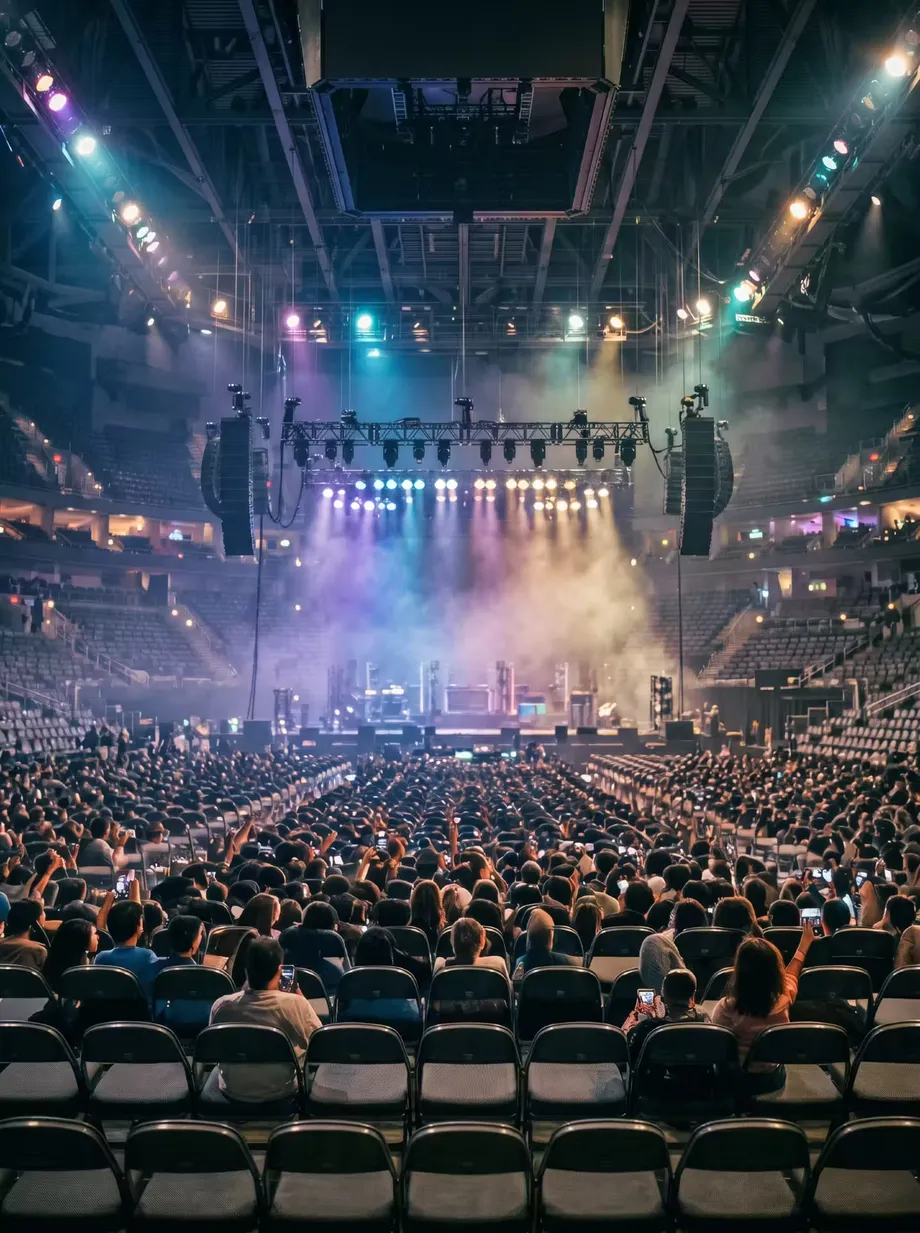
Hundreds of people queued in Hong Kong on October 13, 2026, to see Vincent van Gogh's Chestnut Trees in Blossom, a painting last publicly exhibited at New York's Solomon R. Guggenheim Museum in 1964. Its return to public view comes ahead of a November 18 auction at Sotheby's in New York, where the expected price is around $180 million before fees.
Contents
- A rare public appearance before a possible record sale
- What the $180 million estimate actually means
- Why this painting is scarce even among Van Goghs
- A familiar street transformed by colour
- Hopeful colour or a more troubling scene?
- From the Van Gogh family to private collectors
- The collection and its legal history
- The route from London to New York
- What the auction will establish
- Key Points
Painted in May 1890 in Auvers-sur-Oise, during the final two months of Van Gogh's life, the work belongs to a group of 12 paintings from the collection of the late Argentine collectors Nelly Arrieta de Blaquier and Carlos Pedro Blaquier. The group is expected to raise around $450 million and includes works by Claude Monet, Paul Cézanne, Camille Pissarro, Pierre-Auguste Renoir, Edgar Degas and Paul Gauguin.
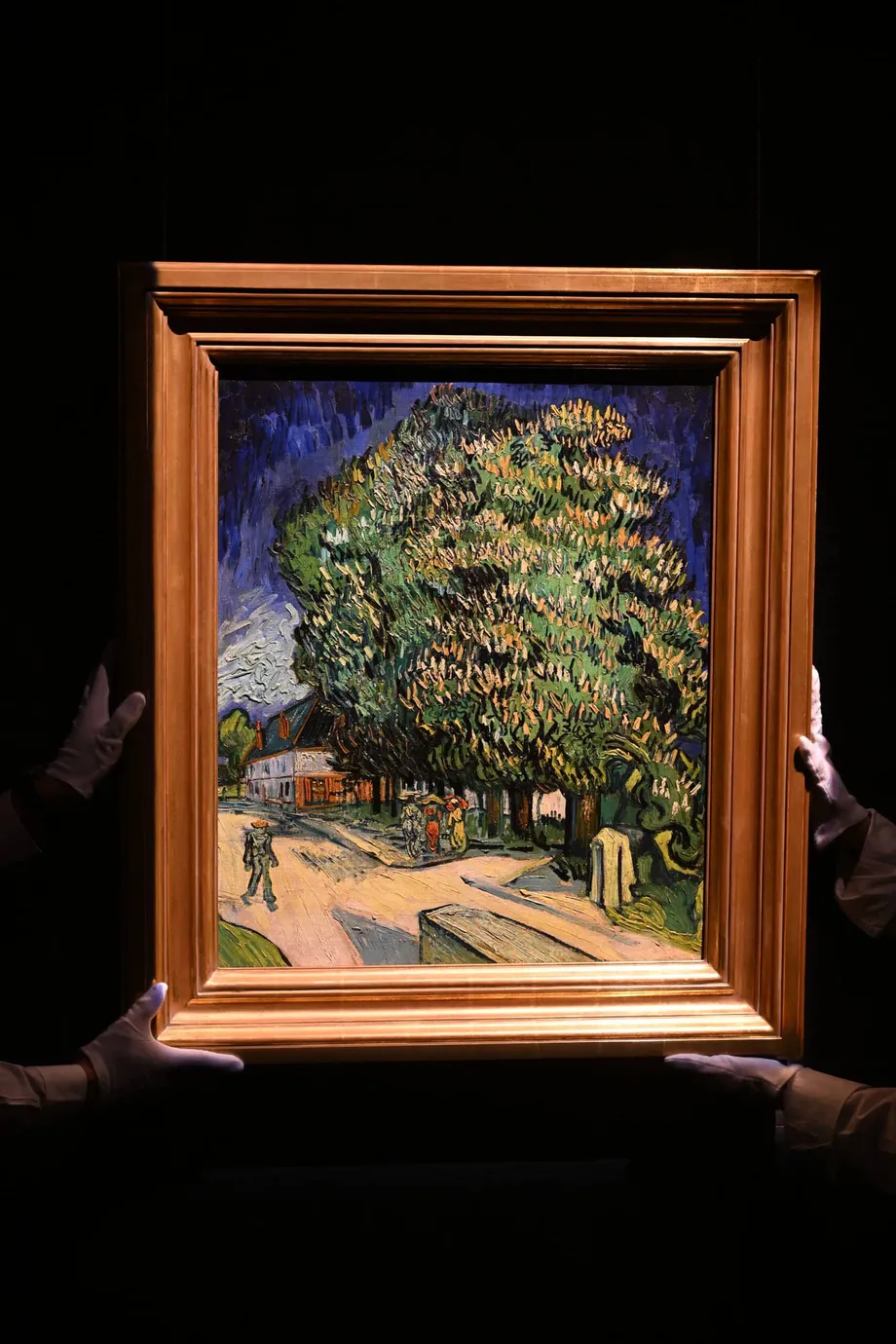
The painting's French title is Châtaigniers en fleurs. Its English title also appears as Blossoming Chestnut Trees. A flowering canopy dominates the scene, above a solitary man and three women carrying parasols. Thick paint and strong contrasts of colour have prompted sharply different readings of its mood, from renewed optimism to isolation.
For visitors, the immediate attraction was the chance to encounter a little seen Van Gogh rather than an auction statistic. Li Shanshan, a 50-year-old art lover from Shenzhen, travelled about two and a half hours to see it. She explained why she had made the journey:
I'd never heard of this painting before, so I wanted to see it with my own eyes.
The queue demonstrated public interest. Whether that interest translates into bidding at the expected price will be decided in New York.
What the $180 million estimate actually means
The expected $180 million figure is a hammer price, the amount reached when the auctioneer accepts the winning bid. The buyer's premium, a fee charged by the auction house on top of that bid, would bring the reported total to approximately $207 million.
That distinction matters when comparing the painting with the existing Van Gogh auction record. Orchard with Cypresses sold for $117.2 million, including fees, at Christie's in New York in 2022. A $207 million total for Chestnut Trees in Blossom would exceed that record by $89.8 million, or about 77 percent. It is a projection, not an achieved sale price.
Sotheby's has guaranteed the painting for an undisclosed sum. A guarantee establishes a financial commitment to the seller under the sale agreement, but it does not establish that bidders will reach the estimate. Neither the guarantee amount nor the eventual buyer is known.
The auction record is also different from a private sale price. Another Van Gogh from the family collection, Seated Zouave, was reportedly sold privately through Christie's in November 2025 for $190 million. That figure probably included fees, although the terms were not publicly confirmed. It cannot be treated as an auction result or compared with a hammer estimate without that qualification.
Why this painting is scarce even among Van Goghs
Chestnut Trees in Blossom comes from an unusually productive period. After leaving the psychiatric asylum at Saint-Rémy-de-Provence, where he had painted The Starry Night, Van Gogh produced approximately 70 works during his final weeks in Auvers-sur-Oise. Accounts describe a pace of about one painting a day, with some putting it above that rate.
The approximately 70 works cover more than landscapes. Of the 50 landscape paintings associated with his Auvers period, only eight are reported to remain in private hands. That is 16 percent of the group, helping explain why an important example reaching auction attracts attention from collectors and institutions.
This canvas is also one of four works Van Gogh made on the chestnut tree theme. Its significance rests on that place within his final output, its long absence from exhibitions and its painted surface, rather than simply on the artist's name.
Scott Niichel, a Sotheby's vice chairman working with its modern and contemporary art department in New York, described the painting as an expression of creative energy:
This is a moment of extraordinary optimism, frenetic energy, enthusiasm, passion, and colour in the artist's body of work.
A familiar street transformed by colour
Van Gogh painted the scene in Auvers-sur-Oise, a village roughly 30 kilometres northwest of Paris. On May 25, 1890, he wrote to his brother Theo that he had just completed "a study of chestnut trees". That brief reference helps place the work in the first days after his arrival.
The composition combines a recognisable local setting with a highly expressive treatment of nature. Deep blue areas of sky contrast with orange, yellow and cream marks representing blossom. Beneath the trees, the figures are small against the flowering canopy, while a building anchors the street scene.
Van Gogh specialist Martin Bailey identifies the building as a bar close to the inn where the artist stayed. Explaining why Van Gogh may have known it well, Bailey said:
Being only two minutes' walk from the auberge where Van Gogh was staying, he is likely to have been a regular customer, particularly as it sold tobacco, which he needed frequently for his pipe.
The building remains a bar and tobacco shop, now called Le Balto, at 19 Rue du Général de Gaulle. A postcard from around 1920 shows a comparable view of the location. By around 1900, most of the horse chestnut trees had been removed to make way for a post office, so the painting preserves a streetscape that soon changed.
Hopeful colour or a more troubling scene?
Niichel's account stresses the painting's hopeful character and thick layers of paint. Discussing the artist's pace of work, the Sotheby's vice chairman said:
This manic frenzy of paint application suggests he has so much more to give, and he's just racing to put it to canvas.
That is an interpretation of the painted surface, not a medical assessment. Van Gogh died aged 37 on July 29, 1890, two days after shooting himself in the chest. Knowledge of his death can influence how viewers read a painting made only weeks earlier.
Art critic Alastair Sooke offers a darker interpretation. He points to the deep blue sky, the separation between the solitary man and the women, and unidentified forms that resemble a tombstone or coffin. He also suggests that the man in blue clothes and a straw hat may represent Van Gogh himself.
Those identities and meanings are not established facts. The women and their parasols evoke Japanese prints, which Van Gogh admired and collected, but the scene is not evidence of a literal encounter with Japanese visitors. Accounts describing Japanese clothing and those stressing the parasols offer different levels of interpretation. No detailed explanation by Van Gogh settles the painting's mood or the identity of its figures.
From the Van Gogh family to private collectors
After Van Gogh's death, the painting passed to his brother Theo and then to Theo's widow, Johanna van Gogh-Bonger, also known as Jo Bonger. Shorter ownership histories include their son Vincent Willem in this family succession. A more detailed account records Jo's sale of the painting through a dealer in 1905 to the fourth Prince de Wagram, a member of the French Rothschild family.
The detailed history then places its purchase by Berlin publisher Samuel Fischer in 1909. Fischer founded S. Fischer Verlag. After his death in 1934, the painting passed to his daughter Brigitte. Because the family suffered persecution for their Jewish heritage, the circumstances of its later disposal are an important part of the ownership review.
Sotheby's says its recent research has satisfied the auction house that the Fischer family was free at all times to dispose of the painting. That is the auction house's stated conclusion. It should not be confused with a court ruling.
Henriette and Marcel Kapferer bought the work in 1936. Marcel headed Royal Dutch Shell's business in France. After another sale, it reached George "Buddy" DeSylva, the Hollywood songwriter, film producer and Capitol Records cofounder, in 1945.
New York collector Harriet Harris-Jonas acquired it in 1953. Her collection attracted enough interest for the Metropolitan Museum of Art to arrange patron visits to her Fifth Avenue apartment. The Blaquier family bought the painting from dealer Wildenstein in 1975, beginning the long period of family ownership preceding the present sale.
The collection and its legal history
Nelly Arrieta de Blaquier died in 2020 and Carlos Pedro Blaquier in 2023. The paintings passed to their children. The couple's wealth came from an Argentine sugar business, and the sale brings together works that had largely remained outside public view.
The family history also includes serious legal allegations. Carlos Pedro Blaquier was indicted in 2012 over alleged participation in 29 cases of unlawful detention of leftist activists in 1976, during Argentina's military dictatorship. Security forces were alleged to have used trucks supplied by his sugar company to round up victims who were subsequently interrogated and tortured. He denied wrongdoing and died before his trial.
A separate customs dispute concerned the movement of the paintings themselves. Argentine customs officials fined descendants in 2023 over the export of artworks, including the Van Gogh, to Luxembourg. The penalty was waived in July 2026, clearing the way for the November auction.
These are distinct matters: the allegations against Carlos Pedro Blaquier concerned events during the dictatorship, while the later customs proceedings concerned the descendants and exported artworks. Neither should be presented as a finding about the painting's earlier European ownership.
The route from London to New York
The Hong Kong display is part of a series of previews intended to bring the collection before potential buyers and the public. Five works were unveiled in London in late September, including Cézanne's Arlequin and Monet's Le Jardin des Tuileries.
The announced exhibition and auction sequence is:
- Late September 2026: Five works from the collection unveiled in London.
- October 5 and 6: Taipei preview scheduled.
- October 13 to 15: Hong Kong preview, with hundreds queuing on the opening Tuesday.
- November 7 to 17: New York exhibition scheduled.
- November 18: Auction in New York.
The stops in Taipei and Hong Kong show that Sotheby's is seeking attention in East Asia as well as in Europe and the United States. They do not establish where the winning bidder will be based.
Niichel, discussing possible buyers, linked the Hong Kong unveiling to interest from the region:
Our revealing in Hong Kong suggests that Asia is certainly a possibility.
No buyer has been identified. The New York preview is the next announced opportunity to see the painting before the sale.
What the auction will establish
The November 18 sale will test demand for a scarce Van Gogh alongside 11 other works from a substantial private collection. The expected $180 million hammer price represents 40 percent of the collection's reported $450 million valuation, although the fee basis for the collection total has not been specified. The Van Gogh is therefore the central financial attraction, but that proportion is only indicative.
Competition for exceptional paintings can persist during broader economic uncertainty. Even so, a strong result for one guaranteed work would demonstrate demand for that painting, not prove that every part of the art market is healthy.
The auction will establish the accepted bid and the published total with fees. It may not reveal the buyer's identity or whether the painting will enter a museum, remain in a private collection or become available for future public loans.
For now, its return offers something the price forecast cannot measure: a chance to inspect a work that had not been publicly exhibited since 1964. The crowds in Hong Kong and the competing readings of the scene show why that return matters independently of a possible record.
Key Points
- Hundreds queued in Hong Kong on October 13, 2026, to view Van Gogh's Chestnut Trees in Blossom.
- Painted in May 1890, it was last publicly exhibited at the Guggenheim Museum in 1964.
- Sotheby's expects about $180 million before fees, or approximately $207 million including the buyer's premium.
- The existing Van Gogh auction record is $117.2 million, including fees, for Orchard with Cypresses in 2022.
- The painting is guaranteed for an undisclosed sum and is part of a 12 work collection expected to raise around $450 million.
- The New York preview is scheduled for November 7 to 17, followed by the November 18 auction.
- The winning bidder, final price and future public access are not yet known.