A decade of finance to remake Korean manufacturing
South Korea has announced a roughly 1,000 trillion won ($747 billion) green transition strategy for 2026 to 2035, combining 200 trillion won in fiscal spending with more than 790 trillion won in climate finance. Unveiled on October 7, 2026, at the Korea Chamber of Commerce and Industry in Seoul, the Korean Green Transformation strategy, known as K-GX, connects industrial investment with renewable power, transport electrification and changes to household heating.
Contents
- A decade of finance to remake Korean manufacturing
- What the 1,000 trillion won package actually contains
- Renewables must expand much faster than before
- More capacity does not automatically mean cleaner electricity
- Hydrogen steelmaking has several different milestones
- Hydrogen supply and factory closures need firmer schedules
- Other factories face transitions extending beyond 2035
- Vehicle subsidies would connect cleaner cars with cleaner steel
- Regional projects target batteries, solar and nuclear equipment
- Heating, jobs and the next decisions
- Key Points
The headline targets are substantial: renewable generating capacity of 100 gigawatts by 2030, electric and hydrogen vehicles accounting for more than 70% of new vehicle sales by 2035, and a hydrogen steelmaking demonstration capable of producing 300,000 tons annually by 2030. Companies also plan approximately 220 trillion won in signature projects spread across regions.
Hydrogen is one of 10 industries selected for support, alongside electric vehicles, batteries, solar, wind, small modular reactors, power equipment, power semiconductors, heat pumps, and carbon capture, utilization and storage. The strategy aims to make Korea one of the world's three leading green manufacturing powers, rather than treating emissions reduction as a separate environmental program.
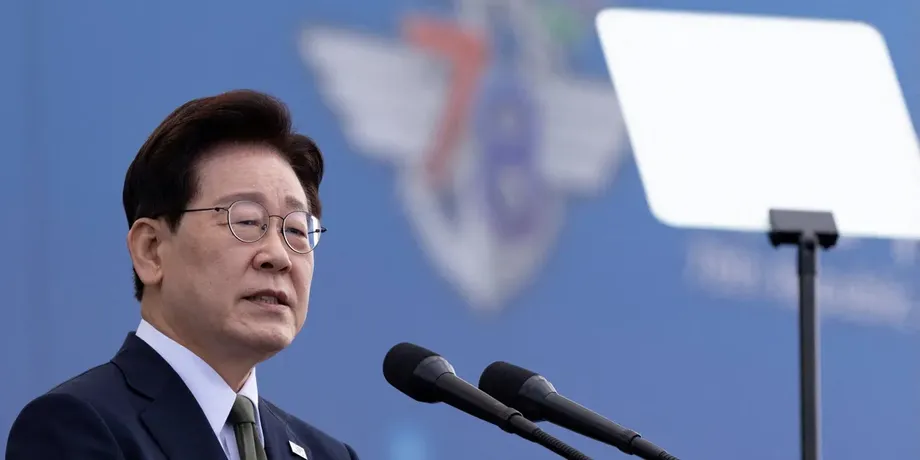
President Lee Jae Myung framed the transition as both an economic and a public protection strategy at the briefing.
"The green transition is a sure strategy for the future that will secure international competitiveness while protecting people's lives and livelihoods from the climate crisis," President Lee Jae Myung said.
The scale of financing is clearer than several of the implementation schedules. Industrial roadmaps expected in December will need to explain how new technologies replace existing equipment, when supporting infrastructure arrives and what companies must deliver in return for public support.
What the 1,000 trillion won package actually contains
The package is not simply a promise to spend 1,000 trillion won from the national budget. Fiscal spending accounts for 200 trillion won, or about 20% of the headline total. Climate finance accounts for approximately 79%, with additional resources intended to bring the package to roughly 1,000 trillion won. The two specified components total 990 trillion won before those additions.
Climate finance includes loans and guarantees supplied through five policy finance institutions: the Korea Development Bank, Industrial Bank of Korea, Export Import Bank of Korea, Korea Credit Guarantee Fund and Korea Technology Finance Corporation. Such financing supports investment but differs from a grant or a direct budget payment.
More than half of climate financing is intended for regions outside the Seoul metropolitan area, while at least 70% is directed toward small and medium enterprises and midsize companies. These categories overlap. A regional manufacturer could qualify under both, so the percentages should not be added together.
The government plans to expand the Climate Response Fund, establish detailed green government bond arrangements by the first half of 2027 and issue its first such bonds in 2028. Green bonds raise money for designated environmental projects; their credibility depends on identifying eligible spending and documenting results.
Reports differ on the dollar equivalent. Most put 1,000 trillion won at approximately $747 billion, while one gives $700 billion. The won amount is consistent. Reports also describe the 220 trillion won corporate project portfolio without establishing whether every commitment is included in, supported by or additional to the main financing package. Adding the two headline totals would therefore risk double counting.
Renewables must expand much faster than before
The strategy would increase renewable capacity from 37 GW in 2025 to 100 GW in 2030. The planned mix is 87 GW of solar, 9 GW of wind and 4 GW from other renewable technologies. Solar would consequently account for 87% of the target capacity.
That requires an additional 63 GW over five years, an average of 12.6 GW annually. Recent annual additions have been around 3 to 4 GW. On those figures, the required average construction pace is roughly three to four times the recent rate. This is a comparison of installed generating capacity, not electricity actually produced.
The government intends to identify sites on factory roofs and agricultural land, reduce generation costs and replace existing transmission cables with equipment capable of carrying more electricity by 2030. Direct current transmission and distribution would help connect renewable generation clusters with consumers. Regional industrial electricity pricing is also being considered, taking transmission costs and regional development into account.
A separate projection announced in August envisaged 220 GW of commercial renewable capacity by 2040, including 155 GW of solar and 61 GW of wind. That longer horizon makes the 2030 target an intermediate step rather than the endpoint.
More capacity does not automatically mean cleaner electricity
The government also aims for renewables to supply more than 30% of electricity generation by 2035. Capacity measured in gigawatts describes how much equipment can produce at a given moment. Generation measured in terawatt hours describes electricity produced over time. Solar and wind output varies, so their share of installed capacity is not the same as their share of annual electricity supply.
Electricity demand is rising as industrial processes, vehicles and heating move away from direct fossil fuel use. Reported forecasts put consumption at 566.1 TWh in 2025, 735.1 TWh in 2038 and a provisional 847.3 TWh in 2040. The last figure is almost 50% above the 2025 level.
Grid expansion, storage and flexible operation therefore matter alongside new generating equipment. Recent summer operations illustrate the problem: coal generation increased while gas generation fell, with more frequent adjustments at power plants associated with days of lower solar output. Building renewables does not by itself guarantee that fossil generation falls immediately.
The Korea Institute of Finance has recommended electricity pricing reforms, standardized contracts and consistent policy signals to attract private capital. Long term power purchase agreements can give generators more predictable revenue. Contracts for difference can settle the gap between an agreed price and a market price. Both can make large infrastructure investments easier to finance when their terms are credible and stable.
Hydrogen steelmaking has several different milestones
Steel is a central target because its emissions are large. Provisional figures put the sector's annual greenhouse gas emissions at 94.9 million tons, compared with national emissions of 685.7 million tons, a share of about 13.8%.
Hydrogen reduction uses hydrogen instead of coal to remove oxygen from iron ore. Its climate benefit depends on the emissions associated with producing the hydrogen and supplying the electricity used across the process. Replacing the reducing agent is therefore only part of the industrial change.
POSCO Holdings plans a hydrogen steelmaking cluster centered on Pohang. The main sequence calls for a demonstration at 300,000 tons annually by 2030, expansion toward 2.5 million tons during 2031 to 2036, phased transition from 2037 and complete conversion by 2050. A corporate project account places the 2.5 million ton capacity milestone specifically in 2035.
Reports differ on what 2030 represents. Some describe an ambition for the world's first commercial hydrogen steel production or mass production by that date. Others identify 2030 as a demonstration milestone and place commercialization from 2037. Those are materially different stages, and the distinction has not been resolved by a single consistent schedule.
The government also plans support for renewable electricity linked electrolysis installations of at least 50 megawatts and a 10 MW nuclear electricity linked hydrogen demonstration. Electrolysis splits water into hydrogen and oxygen using electricity. Hydrogen produced using nuclear power is sometimes called pink hydrogen.
Hydrogen supply and factory closures need firmer schedules
The climate nonprofit Climate Solutions argues that technology targets do not yet establish a concrete route for replacing existing industrial equipment. For steel, it calls for individual facility schedules linking hydrogen plants to blast furnace closures.
The group points to a November 2025 industrial plan proposing replacement of 11 existing blast furnaces with 15 hydrogen reduction facilities by 2050. It says K-GX does not specify the hydrogen volumes, delivery dates and intermediate targets needed by steel producers, or make clear which transition and emissions outcomes will be conditions of government support.
One account of the signature projects gives a clean hydrogen capacity target rising from about 1 million to 150 million tons annually by 2035. That unusually large figure is not corroborated elsewhere in the reporting and should not be treated as a settled national target without confirmation of its units and scope. The uncertainty is especially relevant when hydrogen supply is a prerequisite for the steel timetable.
Related targets include 3.6 million tons of low carbon electric furnace steel production by 2035 and introduction of low carbon steel certification in 2027. Climate Solutions says the certification criteria and procedures delegated under the K Steel law implemented in 2026 have not yet been published.
These details determine whether support creates additional production or actually replaces more polluting output. New equipment, affordable clean hydrogen, reliable electricity and retirement of old facilities have to progress together for the strategy to deliver the intended emissions reductions.
Other factories face transitions extending beyond 2035
The strategy identifies five major industrial groups for process changes: steel, petrochemicals, cement, semiconductors and displays, and refining. Displays are grouped with semiconductors in the fuller descriptions of the five sectors.
Petrochemical producers are to develop electric naphtha cracking, replacing fossil fuel heat used to break feedstock into chemical building blocks. Core technology is targeted for 2028, large demonstrations for 2029 to 2037 and commercialization from 2040. Climate Solutions says demonstration sizes and participating facilities are unspecified and highlights the roughly three year interval between demonstration completion and commercialization.
The share of biological and recycled petrochemical feedstocks is targeted to rise from 0.5% to 10% by 2035, a twentyfold increase. Refining plans include a sustainable aviation fuel blending share of 7% to 10% by 2035.
Cement producers would raise the share of lower emission blended cement from 16% to 40% by 2035. This uses more supplementary materials and less clinker, the main cement ingredient whose manufacture releases substantial carbon dioxide. Semiconductor and display companies would develop alternatives to process gases with high warming effects, with commercialization targeted for 2040 and a stated annual emissions reduction goal of 50,000 tons.
Vehicle subsidies would connect cleaner cars with cleaner steel
Electric and hydrogen vehicles are targeted to exceed 50% of new vehicles by 2030 and 70% by 2035. Most reports describe new vehicle sales, while another uses newly registered vehicles. Neither measure means 70% of all vehicles already on Korean roads.
The government is considering extra support for electric vehicles made with low carbon steel, linking demand for cleaner industrial materials to transport policy. Electric vehicle subsidies could also vary according to regional renewable generation. Other proposals include an electricity fuel subsidy, battery leasing and greater assistance for drivers replacing combustion vehicles.
Corporate electric and hydrogen vehicle depreciation allowances could rise from 8 million won to 10 million won annually. New corporate taxis would all become electric from 2035 under a proposed measure. Korea also aims to improve its global electric vehicle market position from eighth, with a reported 3.8% share, to third by 2035, although no numerical market share target for that ranking is given.
Electrification would extend to buses, railways, motorcycles, construction machinery, ports and vessels. Working with delivery platform operator Woowa Brothers and other companies, the government aims for electric models to account for 60% of all two wheelers by 2035. Jeju has a separate ambition for all new vehicles on the island to be electric by that year.
Shipping plans include a 1 trillion won clean fuel infrastructure fund and a fuel supply hub at Ulsan Port. Climate Solutions says the plans need clearer financing milestones, operating cost support for alternative fuels and transition schedules for container and bulk ships, rather than concentrating mainly on financing new vessels.
Regional projects target batteries, solar and nuclear equipment
The corporate signature projects attach named companies and locations to the industrial strategy. Hanwha Qcells plans a tandem solar cell production line with annual capacity of 1 GW in Jincheon and Eumseong. Tandem cells stack different materials, including perovskite and silicon, to capture more sunlight than a conventional single layer cell.
The government targets tandem cell commercialization and mass production in 2028 and the largest global market share in that technology by 2035. The starting position is modest: Korean companies reportedly hold 4% of the domestic solar cell market and 0.6% globally.
Battery targets include commercial all solid state technology in 2027 and sodium ion batteries in 2030. LG Energy Solution plans a sodium battery storage pilot line in Ochang and a 10 MW demonstration on Jeju by 2029. Sodium batteries are intended to compete in stationary electricity storage, including against lithium iron phosphate products.
Eight wind companies, including Doosan Enerbility, Unison and SK Oceanplant, plan about 3 trillion won in private investment in a domestic supply chain. Projects include turbines of at least 20 MW, expansion of support quays from four berths to 13 and an increase in dedicated installation vessels from two to six.
Doosan Enerbility plans a small modular reactor manufacturing base in Changwon capable of supplying more than 20 units annually, with construction scheduled during 2026 to 2030. Korea separately targets deployment of its first innovative small modular reactor in 2035. Manufacturing capacity and reactor deployment are distinct milestones.
LS Cable & System, Hyosung Heavy Industries, Taihan Cable & Solution and HD Hyundai Electric will work on domestic production of major grid equipment, including submarine direct current cables. Power semiconductor commercialization is targeted for 2029. Proposed tax credits for domestic solar, wind and battery components, together with strategic technology status for small modular reactors, are intended to support these supply chains.
Heating, jobs and the next decisions
Buildings form another substantial part of K-GX. The government aims to deploy 3.5 million heat pumps by 2035, with a stated emissions reduction goal of 5.18 million tons. Heat pumps use electricity to move heat rather than generate it through combustion, and can provide both heating and cooling.
Samsung Electronics plans a domestic supply base by 2027 and wider deployment in 2028 and 2029. LG Electronics plans to expand production around Changwon and connect heat pumps with solar, storage and home energy management. Its Smart Cottage model combines these systems in a home designed to manage its own energy production and consumption.
The government intends to redirect fossil fuel heating support toward heat pumps and require green renovations of public buildings with high energy consumption. Naju would become an energy industry hub centered on Korea Electric Power Corporation and the Korea Institute of Energy Technology.
Worker measures include proposed Just Transition Zones providing vocational training and incentives, a 2040 Coal Power Plant Transition Roadmap, and training for approximately 70,000 green industry specialists by 2030. The coal roadmap's name should not be read as a finalized schedule for every plant closure.
The next decisions include industry roadmaps expected in December 2026, proposed tax legislation changes in the first quarter of 2027 and green bond arrangements by the first half of 2027. Promising climate technology companies could receive support packages worth up to 10 billion won, with targets of 30 potential unicorns by 2030 and 10 unicorn companies by 2035.
A government and business council chaired by the deputy prime minister for economic affairs will monitor implementation. The key test is whether those reviews connect financing to measurable emissions reductions, infrastructure delivery and replacement of existing facilities, rather than simply recording money committed and technologies announced.
Key Points
- K-GX covers 2026 to 2035, with roughly 1,000 trillion won in fiscal resources and climate finance.
- The main components are 200 trillion won in fiscal spending and more than 790 trillion won in financing, including loans and guarantees.
- Renewable capacity is targeted to rise from 37 GW in 2025 to 100 GW in 2030.
- Electric and hydrogen vehicles are targeted to exceed 70% of new vehicle sales by 2035.
- Hydrogen steelmaking targets include a 300,000 ton demonstration by 2030, but reports differ on the commercialization date.
- Companies plan approximately 220 trillion won in regional signature projects; its precise relationship to the main package is not established.
- December industrial roadmaps and 2027 financing decisions are expected to clarify execution, support conditions and transition schedules.