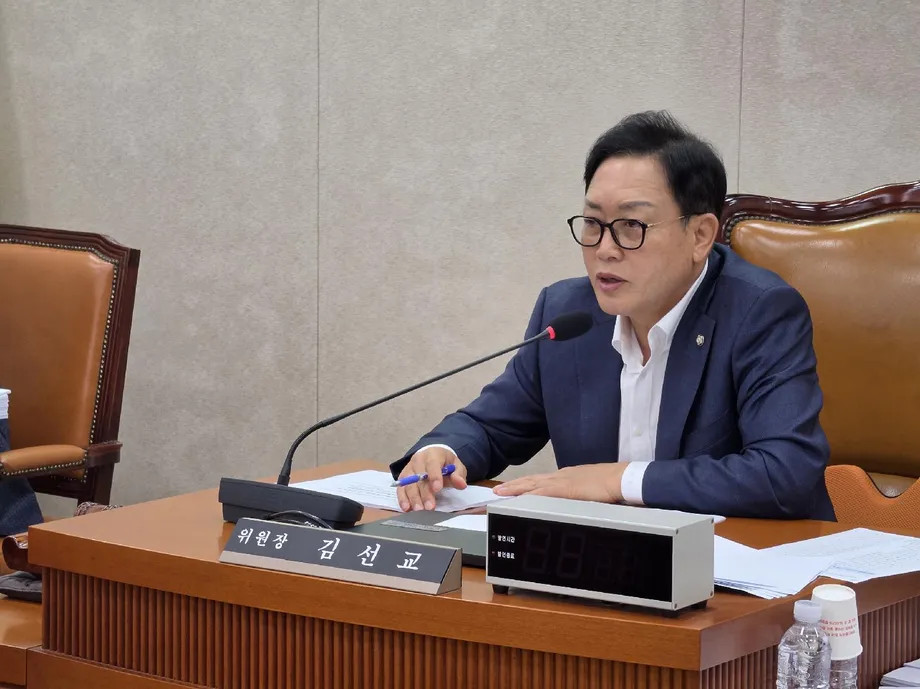
A price forecast meets a widening supply gap
South Korea's main public housing developer faced a stark challenge at the National Assembly on October 12, 2026: explain why only 13,293 homes had reached the reported construction start stage against an annual target of 51,783, while its president was urging tighter mortgage lending and predicting a possible sharp fall in house prices.
Contents
- A price forecast meets a widening supply gap
- What Lee said about mortgages
- Lawmakers challenge the advice to wait
- Can the remaining construction target be met?
- Approvals and applications are already delayed
- What counts as a construction start?
- Debt forecasts differ, but point in the same direction
- Restructuring, staffing and rents complicate delivery
- A fast industrial project brings another cost debate
- Who would carry the industrial development cost?
- Quality, personal property and the next milestones
- Key Points
Lee Sung-hoon, president of the Korea Land & Housing Corporation (LH), defended his outlook before the assembly's Land, Infrastructure and Transport Committee. Seoul apartment sale prices had risen for 87 consecutive weeks, according to the Korea Real Estate Board figures cited during the controversy, leaving prospective buyers worried about being priced out.
Lee argued that increasing supply and high interest rates could reverse that pressure. He also said households would begin to feel the effect of LH's supply from 2028, a timetable that separates his reassurance to buyers today from the delivery of housing they can actually use.
The hearing extended beyond his price forecast. Lawmakers from both the ruling Democratic Party and the opposition People Power Party questioned construction delays, the meaning of reported starts, organizational restructuring, rising debt and an industrial development estimated to cost 9 trillion won.
Several figures describe different programs rather than a single supply total. The 51,783 target concerns construction based public housing. Lee separately outlined plans for 96,000 starts nationwide, including 86,000 in greater Seoul. Another figure discussed was a government supply target of 115,000 homes. The relationship between those broader totals was not fully explained at the hearing.
What Lee said about mortgages
The dispute began at a September 30 briefing at the advanced system semiconductor national industrial complex site in Yongin, Gyeonggi Province. Lee suggested discussing a further reduction in the 600 million won mortgage ceiling for homes priced at 1.5 billion won or less.
He also questioned whether allowing people buying their first home to borrow up to 70% of the property's value encouraged competitive purchasing. That percentage is the loan to value ratio, or LTV. It measures a mortgage against the property's value, but a separate monetary ceiling can still limit the amount a buyer receives.
The lending limits discussed were 600 million won for homes worth up to 1.5 billion won, 400 million won for homes above 1.5 billion and up to 2.5 billion won, and 200 million won for homes above 2.5 billion won in regulated areas. Lee's comments were a proposal for discussion, not an announcement of a new lending rule.
At the audit, Lee said he retained his personal view but apologized for discussing financial regulation outside LH's responsibilities. He explicitly distinguished his position from government policy.
Lee, whose agency builds and manages public housing rather than sets mortgage rules, explained that distinction:
This is not the government's policy stance, but my own view.
Lawmakers challenge the advice to wait
Kim Eun-hye of the People Power Party pressed Lee on how young people and newly married couples could buy homes if access to borrowing were reduced. Eom Tae-young, also of the People Power Party, challenged whether ordinary households could purchase homes with cash and warned against using delayed supply to justify lending restrictions.
Chung Il-young of the Democratic Party said suppressing demand was not the LH president's role. Fellow Democratic Party lawmaker Bok Ki-wang noted that Lee had previously served as the presidential secretary for land and transport, but now headed LH. His comments could therefore be mistaken for a policy decision.
Lee responded by linking his advice to his expectation of lower prices. He said the decline after the 2021 price peak, which he attributed to high interest rates, could happen again.
Explaining why buyers might not need to rush, Lee told the committee:
If the market stabilizes, you do not lose out by not buying a home right now.
That reassurance depends on a forecast rather than an established outcome. Lee gave no date or numerical estimate for a price decline. He said he did not know when prices would turn, although he considered a reversal a matter of time. Asked whether he would resign if prices were not brought under control, he agreed.
Can the remaining construction target be met?
People Power Party lawmaker Jeong Hee-yong said LH had recorded 13,293 construction starts by October 2, or 25.7% of its 51,783 annual target. That leaves 38,490 homes, roughly three times the recorded total, to reach the target before the end of the year.
Lee maintained that the target remained achievable. He said many projects were at the Public Procurement Service's contractor selection stage and could begin once selection was complete. Projects involving private partners had also largely selected preferred bidders, leaving substantial volumes capable of starting in November or December.
The difference between that explanation and the lawmakers' concern is practical: projects approaching contract award may support an annual forecast, but they have not necessarily become active building sites.
Lee acknowledged that concentrating starts at the end of the year was a problem and said he would consider ways to spread them more evenly, including discussions with the assembly.
A separate acquisition rental program was also behind schedule. Democratic Party lawmaker Kim Nam-geun said progress through August amounted to just 13% of an annual 18,000 home target. He warned that LH would carry a substantial share of a public housing goal of 1.19 million homes through 2030, making weak delivery a concern even if late activity improved the annual result.
Approvals and applications are already delayed
The backlog extends beyond this year's target. Jeong said 209,270 homes nationwide had received project plan approval but had not started construction as of August. Within that total, 23,802 had been approved before 2022, about 11.4% of the backlog.
Approval is an administrative milestone, not a completed home. Contractor selection, site work and construction must follow before households can move in. A large approved pipeline therefore does not automatically mean housing will arrive soon.
Jeong also said the main application stage had been delayed in 70 of 99 public housing blocks in the capital region, approximately 70.7%. The average delay was 12.8 months.
Those delays affect households that had relied on schedules announced during preliminary applications. Lee acknowledged that LH had not always been sufficiently active in resolving complaints and said employees had been instructed to address them faster. He also promised to catch up on delayed projects approved in 2022 and 2023.
What counts as a construction start?
Kim Jung-jae of the People Power Party challenged LH's practice of counting projects as started once construction commencement paperwork had been accepted, even before physical work began. She accused the agency of inflating performance and questioned its separate use of the term actual construction start.
Lee disputed the allegation, saying the reporting method was longstanding. He nevertheless accepted that the terminology had caused confusion and promised to change it. That leaves a substantive distinction for readers: an administrative start and workers beginning construction are not necessarily the same event.
Figures for newly built acquisition rental homes in greater Seoul illustrate the issue. By the end of September, recorded starts were 11,277 against a target of 40,085, or 28.1%. These figures concern a different program and should not be added to the 13,293 construction based public housing figure without checking for overlap.
LH planned approximately 29,000 starts in that program during the fourth quarter, with about 21,000, roughly 72%, proceeding through an accelerated start procedure. That procedure allows construction cost verification and changes to acquisition agreements to follow the commencement filing.
Lawmakers warned that the gap between receiving the commencement certificate and beginning physical work could reach six months. Meeting a paperwork target at the end of December would therefore not necessarily demonstrate the same amount of construction activity on the ground.
Debt forecasts differ, but point in the same direction
Figures attributed to the public institution disclosure system ALIO put LH's debt at 173.6567 trillion won at the end of the previous year, with a debt to equity ratio of 230.79%. That ratio means liabilities were about 2.31 times equity. It is not, by itself, a declaration that an institution cannot meet its obligations.
People Power Party lawmaker Yoo Sang-bum cited debt of approximately 197 trillion won this year and a projected 372 trillion won by 2030. Another lawmaker, Shin Sung-bum, cited a 2030 projection of 373 trillion won. The accounts differ by 1 trillion won, and no reconciliation was given.
Using Yoo's figures, the projected increase is 175 trillion won, or about 88.8%. Yoo also questioned how LH could supply 940,000 rental homes while its interest coverage ratio was negative. That ratio compares earnings with interest costs; a negative result indicates that the earnings measure used does not cover interest. His description of LH as a zombie company was a political assessment, not a formal insolvency finding.
Lee attributed financial pressure to compensation for third generation new towns, concentrated construction volumes and building costs that had risen by nearly 50%. He said LH and the land ministry were seeking budget support because debt was growing faster than the agency could recover costs.
Restructuring, staffing and rents complicate delivery
Lawmakers questioned whether separating parts of LH and moving toward direct development of public land would weaken its capacity to supply housing. Yoo warned that the change could undermine the arrangement under which proceeds from land sales helped cover rental housing losses.
Democratic Party lawmaker Kang Deuk-gu raised the risk that a separated asset company could inherit rental losses and debt. People Power Party lawmaker Jeong Dong-man also cited staffing shortages and a threatened general strike by the union. Lee said LH was preparing its views on the proposed separation and reviewing the organization and staffing it would need.
Yeom Tae-young of the Democratic Party called for substantial recruitment as workloads expanded. Lee agreed that both project volumes and the variety of work had grown, and said talks with government departments covered recruitment and employee pay.
Kim Young-kook, the land ministry's head of housing and land policy, said regular staffing had increased by about 400 since 2024 and workers had been reassigned to core projects. He nevertheless acknowledged the need for more staff and said further regular and temporary recruitment would be discussed.
Kim also said the ministry was negotiating higher rental housing support rates with fiscal authorities. Lee argued that much of the future rental expansion would charge rents close to market levels and therefore help LH's finances. That response addresses financial recovery, but does not establish how affordable those homes would be for households with limited incomes.
A fast industrial project brings another cost debate
LH's housing delays were contrasted with the pace of the proposed Honam semiconductor national industrial complex on the former Gwangju military airport site. People Power Party lawmaker Kang Dae-sik questioned why that project moved faster than other national industrial developments.
The site became a candidate on July 29, LH was asked to participate the following day, and design services were commissioned on August 3. The design contractor selection period was shortened from the usual 107 days to 58 days.
Of 30 national industrial complexes for which the land ministry had requested LH participation, 10 were still undergoing reviews of development conditions. Among six projects designated as candidates in 2023 that had reached the design service stage, all except the Yongin semiconductor complex had taken more than a year from the participation request to commissioning.
Kang's office estimated total costs at about 9 trillion won: 5 trillion won to acquire the former airport site and 4 trillion won for development. Assuming 70% of the approximately 2.5 million pyeong site would be sold, the estimated cost was 5.14 million won per pyeong. A pyeong is about 3.3 square meters.
That estimate was about 2.1 times the 2.41 million won industrial land price at Gwangju's Advanced District 3 in 2024, and 6.7 times the 770,000 won price at the Bitgreen national industrial complex in 2020. These comparisons involve different locations and sale years, not identical properties.
Who would carry the industrial development cost?
Kang's office estimated that selling the planned 1.575 million pyeong of industrial land at 4 million won per pyeong would leave a simple gap of approximately 1.7955 trillion won against the estimated unit development cost. At 3 million won, the gap would rise to about 3.3705 trillion won. These are scenario calculations, not confirmed project losses.
The office also questioned an estimated 5 trillion won acquisition price against its assessment of approximately 4 trillion won before development. The military airport relocation arrangement involves constructing and donating a replacement airport to the state in exchange for the former site. How acquisition and development costs are allocated could therefore affect both industrial land prices and public finances.
LH said it intended to accelerate the complex to support semiconductor competitiveness, using parallel procedures where possible. The land ministry said location, industrial strategy and company demand had informed the selection. No final industrial land sale price or settled funding arrangement was identified.
Parallel procedures also feature in Lee's housing plans. At Seoripul and Taereung, LH intends to run permitting, compensation, demolition and site preparation alongside one another to bring groundbreaking forward by more than a year. From 2027, it plans more urban projects through rebuilding older rental housing and using idle land.
Quality, personal property and the next milestones
Housing quality was another concern. Moon Jong-bok of the Democratic Party cited thousands of repair requests at Newlywed Hope Town developments and questioned sanctions against contractors. Lee promised stricter defect and quality management. Mo Gyeong-jong called for measures addressing litigation and debt recovery under construction cost linked acquisition agreements; Lee said a management response was being reviewed.
Lee also promised larger rental homes, more locations near subway stations, and comparable finishing materials and design for rental and sale units. Those plans have to be judged alongside the complaints about existing developments, rather than treated as completed improvements.
Questions about Lee's own properties added pressure to the mortgage dispute. He said a Dogok apartment had been sold in early June and a Sejong apartment sale contract signed in May. LH explained that the Sejong ownership transfer was expected at the end of October because a tenant's contract had not expired.
Lee said he had bought the Sejong apartment for about 800 million won without borrowing and agreed to sell it for slightly more than 1.4 billion won. Kim Mi-ae contrasted that experience with buyers needing 900 million won in cash for a 1.5 billion won home under a 600 million won lending ceiling.
The immediate milestones are concentrated late in the year, while Lee's stated date for households to feel new supply is 2028:
- End of October 2026: expected completion of the Sejong apartment ownership transfer.
- November and December 2026: the construction surge Lee said would support LH's annual target.
- End of 2026: assessment of annual starts, including the distinction between administrative filings and physical construction.
- From 2027: planned expansion of urban groundbreaking.
- 2028: Lee's stated point for households to begin feeling the supply increase.
- 2030: the horizon for the public housing goal and sharply higher debt projections.
Key Points
- Lee called tighter mortgage limits his personal view, not government policy, and apologized for speaking outside LH's remit.
- Reported construction based public housing starts reached 25.7% of the annual target by October 2.
- Lee expects substantial November and December activity, but filing a construction start may precede physical work.
- Lawmakers cited 2030 debt projections of 372 trillion and 373 trillion won.
- LH is seeking more funding and staff while facing scrutiny over restructuring, quality and industrial development costs.
- No date or scale was given for the predicted price decline. Lee identified 2028 as the point when households would feel additional supply.