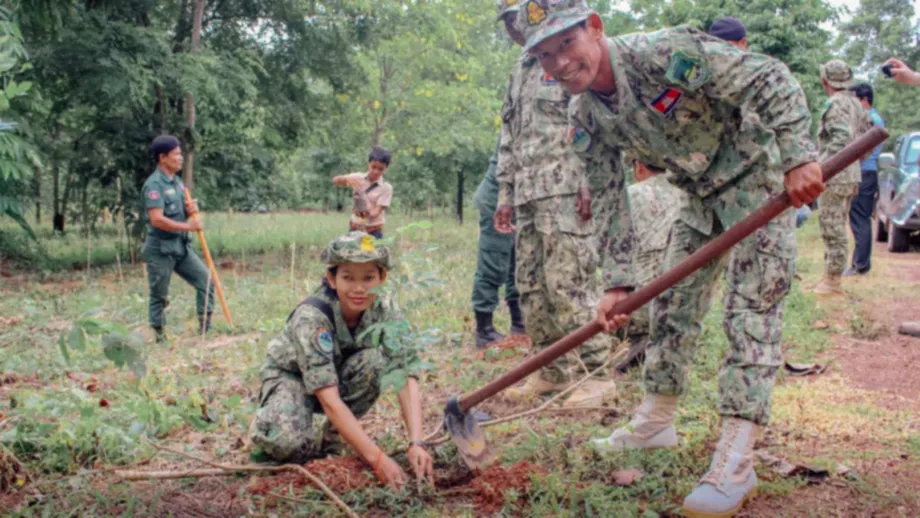
Nearly 7,800 meters of wire removed from a threatened forest
Rangers working with Angelina Jolie's Maddox Foundation removed close to 7,800 meters of wire snares from Cambodia's Samlaut forest in 2025, according to a foundation field note published in June 2026. The haul, roughly 4.8 miles of wire, came from a protected landscape where researchers have documented Asian elephants, Sunda pangolins and dholes, the wild dogs of Asian forests.
Contents
- Nearly 7,800 meters of wire removed from a threatened forest
- From clearing landmines to supporting local rangers
- A protected area connected to forests across the border
- What the cameras recorded, and when
- Hunting risks appeared alongside wildlife
- Bats, birds and orchids broaden the picture
- Honey provides a reason to keep trees standing
- Restoration measured by surviving seedlings
- The next priorities are patrols and better access
- Key Points
The foundation has helped protect the Samlaut Multiple Use Area since 2006, working alongside Cambodia's Ministry of Environment. It describes the area as 60,994 hectares, or 150,720 acres, across Battambang and Pailin provinces near Thailand. Jolie does not own the forest. Its protection is a government responsibility supported by locally recruited rangers, conservation researchers and community programs.
Twenty years into that work, the forest presents two closely connected challenges: keeping animals safe from hunting and keeping their habitat from being cleared. The foundation identifies land encroachment as the biggest pressure, alongside illegal logging and hunting. Removing snares addresses an immediate danger to animals, while protecting trees preserves the places where they feed, shelter and reproduce.
A detailed biodiversity survey gives the clearest picture of what is at stake. Researchers recorded 44 species on cameras, while a dedicated bird team counted 142 species. Other teams documented bats, orchids and plants previously unrecorded in Cambodia. Together, the findings describe a surviving forest whose importance reaches beyond its best known animals.
From clearing landmines to supporting local rangers
Jolie first visited Cambodia in 2000 while filming Lara Croft: Tomb Raider and adopted her son Maddox from an orphanage in Battambang in 2002. The foundation bearing his name began in 2003, initially helping communities clear landmines left by conflict.
Samlaut was a Khmer Rouge stronghold, and about 57,000 people live in the area today. Making land safe allowed families to live and work on it again. The foundation then expanded into conservation, livelihoods, schools and healthcare.
The foundation's history page dates the start of its forest protection work to 2006, when it also established a satellite office in Battambang. Local residents were recruited and trained to patrol against logging and poaching. In 2016, those rangers became government officials under the Ministry of Environment.
A permanent headquarters opened in Samlout in 2018 and became the ranger unit's base. The foundation also describes 11 community forestry schemes across four communes, developed with the Battambang Forestry Administration and local authorities. Its history page places that work under both 2011 and 2017, leaving the precise establishment date unclear.
A protected area connected to forests across the border
King Norodom Sihanouk declared Samlout a protected area in 1993, more than a decade before the foundation began helping protect it. Samlaut and Samlout are spellings used for the same landscape in foundation and research documents.
Fauna & Flora's Samlout Biodiversity Report describes the area as one of the last remnants of forest in northwestern Cambodia. It also identifies its role in maintaining connections with nearby protected areas, including Phnom Samkos Wildlife Sanctuary in Cambodia's Cardamom Mountains and Khlong Kruewai Chalearm Phrakiat Wildlife Sanctuary and Namtok Klong Kaeo National Park in Thailand.
Connected forests give wildlife more room to move between feeding areas and shelter. Clearing a stretch of forest can therefore affect animals beyond the cleared site by breaking the route between remaining habitats. For Samlout, keeping forest cover intact matters both inside the protected boundary and across the wider landscape.
Armed clashes broke out along the Cambodia and Thailand border in July 2025. Samlout's location near that border adds a security concern to conservation work in a region where researchers had already faced restrictions on access during earlier surveys.
What the cameras recorded, and when
Fauna & Flora led the biodiversity surveys between October 2021 and June 2022, in collaboration with Cambodia's Ministry of Environment. The Maddox Jolie-Pitt Foundation commissioned and funded the work, with additional financial support from Fauna & Flora International through the Halcyon Fund.
The institution's report publication page gives December 9, 2024, as the publication date. Although the report carries 2023 in its title and its findings received attention in 2025, the field observations date from 2021 and 2022.
The camera survey recorded 28 mammal species, 15 bird species and one reptile species, making 44 species in total. Twelve were classified as threatened on the International Union for Conservation of Nature Red List: one critically endangered, three endangered and eight vulnerable. Two more were near threatened.
Researchers logged 2,345 independent camera records. They counted a record as independent when at least 30 minutes had passed since the previous recording of that species. Ten records showed Asian elephants at three camera stations, four showed Sunda pangolins at four stations, and three showed dholes at two stations. Those figures count recording events, so an animal returning to a camera could appear more than once.
The main dates show how the conservation program and its evidence developed:
- 1993: King Norodom Sihanouk declared Samlout a protected area.
- 2003: The foundation began its work with Cambodian communities.
- 2006: The foundation took up forest protection responsibilities.
- 2016: Locally trained rangers became Ministry of Environment officials.
- October 2021 to June 2022: Researchers conducted the biodiversity surveys.
- December 9, 2024: Fauna & Flora published the report.
- June 2026: A foundation field note described snare removal during 2025.
Hunting risks appeared alongside wildlife
The cameras also photographed a man carrying a gun and a sambar deer missing a foot. The report's authors judged the injury almost certainly to have resulted from a snare wound. Wire snares tighten around an animal that steps into them and can cause severe injury or death.
The 2025 removal of almost 7.8 kilometers of snare wire shows the scale of material rangers were finding. The foundation's figure measures the length of wire collected; it gives no total number of traps or animals rescued.
Domestic dogs were another concern in the biodiversity report. They appeared at one of the two camera stations where dholes were detected, and the authors identified their presence across the protected area as a substantial threat to the endangered wild dogs.
Three camera records also showed raised skin lesions on gaur, a species of wild cattle. The researchers said these might be symptoms of lumpy skin disease, a viral infection affecting wild and domestic cattle. The images came from one camera station and may have shown the same animal; the report offered no confirmed diagnosis.
Bats, birds and orchids broaden the picture
The dedicated bird surveys, conducted in October 2021 and February 2022, recorded 142 species from 48 families. The report listed the wreathed hornbill as vulnerable and four other bird species as near threatened. Those surveys covered a wider range of birds than cameras placed near the forest floor could capture.
Bat researchers documented at least 21 species. Using the report's national total of 80 known bat species, that represents about 26 percent of Cambodia's recorded bat diversity in this one protected area. The authors expected further sampling to find more, particularly with work during both wet and dry seasons and with several detection methods.
Local authorities told researchers that large cave roosts holding more than 100 bats were unlikely in the area. The report therefore placed special importance on forest roosts. Older trees provide cavities, hollows and crevices, making the retention of mature forest a practical priority for bat protection.
Botanical teams recorded 50 orchid species from 29 genera in November 2021 and added another species in June 2022. They also found two begonias, Begonia afromigrata and Begonia longifolia, that specialists identified as new records for Cambodia.
Orchid collection and forest clearance threatened those plants in different ways. Collectors target attractive or valuable species, while clearing removes shade and the large trees on which some orchids grow. Researchers observed damage associated with road development and agricultural expansion, linking plant conservation directly to the foundation's concern about land encroachment.
Honey provides a reason to keep trees standing
The foundation began training farmers in sustainable beekeeping in 2019 after learning from problems with projects based on collecting wild honey. Women were encouraged to participate from the first year. A 2025 field note put local beekeepers' production at 1,392 liters, or 368 gallons, of honey.
The Maddox Foundation described the connection between this income and conservation in its 2026 field report:
Beekeeping offers something rare: an income that depends on the forest staying intact.
The foundation says honey revenue has discouraged participating farmers from using pesticides on their farms. Its account links a household decision, how to manage crops, with another source of earnings that benefits from healthy bees and forest vegetation.
UNESCO's Women for Bees program also documented Jolie with Cambodian beekeepers in a 2022 video. The local effort places women within the conservation economy as producers earning income, alongside the ranger work focused on enforcement.
Schools and healthcare form another part of that community program. The foundation says dormitories opened at Samlaut high school in 2018 and benefit hundreds of students from remote villages each year. It also built Boeng Ron Health Center in 2009, later adding maternity and eye care wards.
Restoration measured by surviving seedlings
Rangers, forestry officers and villagers checked five replanted sites in the Sangker River Basin in April 2023 with a team from the International Centre for Environmental Management. The foundation reported seedling survival rates ranging from 71 to 94 percent.
Expressed simply, about 71 to 94 of every 100 planted seedlings remained alive at the sites assessed. The 23 percentage point spread shows that results varied between locations. Checking survival helps identify where planting has taken hold and where more attention may be needed.
The foundation began its reforestation partnership in 2022 and says it established nurseries to supply thousands of seedlings for distribution and planting each year. Its approach follows trees beyond planting day, using later survival as the measure of progress.
Restoring cleared sites and protecting mature forest serve different needs. New seedlings can rebuild vegetation over time. Existing large trees already provide the hollows, shade and growing surfaces that the survey identified as important for bats and orchids.
The next priorities are patrols and better access
The foundation's 2026 field account identifies land encroachment, illegal logging and hunting as continuing priorities for its ranger unit. Beekeeping and reforestation programs are also expected to expand, although no timetable or numerical targets were given.
The biodiversity survey leaves substantial areas still to examine. Security concerns prevented researchers from visiting many remote locations and higher elevations during the 2021 and 2022 fieldwork. The authors considered those places promising for further discoveries.
Fauna & Flora's survey authors, including conservation researchers P. Sinovas, N. Furey and J. Holden, recommended maintaining forest condition and cover, alongside further research. For bats, they specifically proposed sampling in both wet and dry seasons, using live trapping and acoustic methods that detect their calls.
Samlaut's conservation record now combines three different kinds of measurement: wildlife recorded in the forest, hazards removed by rangers and community activities tied to keeping trees alive. The next task is to sustain those efforts while preventing further loss of the habitat that supports them.
Key Points
- The Maddox Foundation says rangers removed close to 7,800 meters of snare wire from Samlaut in 2025.
- The foundation has helped protect the 60,994 hectare forest with Cambodia's Ministry of Environment since 2006.
- Surveys conducted in 2021 and 2022 recorded 44 species on cameras, including elephants, pangolins and dholes; separate bird surveys counted 142 species.
- Researchers also documented at least 21 bat species and 51 orchid species.
- Local beekeepers produced 1,392 liters of honey in 2025, while checks at five restoration sites in 2023 found seedling survival of 71 to 94 percent.
- Land encroachment, logging and hunting remain priorities, and remote areas still need further biodiversity surveys.