Sand Trade Returns to Cambodia
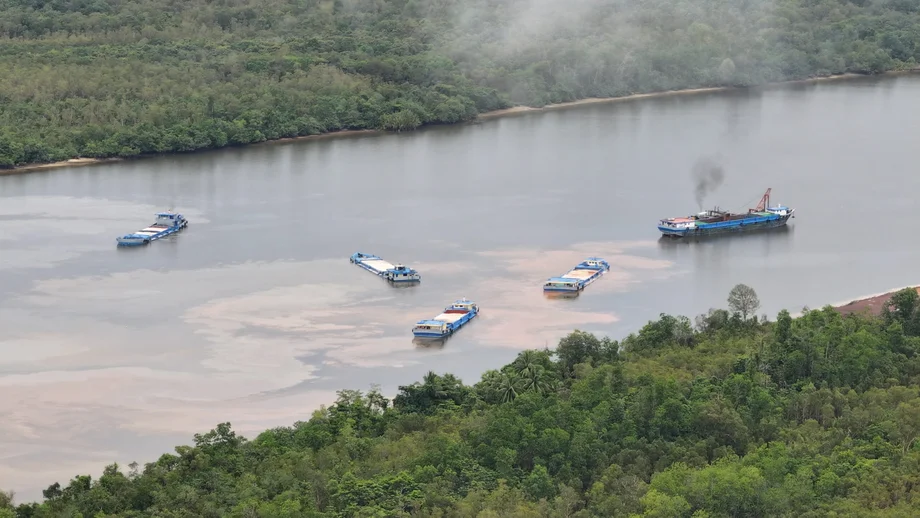
Cambodia has resumed exporting natural sand to Singapore, and fishers in the mangrove village of Koh Sralao say their catches are already suffering. Between June and September 2026, roughly 694,000 metric tons of natural sand worth US$3.47 million left Cambodia for Singapore, according to the International Merchandise Trade Statistics. Cambodia banned the sand trade in 2017 after politically connected companies dredged and removed hundreds of millions of dollars worth of sand. However, sand vessels returned to the area in June 2026, marking a return to a trade that had been halted for about a decade. Mining is currently taking place 10 kilometers upstream of Koh Sralao on the Trapeang Rung River in Koh Kong province. One resident counted around 10 sand mining barges operating on the river. Mongabay identified 14 ships making the journey to Singapore since June. Two of these ships, the Panama-flagged Swan and PVT Coral, were photographed loading sand in the open ocean off Koh Kong Krao, which is Cambodia's largest island. Both ships then continued to Singapore's Tuas Port.
Contents
Environmental Concerns in Protected Areas
The mining site sits in a sensitive ecological area where the river flows through four protected areas in the Cardamom Mountains, and the Koh Kapik Ramsar Site lies just three kilometers downstream. Koh Sralao itself lies within the Peam Krasaop Wildlife Sanctuary, in one of mainland Southeast Asia's largest mangrove forests. A 2023 survey recorded more than 70 fish species in the Koh Sralao estuaries alone. The area is also home to a host of threatened species, including the Irrawaddy dolphin, Indo-Pacific bottlenose dolphin, Fishing cat, and Hairy-nosed otter, which is considered the world's rarest otter species. Magdalena Smigaj, an Earth observation data scientist, conducted an independent analysis of radar imagery on the Trapeang Rung River from January 2020 to July 2026. Her analysis found vessels have been consistently active along the stretch of the river photographed by Mother Nature Cambodia since late April 2026, around the same time provincial officials attended a public event announcing the launch of Catalyst's operations to export sand from Trapeang Rung commune to Singapore. The stretch of the river being dredged falls within the boundaries of both Tatai Wildlife Sanctuary and Botum Sakor National Park.
Impact on Local Fishing Communities
Around 300 families in Koh Sralao depend on fishing, and the village's fisheries had already been declining for years due to charcoal production, overfishing, and pollution from shrimp farms. Residents now report oil slicks, cloudier water, and dead shrimp since the barges arrived. Surveys in 2016 and 2017 found that 61 percent of households had at least one family member who had left the village to find work. One fisher saw his average daily earnings fall from $25 to around $7.50 over a few years. Describing the impact on his fishing grounds, local fisher Rithy told Mongabay that it is impossible to go now because they will destroy his nets and that the operation has affected all of his catch. Fellow fisher Pich added that they left home to work in a garment factory because they could not catch enough fish to survive. Explaining the wider risk to marine life, Chris Hackney, senior lecturer at Newcastle University, noted that material species feed from or breed in is being removed. As described in Sand shipments return to a river that feeds 300 families, fishing families face several pressures at once, including shrinking space to earn a living and higher fuel costs for longer journeys.
Official Responses and Ministerial Positions
Provincial officials argue that dredging reduces flood risk and that deeper rivers help fish and shrimp populations grow. Khlem Yonviseth, director of the Koh Kong provincial mining department, told Mongabay that the 2017 sand export ban had been lifted and that his office had given a permit to the dredging operation and approved the exports. Yonviseth did not respond to a request to provide documentation of the ban being lifted. Mongabay was unable to locate any official announcement regarding the ban, and relevant national agencies did not respond to requests for comment. Minister of Mines and Energy Keo Rattanak publicly defended the government's sand mining policies. On July 17, 2026, he was quoted in the government-aligned Phnom Penh Post as saying that such operations were crucial for water navigation, infrastructure development, and to sell to the construction sector. He did note that there are concerns regarding the environmental impacts associated with sand mining. Activist Lisa Mean questioned Minister of Mines and Energy Keo Rattanak regarding the ban in a video published by environmental activism group Mother Nature Cambodia on July 14, 2026. Cheryl Lee Yen Yong is named as a spokesperson for Singapore's Ministry of Trade and Industry, but calls went to voicemail and emails received no response. Singapore's Minister for National Development has only stated that exporters must comply with the laws of their source countries.
The Scale of Regional Sand Demand
Singapore has added more than 160 square kilometers of land since independence, much of it through reclamation. At its independence in 1965, Singapore had 581.5 square kilometers of land. By the end of 2025, that figure had reached 744.3 square kilometers, which is an increase of about 28 percent. A 2019 United Nations linked analysis estimated that Singapore had imported 517 million tonnes of sand over the preceding two decades, making it the world's largest sand importer. Sand and gravel are the world's most heavily consumed solid resources, with roughly 50 billion tonnes used each year, according to the United Nations Environment Programme. Demand is driven by construction, urbanization, and infrastructure development, while natural replenishment takes geological timescales. Indonesia was previously a major supplier, with Reuters reporting that it shipped an average of more than 53 million tonnes of sea sand annually to Singapore between 1997 and 2002. Indonesia banned sea sand exports in 2003 and reaffirmed the prohibition in 2007. Malaysia imposed its own sea sand export ban in 2018. Data from the United Nations trade statistics database Comtrade show that Cambodian exports of sands covered under the category that includes river and marine sand reached $755 million in value between 2017 and 2025, with 128 million metric tons exported to China, Malaysia, Thailand, Vietnam, and other Asian countries during that period.
Activism and Government Pressure
The latest developments follow years of tension between environmental activists and the Cambodian government over resource extraction and conservation. Mother Nature Cambodia has long protested and organized against sand mining operations in Koh Kong, where local fishing communities saw their livelihoods decimated after dredging began in estuaries across the province in 2008. Three members of Mother Nature Cambodia previously spent 10 months in prison after allegedly threatening to damage sand mining boats. Another five members of the group were jailed in July 2024, receiving between six and eight years behind bars on charges of plotting against the government and insulting the king, which are charges widely seen as politically motivated. Activist Lisa Mean asked in the group's video when the 2017 ban was quietly scrapped and called on Cambodians to join in demanding an end to what she called Cambodia's sand theft. Mongabay identified four specific bulk carrier ships involved in the recent trade, including the Maltese-flagged Densa Dolphin, Liberian-flagged Star Halifax, Panama-flagged HPC Atlantic, and Marshall Islands-flagged Krait. All four ships are between 185 and 199 meters in length and are classified as bulk carriers. These vessels were tracked to Singapore's Tuas Port, where a state-backed land reclamation project is currently underway. The Pulau Tekong polder project covers about 800 hectares and is expected to use roughly 50 percent less sand than conventional reclamation, showing that Singapore is exploring ways to reduce its reliance on traditional sand filling.
At a Glance
- Cambodia exported around 694,000 metric tons of natural sand worth US$3.47 million to Singapore between June and September 2026.
- Mining operations are taking place 10 kilometers upstream of Koh Sralao on the Trapeang Rung River within protected wildlife sanctuaries and national parks.
- Koh Kong provincial mining department officials confirmed the 2017 export ban was lifted and a permit was granted to Catalyst Marine and Resources.
- Four major bulk carrier ships, including the Densa Dolphin and Star Halifax, were tracked transporting material from Cambodia to Singapore's Tuas Port.
- Local fishers report declining catches, cloudy water, and damaged fishing nets since the sand mining barges arrived in the area.