A five year journey to bring home at least 10 grams
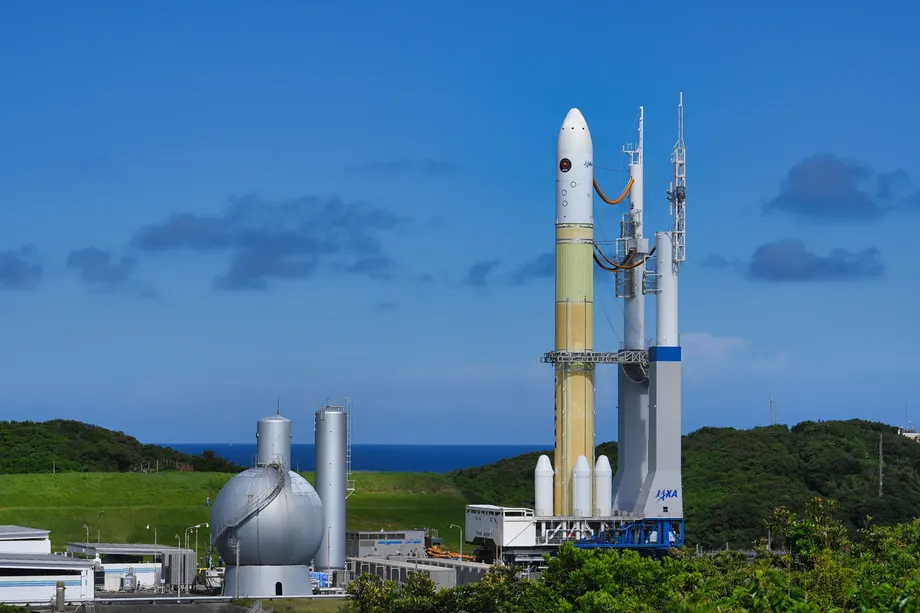
Japan launched its Martian Moons eXploration spacecraft, MMX, from the Tanegashima Space Center in Kagoshima Prefecture on October 20, 2026, beginning a mission to collect material from Phobos and return it to Earth in 2031. The goal is to bring home at least 10 grams of rock and soil that could help explain how the moons of Mars formed.
Contents
- A five year journey to bring home at least 10 grams
- Why Phobos is the main target
- A rover will check the ground first
- How MMX plans to collect its samples
- The schedule from Mars arrival to Earth return
- Two competing explanations for the moons
- Phobos may also hold fragments of Mars
- Japan builds on Hayabusa experience
- H3 delivers, with the hardest operations ahead
- Key Points
The Japan Aerospace Exploration Agency, JAXA, said H3 flight 10 lifted off at 4:41:03 a.m. local time. Spacecraft separation was confirmed 71 minutes and 13 seconds later, sending the uncrewed probe toward Mars. A launch account also gave 4:31 a.m.; the time attributed to JAXA was 4:41 a.m.
MMX is expected to reach the Mars system in August 2027. It will study Phobos, the larger and closer of the planet's two moons, observe the smaller moon Deimos, and deploy a rover named Idefix before attempting its own landings and sample collection.
Success would make MMX the first mission to return samples from a Martian moon and the first spacecraft to complete a journey to the Mars system and back with collected material. Its return capsule is intended to land at Woomera in Australia.
Japan is taking experience gained from two successful asteroid sample missions to a different destination. Phobos has extremely weak gravity, an irregular surface and a powerful planetary neighbour nearby. Reaching it is only the opening step: MMX must examine the terrain, land safely, gather material, lift off again and carry its cargo home.
Why Phobos is the main target
Phobos is roughly 20 to 22 kilometres across and shaped more like a lumpy potato than a sphere. It travels about 6,000 kilometres above the surface of Mars and completes an orbit in approximately seven hours and 39 minutes, circling the planet about three times each day.
Phobos experiences less than one thousandth of Earth's surface gravity. An object that rests firmly on the ground on Earth behaves very differently there: a small push can lift it from the surface, and landing equipment must manage contact without bouncing away.
Mars also strongly influences the spacecraft's motion. MMX will conduct detailed observations from a quasi-satellite orbit, a path around Mars that keeps the probe near Phobos. This arrangement lets the spacecraft repeatedly examine the moon without relying on its weak gravity to hold a conventional close orbit.
Deimos provides a second object for comparison. MMX will observe that moon remotely, allowing scientists to compare the appearance and composition of both satellites while concentrating its surface operations on Phobos.
A rover will check the ground first
Idefix, developed jointly by France's space agency CNES and the German Aerospace Center, DLR, will investigate the surface before the main spacecraft lands. Its name comes from the dog in the Asterix comics.
The rover has four wheels and is approximately the size of a microwave oven. Plans describe a release from about 40 metres above Phobos, followed by roughly 100 days of surface exploration. It is expected to travel at about one millimetre per second, a deliberately slow pace suited to a place where traction and stability are difficult.
Idefix will examine the terrain and soil, providing information to help select landing sites for MMX. Pictures taken from above can reveal slopes and large rocks; measurements on the ground can add information about how the surface behaves when a vehicle touches and moves across it.
The rover and the main spacecraft have different jobs. Idefix will spend months investigating the ground, while a sampling visit by MMX is expected to last about two hours. The rover's findings will help the mission team prepare for that short period of direct contact.
How MMX plans to collect its samples
JAXA's stated minimum target is at least 10 grams of material. More detailed descriptions set out two collection attempts and a larger ambition of about 20 grams, with around 10 grams gathered on each attempt.
The sampling approach combines access to material beneath the surface with collection of loose material on top. A robotic arm will help obtain material several centimetres below the ground, while a system using pressurised gas will disturb surface particles and guide them into a container.
Collecting from different depths and locations would give researchers a broader selection than a single scoop. Surface grains have been exposed to space, while material below them may have experienced different conditions. Scientists can compare the samples with the geological observations made before landing.
MMX has separate propulsion, exploration and return modules. The exploration module includes four landing legs, and the mission carries instruments to investigate the surface and its composition. NASA supplied MEGANE, an instrument designed to identify elements present on Phobos, helping connect measurements made near the moon with later laboratory work.
The schedule from Mars arrival to Earth return
MMX's broad timetable allows about a year for travel toward Mars, roughly three years of exploration in the Mars system and about a year for the journey home. The three years of local operations sit within the longer mission ending in 2031.
Detailed accounts give conflicting dates for rover deployment and sampling. One schedule places Idefix deployment in early 2029 and sample collection at two locations in 2030; another sets a sampling target before December 2028. A definitive reconciliation of those dates has not been given.
- October 20, 2026: H3 flight 10 launches MMX from Tanegashima, with separation confirmed about 71 minutes later.
- August 2027: Planned arrival in the Mars system.
- September 2027: Detailed observations of Phobos are scheduled to begin, covering its surface, internal structure, gravity and mineral composition.
- During exploration: Idefix is expected to investigate the surface for about 100 days before MMX conducts sampling operations.
- November 2030: A detailed mission schedule places departure for Earth in this month.
- 2031: Planned return of the sample capsule to Woomera, Australia, with a detailed schedule targeting late in the year.
Each stage supports the next. Observations help identify suitable terrain, the rover adds information from the surface, and sampling must leave the spacecraft ready for its return journey.
Two competing explanations for the moons
Scientists want the samples to help answer a basic question: were Phobos and Deimos once independent objects that Mars captured, or did they form from debris after a large collision?
Under the capture explanation, asteroids travelling through the Solar System became trapped by the gravity of Mars. Under the impact explanation, a large object struck Mars and threw material into space, where some of it gathered into moons.
Laboratory measurements can examine the minerals and chemical makeup of individual grains in much greater detail than images alone. Researchers will look for similarities to asteroid material and to material associated with Mars, then combine those findings with observations of the moons' structure and surfaces.
MMX's comparison of Phobos and Deimos adds another part of the investigation. Similarities or differences between them can help researchers evaluate whether the two moons share a formation history. The mission therefore joins measurements across an entire moon with close examination of a very small amount of material.
Phobos may also hold fragments of Mars
Impacts on Mars can throw pieces of the planet into space. Over long periods, some fragments may reach nearby Phobos and become mixed into its surface. MMX could therefore collect material from Mars while landing on its moon.
Researchers hope such fragments could provide information about ancient Martian conditions. Finding and identifying them would require careful laboratory work after the capsule returns, alongside analysis of the material belonging to Phobos itself.
The broader science programme also concerns the movement of water and organic material through the early Solar System. Organic compounds are chemicals based on carbon. Studying their composition and history can help scientists investigate how ingredients associated with habitable environments reached rocky planets.
Earth laboratories can apply different instruments to the same grains and preserve portions for later research. That is a central reason to bring material home rather than conduct every measurement with equipment carried on a spacecraft.
Japan builds on Hayabusa experience
Japan's Hayabusa mission returned less than one gram of material from the asteroid Itokawa in 2010. Hayabusa2 brought back 5.4 grams from Ryugu in 2020. MMX extends that sequence from asteroids to a moon orbiting another planet.
The minimum MMX target of 10 grams is about 1.9 times the 5.4 grams returned from Ryugu. A collection of 20 grams would be about 3.7 times that amount. Small samples can support extensive research because scientists examine individual particles and divide material among specialised tests.
Phobos has proved difficult to reach. Three earlier Soviet and Russian missions attempted exploration that included intended surface operations, but none achieved a landing. Phobos 2 approached the moon and transmitted images in 1989.
MMX combines Japanese leadership with contributions from NASA, the European Space Agency, CNES and DLR, alongside universities and technology companies. France and Germany provide the rover, while NASA's MEGANE contributes measurements of surface elements. The partnership connects engineering for travel and landing with the scientific work needed to interpret the eventual samples.
H3 delivers, with the hardest operations ahead
JAXA and Mitsubishi Heavy Industries began developing H3 in 2014. The rocket failed on its first flight in 2023, then completed five consecutive successful launches before another failure in December 2025. Successful flights resumed in June 2026.
The MMX launch brought H3's reported cumulative success rate to 80%, from approximately 78%. For this mission, the immediate result was successful spacecraft separation and departure toward Mars, clearing the first major operational milestone.
MMX's investigations also have a longer practical purpose. JAXA plans to examine whether Phobos could serve as a natural staging location for future journeys to Mars. Measurements of the terrain, gravity and surface material would provide concrete information for assessing such a role.
The next major destination is the Mars system in August 2027. The mission's eventual scientific return will depend on the operations that follow: surveying Phobos, deploying Idefix, choosing landing sites, collecting material and delivering the sealed samples to Australia in 2031.
Key Points
- Japan launched MMX aboard H3 flight 10 from Tanegashima on October 20, 2026.
- JAXA gave a liftoff time of 4:41:03 a.m. and confirmed separation 71 minutes and 13 seconds later.
- MMX aims to reach the Mars system in August 2027 and return samples in 2031.
- The minimum collection target is 10 grams from Phobos, with detailed plans describing an ambition of 20 grams.
- The French and German rover Idefix will investigate the surface and support landing site selection.
- Scientists will study how the Martian moons formed and search the samples for material ejected from Mars.
- The return capsule is planned to land at Woomera in Australia.