Japan’s Only IceCube Team Shares in a Global Achievement
Francis Halzen, 82, of the University of Wisconsin–Madison has been awarded the 2026 Nobel Prize in Physics for the IceCube Neutrino Observatory and its discovery of high energy particles arriving from distant cosmic sources. The October 6 announcement also recognizes a scientific effort to which Chiba University, the collaboration’s only Japanese institution, has contributed since 2002.
Contents
- Japan’s Only IceCube Team Shares in a Global Achievement
- From a 1988 Idea to a Cubic Kilometer Observatory
- How Ice Detects Particles That Usually Pass Through Earth
- Chiba’s First Signals and the Discovery Date
- Following a Neutrino Back to a Distant Galaxy
- A Rare Antineutrino Interaction Tests Particle Physics
- More Than 600 New Detectors Installed in January
- A Larger Target for Lower Energy Neutrinos
- The Milestones Behind the Prize
- Key Points
The Royal Swedish Academy of Sciences states in its Nobel Prize announcement that Halzen was honored "for decisive contributions to the IceCube Neutrino Observatory and the discovery of high-energy neutrinos of astrophysical origin." The prize carries an award of 12 million Swedish kronor.
Chiba’s contribution extends from identifying the first cosmic neutrino signals to building instruments now buried beneath the South Pole. Its researchers helped connect a neutrino to a distant galaxy, participated in the first detection of a rare antineutrino interaction, and manufactured about 40 percent of the more than 600 optical detectors installed in IceCube’s latest upgrade.
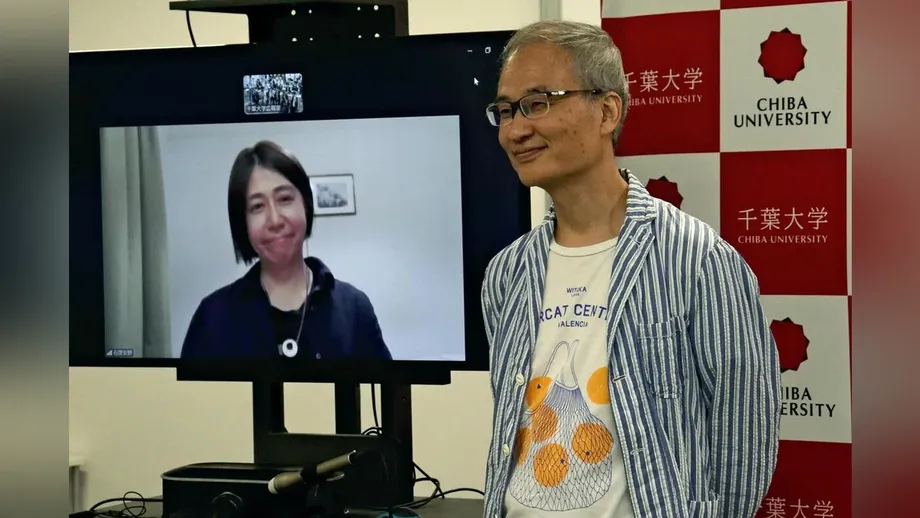
The university’s professors Shigeru Yoshida, 60, director of its International Center for Hadron Astrophysics, and Aya Ishihara, 52, welcomed the award at an October 6 news conference at the Nishichiba campus in Chiba city. Ishihara joined online from Nagoya.
The Nobel Prize names Halzen individually. The observatory’s achievements, however, belong to an international effort involving roughly 450 scientists at 58 institutions in 14 countries. Chiba’s role shows how a small research group became central to both interpreting the observations and designing the next generation of equipment.
From a 1988 Idea to a Cubic Kilometer Observatory
Halzen first presented his vision of using South Pole ice to detect neutrinos in 1988. Born in Tienen, Belgium, in 1944, he earned his doctorate at KU Leuven in 1969 and became a professor at Wisconsin–Madison. His proposal required turning an enormous volume of natural ice into a particle detector rather than constructing a conventional laboratory vessel.
The finished observatory instruments one cubic kilometer of ice beneath the Amundsen–Scott South Pole Station. Its original array contains 5,160 optical modules distributed along 86 cables, with 60 modules on each cable.
Construction began in 2004. Accounts use different dates for its completion: Chiba’s project history places the end of construction in December 2010, while the Nobel announcement describes IceCube as finished in 2011. Full operation of all 86 strings began in 2011, distinguishing the end of installation from the start of observations with the complete array.
The original construction cost was reported as US$271 million, with the U.S. National Science Foundation providing most of the funding. In its award statement, the NSF says it invested in IceCube’s design, construction and operation for more than two decades. The U.S. Antarctic Program supported construction at the remote station.
Mark Pearce, chair of the Nobel Committee for Physics, credited Halzen’s leadership in turning the idea into a working observatory.
Francis Halzen has led an international team of researchers and engineers who have provided us with a fantastic instrument. His tenacity and scientific vision has paved the way for a new kind of astronomy.
How Ice Detects Particles That Usually Pass Through Earth
Neutrinos have no electric charge and interact with matter extremely rarely. Most pass through Earth without leaving a detectable trace. That makes them difficult to observe, but also useful messengers: magnetic fields do not bend their paths as they do the paths of charged cosmic particles.
The detector does not photograph a neutrino directly. When a neutrino occasionally interacts with an atomic nucleus or electron, it produces charged particles. Those particles can emit Cherenkov light, the faint radiation produced when a charged particle travels through a material faster than light travels through that material.
IceCube’s optical sensors register the timing and brightness of this light. Researchers use those measurements to estimate the incoming particle’s energy and direction. The enormous volume compensates for the rarity of neutrino interactions.
Chiba’s IceCube project description gives the original modules’ depths as 1,450 to 2,450 meters. Other accounts use broader ranges, including 1,400 to 2,600 meters. The latest upgrade involved drilling to 2,600 meters, a construction depth that should not be confused with the original sensors’ placement.
The modules contain photomultiplier tubes, devices that convert tiny flashes of light into measurable electrical signals. Hamamatsu Photonics, based in Hamamatsu, Japan, developed tubes used in IceCube’s detectors, giving Japanese industry a role alongside the university researchers.
Detecting light is only the first step. Juan Carlos Díaz Vélez, who works at the Wisconsin IceCube Particle Astrophysics Center and coordinates data processing and simulations, says IceCube detects more than a million muons generated by cosmic rays for every neutrino it detects. Muons are charged particles that can also leave bright tracks, creating a large background against which neutrino events must be identified.
According to Díaz Vélez, processing observations and producing simulations use approximately 10,000 CPU cores and 1,000 graphics processing units across distributed computing networks. The NSF also credits its computing facilities with helping researchers interpret IceCube’s measurements.
Chiba’s First Signals and the Discovery Date
Chiba University says its group joined when the IceCube collaboration formed in 2002. Yoshida had known Halzen since the 1990s, but joining the project brought substantial uncertainty. In the university’s award response, he recalls widespread skepticism about whether neutrinos could become a practical tool for observing the high energy universe.
Ishihara joined the Wisconsin group in January 2005, after completing her doctorate in 2004, and moved her research base to Chiba in 2006. She describes a team with limited staff and funding that developed its own analysis strategy to make a distinctive contribution within a much larger collaboration.
That strategy helped identify two exceptionally energetic events. Chiba’s detailed project history dates them to August 2011 and January 2012, with measured energies of 1.04 ± 0.16 and 1.14 ± 0.17 petaelectronvolts. A petaelectronvolt, or PeV, is one quadrillion electronvolts, a unit used to measure particle energy.
The university presented the initial findings at an international conference in June 2012. A paper followed in Physical Review Letters in July 2013, and a broader analysis appeared in Science in December 2013. This sequence explains why Chiba describes a 2012 discovery while the NSF and IceCube’s Nobel announcement refer to the landmark findings in 2013.
Reports differ on the timing of the two early events: one places their detection in 2013 and 2014, while Chiba’s detailed account places them in 2011 and 2012. The university’s history also contains differing energy summaries, but its individual event entries provide the values and uncertainties above.
Further analysis added 26 events to the initial two. Chiba’s account says about 11 background events were expected among the 28, and that their energies, shapes and arrival directions supported a cosmic origin with statistical confidence exceeding four standard deviations.
Chiba compares the new energy range with the neutrinos observed by Kamiokande in 1987, describing an increase of about 100 million times. The NSF uses the broader statement that the detected neutrinos carried more than a million times the energy of previously observed neutrinos. Those comparisons are presented with different reference points and should not be treated as identical measurements.
Following a Neutrino Back to a Distant Galaxy
Finding cosmic neutrinos established that natural particle accelerators were producing them. Identifying a source required another step: combining a neutrino’s estimated arrival direction with observations made by other instruments.
On September 22, 2017, in Japan time, IceCube detected the event known as IC170922A. Gamma ray satellites and optical telescopes followed the alert, linking the event to TXS 0506+056, a blazar associated with a supermassive black hole. The findings were announced and published in Science in 2018.
A blazar is an active galactic nucleus whose powerful jet points toward Earth. The original account describes the 2018 result as evidence that the neutrino may have come from the blazar. Chiba calls it the first identification of a neutrino source, while the NSF describes the 2018 result as definitive evidence of neutrinos coming from a supermassive black hole in another galaxy.
The connection depended on what researchers call multimessenger astronomy: studying the same cosmic activity through different signals, here neutrinos and several forms of electromagnetic radiation. The neutrino supplied information that light alone could not provide, while telescope observations helped identify the object in its direction.
Yasushi Fukazawa, a Hiroshima University professor specializing in observations of the high energy universe, credited Chiba with detector development and assembly, as well as the system that rapidly distributes neutrino information to observatories worldwide. That alert system made coordinated followup possible.
IceCube has since reported evidence of neutrino emission from another galaxy, NGC 1068, also called Messier 77. In 2023, it announced neutrino observations of the Milky Way, producing the first image of our galaxy based on neutrinos, according to the NSF. The progression moves the experiment beyond detecting isolated particles toward mapping their sources.
A Rare Antineutrino Interaction Tests Particle Physics
Chiba also contributed to a result published in Nature in 2021: the first detection of the Glashow resonance through an electron antineutrino. An antineutrino is the antimatter counterpart of a neutrino.
The Glashow resonance is a predicted interaction in which an electron antineutrino collides with an electron and produces a W boson, a particle involved in the weak force. Its observation tested a prediction of the Standard Model, the theory describing known elementary particles and their interactions.
This achievement gives IceCube two linked purposes. It can investigate the cosmic environments that generate energetic particles and use those particles to test fundamental physics at energies difficult to study with human made accelerators.
Takaaki Kajita, the University of Tokyo professor who shared the 2015 Nobel Prize in Physics for the discovery of neutrino oscillations, welcomed Halzen’s award. Kajita described IceCube as a long awaited step toward understanding where cosmic rays originate and how they are accelerated.
More Than 600 New Detectors Installed in January
The award arrives after a major expansion of Chiba’s engineering contribution. The university’s upgrade completion announcement, published February 13, states that installation finished on January 21, 2026.
A special team of approximately 40 researchers and engineers worked for about two and a half months, beginning in late November 2025. They drilled six deep holes and installed more than 600 new optical modules in the center of the existing detector.
About 40 percent of the new modules are D-Egg detectors designed and manufactured by Chiba’s International Center for Hadron Astrophysics over more than a decade. German and American groups supplied another detector design, mDOM.
Each D-Egg contains two sensitive light sensors pointing in opposite directions inside a glass housing. Capturing light from above and below helps measure its direction and intensity. The housing also fits into narrower drilled holes. Ishihara, who led manufacturing, joined the Antarctic installation team.
The construction schedule was demanding. Hot water drilling took about 60 hours to create and shape a hole reaching 2,600 meters. Installers then had to lower roughly 110 connected detectors within 30 hours, before refreezing closed access.
The university also reports that five demonstration detectors manufactured at Chiba were installed for development toward IceCube-Gen2. Domestic companies, graduate students and younger researchers participated in detector development and production, extending Japan’s contribution beyond data analysis.
A Larger Target for Lower Energy Neutrinos
The upgrade places sensors more densely together to detect weaker light from lower energy neutrinos. It targets the gigaelectronvolt, or GeV, range while improving measurements of how light travels through the surrounding ice. Better knowledge of the ice should improve reconstruction of neutrino arrival directions.
Chiba gives the upgrade’s effective detection volume as equivalent to about two million tons of water, compared with approximately 50,000 tons for Super-Kamiokande. Those figures yield a ratio of about 40 to one. Volume alone does not determine sensitivity or precision, since the instruments use different layouts and observation methods.
The denser array broadens a facility known for very high energy astronomy into another particle energy range. Chiba identifies neutrinos released during the gravitational collapse of massive stars and the formation of black holes as a possible research target, not an observation already achieved.
The observation timetable has changed in specificity. Chiba’s February announcement anticipated observations beginning around summer 2026 after refreezing, communication checks, calibration and precise detector positioning.
IceCube’s October Nobel award announcement instead says the first science data from the upgrade are expected later in 2026. It does not confirm that full scientific observations began during the summer.
The proposed IceCube-Gen2 would have an optical array eight times the volume of the current observatory and add radio detection for even higher energy neutrinos. It remains a proposal; the announcements do not establish a construction start or completion date.
The Milestones Behind the Prize
IceCube’s history separates several stages that are sometimes compressed into a single discovery date: proposing the instrument, constructing it, recording events, presenting analyses and publishing results.
- 1988: Halzen first presents his South Pole neutrino detection vision.
- 2002: The IceCube collaboration forms, with Chiba joining as its only Japanese institution.
- 2004–2011: Construction begins and the complete observatory enters operation.
- 2011–2013: The first major events are recorded, presented in June 2012 and described in journal papers in 2013.
- 2017–2018: Event IC170922A leads to the association with blazar TXS 0506+056 and publication of the findings.
- 2021: The first Glashow resonance detection is published.
- 2023: IceCube announces neutrino observations of the Milky Way.
- January 21, 2026: Installation of the IceCube Upgrade is completed.
- October 6, 2026: Halzen is announced as the Nobel physics laureate.
The collaboration has grown from five countries at its formation, according to Yoshida, to 14 today. Chiba’s project page recorded about 300 researchers at 53 institutions in 12 countries in 2020, compared with roughly 450 researchers at 58 institutions now.
Halzen, IceCube’s principal investigator, placed that collective effort at the center of his response to the prize.
It’s a great relief for me to finally deliver the recognition that this great collaboration deserves.
For Chiba, the next concrete milestone is the expected release of the upgrade’s first science data later in 2026. Its researchers are also preparing for the proposed larger observatory, while continuing the search for the cosmic accelerators that produce the particles IceCube detects.
Key Points
- Francis Halzen receives the 2026 Nobel Prize in Physics for IceCube and discoveries of cosmic neutrinos.
- Chiba University has participated since 2002 and remains the collaboration’s only Japanese institution.
- Chiba helped identify early cosmic signals, a blazar source and the first Glashow resonance event.
- The original observatory uses 5,160 optical modules across one cubic kilometer of Antarctic ice.
- About 40 percent of the more than 600 newly installed upgrade detectors were made by Chiba.
- The latest timetable expects the upgrade’s first science data later in 2026; IceCube-Gen2 remains proposed.