
A Small Molecular Imbalance With a Big Consequence
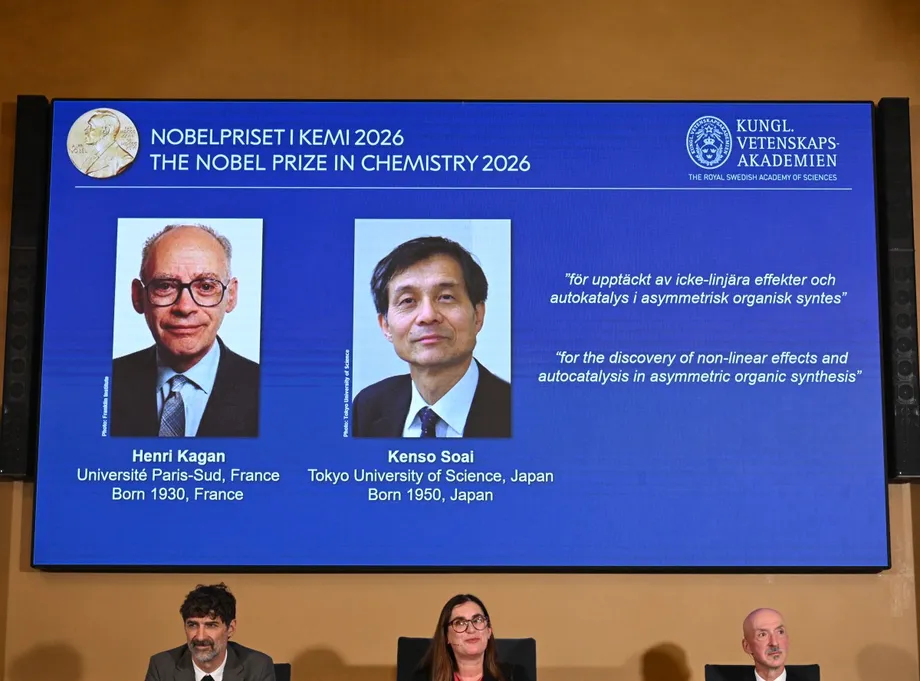
A mixture containing two mirror forms of a molecule in a ratio of 51 to 49 can, through repeated reactions, become almost entirely one form. That striking result lies at the heart of research by Kenzo Soai, professor emeritus at Tokyo University of Science, who is named alongside Henri Kagan in reports dated October 7 and 8, 2026, announcing the Nobel Prize in Chemistry.
Contents
- A Small Molecular Imbalance With a Big Consequence
- Why Molecular Handedness Matters
- What Kagan and Soai Each Discovered
- A Route Toward Understanding Life, Not a Final Answer
- From Early Experiments to the 1995 Paper
- Why Careful Experiments Were Essential
- A Career Built Around Curiosity and Teaching
- A Phone Call While Shopping, Then Campus Celebrations
- Influence Beyond One Laboratory
- Key Points
The reports describe recognition for discoveries involving nonlinear effects in asymmetric organic synthesis and reactions in which a product helps make more of itself. Kagan, identified as professor emeritus at Paris-Saclay University, demonstrated a nonlinear effect in 1986. Soai published the reaction that bears his name in 1995.
The reported Nobel announcement, prize amount and ceremony arrangements have not been independently verified against an official announcement from the Royal Swedish Academy of Sciences. The reported award details should therefore be distinguished from the scientists' established research contributions.
The discoveries address a fundamental chemical problem: why biological molecules so often occur predominantly in one of two possible mirror forms. They also concern a practical challenge for chemistry, producing the particular molecular form needed for a medicine or another useful substance.
The reported prize is 12 million Swedish kronor, divided equally between the two scientists. That would give each recipient 6 million kronor. The ceremony is described as scheduled for December 10 in Stockholm.
Why Molecular Handedness Matters
Some molecules resemble a pair of hands. Their constituent atoms are the same, but their spatial arrangements are mirror images that cannot be placed exactly on top of one another. Chemists call this property chirality, and the two forms are called enantiomers.
The distinction can matter enormously inside a living organism. Biological molecules interact with other molecules through their shapes, so two enantiomers can behave differently even though they have the same chemical formula. A useful comparison is a hand fitting into a glove: the arrangement matters, not just the parts involved.
Living organisms show a strong preference for particular forms of molecules such as amino acids and sugars. Explaining how a small initial preference could grow into a pronounced imbalance is one part of understanding that pattern.
Asymmetric synthesis means making a substance in a way that favors one enantiomer. The work associated with Kagan and Soai explores how that preference can become much larger than the imbalance that initially produced it.
What Kagan and Soai Each Discovered
Kagan's 1986 work demonstrated that the relationship between an initial molecular imbalance and the resulting product need not be proportional. He also developed a mathematical explanation for the phenomenon.
In a simple proportional process, a modest preference at the start would produce a similarly modest preference at the end. A nonlinear effect means that the output does not follow that straightforward relationship. Under suitable reaction conditions, a small starting preference can yield a much stronger preference in the product.
Soai's contribution involved asymmetric autocatalysis. A catalyst helps a chemical reaction proceed. In an autocatalytic reaction, a product of the reaction itself acts as a catalyst for producing more product.
In the Soai reaction, each enantiomer promotes production of its own form. A slight initial advantage can grow as the reaction proceeds, leaving one form increasingly dominant. The reported example of a 51-to-49 mixture approaching almost 100 percent of one form illustrates the scale of that change, rather than a guarantee for every reaction or set of conditions.
Together, the discoveries provide a chemical route by which a small imbalance can become a large one. That is a more specific achievement than simply producing a pure substance: it demonstrates a process capable of magnifying molecular handedness.
A Route Toward Understanding Life, Not a Final Answer
The connection to life is compelling because organisms make strong distinctions between molecular mirror forms. A reaction that increases an initial imbalance offers a possible mechanism for explaining how such preferences could develop.
A laboratory demonstration, however, does not establish the complete sequence of events through which biological molecular preferences arose. Showing that chemistry can magnify an imbalance is different from proving exactly where the first imbalance came from or which reactions operated before life emerged.
Soai made that distinction himself in remarks described from the announcement interview. Speaking as a researcher whose work addresses molecular handedness, he urged others to continue investigating rather than treat the result as a complete explanation. His remarks translate as:
Our results are not the final answer. To understand life, we must advance the research much, much further.
This qualification matters when assessing the reported prize citation. The research supplies a mechanism relevant to a longstanding mystery, while leaving further work necessary to connect that mechanism to the history of living systems.
From Early Experiments to the 1995 Paper
Soai began experiments directed toward the reaction in the 1980s. Early results did not match what he was seeking, but colleagues recall that he continued testing the idea rather than abandoning it.
The paper describing the Soai reaction appeared in Nature in 1995, when he was a professor at Tokyo University of Science. Takanori Shibata, now a professor at Waseda University, was then the laboratory's sole research assistant.
Shibata recalled celebrating the publication decision with students, while Soai was already thinking about further work. His recollection of Soai's words translates as:
This is just the beginning. Rather than staying here, let's move forward.
Shibata also described a contrast between Soai's usually quiet manner and his visible happiness when an experiment produced a much better result. The recollections suggest that publication was a milestone in a continuing research program, rather than its endpoint.
The main dates connect the scientific work with the subsequent reports of recognition:
- 1981: Soai joined Tokyo University of Science as a lecturer.
- 1986: Kagan demonstrated a nonlinear effect in asymmetric synthesis; Soai became an associate professor.
- 1991: Soai became a professor at Tokyo University of Science.
- 1995: The Soai reaction paper appeared in Nature.
- 2017: Soai became professor emeritus.
- 2023 and 2025: Soai received the Noyori Prize and Japan Academy Prize, respectively.
- October 7 and 8, 2026: Reports describe the Nobel announcement, campus celebrations and a new university honor.
Why Careful Experiments Were Essential
A reaction that magnifies a tiny imbalance makes experimental care especially consequential. If a small starting difference can shape the result, researchers need to control what enters an experiment and check whether previous work has affected it.
Arimasa Matsumoto, an associate professor at Nara Women's University who worked with Soai for about five years from 2012, recalled repeated experiments and meticulous cleaning of equipment. On some occasions, Soai changed laboratories to prevent earlier experiments from influencing new ones.
Matsumoto described Soai encouraging students to try again when results were unsuccessful. Takashiro Akitsu, a professor at Tokyo University of Science, separately recalled that Soai could be strict about experimental practice, including correcting students who handled apparatus roughly.
These accounts connect the scientific result to the way it was pursued. Repetition, clean equipment and attention to experimental conditions were central to investigating whether a small molecular preference could reliably grow.
A Career Built Around Curiosity and Teaching
Born in Hiroshima in 1950, Soai is described in the October 2026 reports as 76. He graduated from the University of Tokyo's chemistry department in 1974 and received his doctorate there in 1979. That year, he became a postdoctoral researcher at the University of North Carolina at Chapel Hill.
His appointment at Tokyo University of Science in 1981 began a 36 year period before his retirement as a professor in 2017. His research continued beyond retirement.
Osamu Eguchi, professor emeritus at Otaru University of Commerce and a former classmate at Hiroshima University High School, recalled Soai studying university level mathematics while still at school. Soai also played basketball. When University of Tokyo entrance examinations were canceled during the Yasuda Auditorium incident, he spent another year preparing and subsequently entered the university.
Colleagues describe the same combination of determination and patience in his teaching. Keisuke Suzuki, identified in the detailed accounts as a specially appointed professor at Institute of Science Tokyo, recalled receiving careful instruction from Soai during undergraduate research, including how to introduce reagents into a flask. A source summary gives Suzuki a different university affiliation, so that detail is not consistent across the reports.
Tsunemi Kawasaki, a Tokyo University of Science professor who worked with Soai for more than 20 years, recalled attentive guidance that helped research continue when difficulties arose. Former classmates and alumni also described a warm personality, including at an alumni gathering in June 2025.
A Phone Call While Shopping, Then Campus Celebrations
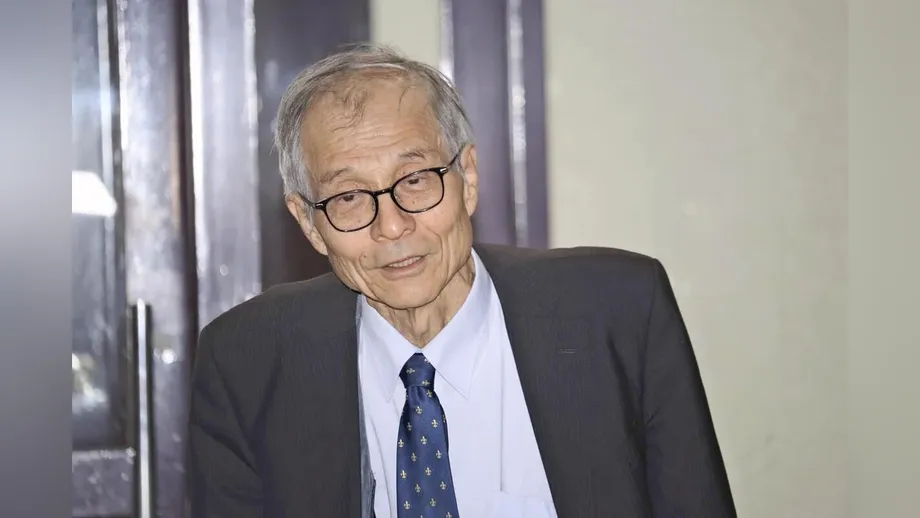
According to the October reports, Soai learned of the award by telephone while buying food at a nearby supermarket. He later spoke during the Royal Swedish Academy of Sciences' announcement proceedings and attended a press conference at the Kagurazaka campus at 10 p.m. on October 7.
In the reported telephone interview, Soai expressed both excitement and respect for Kagan. His remarks translate as:
I am more excited than at any other time in my life to have been awarded the Nobel Prize. I am honored to receive it together with Dr. Henri Kagan, whom I respect.
About 100 students and staff reportedly saw him off after the evening press conference. The following afternoon, he returned to the campus in Tokyo's Shinjuku district and received flowers and congratulations from hundreds of students and employees.
Soai credited the students who had worked with him at Kagurazaka and encouraged younger researchers to pursue their work with confidence. Tokyo University of Science is also reported to have conferred the title of honorary professor on October 8, recognizing his research achievements and contributions to education and research.
Influence Beyond One Laboratory
The reaction has reached researchers far beyond Soai's own institution. Soumitra Atabale, identified in the reports as an assistant professor at the University of California, Los Angeles, recalled encountering it in a problem collection while preparing for the International Chemistry Olympiad as a school student.
Atabale later contributed to a specialist book edited by Soai, about five years before the reported award. Describing his admiration for the Japanese researcher, he said, in translation:
He is a scientific hero to me.
Iwao Ojima, a distinguished professor at Stony Brook University who had known Soai for more than 40 years, praised his intellectual curiosity and willingness to investigate a question before its practical usefulness was certain.
The practical interest is nonetheless substantial. Producing a particular enantiomer matters for pharmaceutical safety and efficient synthesis, and the research may support production of substances with high purity, including medicines and fragrances. The reports do not identify a specific newly approved drug, commercial process or manufacturing timetable resulting from the reported award.
Akira Yoshino, the 2019 chemistry Nobel laureate, connected the work both to drug discovery and to understanding the origins of life. He also observed that the achievements receiving recognition were made decades earlier, expressing hope that younger people would take an interest in chemical research.
That distinction between discovery and later recognition is visible in the dates: Kagan's 1986 result and Soai's 1995 paper would precede a 2026 award by 40 and 31 years, respectively. Their scientific importance rests on the reactions and explanations they developed, independently of whether the reported Nobel announcement is confirmed.
Key Points
- October 2026 reports name Kenzo Soai and Henri Kagan as chemistry Nobel recipients, but the award details have not been independently verified against an official announcement.
- Kagan demonstrated a nonlinear effect in asymmetric synthesis in 1986.
- Soai's 1995 reaction showed how asymmetric autocatalysis can increase a small initial imbalance between molecular mirror forms.
- A reported illustrative ratio of 51 to 49 can approach almost entirely one form through repeated reactions under suitable conditions.
- The research helps explain a possible mechanism behind biological molecular preferences, not the complete origin of those preferences.
- The reported prize is 12 million Swedish kronor, shared equally, with a December 10 ceremony in Stockholm.