
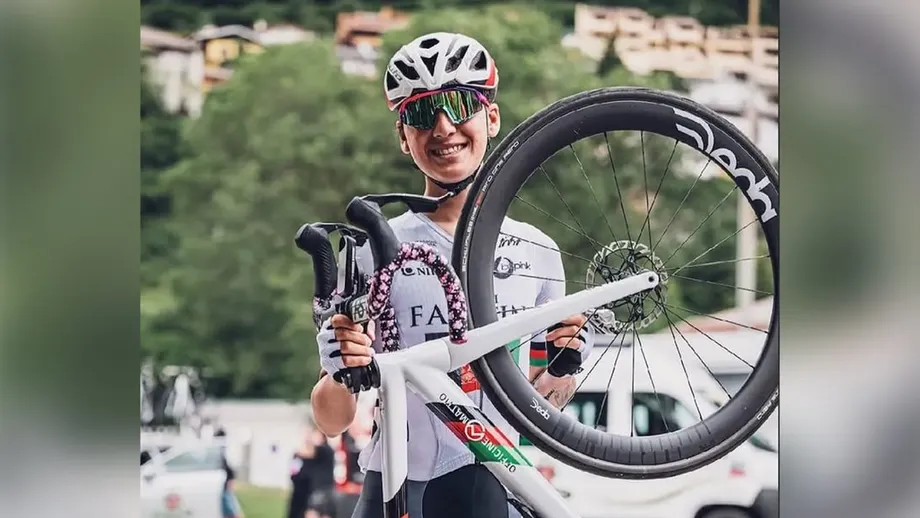
A podium finish with a meaning beyond cycling
Fariba Hashimi won silver in the women's road race at the Aichi Nagoya Asian Games on Tuesday, 22 September 2026, becoming the first Afghan woman to earn an Asian Games cycling medal and the country's first female medallist at the competition since 2002. The 23 year old finished in 2 hours, 50 minutes and 5 seconds, narrowly missing gold in a sprint.
Contents
- A podium finish with a meaning beyond cycling
- Two races and a historic result
- Borrowed bicycles opened the way
- Training in disguise before the Taliban returned
- Leaving Afghanistan and rebuilding in Italy
- A career built through championships abroad
- A sister's support and help with the bicycle
- Representing women who cannot compete at home
- Los Angeles is a goal, not a confirmed place
- Key Points
China's winner is identified as Li Guo in the initial race account and Guo Li in subsequent reports. Hong Kong's Leung Wing Yee took bronze. Although the winning margin was described as a fraction of a second, the precise gap is not established by the official competition listing.
The result came two days after Hashimi placed seventh in the women's individual time trial. For a rider who once concealed her identity to train in Afghanistan, the move from seventh place to the podium brought international recognition to a career rebuilt in Italy after she fled her country in 2021.
Hashimi, an Afghan Olympian and Olympic Solidarity scholarship holder, described what she had hoped to achieve before the race:
I came to the Asian Games dreaming about standing on the podium and representing my country.
The International Olympic Committee's account of her achievement identifies her as Afghanistan's first female Asian Games medallist since 2002. That earlier medal was a taekwondo bronze won by Roia Zamani at the Busan Games, making the interval between the two achievements 24 years.
Hashimi's silver also exposed a stark divide: Afghan women can represent their country internationally while women and girls inside Afghanistan remain largely excluded from organized sport under Taliban rule.
Two races and a historic result
The Union Cycliste Internationale's road cycling event listing schedules the competition from 20 to 23 September 2026. It places both individual time trials on 20 September, the women's road race on 22 September and the men's road race on 23 September. Wayne Pomario of Canada is listed as president of the commissaires panel, the officials responsible for overseeing competition rules.
Hashimi's two events tested different skills. In an individual time trial, riders start separately and compete against the clock. In a road race, riders compete together, with positioning, cooperation and the final sprint helping determine the result. Her seventh place on Sunday and silver on Tuesday were therefore separate achievements, rather than stages of one competition.
The UCI listing confirms the scheduled race dates, but it does not provide a finishing classification in the information published here. The reported finishing time, medal order and narrow sprint margin should therefore be distinguished from the schedule verified by cycling's governing body.
The silver came at the 20th Asian Games, held in Japan's Aichi Nagoya region with athletes from 45 countries and territories. Afghanistan's delegation included men travelling from inside the country and women joining from abroad because of restrictions on women's participation at home.
Borrowed bicycles opened the way
Hashimi's cycling career began in Faryab province in northern Afghanistan, where she and her older sister, Yulduz, saw an advertisement for a local race in 2017. They had neither bicycles of their own nor much experience riding. They borrowed bicycles from neighbours, practised for a few hours and entered anyway.
Fariba finished first and Yulduz second. The sisters then continued racing, initially hiding their identities with false names, scarves, masks and sunglasses. Their early success eventually attracted attention that made anonymity harder to maintain.
Reports differ on Fariba's exact age when she began. One puts her at 15, while another describes her as around 14 at the 2017 race. The institutional account dates that first race to 2017 without specifying her age. The shared account is that she discovered cycling as a teenager alongside her sister.
The local race was more than a surprising debut. It established a partnership that would survive dangerous training conditions, evacuation, national championships abroad and Olympic competition. At the Asian Games, Yulduz was again racing alongside Fariba, joined by fellow Afghan cyclist Zahra Rezayee.
Training in disguise before the Taliban returned
The threats the sisters faced did not begin with the Taliban's return to power in 2021. Their accounts describe harassment and violence during their earlier years of cycling in Faryab, when they tried to avoid recognition by dressing as men and covering their faces.
Hashimi described the precautions she took while training:
I always dressed as a man to go to training, wearing two or three different masks so people would not recognise or attack me.
The sisters faced stones and bottles thrown at them, insults and threats. On one occasion, a rickshaw driver struck Yulduz while she was cycling, breaking her wrist. These were physical dangers, not simply objections to women taking part in sport.
In the IOC account, Fariba recalled her father's fear before a race:
Once before a race, my father asked me, 'Do you want to ride? I'm fine with it, but I'm afraid they might kill you'.
That history matters when interpreting the medal. Hashimi had already been fighting for the ability to train before the change of government made continuing her sporting career inside Afghanistan even more difficult. An invitation to join the national women's cycling team in 2020 recognized the sisters' ability, but did not protect their future from the upheaval that followed.
Leaving Afghanistan and rebuilding in Italy
After the Taliban regained power in 2021, restrictions on women's education, movement and participation in sport left the sisters facing a decision to leave. Alessandra Cappellotto, the 1997 women's road cycling world champion and a twice competing Olympian, helped them escape on a flight organized by the Italian government.
Cappellotto's Road to Equality initiative and Italy's Aquila Omnia evacuation operation are also identified in accounts of their departure. The sisters settled in the Veneto region, exchanging the roads of Faryab for training routes that included the Dolomite mountains.
The transition began with practical adjustments. According to the IOC account, the sisters completed a standardized Italian cycling proficiency course, normally taken by children in schools, before exploring their new surroundings. Competitive talent and learning to navigate a new country's roads were separate parts of starting again.
Hashimi described the personal cost of leaving while speaking at the Asian Games:
It is sad I can't live in my country. I haven't seen my family for such a long time.
Her family has moved several times since her departure. Italy gave her a place to live and train, but her progress in cycling has come with prolonged separation from her mother, brothers and sisters. The podium did not erase that loss.
A career built through championships abroad
In 2022, Afghanistan's national championships were held in Aigle, Switzerland, because the women could not race safely at home. All 50 participants had fled Afghanistan and found refuge elsewhere. Fariba won her first national title, beating Yulduz in the road race sprint.
The race illustrated an unusual reality: a national championship could preserve Afghan sporting representation even when its competitors were scattered across other countries. For Fariba, the victory also helped open the way to a contract at Women's WorldTour level, the highest tier of professional women's road cycling.
Further milestones followed. Fariba and Yulduz represented Afghanistan at the UCI Road World Championships in Glasgow, becoming the first women to do so since the Taliban returned to power. Both received Olympic scholarships, which provided financial and technical training support.
The main steps in their progression were:
- 2017: Fariba won a local race in Faryab after learning to ride on a borrowed bicycle; Yulduz finished second.
- 2020: Afghanistan's national women's cycling team invited the sisters to join.
- 2021: They fled Afghanistan and settled in Italy with help from Cappellotto.
- 2022: Fariba won the Afghan national road championship in Switzerland.
- 2024: Both sisters competed at the Paris Olympics, and Fariba won a stage of the Tour de l'Ardèche.
- 2025: Fariba joined Ceratizit Pro Cycling Team.
- 20 and 22 September 2026: Fariba placed seventh in the Asian Games time trial, then won road race silver.
Her 2024 victory came on the queen stage of the Tour de l'Ardèche, a term used for a race's most demanding stage. It made her the first Afghan female cyclist to record a UCI victory. Reports also record eighth place at the Tour de l'Avenir Femmes and 10th at the Giro Mediterraneo Rosa that year.
A sister's support and help with the bicycle
At the Asian Games, Hashimi credited Yulduz with helping make the silver possible. Their relationship had included both competition against each other and years of shared training under threat. In Japan, Fariba described her older sister as a source of confidence before the race.
Fariba explained Yulduz's place in the achievement:
I think my sister is the hero of this story. If she wasn't there, winning this silver medal would not have been possible.
The Afghan riders also faced practical limits in their race support. Fariba said the person accompanying them from the national federation drove the car, while she handled work that larger teams normally assign to a mechanic. She washed her bicycle herself and helped make repairs.
Hashimi thanked the Japanese team for assistance with the equipment:
I was the mechanic for myself. I was washing the bike myself. Thank you to the Japanese team. They were really, really nice to me, fixed my bike.
Her account adds a concrete detail to the result: reaching the podium required preparation beyond riding and tactics. The lack of a dedicated mechanic placed extra work on the cyclist, while help from another national team contributed to getting her bicycle ready.
Representing women who cannot compete at home
The sisters were two members of the six athlete Afghan team at the Paris 2024 Olympics. The International Olympic Committee arranged a delegation with equal numbers of men and women, preserving female representation despite the restrictions inside Afghanistan.
At the Asian Games, Hashimi again raced under her country's name while living outside it. Her success demonstrates what an Afghan woman can achieve with access to training, international competition and support. It does not establish that women inside Afghanistan have gained those opportunities.
Hashimi connected the medal to women beyond her own team:
I'm not alone. I know that behind me are millions of women, from many countries, who have the same dream. They are standing with me.
She has said she wants a future in which the next generation can travel from inside Afghanistan to compete, rather than having to leave the country to pursue sport. That distinction separates the celebration of an individual achievement from any claim that conditions at home have improved.
Los Angeles is a goal, not a confirmed place
Fariba and Yulduz are targeting the 2028 Los Angeles Olympics after their participation in Paris. Hashimi has spoken about continuing to compete and refusing to give up, but no confirmed Los Angeles qualification or entry is established in these accounts.
Her immediate achievement is concrete: an Asian Games silver, following a seventh place time trial finish, and an end to Afghanistan's 24 year wait for another female medallist. Her longer ambition reaches beyond results, toward returning home and inspiring women who cannot currently follow the same route into international sport.
Hashimi expressed that hope after the road race:
I hope that the next generation will come here and represent their country without any fear.
The next scheduled event on the UCI road cycling programme was the men's road race on 23 September. For Hashimi, the longer sporting target is Los Angeles in 2028. Neither that ambition nor the silver medal changes the restrictions confronting women inside Afghanistan, but both keep Afghan women visible in international competition.
Key Points
- Fariba Hashimi won women's road race silver at the Asian Games on 22 September 2026.
- She became Afghanistan's first female Asian Games medallist since Roia Zamani's taekwondo bronze in 2002.
- Hashimi placed seventh in the individual time trial two days earlier.
- She fled Afghanistan in 2021 and rebuilt her cycling career in Italy with help from Alessandra Cappellotto.
- Her sister Yulduz and fellow Afghan cyclist Zahra Rezayee also competed in Japan.
- The sisters competed at Paris 2024 and are targeting Los Angeles 2028, without a confirmed place yet.
- Women and girls inside Afghanistan remain largely excluded from organized sport under Taliban rule.