31 projects selected to rethink how science is done
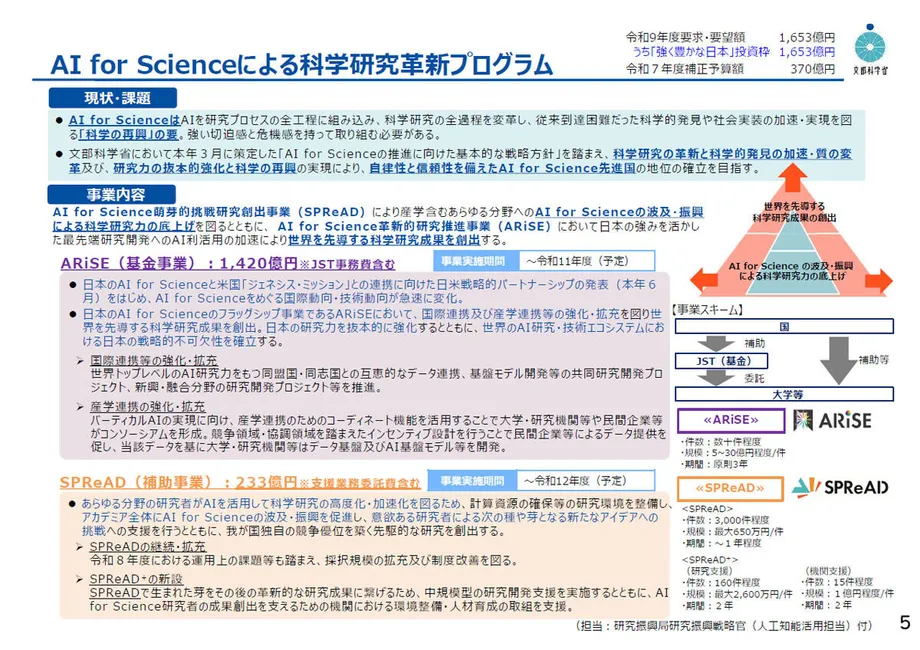
Japan's new ARiSE initiative will commit ¥32 billion to scientific research that uses artificial intelligence to generate hypotheses, plan and run experiments, analyze results, and decide what to investigate next. The Japan Science and Technology Agency (JST) selected 31 projects from 203 applications, with funding covering approximately two and a half years, from October 2026 through March 2029.
Contents
- 31 projects selected to rethink how science is done
- A national strategy takes shape
- Two funding categories with different roles
- Materials data becomes a shared research platform
- A genome model that learns from failed experiments
- From automated instruments to an autonomous facility
- Scientific theory becomes part of the AI
- Cancer research moves beyond recognizing patterns
- Computing access and sharing will shape delivery
- Key Points
JST's September 29 selection announcement confirms that 12 projects were chosen for the Strategic Target category and 19 for the International and Interdisciplinary category. A total of 82 advisers participated in document reviews and interviews. Research is scheduled to begin once contracts and other preparations are complete, rather than automatically starting on the announcement date.
ARiSE stands for AI to Redesign Scientific Exploration. Its ambition goes beyond using AI to process a dataset or summarize scientific papers. The program seeks to connect digital reasoning with physical experiments, creating a repeated cycle in which experimental results help AI develop better hypotheses and designs.
The overall selection rate was about 15.3%, calculated from 31 successful proposals out of 203 applications. The Strategic Target category accepted 12 of 70 proposals, about 17.1%, while the International and Interdisciplinary category accepted 19 of 133, about 14.3%. These figures show the competition for entry, although they do not establish how individual projects ranked or how funding will ultimately be distributed.
The program director is Takafumi Aoki, executive vice president of Tohoku University. Sadao Kurohashi, director of the National Institute of Informatics (NII), oversees the Strategic Target category. Shunichi Ueda, deputy director of RIKEN's Center for Advanced Intelligence Project, oversees the International and Interdisciplinary category.
A national strategy takes shape
ARiSE follows the Ministry of Education, Culture, Sports, Science and Technology's strategy for promoting AI for Science, adopted on March 31, 2026. JST describes the initiative as a flagship program intended to concentrate investment where Japan's scientific strengths can produce internationally competitive results, while supporting collaboration with leading researchers abroad.
The ministry's Research Promotion Bureau published its ARiSE basic policy page on April 16, 2026. That page links to a 262 KB policy document, but does not reproduce the document's detailed provisions in its text.
The sequence from policy development to project selection was relatively compact:
- March 31, 2026: The ministry adopted its basic strategic policy for promoting AI for Science.
- April 16, 2026: The Research Promotion Bureau published the ARiSE basic policy page.
- May 12 to June 30, 2026: JST accepted research proposals.
- September 29, 2026: JST announced the 31 selected projects.
- October 2, 2026: Tohoku University announced three successful projects.
- October 13, 2026: JST held a briefing explaining the initiative's background and planned operation.
- March 2029: The current research funding period is scheduled to end.
JST President Kazuhito Hashimoto has argued that Japan cannot match the United States and China through investment volume alone. The alternative is to focus on areas where Japan has accumulated valuable scientific data, specialist knowledge, experimental capabilities, and robotics expertise.
His concern is also about dependence. If Japanese researchers use only AI developed overseas, foundational technology and computing resources may remain under the control of other countries. ARiSE therefore combines domestic model development with international cooperation, rather than treating the two as competing choices.
Two funding categories with different roles
The Strategic Target category supports larger teams in materials science, life sciences, and large research facilities and equipment. Its 12 selections comprise six materials projects, four life sciences projects, and two projects involving large facilities or equipment.
The materials selections are divided among three targets. Targets 1-1 and 1-2 each have one selected project, with approximate funding ceilings of ¥3 billion per project. Target 1-3 has four projects, with ceilings of about ¥1 billion each. Life sciences and large facility projects have approximate ceilings of ¥2 billion per project. These are funding limits, not confirmed awards to every team.
The International and Interdisciplinary category is open to all scientific fields. It supports research that incorporates scientific theories, laws, and structural knowledge into AI, with funding normally set at ¥200 million per project. Proposals may seek up to ¥650 million when necessary to achieve their objectives.
Every proposal must bring together an AI researcher and a researcher from the relevant scientific discipline as joint leaders. Teams must also plan computing needs from the outset, pursue international collaboration, establish rules for sharing and protecting data, and address research security. The requirements make scientific expertise and infrastructure planning part of the research design, rather than additions made after an AI model has been chosen.
Materials data becomes a shared research platform
A central materials project aims to connect Japan's accumulated materials data with domestic large language models and specialized AI. Data and research resources developed around the National Institute for Materials Science (NIMS) are intended to help build a national materials AI platform.
The proposed platform has several connected layers: data and analytical tools prepared for AI use, materials foundation models, AI agents that assist with discovery and design, and advanced experimental equipment. A foundation model is a broadly trained model that can serve as a starting point for multiple research tasks. An AI agent can use tools and coordinate steps toward a specified objective.
The intended research cycle starts with AI proposing a material or experimental condition. Connected equipment then performs the experiment, and the results feed back into the next design. The aim is to make this capability available to a broad community of materials researchers, not restrict it to a few teams with extensive AI expertise.
Tohoku University's three project selections show how this national effort connects with specific research programs. Professor Yu Kumagai leads a platform for developing hard bulk materials using AI, with professors Goro Miyamoto and Motoki Shiga as joint research leaders.
A second Tohoku project addresses autonomous creation of magnetic materials and understanding their mechanisms through cooperation between people and AI. It is led by Professor Takafumi Hirohata, with Yuma Iwasaki of NIMS and Professor Kanta Ono of Osaka University as joint leaders.
Tohoku's third selection, in the International and Interdisciplinary category, is the Tsunami World Model. Professor Shunichi Koshimura leads it with Professor Kentaro Inui and Yuichiro Usuda of the National Research Institute for Earth Science and Disaster Resilience. Its inclusion demonstrates that ARiSE extends beyond laboratory materials and biology, although the university announcement does not detail the model's intended capabilities.
A genome model that learns from failed experiments
The life sciences program includes a genome language model with approximately four billion parameters, intended to cover plants, animals, humans, and microorganisms. Unlike a conventional language model trained on words, a genome language model learns patterns in DNA sequences to support research into biological function and genome design.
Parameters are the numerical values a model adjusts during training. The planned model will build on an existing model of approximately seven billion parameters. Those figures describe model size, not proof that the new model will outperform its predecessor. Its intended scientific value depends on the biological data, experiments, and learning process built around it.
The project uses a Design, Build, Test, Learn cycle. Researchers design a sequence or hypothesis, produce and test it experimentally, then return the results to the model. Successful outcomes, failed experiments, and genetic resources are all intended to contribute to subsequent learning. Including failures matters because an unsuccessful experiment can help identify which designs or conditions do not work.
The model is intended to become a shared resource for life sciences researchers, with practical use pursued through the Bio-AGILE consortium. Biosecurity and model safety are explicitly part of the work. A tool capable of supporting biological design requires safeguards alongside improvements in predictive ability.
From automated instruments to an autonomous facility
The project to develop an unmanned research facility brings together the Institute of Science Tokyo, RIKEN, and Epistora. According to Epistora's project announcement, Professor Genki Kanda of the Institute of Science Tokyo leads the research. Joint leaders are Koichi Takahashi, a project director in RIKEN's scientific foundation model development program, and Epistora CEO Yosuke Ozawa.
The project belongs to Strategic Target 3, which covers operation optimization, automation, autonomous operation, and improvements in experiment planning and data analysis at large research facilities. It will develop and demonstrate AI agents and foundation models that connect research plans, experimental equipment, and the resulting data.
The distinction between an automated instrument and an autonomous facility is practical. A robot might perform one experiment, yet people may still need to prepare equipment, move samples, replenish supplies, schedule instruments, and recover from interruptions. ARiSE aims to address those surrounding tasks as well as the experiment itself.
The proposed facility has three connected elements. Its information systems will handle research objectives, hypotheses, experimental plans, analysis, and decisions about subsequent experiments. Operational systems will allocate equipment, time, and materials. Physical systems will automate transport, replenishment, and recovery.
People would oversee the process rather than manage every individual step. The facility is intended to support continuing research into cancer, immunity, vaccines, aging, and regenerative medicine. Epistora says it brings approximately a decade of research involving AI and robotics, including work on optimizing conditions for turning induced pluripotent stem cells into retinal pigment epithelial cells. These are cells that support the retina.
Kurohashi described expectations for such facilities moving from around 2050 toward 2040 and then around 2030 as AI and robotics advance. That is an evolving estimate, not a guarantee that a fully autonomous facility will be operational before ARiSE's funding period ends in March 2029.
Scientific theory becomes part of the AI
The International and Interdisciplinary category takes a different route to stronger scientific AI. Ueda's approach incorporates scientific theory into model structures, representations, and learning principles, rather than using theory only as a rule that limits an otherwise conventional model.
Relevant knowledge includes symmetry, invariance, causality, boundary conditions, and scaling laws. In accessible terms, these describe relationships that should hold when a system changes, how causes connect with outcomes, and the conditions under which a scientific model applies. Building such knowledge into AI is intended to improve reasoning when data are scarce or conditions differ from those encountered during training.
One selected project combines mathematical physics and AI to generate scientific hypotheses and check their validity using mathematical and physical theory. Its aim is to reduce the gap between producing a plausible statement and establishing whether that statement is correct. Autonomous verification is a research objective, not an already demonstrated capability of the program.
Another project focuses on metal organic frameworks (MOFs), porous materials studied for uses including gas adsorption and separation. Their properties can vary with synthesis and experimental conditions. The project combines changing scientific representations, counterfactual reasoning, and researcher feedback to explore how changing a condition might change an outcome.
Counterfactual reasoning asks what would happen under a different condition, rather than simply identifying patterns in existing observations. Researchers will assess hypotheses and reasoning, then feed those judgments back into the AI. This project therefore retains direct human participation, even while the unmanned facility project pursues much greater operational autonomy.
Cancer research moves beyond recognizing patterns
A separate cancer project will combine tissue structure, cell shape, gene expression, and interactions among cancer cells, immune cells, and other surrounding cells. Its aim is to build models that reason about disease mechanisms, rather than only recognize features associated with cancer.
The work connects two levels of observation. From the organization of a tissue, the model would infer how individual cells behave. From those behaviors, it would predict how the tissue's condition changes. Examining both space and time could help researchers investigate how cancer develops within its surrounding biological environment.
The intended applications include discovering disease mechanisms, predicting prognosis, and exploring treatments. These are proposed research outcomes. Selection for ARiSE does not establish clinical effectiveness or mean that a diagnostic or treatment tool is ready for patients.
Computing access and sharing will shape delivery
ARiSE requires computing plans at the proposal stage because training models and running them can consume a substantial share of research funding. JST intends to combine resources at universities, public research institutions, companies, and RIKEN, while allowing overseas commercial computing where appropriate.
Accounts differ on the name of the RIKEN AI supercomputer under consideration: one identifies it as RIKEN, while the October briefing account names it 理究. The shared point is the intention to use domestic computing alongside other resources. A final allocation of computing capacity to individual projects has not been specified.
The program also aims to distribute broadly useful models, agents, tools, and evaluation methods beyond the selected teams. JST plans connections with NII's SINET academic network and NII RDC research data infrastructure. These links are intended to make outputs accessible to researchers across Japan and support exchange among the materials, life sciences, and facility projects.
Sharing will not mean publishing everything. Data or results that require protection for competitive or security reasons may remain confidential. Research security requirements apply from selection onward, while the genome project also has specific biosecurity and model safety responsibilities.
Program officers are expected to review progress and support adjustments, including expanded research tasks, additional international partners, and joint events. This flexibility responds to the risk that a plan fixed in 2026 could be outdated by 2029. The current information does not establish individual contract start dates, final grant amounts, computing allocations, or a detailed schedule for public model releases.
The central test is whether the projects can connect Japan's scientific assets with functioning AI systems, reproducible experiments, and resources other researchers can actually use. ARiSE sets out that direction, but its promised discoveries, autonomous capabilities, and shared platforms still have to be developed and demonstrated.
Key Points
- ARiSE has ¥32 billion in funding for approximately October 2026 through March 2029.
- JST selected 31 projects from 203 applications, an acceptance rate of about 15.3%.
- The Strategic Target category has 12 projects; the International and Interdisciplinary category has 19.
- Major efforts include a materials AI platform, a genome model of approximately four billion parameters, and an unmanned research facility.
- Selected research also covers mathematical physics, MOFs, cancer mechanisms, and a Tsunami World Model.
- Domestic computing and shared research infrastructure are priorities, with overseas resources permitted where appropriate.
- Individual start dates depend on contracts and preparations; autonomous facilities and scientific applications remain development goals.