Hanul 4 has just 1.1°C of temperature margin
Eight South Korean nuclear reactors have cooling seawater temperatures less than 2°C below their design limits, according to Korea Hydro & Nuclear Power data presented by lawmaker Kim Sun-min. At Hanul Unit 4 in Uljin, North Gyeongsang Province, the reported summer peak reached 30.4°C, leaving just 1.1°C below its 31.5°C limit.
Contents
- Hanul 4 has just 1.1°C of temperature margin
- What the cooling limit actually means
- Which reactors are closest?
- Forecasts are moving faster than the response trigger
- A different group faces projected limits from 2030
- Cooling upgrades are planned, with Hanbit work due in 2029
- Why raising the limit has drawn objections
- What the warming evidence establishes
- Regulators face requests for earlier checks
- Key Points
The pressure is also changing the timetable for action. KHNP cut its estimate of the time remaining before Hanul Units 3 and 4 reach their design seawater temperature from 28 years to 13 years between successive assessments. That revision removed 15 years of anticipated preparation time in a single year.
Kim, a Rebuilding Korea Party member of the National Assembly's Science, ICT, Broadcasting, and Communications Committee, challenged the company's policy of immediately pursuing equipment improvements when a reactor is forecast to reach its limit within 10 years. Hanul 3 and 4 remain outside that trigger despite the sharp revision.
The eight reactors with temperature gaps below 2°C are Hanul Units 1, 3 and 4 and Hanbit Units 1, 3, 4, 5 and 6. They represent about 35% of the 23 reactors covered by the comparison. Wolsong Units 2, 3 and 4 were excluded because the data described them as having no seawater temperature restriction.
These findings concern shrinking cooling margins, not a reported breach of the limits. They nevertheless put the timing of engineering work, regulatory checks and operating preparations under scrutiny.
What the cooling limit actually means
A reactor's design seawater temperature is the upper temperature used to demonstrate that its cooling equipment can remove the required heat, including during accident conditions. Warmer seawater leaves less temperature difference between the cooling water and the equipment it must cool, making heat removal more demanding.
The sea is a heat sink, not a substitute for the reactor's internal cooling systems. Heat exchangers transfer heat between separate water circuits so that seawater can carry it away. Their capacity becomes especially relevant as intake water approaches the temperature assumed in the plant's safety calculations.
The operating requirements described in the reports call for entry into hot shutdown, operating Mode 3, within six hours if seawater exceeds the applicable limit, followed by cold shutdown, Mode 5, within 36 hours. Cold shutdown does not mean the reactor stops producing residual heat. Cooling remains necessary after the nuclear chain reaction stops.
Design temperatures differ between plants. Shin Hanul Units 1 and 2 have a reported limit of 31°C, while Kori Unit 2 has a limit of 36.1°C. A temperature that is acceptable at one reactor therefore cannot automatically be treated as acceptable at another.
Which reactors are closest?
Hanul 4's reported peak of 30.4°C compares with 25.2°C in the preceding year, a rise of 5.2°C between annual maxima. That is a large change in a local peak measurement, but it should not be read as a sustained annual warming rate.
Hanul 3 reached a reported 30°C, leaving 1.5°C below its design limit. At Hanbit in Yeonggwang, South Jeolla Province, Units 1, 3 and 4 each had a remaining gap of 1.6°C. Hanbit 5 and 6 and Hanul 1 also had gaps below 2°C, although exact values were not given.
There is a distinction in how the latest figures are described. A report dated October 11, 2026, identifies the comparison as projected peak seawater temperatures for 2026, while accounts of a parliamentary audit held on the 13th describe the same figures as summer maxima already recorded. Reports therefore differ on whether the complete eight reactor comparison is a forecast or an observation.
That distinction matters for judging immediate operating conditions. The figures establish the margins being discussed, but the accounts do not resolve the measurement or forecast status of every value.
Forecasts are moving faster than the response trigger
The revisions extend beyond Hanul 3 and 4. The estimated period before Hanul Units 5 and 6 reach their limit fell from 40 years to 27 years. For Shin Hanul Units 1 and 2, it fell from 57 years to 46 years.
For Hanul 3 and 4, the reduction from 28 to 13 years amounts to about 54% of the previously estimated preparation period. The reductions for Hanul 5 and 6 and Shin Hanul 1 and 2 were about 33% and 19%, respectively. These are changes in forecasts, not equivalent measurements of how quickly the sea warmed.
Kim said the reason for those revisions needs investigation. Changes in seawater temperatures, calculation methods or both could alter the projected dates. Without that explanation, a forecast cannot be treated as a fixed countdown.
Kim explained why this uncertainty affects construction schedules:
A shorter margin period means there is less time than initially expected to reinforce cooling facilities and prepare operating countermeasures.
Her proposed approach would consider three factors together: the actual temperature gap, recent volatility in forecasts and the time required to design, manufacture, license and install improvements. Under that approach, a reactor could merit earlier work even if its central forecast remains more than 10 years away.
A different group faces projected limits from 2030
The eight reactors closest to their limits in the latest temperature comparison are not the same eight identified in a 2025 forecast of threshold dates. That earlier forecast placed Shin Wolsong Units 1 and 2 at their design seawater temperature in 2030, Hanbit Units 3 and 4 in 2031, and Hanbit Units 1, 2, 5 and 6 in 2034.
The distinction separates two measures of exposure: a small temperature gap in a particular summer and a projected date for reaching a limit. Hanbit 2 appears in the earlier timetable but not in the latest list of eight reactors within 2°C. Hanul 1, 3 and 4 appear in the latest list but not in that earlier group forecast to reach limits by 2034.
Other projections have also shifted. KHNP's estimate for Kori 2 moved from 2087 in a 2022 assessment to 2050 in a 2025 assessment, bringing the expected threshold forward by 37 years. Forecast dates for Kori 3 and 4 moved forward by 20 years, and those for Hanbit 3 and 4 by nine years.
These dates are planning estimates, not scheduled shutdowns. Actual temperatures, approved equipment changes and any revised operating limits will determine whether and when a reactor must stop.
Cooling upgrades are planned, with Hanbit work due in 2029
KHNP presented its response measures to the Nuclear Safety and Security Commission at a meeting on August 14, 2025. The company described a shift toward physical improvements to cooling equipment, after years of raising permitted seawater temperatures within assessed safety margins.
By that meeting, KHNP said it had completed improvements at Shin Wolsong 1 and 2 by increasing the plate size in their existing heat exchangers. It also planned to pursue an increase in the permitted operating seawater temperature. Earlier reporting described the licensing process as under way in July 2025, so completed equipment work should not be confused with approval of a higher operating limit.
For Hanbit Units 1 through 6, KHNP plans to replace existing tubular heat exchangers by the first half of 2029. That target is two calendar years before the projected 2031 threshold for Units 3 and 4 and five years before the 2034 threshold for Units 1, 2, 5 and 6.
KHNP estimated improvement costs at KRW10 billion to KRW20 billion per plant. That estimate is not presented as a total budget for the six Hanbit reactors, and the precise meaning of the plant level costing is not explained.
The company also said it would assess expected threshold dates annually and develop a seawater temperature prediction system. Those commitments make updated forecasts central to the upgrade programme, rather than figures calculated once and left unchanged.
Why raising the limit has drawn objections
The debate predates the latest findings. On August 7, 2017, cooling seawater at Shin Kori Unit 3 reached 31.2°C, just 0.4°C below its then design temperature of 31.6°C. The reactor was subsequently renamed Saeul Unit 1.
KHNP applied on March 7, 2019, to raise the design seawater temperature for Shin Kori 3 and 4, now Saeul 1 and 2, from 31.6°C to 34.9°C. The commission approved the increase on July 21, 2022, while requesting a later report on detailed equipment improvements and other measures addressing climate change.
Figures described from Korea Institute of Nuclear Safety review material show why the proposed change attracted objections. At an intake temperature of 31.6°C, the required heat removal was 3.97 million British thermal units per hour. At 34.9°C, it rose to 6.67 million, an increase of about 68%.
Against a stated heat exchanger design capacity of 7 million British thermal units per hour, the calculated spare capacity fell from 3.03 million to 0.33 million. On that basis, the operating margin fell from 43.3% to 4.7%. A separate later account gives a margin of 16.1% following the temperature increase. The reports do not explain the different calculation bases, so those percentages should not be treated as interchangeable.
The earlier review also described an improvement in the manufacturer's guaranteed performance from 7.92 million to 7.95 million British thermal units per hour, about 0.38%. Commission members Lee Byung-ryung, Kim Ho-cheol and Ha Jung-gu questioned the loss of margin and whether equipment changes were sufficient.
The engineering issue is therefore more specific than whether a higher temperature can be approved. It is how much dependable cooling capacity remains after that approval, and whether physical improvements restore the margin used in the safety assessment.
What the warming evidence establishes
The National Institute of Fisheries Science's 2025 climate impact briefing reported that surface seawater temperatures around the Korean Peninsula rose 1.58°C between 1968 and 2024. That regional trend provides context for cooling concerns, but it cannot by itself predict temperatures at an individual intake.
The original design temperature for Shin Kori 3 was based on a local maximum of 28.6°C observed during 1971 to 2000, plus 3°C to account for recirculation of warm discharge water. That historical calculation explains why changes beyond the observation period can place pressure on the original assumptions.
Two reports also attribute an 8.3°C rise in average East Sea water temperature between 1980 and 2010 to the Korea Institute of Ocean Science and Technology, alongside a 1°C rise between 2021 and 2023. They provide no underlying dataset or definition to explain the unusually large earlier figure. It should not be treated as equivalent to the fisheries institute's clearly dated peninsula surface temperature series.
KHNP has also reportedly tried adding large quantities of ice to seawater near a plant. The effect was temporary. Such an intervention does not establish lasting cooling capacity or replace the heat exchanger work already planned.
Regulators face requests for earlier checks
At the August 2025 meeting, NSSC Chairman Choi Won-ho called for faster improvements and prompt responses to unusually warm seawater:
In order to prepare for accelerated global warming, we must quickly improve facilities so that we can fundamentally solve the problem, and we must do everything possible to respond immediately when high sea temperatures are observed.
Choi also said the commission planned periodic inspections of the improvement programme. One separate account identifies an NSSC official as Lim Si-woo, so the reported names and roles should not be merged.
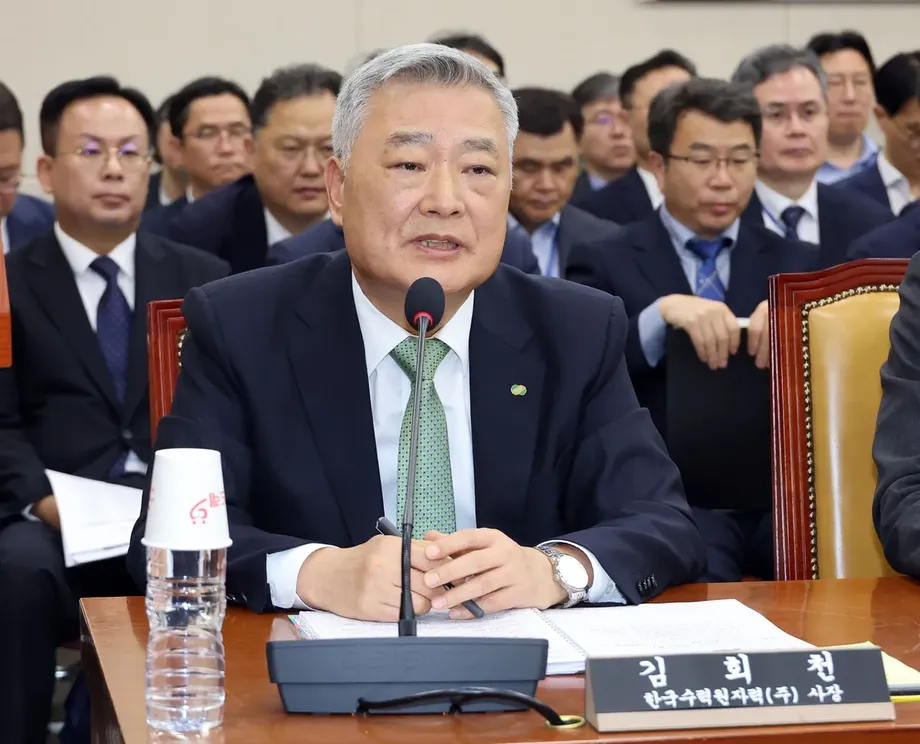
At the parliamentary audit, KHNP President Kim Hoe-cheon said the company would replace heat exchangers before the existing trigger if risk was detected. That response allows earlier intervention, but the audit accounts do not specify a new numerical trigger or a revised completion date for Hanul 3 and 4.
Kim Sun-min requested reactor specific reassessment plans, revised improvement criteria and staged response plans before the audit's concluding session. No calendar date for that session is given. She also sought checks before summer and planning for prolonged periods of warm seawater.
Other audit findings concerned separate safety responsibilities. Lawmaker Cho Kyoung-tae said only Wolsong, among five nuclear headquarters, had radar capable of detecting autonomous drones approaching over long distances. The NSSC said detailed design contracts had been commissioned for the other four locations. Kim also sought disclosure of safety evidence and measures addressing delayed removal of spent fuel, citing an unmet promise to remove Wolsong fuel by 2016 and the completion of seven additional dry storage structures in 2022. Neither issue explains the cooling temperature changes, but both were part of the same scrutiny of preparation and follow through.
Key Points
- Eight reactors had reported cooling seawater temperature gaps below 2°C, with Hanul 4 closest at 1.1°C.
- Hanul 3 and 4's projected preparation period fell from 28 years to 13 years between assessments.
- The latest accounts differ on whether the temperature comparison represents recorded summer peaks or projected 2026 peaks.
- KHNP's immediate upgrade trigger is a forecast of reaching the limit within 10 years, although its president said earlier intervention was possible.
- Shin Wolsong cooling improvements were reported complete in August 2025. Hanbit heat exchanger replacements are planned by the first half of 2029.
- Earlier forecasts place Shin Wolsong thresholds in 2030 and Hanbit thresholds in 2031 or 2034, subject to changing temperatures and approved improvements.
- Lawmakers requested revised criteria and reactor specific plans. No new Hanul 3 and 4 completion timetable was specified.