A pollution emergency plan with consequences for daily life
Vietnam's Ministry of Agriculture and Environment has proposed moving all educational institutions online and directing eligible public employees to work remotely when the daily Vietnam Air Quality Index reaches the hazardous level of 301 or higher across eight northern cities and provinces. The proposed red alert would also bring restrictions on heavy diesel trucks, construction stoppages and pollution warnings at least three times a day.
Contents
- A pollution emergency plan with consequences for daily life
- Why eight localities need a shared response
- Yellow alerts would start controls before an emergency
- What a red alert would change
- Hanoi plans warnings up to a week ahead
- Construction sites face cameras, cleaning duties and deadlines
- Why this winter is drawing concern
- Dust controls fit into a larger emissions plan
- The next test is implementation
- Key Points
The plan covers Hanoi, Hai Phong, Bac Ninh, Hung Yen, Ninh Binh, Phu Tho, Thai Nguyen and Quang Ninh. It follows monitoring that found daily average concentrations of fine particle pollution exceeded Vietnam's national limit on more than 15% to nearly 40% of days at stations across those localities during 2021–2025.
Hanoi is already preparing its own response. Under Plan No. 400/KH-UBND, issued by the Hanoi People's Committee on October 15, 2026, the capital intends to warn of pollution risks five to seven days ahead and require technological dust monitoring at every construction project larger than one hectare.
The regional emergency rules remain a proposal submitted to the Government, with no approval date or start date announced. Deputy Minister of Agriculture and Environment Le Trong Yen confirmed the submission at an October 21 conference with Hanoi officials. The ministry's office said the proposal had been sent to Deputy Prime Minister Ho Quoc Dung.
For residents, the practical change would be a more organized response before and during dangerous smog: earlier warnings, fewer activities outdoors, tighter controls on sources of pollution and changes to school, work and travel.
Why eight localities need a shared response
The ministry's environmental status report for 2021–2025 identified fine particulate matter, known as PM2.5, as the main air pollution concern. At automatic monitoring stations across the eight localities, daily concentrations exceeded the limit set by the national ambient air quality regulation, QCVN 05:2023/BTNMT, on more than 15% to nearly 40% of days.
Those figures mean that, depending on the station, excessive pollution occurred on more than roughly one day in seven to almost two days in five. Hanoi's reported average PM2.5 concentration in 2025 was 48.5 micrograms per cubic meter, with days exceeding the daily standard accounting for about a third of the year.
PM2.5 consists of particles measuring 2.5 micrometers or less across. These particles are small enough to reach deep into the lungs, and some can enter the bloodstream. Exposure increases risks to respiratory and cardiovascular health, with children, older people and people with existing illnesses particularly vulnerable.
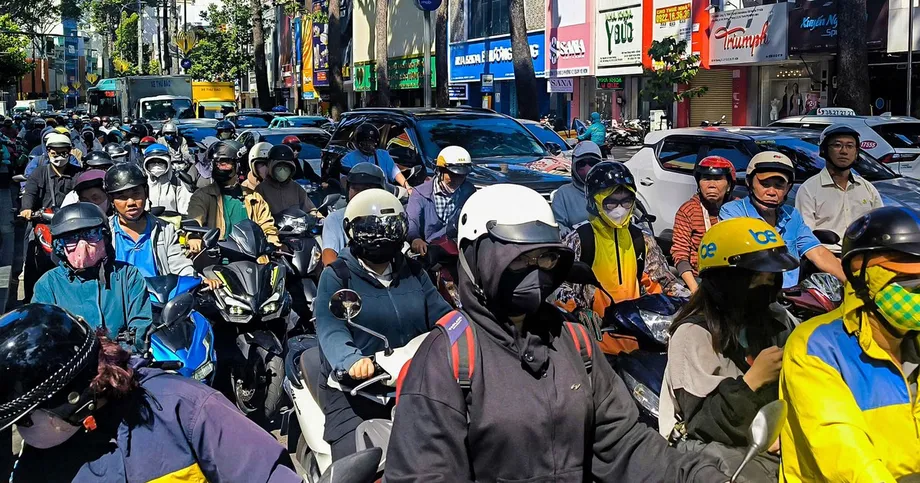
The eight localities contain dense traffic networks, major construction sites, cement factories, steel production facilities and thermal power plants. Emissions can travel across their boundaries, making coordinated action necessary even when the pollution is measured inside a single city.
Dr. Hoang Duong Tung, chair of the Vietnam Clean Air Network, has called for controls across neighboring provinces and cities based on accurate, consistent inventories of emissions. Such inventories identify how much pollution comes from each type of activity, helping authorities decide where reductions would make the greatest difference.
Yellow alerts would start controls before an emergency
The draft establishes two alert levels based on the daily Vietnam Air Quality Index, or VN_AQI: yellow and red. AQI turns measurements of air pollution into a number that helps people understand health conditions. The proposed red threshold is 301; the yellow threshold has not been specified.
For a yellow alert, the ministry would issue the warning on behalf of the prime minister through the VN Air application. Authorities would publish pollution warnings and health recommendations at least twice daily.
Major sources of emissions would have to keep automatic monitoring systems running continuously and operate exhaust treatment equipment at maximum efficiency. Facilities would also prepare plans to adjust production if conditions worsened to red alert.
Local authorities would increase street sweeping, dust collection and road washing, prioritizing nighttime work. Construction stages that generate dust would be temporarily suspended, while sites would face stronger requirements for mist spraying, cleaning and washing vehicles.
Kindergartens, primary schools and middle schools would suspend outdoor group activities, adjust arrival and departure times when needed, and encourage online learning. Patrols would also target the open burning of rice straw, agricultural byproducts, waste and scrap materials.
What a red alert would change
The ministry would seek the prime minister's authorization to issue a red alert. Once activated, all educational institutions would switch to online teaching and learning until the warning was lowered or lifted.
State agencies and public service units would require remote work for employees whose duties do not involve directly handling administrative procedures at their offices. Staff needed to provide those services in person would therefore have a different arrangement from colleagues able to work remotely.
Authorities would issue warnings at least three times daily and provide protective supplies to outdoor workers and disadvantaged residents. This would extend protection to people who cannot simply stay home, including those whose jobs require them to remain outside.
Diesel trucks weighing at least three metric tons would be restricted from entering inner city areas and densely populated neighborhoods during two periods: 6 a.m. to 9 a.m. and 4 p.m. to 7:30 p.m. Vehicles carrying essential goods and food would be exempt.
The detailed proposal encourages residents to limit private motorbike use, promotes public transport and allows consideration of fare exemptions. Free travel would therefore depend on a further decision. Broader descriptions of the proposal refer to possible motorbike restrictions, while the detailed measures focus on encouraging reduced use.
Dust generating construction activities in inner city areas and densely populated neighborhoods would stop. Authorities would continue monitoring industrial emissions and require emissions reports. The draft also calls for suspending votive paper burning and ceremonies that create widespread smoke and dust in public spaces, religious establishments, places of worship and residential areas.
Hanoi plans warnings up to a week ahead
Hanoi's October 15 plan creates a sequence of warnings intended to give officials, businesses and residents time to prepare. The city's Department of Agriculture and Environment would combine air monitoring, weather forecasts and air quality forecasts to assess the risk.
The department already uses AQI forecasts from the ministry's Northern Environmental Monitoring Center to issue weekly pollution warnings. The new schedule sets out more specific steps as a possible episode approaches:
- Five to seven days ahead: issue an initial risk assessment, begin reviewing major sources of emissions and inform the public.
- Forty eight to 72 hours ahead: update the affected area and severity, tighten construction controls, increase road cleaning and issue health advice.
- Twenty four hours ahead: review forecasts again, adjust the response area and staffing, and notify affected groups directly.
- As conditions improve: assess monitoring results and forecasts for the following 24 to 48 hours before recommending changes or ending intensified controls.
Hanoi and the ministry are also working on forecasting pollution across provincial boundaries and expanding environmental monitoring stations. These systems would support decisions about where controls are needed and when conditions have improved enough to ease them.
Construction sites face cameras, cleaning duties and deadlines
Hanoi's construction controls set concrete responsibilities for developers and contractors. Every project exceeding one hectare, equivalent to 10,000 square meters, must monitor dust through sensors, cameras, artificial intelligence or other suitable technology. Monitoring data must connect to commune authorities and police.
The city will classify sites as posing high, medium or low dust risks. Location and activity matter alongside size: demolition or excavation near a school, hospital or crowded neighborhood can require close inspection even at a smaller project.
By November 15, 2026, sites covered by the requirements must have fences at least three meters high, with a retaining wall at least 40 centimeters high beneath them. Dust suppression systems and cameras must be installed, and camera images retained for at least 30 days.
Trucks carrying soil, rocks, building materials or construction waste must be checked before leaving. Loads must be covered, and wheels, undercarriages and vehicle bodies cleaned of mud. Contractors must keep logs recording number plates, transport companies, entry and exit times, materials carried and washing checks.
Project investors must immediately arrange cleanup when construction mud or soil spills at gates or along affected access roads within a radius of 50 to 100 meters. Hanoi is also considering at least two cleaning sessions daily on roads where dust repeatedly accumulates.
Residents can submit photographs or videos of dusty vehicles, spilled soil and other incidents through iHanoi, a hotline and other official channels. Citywide implementation results are to be published weekly, giving residents a way to follow enforcement as well as report problems.
Why this winter is drawing concern
Hanoi's early October measurements show how quickly conditions can deteriorate. At the 8 a.m. observation, air quality was good during the first six days of October 2026. From October 7 to 18, it stayed in moderate or poor categories, including eight days with AQI readings between 102 and 138.
Weak winds, a lack of rain and light morning fog made it harder for pollution to disperse. Winter temperature inversions can add to the problem: warmer air above a cooler layer near the ground acts like a lid, trapping emissions where people breathe.
A forecast published on October 19 put the northern region's peak pollution season through February 2027. Hanoi's control plan uses a wider precautionary window, from October through March, when it calls for stronger oversight of construction, major industrial sources, vehicles with high emissions, open burning and street cleaning.
Monitoring during the first nine months of 2026 recorded fewer days above standards in Hanoi, with September less severe than in previous years. Ministry monitoring for the broader Hanoi Capital Region during 2022–2025, however, showed no clear improvement, with PM2.5 remaining the main concern.
Southeast Asia has also experienced smoke from Indonesian wildfires during 2026, reaching Malaysia, Singapore and the Philippines. Hanoi's response focuses on the nearby sources identified by authorities: traffic, industry, construction and agricultural or waste burning.
Dust controls fit into a larger emissions plan
Construction and road dust account for about 20% of PM2.5 emissions in major cities such as Hanoi, according to the Environment Department. That is roughly one fifth, making dust a substantial target while leaving traffic, industry and other sources requiring attention.
Associate Professor Hoang Anh Le, of the University of Science at Vietnam National University, Hanoi, has identified construction and demolition as major direct sources of dust. He recommends wetting structures before demolition, covering sites and collecting dust frequently, pointing to shortcomings in shielding and pollution controls at some projects.
Hanoi's transport plans include investment in buses, urban rail, public bicycles and supporting services, together with charging stations and battery swapping facilities. The city also plans to continue developing zones that limit emissions and consider expanding them, while studying traffic zoning and charges for motor vehicles entering certain areas.
The regional draft draws on the Law on Environmental Protection and Decision No. 2530/QD-TTg, dated November 19, 2025. That decision approved the National Action Plan on Pollution Mitigation and Air Quality Management for 2026–2030, with a vision to 2045.
The next test is implementation
Hanoi's immediate deadlines are more specific than the timetable for the regional emergency proposal. The construction department was assigned to compile lists of large and high risk sites during October 2026, followed by the November 15 deadline for physical dust controls and camera data storage.
The ministry has also been preparing a submission to establish a national steering committee on air pollution, intended to coordinate work across sectors and localities. After applying the proposed regional rules in the eight northern jurisdictions, it plans to advise on similar arrangements elsewhere.
Hanoi Vice Chairman Bui Duy Cuong told the October 21 coordination conference that the city's main task was implementing its mechanisms and policies. For residents, that means turning plans into visible changes: cleaner trucks leaving construction sites, timely warnings, less burning and coordinated action when pollution rises.
The proposed red alert would change daily routines during the most hazardous episodes. Hanoi's advance warnings and routine emissions controls are intended to begin earlier, reducing pollution before schools and workplaces need emergency arrangements.
Key Points
- Vietnam proposes yellow and red pollution alerts across eight northern localities, including Hanoi, Hai Phong and Bac Ninh.
- A daily VN_AQI of 301 or higher would trigger proposed red alert measures, including online education and remote work for eligible public employees.
- Heavy diesel trucks would face peak period restrictions, with exemptions for essential goods and food.
- Hanoi plans initial pollution risk warnings five to seven days ahead, followed by increasingly specific updates.
- Construction projects larger than one hectare must use technological dust monitoring, with further site requirements due by November 15, 2026.
- The regional emergency rules await approval; Hanoi's separate pollution control plan was issued on October 15, 2026.