78 power facilities exceeded voltage limits in 2025
South Korea recorded excessive voltage at 78 major transmission and substation facilities in 2025, up from four in 2021, as expanding solar generation reduces the operation of conventional generators that also help keep the grid stable. The increase is putting new pressure on electricity authorities to replace those generators' voltage control services, upgrade solar equipment and pay for functions the electricity market currently leaves uncompensated.
Contents
- 78 power facilities exceeded voltage limits in 2025
- Why more solar changes voltage management
- Repeated events reveal pressure beyond the facility count
- A Korean grid model explains the geographic strain
- Most renewable connections sit on local networks
- Staying connected during a disturbance
- AI centres add sudden changes in demand
- Equipment is planned, but delivery and payment lag
- Jeju offers a concrete project and deadline
- Key Points
Korea Power Exchange data supplied to lawmaker Lee Jong-bae's office show that the number of affected facilities on the 345 kilovolt network rose every year: four in 2021, 22 in 2022, 52 in 2023, 61 in 2024 and 78 in 2025. The latest figure is 19.5 times the starting level, measured across five annual counts spanning four years.
More detailed operating figures also point to repeated and prolonged voltage problems. Meanwhile, equipment procurement can now take up to three years, and electricity authorities lack a complete picture of how much installed renewable generation can actively support voltage or stay connected during disturbances.
South Korea has already begun pursuing technical solutions. On Jeju Island, Korea Electric Power Corporation, or KEPCO, is working with ABB on a rotating machine designed to support both voltage and frequency, scheduled to enter service by the end of 2026. Broader inverter improvements extend to 2029, while another programme for rotating support equipment runs to 2034.
The immediate challenge is matching those construction and upgrade schedules to operating conditions that are changing now. At noon on March 29, 2026, solar supplied about 25.2 gigawatts, or 44.5% of generation, while coal supplied about 6.1 gigawatts, according to Korea Power Exchange figures. Solar output at that moment was more than four times coal output.
Why more solar changes voltage management
Voltage is the electrical pressure that moves electricity through a network. Equipment needs it to remain within a controlled range. Frequency measures the rhythm of alternating current. Both require constant management, but the equipment and actions needed to control them differ.
Coal and liquefied natural gas plants use synchronous generators, rotating machines that turn in step with the grid's electrical frequency. Alongside producing electricity, they can supply or absorb reactive power, an electrical exchange that helps control voltage.
Reactive power supports the electrical conditions needed to move useful power through the system. Too much or too little in a particular area can push voltage outside its desired range. During periods of low electricity demand, transmission lines can contribute to rising voltage, requiring equipment that absorbs reactive power.
Solar generation changes the operating balance. When sunlight supplies more electricity, conventional plants may reduce output or stop to keep total supply matched to consumption. A stopped generator also removes some of the voltage support previously available from that machine.
Baek Cheol-woo, a professor at Duksung Women's University, attributes much of the recent increase in overvoltage to these more frequent generator shutdowns. Rising transmission voltage has occurred before, he said, but fewer operating conventional generators make it harder to control.
Solar inverters, which convert the direct current produced by panels into alternating current for the grid, can also provide voltage support when equipped and operated to do so. South Korea's challenge therefore involves both adding dedicated equipment and making better use of renewable generators already connected.
Repeated events reveal pressure beyond the facility count
The 78 figure counts affected facilities. Operating records count repeated voltage events and accumulated hours at different locations, giving a more detailed picture of the burden on the network.
Figures attributed to a grid reliability performance report circulated through government advisory meetings put violations of voltage operating targets in 2025 at 582 on the 765 kilovolt network, 55,265 on the 345 kilovolt network and 4,943 on the 154 kilovolt network.
The same account gives 55,526 as the 345 kilovolt overvoltage total, while its target violation table gives 55,265. KEPCO's parliamentary disclosure used approximately 55,000. The precise totals therefore carry a discrepancy, although each places the annual count above 55,000.
The event series lists 18,753 cases in 2023, 36,717 in 2024 and 55,526 in 2025, nearly tripling in two years. Accumulated time associated with overvoltage lasting more than an hour increased from 13,174 hours in 2024 to 21,396 hours in 2025, about 62%. Those hours accumulate across facilities. Voltage above 366 kilovolts accounted for 70 hours.
The figures also use different voltage benchmarks. The facility count describes a permitted band of 5% above or below 345 kilovolts, approximately 327.75 to 362.25 kilovolts. The operating report uses a narrower target of 336 to 360 kilovolts. An operating target calls for intervention before voltage reaches the wider permitted boundary.
Target violation hours were highest at Singajwa substation, with 3,857 hours, followed by Sejong with 3,032, Hwaseong with 2,676 and Gunsan with 2,420. These locations show that voltage management requires attention across several regions, including areas serving major centres of consumption.
A Korean grid model explains the geographic strain
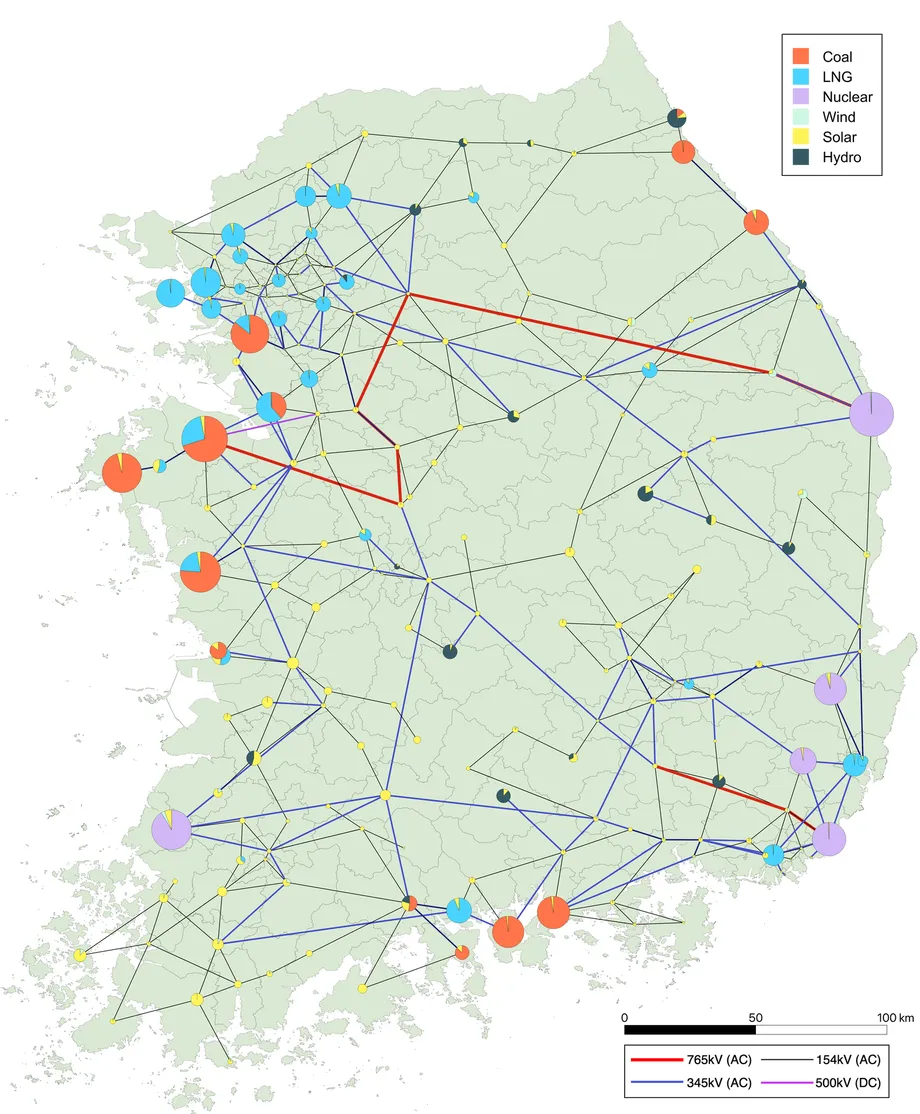
Researchers behind the academic paper KPG 193 study identify emerging overvoltage problems in southwestern South Korea, where solar installations are concentrated and the transmission network is relatively weak.
Their synthetic model, built from public data, contains 193 electrical connection points, called buses, 123 generators and 407 transmission lines. It includes 23.75 gigawatts of solar capacity, about 18% of its total 134.49 gigawatts of generating capacity. Capacity measures potential output, while the March 29 figures describe electricity actually being generated at a particular moment.
A simulation using conditions at 13:00 on July 22, 2022, the summer's peak demand day, places roughly 40% of electricity demand in the metropolitan area. Large coal and nuclear plants cluster along the coast, with eastern plants transmitting electricity more than 200 kilometres towards the capital region.
South Korea consequently needs to manage both large transfers towards its main demand centre and local voltage conditions in areas with concentrated generation. The southwestern solar concentration adds a different operating challenge from the long coastal transmission routes.
The researchers built KPG 193 as a simplified testing platform. Actual grid equipment, including shunt capacitors, static synchronous compensators and transformers with adjustable voltage settings, was omitted. Detailed network information is also restricted, so the model groups facilities using KEPCO regional service areas and public mapping data.
The study provides a way to test how generation, demand and geography interact. Its design also shows why planning requires detailed simulations that include the voltage control equipment installed at individual locations.
Most renewable connections sit on local networks
KEPCO data presented during parliamentary scrutiny show that distribution networks carry 30.7 gigawatts of South Korea's 41.1 gigawatts of renewable connection capacity, approximately 75%. By number of connections, 99% use those local networks, which deliver electricity to homes and businesses.
KEPCO says distribution inverters operate at a fixed power factor of 1.0. In simple terms, that setting focuses on supplying useful power without exchanging reactive power for voltage control. Inverters capable of adjusting reactive power need suitable settings and operating instructions to perform that task.
Renewable equipment installation rules have required voltage control capability since 2020. Authorities, however, have not established the actual application and operating status of those functions across more than 30 gigawatts of installed equipment. That missing inventory also affects decisions about upgrades, costs and operating instructions.
Song Seung-ho, an electrical engineering professor at Kwangwoon University, argues that renewable generators should participate in reactive power control as members of the electricity system. He also calls for more simulation work and staffing, with equipment selected according to conditions across the network.
Jeon Young-hwan, a professor at Hongik University, proposes using synchronous condensers to strengthen the grid and STATCOMs to manage voltage where improving existing inverters immediately is difficult. Both approaches seek to supply support that conventional generators previously provided while producing electricity.
Staying connected during a disturbance
Inverter upgrades must also address what happens when voltage or frequency briefly moves outside normal conditions. Protective devices may disconnect equipment to prevent damage. If many generators disconnect together, the sudden loss of supply can deepen the disturbance.
KEPCO's plans cover functions known as LVRT, LFRT and HVRT. These allow equipment to continue operating through specified periods of low voltage, abnormal frequency or high voltage. Appropriate high voltage settings can also enable an inverter to absorb reactive power while remaining connected.
KEPCO President Kim Dong-cheol described the existing coverage and intended expansion during parliamentary scrutiny:
We have ensured continuous-operation performance for facilities of 90 kilowatts (kW) or more, and plan to expand coverage to facilities of 20 kW or more.
KEPCO says it is pursuing improvements covering these functions through 2029 and plans synchronous condenser installations by 2034 to secure inertia. Inertia is the stored energy in rotating machinery that slows a sudden change in grid frequency, giving other controls time to respond.
Lawmaker Kim Juyoung also requested checks on emergency disconnection arrangements. Under-frequency load shedding disconnects selected customer circuits when electricity supply falls short and frequency drops dangerously. A circuit containing solar generators may remove less net demand than expected because disconnecting it removes both electricity users and local generation.
Kim cited an ENTSO-E expert panel assessment of the April 2025 blackout in Spain and Portugal, identifying overvoltage as the direct cause within a chain involving 14 factors. Fixed power factor operation and successive solar disconnections were among the factors described as worsening the voltage rise.
AI centres add sudden changes in demand
AI data centres present another operational challenge: electricity consumption can change quickly as large numbers of graphics processors shift between computation and data exchange.
Baek estimates that demand at a large AI training centre can vary by 30% to 40% over a short period. At a centre drawing one gigawatt, that would mean a change of 300 to 400 megawatts.
A July 2024 incident in Virginia illustrates the effect of a sudden loss of demand. According to an account attributed to the North American Electric Reliability Corporation, a transmission fault caused a brief voltage dip, triggering data centre protection systems. About 1,500 megawatts of demand disconnected, after which voltage rose to 107% of normal. A widespread blackout did not follow.
South Korea's Ministry of Climate, Energy and Environment launched a study group in August 2026 to develop grid connection and operating requirements for AI data centres. Detailed requirements addressing rapid demand changes and protective disconnections were still being developed.
Generation and consumption therefore need coordinated protection settings. A large solar disconnection suddenly removes supply; a large data centre disconnection suddenly removes demand. Either event requires the network to adjust quickly.
Equipment is planned, but delivery and payment lag
Synchronous condensers and STATCOMs are included in South Korea's 11th long term transmission and substation facilities plan, but installations remain unfinished. A synchronous condenser is a rotating machine that supports the network without generating electricity for sale. A STATCOM uses power electronics to adjust reactive power rapidly and control voltage.
Existing equipment is also under strain. Figures attributed to the grid reliability report put failed voltage compensation capacity, including shunt reactors and STATCOMs, at 3,500 megavolt amperes reactive in 2025, about three times the 2024 level. Shunt reactors absorb reactive power to restrain voltage rises, particularly when transmission lines are lightly loaded.
KEPCO says procurement periods for compensation equipment have stretched from around one year to as long as three years, with domestic manufacturers also supplying overseas orders. Repair and expansion schedules must therefore account for longer waits.
The electricity market presents a further constraint: reactive power control services are not separately compensated. A machine built mainly to regulate voltage has no ordinary electricity sales to justify its investment.
Yoo Seung-hoon, a professor at Seoul National University of Science and Technology, argues that investment in equipment such as STATCOMs should be included when policymakers assess renewable energy costs. Lee Jong-bae is calling for rules that keep renewable expansion aligned with stable voltage, frequency and electricity quality.
The practical decisions involve who pays, which existing inverters need upgrades, where new machines provide the greatest benefit and how quickly those machines can be delivered. Construction targets alone leave the operating task unfinished until equipment is connected, tested and available.
Jeju offers a concrete project and deadline
KEPCO and ABB have signed a memorandum of understanding for South Korea's first synchronous condenser coupled to a flywheel for high inertia. ABB's Jeju project announcement places the machine near the island's northern high voltage direct current station, where a subsea cable connects Jeju to the mainland.
The unit is rated at 50 megavolt amperes reactive for voltage support and close to 500 megawatt seconds for stored rotational energy. The flywheel adds rotating mass, increasing the energy available to slow sudden frequency changes. ABB is designing and manufacturing the system in Sweden, with operation scheduled by the end of 2026.
Jeju, home to around 670,000 people, aims for net zero emissions by 2035 through renewable energy and clean hydrogen. The project gives that transition a specific piece of supporting infrastructure and a near term commissioning target.
The main dates show how operating pressures and planned responses overlap:
- 2021 to 2025: Facilities exceeding voltage limits increased from four to 78.
- July 2024: A Virginia disturbance disconnected approximately 1,500 megawatts of data centre demand.
- March 29, 2026: Solar supplied 44.5% of South Korean generation at noon.
- End of 2026: Jeju's flywheel synchronous condenser is scheduled to enter operation.
- 2029: KEPCO's inverter performance improvement programme extends to this year.
- 2034: KEPCO plans synchronous condenser installations to secure inertia.
Key Points
- South Korea recorded overvoltage at 78 major facilities in 2025, compared with four in 2021.
- More solar generation reduces the operation of conventional generators that also provide voltage support.
- Distribution networks carry about 75% of renewable connection capacity, making inverter settings and performance central to grid stability.
- Authorities need a complete inventory of installed inverter capabilities, while equipment delivery can take up to three years.
- Jeju's new synchronous condenser is scheduled for operation by the end of 2026; broader improvements extend to 2029 and 2034.