A $100 Billion Opportunity Still Needs Commercial Projects
Vietnam produces about 500,000 tonnes of hydrogen annually, yet none comes from commercial green or blue hydrogen projects, according to a draft market assessment discussed by the National Innovation Centre (NIC) and the Global Green Growth Institute (GGGI). The assessment puts the potential market at $100 billion by 2035, while identifying electricity costs, committed buyers, financing and permits as obstacles between that opportunity and operating plants.
Contents
- A $100 Billion Opportunity Still Needs Commercial Projects
- Existing Industrial Demand Provides a Starting Point
- The Targets Measure Cleaner Supply, Not Today's Total
- Fertiliser, Refineries and Steel Have Different Prospects
- Electricity Costs Shape the Economics
- Renewable Potential Is Not Ready Electricity Supply
- Four Corridors Could Connect Production and Customers
- Buyers and Permits Are Holding Back Investment
- Eight Proposed Actions and a Phased Timetable
- The Bottom Line
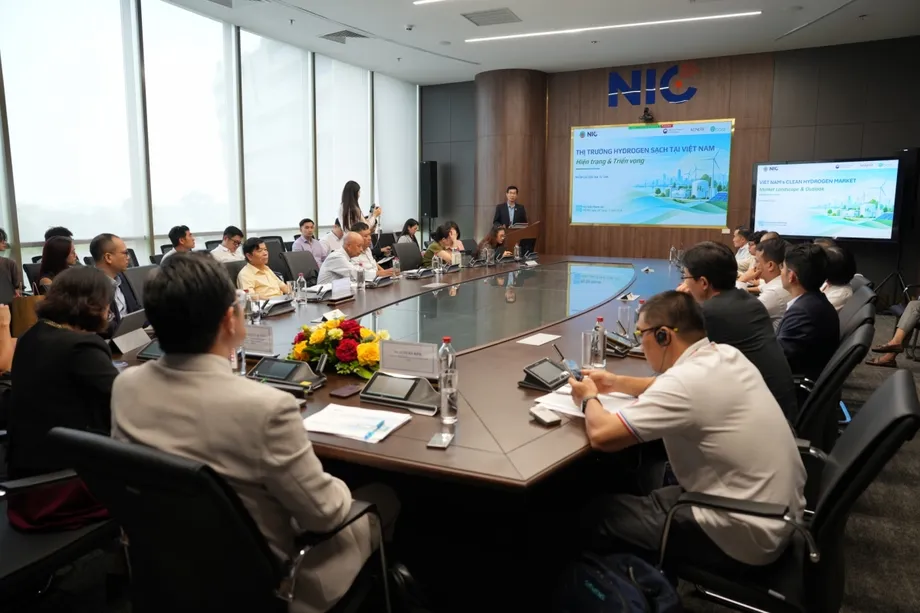
The October 2 consultation in Hanoi formed part of National Innovation Day 2026 and coincided with NIC's seventh anniversary. Government agencies, industry associations, businesses, researchers and universities reviewed the draft Clean Hydrogen Market in Vietnam report, including its assessment of which projects could move toward investment.
The central finding is that Vietnam needs more than additional project announcements. Most initiatives remain in preparation or are still assembling the technical, financial and regulatory conditions needed to proceed. Only a limited number appear ready to move toward implementation in the near term.
The workshop builds on Decision No. 165/QD-TTg, approved on February 7, 2024, which established Vietnam's Hydrogen Energy Development Strategy to 2030, with a vision to 2050. The consultation also follows the direction under Decision No. 21/2026/QD-TTg to prioritise hydrogen technologies.
Do Tien Thinh, NIC's deputy director, called for coordination among regulators, businesses, investors and research institutions to turn the strategy into a functioning market. Juhern Kim, GGGI's country representative in Vietnam, said the next task is to identify commercially viable opportunities, priority customers and the conditions that would allow projects to attract investment. That distinction matters: renewable resources can support production, but they do not guarantee that customers will buy hydrogen at a price sufficient to finance a plant.
Existing Industrial Demand Provides a Starting Point
The draft assessment assigns about 36% of Vietnam's current hydrogen use to oil refining and petrochemicals and 64% to fertiliser production. Applied to annual production of 500,000 tonnes, those shares imply approximately 180,000 tonnes and 320,000 tonnes respectively.
A separate implementation account describes Ministry of Industry and Trade document No. 1638/BCT-DKT, dated March 5, 2025, as recording 316,000 tonnes annually for fertiliser, 39,000 tonnes at Dung Quat refinery and 139,000 tonnes at Nghi Son refinery. Those figures total 494,000 tonnes, broadly consistent with the rounded national estimate. Other industrial uses account for about 0.5% of domestic demand.
GIZ's industrial hydrogen analysis describes a market dominated by production and consumption within the same facilities, rather than widespread distribution or trading. This makes existing industrial customers a practical starting point: projects could replace hydrogen supplies already used in production instead of first creating an entirely new application.
The different hydrogen labels describe production methods. Grey hydrogen usually comes from natural gas without capturing the resulting carbon dioxide; brown hydrogen comes from coal. Blue hydrogen combines production from fossil fuels with carbon capture and storage. Green hydrogen uses renewable electricity to split water into hydrogen and oxygen through electrolysis.
Thinh suggested that blue hydrogen could be a transitional step toward green hydrogen at greater scale. However, a 2024 academic assessment identifies limited gas supplies as a constraint on blue hydrogen development. The proposed definition of clean hydrogen based on carbon intensity would judge production by its emissions, rather than relying on colour labels alone.
The Targets Measure Cleaner Supply, Not Today's Total
Vietnam's strategy targets annual production capacity of 100,000 to 500,000 tonnes by 2030 from renewable energy and other processes using carbon capture. By 2050, the target rises to 10 million to 20 million tonnes annually. Today's roughly 500,000 tonnes of conventional production should therefore not be treated as evidence that the clean production target has already been reached.
The 2050 ambition is equivalent to 20 to 40 times current hydrogen production. It requires both replacing existing supplies and developing much larger markets across industry, transport, electricity generation and exports.
In a hydrogen strategy essay published by the National Bureau of Asian Research on May 29, 2024, Nguyen Duc Tuyen projected potential Vietnamese demand of 22 million tonnes annually by 2050. Tuyen is an associate professor at Hanoi University of Science and Technology and an adjunct associate professor at Shibaura Institute of Technology.
His demand scenario is 2 million tonnes above the national strategy's upper production target, but the figures measure different things and do not establish an import requirement. The essay also estimated a possible $1.2 trillion market in 2050 and described potential emissions and employment benefits:
By replacing fossil fuels with hydrogen, Vietnam could reduce CO2 emissions by 5.4% and create 62,000–92,000 jobs every year.
These are scenario estimates, not recorded outcomes. Likewise, the draft's $100 billion market estimate for 2035 is not a measure of secured contracts or committed investment. Its cited global market figures, $229.53 billion in 2025 and $406.95 billion in 2034, imply growth of about 77%. Different dates and unspecified valuation boundaries make a direct market share comparison with Vietnam inappropriate.
Fertiliser, Refineries and Steel Have Different Prospects
Oil refining and fertiliser production are potential early customers because they already consume hydrogen. GIZ estimates that replacing hydrogen used to meet the fertiliser sector's projected ammonia needs could require around 370,000 tonnes of green hydrogen annually. That calculation draws on projected ammonia demand of approximately 2.08 million tonnes in 2035.
Facility estimates differ across assessments. GIZ places Nghi Son's demand at around 180,000 tonnes annually, compared with 139,000 tonnes in the account of the March 2025 implementation document. GIZ also calculates potential refinery requirements of approximately 162,500 tonnes for Dung Quat and 250,000 tonnes for Nghi Son using international benchmarks for hydrogen consumption per tonne of crude oil processed. Those benchmark calculations should not be confused with reported current consumption.
Steel presents a larger potential market over time. GIZ estimates technical demand of approximately 1.65 million tonnes annually across partial fuel replacement in conventional steelmaking, replacement of natural gas in direct reduction processes and heating applications in rolling mills. Direct reduction removes oxygen from iron ore without using a conventional blast furnace.
That steel estimate is about 3.3 times Vietnam's current hydrogen production, but it assumes extensive substitution. It is not committed demand. GIZ also identifies smaller applications in electronics, glass and rolling steel, where production near the customer could reduce transport costs and provide opportunities to test commercial arrangements.
Electricity Costs Shape the Economics
Electricity accounts for an estimated 60% to 70% of the levelised cost of hydrogen produced through electrolysis. Levelised cost measures production costs over a project's working life against its hydrogen output. Access to affordable, dependable renewable electricity is therefore central to the economics.
GIZ's 2025 calculations show why commercial prospects differ by application. Two modelled systems producing 45 tonnes of hydrogen annually have costs of $9.66 and $9.81 per kilogram. A larger model producing 450 tonnes annually reaches $7.49 per kilogram, with investment of $38.23 million, compared with $4.81 million and $3.96 million for the smaller systems.
The larger configuration has a modelled internal rate of return of 12.4%, a measure of investment performance, compared with 10.7% and 10.6% for the smaller cases. All three show positive net present values, meaning projected revenues exceed costs after accounting for the value of money over time.
The comparison depends on its assumptions. GIZ uses a grey hydrogen benchmark of $10.22 per kilogram over 25 years, including inflation and price escalation. It separately records a current average supplier price of $6.47 per kilogram for hydrogen delivered in compressed gas tanks. Neither figure should be treated as the cost of hydrogen made inside a refinery or fertiliser plant.
Ammonia performs worse in the same analysis. Modelled green ammonia costs range from $1.71 to $2.31 per kilogram against a conventional benchmark of $0.89. All three ammonia cases have negative net present values, with financing gaps of $0.82 to $1.42 per kilogram. A promising hydrogen model therefore does not automatically make a fertiliser or export fuel project commercially viable.
Tuyen's 2024 essay cites a separate GIZ supported projection of hydrogen costs falling to €1.25 to €1.50 per kilogram by 2050, from €2.76 to €4.60 at the time of that assessment. Those longer term projections use a different currency, date and modelling basis from the 2025 cases. They cannot be presented as directly comparable prices.
Renewable Potential Is Not Ready Electricity Supply
The draft estimates technical offshore wind potential of approximately 1,068 gigawatts within Vietnam's exclusive economic zone, describing it as the largest in ASEAN. GIZ also cites potential exceeding 1,000 gigawatts. Technical potential is an estimate of the resource that could be developed under specified conditions, not installed capacity or electricity immediately available to electrolysers.
Transmission constraints in areas rich in renewable resources remain a barrier. Projects also need water supply, treatment facilities, storage and reliable arrangements for delivering hydrogen to customers.
GIZ describes the renewable electricity targets in the Power Development Plan VIII approved in May 2023 as 30.9% to 39.2% by 2030 and 67.5% to 71.5% by 2050. A conditional 47% target for 2030 depends on support through the Just Energy Transition Partnership (JETP). These are planning figures discussed in that analysis, not measured electricity shares.
A Ministry of Industry and Trade green hydrogen assessment, published on March 3, 2023, cautions against assuming that renewable electricity otherwise curtailed by the grid provides an easy source of cheap hydrogen. Institute of Energy research found that collecting and delivering that electricity to electrolysis facilities would be difficult and costly, with low potential hydrogen output.
The assessment instead identifies substantial renewable resources in the South Central Coast and southwest as a basis for supplying nearby industries. It describes JETP as a $15.5 billion partnership, but that total is not a dedicated hydrogen fund. GIZ's models also depend on local renewable profiles and supplementary revenues from oxygen and excess electricity sales, so their results cannot simply be transferred to every location.
Four Corridors Could Connect Production and Customers
The consultation identifies four emerging regional corridors with different energy and industrial strengths. These remain development concepts rather than established hydrogen trading networks.
- Quang Tri and Hue: wind resources supporting hydrogen production.
- Ninh Thuan and Binh Thuan: solar resources and potential export activity.
- Tra Vinh and Ben Tre: diverse energy sources, including Mekong Delta biomass.
- Ba Ria and Vung Tau: potential blue hydrogen linked to existing oil and gas infrastructure.
Reports differ on the first corridor's spelling: one account gives Quang Te and Hue, while another identifies Quang Tri and Hue. The latter also matches the Quang Tri project location discussed in the 2024 academic essay.
The account of the March 2025 implementation document identifies four green hydrogen projects under development in Tra Vinh, Ben Tre, Bac Lieu and Tien Giang, with combined planned capacity of about 120,000 tonnes annually. If delivered, that would equal 120% of the national strategy's lower 2030 target, or 24% of its upper target.
Planned capacity is not operating production. The same implementation account says most projects remain in preparation or research. It also lists proposals for 20,000 tonnes annually in Binh Dinh and 249 tonnes in Long An, alongside proposals in several other locations. Vietnam had no hydrogen exports at that reporting point.
Tuyen's May 2024 essay anticipated operation of a Ben Tre green hydrogen plant during 2024. The March 2025 implementation account and the later consultation instead describe projects still under development and no commercial green or blue production. The earlier anticipated start date should therefore not be treated as proof that the plant opened.
Buyers and Permits Are Holding Back Investment
A Ministry of Industry and Trade survey cited in the draft found that more than 58% of businesses considered hydrogen important, while around 68% had undertaken no substantial activity in the sector. These are separate survey findings, not complementary shares. They indicate considerable interest alongside limited practical engagement.
The draft attributes that gap to missing purchase mechanisms, price support and financing over longer periods. An offtake agreement is a contract under which a customer commits to buying output, often specifying volume and pricing arrangements. It helps lenders judge whether a project can earn enough revenue to repay its borrowing.
Kim said clean hydrogen was not yet commercially viable in Vietnam and that ready technology needed to be matched with suitable policy and committed buyers. GIZ's positive results for selected hydrogen models do not necessarily contradict that assessment: favourable modelled cases are different from a broadly functioning commercial market, and its ammonia models remain uncompetitive without support.
Investment approval and licensing for industrial hydrogen projects currently take 12 to 36 months, according to the draft. Responsibility is spread across ministries and agencies, adding uncertainty to project preparation. GIZ identifies developing rules for certification and purchase agreements as further concerns, alongside limited dedicated infrastructure and domestic equipment capacity.
Eight Proposed Actions and a Phased Timetable
The draft proposes eight priority action groups. They cover a legal framework with a carbon intensity definition and a single licensing channel; coordination among agencies; instruments to create demand; financial tools and origin certification; controlled regulatory trials; support for priority projects; shared infrastructure developed ahead of demand; and targeted international cooperation.
These are consultation recommendations, not measures shown to have been adopted. GIZ describes an existing foundation in Electricity Law No. 61/2024/QH15, including provisions concerning green hydrogen and ammonia and incentives involving tax, credit and land or sea use fees. Project developers still need detailed rules that make those provisions usable.
At the workshop, Associate Professor Pham Hoang Luong recommended pilots combining renewable generation with hydrogen consumption at the production site. He also proposed investment support, technical standards, trial purchase contracts and project preparation funding through official development assistance, concessional finance and JETP, alongside partnerships with Japan, South Korea, Germany and Australia.
The policy history and proposed sequence distinguish completed milestones from future ambitions:
- October and November 2022: hydrogen research workshops and technology presentations took place in Vietnam.
- March 3, 2023: the ministry published its assessment of renewable hydrogen production potential.
- February 7, 2024: Decision No. 165/QD-TTg approved the national hydrogen strategy.
- March 5, 2025: the implementation document recorded developing projects and existing industrial use.
- 2026 to 2028: Luong proposed pilot and demonstration projects, technical standards and financing support.
- 2028 to 2040: the proposed phase focuses on expanding markets, grids, storage, logistics and industrial centres.
- 2040 to 2050: the proposal envisages export corridors for hydrogen, clean ammonia and methanol.
GGGI and NIC are working with support from the Korea Green New Deal Trust Fund to connect policy, finance, technology and industry participants. The expert team will consolidate workshop feedback before finalising the market report. No publication deadline or project investment decision date was announced in the consultation accounts.
The Bottom Line
- Vietnam produces about 500,000 tonnes of conventional hydrogen annually, mainly for fertiliser and refining.
- The strategy targets 100,000 to 500,000 tonnes of cleaner annual production capacity by 2030 and 10 million to 20 million tonnes by 2050.
- Four developing projects have combined planned capacity of about 120,000 tonnes annually, but planned capacity is not operating output.
- Electricity represents 60% to 70% of electrolysis production costs; commercial prospects differ sharply between hydrogen and ammonia applications.
- Committed buyers, financing, certification, infrastructure and permits remain central to investment readiness.
- The draft recommends eight action groups, with consultation feedback still to be incorporated into the final report.