
Manufacturing surge meets a tougher economic balance
Vietnam’s economy expanded an estimated 9.01% in the first nine months of 2026, with growth accelerating to 9.95% in the third quarter. The figures, released on October 3, came alongside a $19.42 billion goods trade deficit and September inflation of 5.08%, exposing the pressures accompanying the country’s drive for annual growth of at least 10%.
Contents
- Manufacturing surge meets a tougher economic balance
- What accelerated during the year?
- Factories and construction provide the strongest lift
- Foreign firms dominate exports as imports climb faster
- September’s surplus does not erase external exposure
- Investment commitments and actual spending tell different stories
- Services and agriculture broaden the expansion
- Household gains face rising essential costs
- Business exits and regional gaps qualify the boom
- The final quarter requires more than another strong result
- Key Points
The National Statistics Office’s nine month economic report shows industry and construction supplying almost half the increase in total economic value added. Foreign investment commitments reached $50.36 billion, while exports climbed 24.5%. Imports grew even faster, rising 36.7%, largely because of purchases of equipment, components and other production supplies.
The expansion was stronger than the 8.65% median forecast in a survey of eight economists and the fastest quarterly pace since the third quarter of 2022. Yet growth in output does not translate automatically into equal gains for households or domestic businesses. Consumer spending rose more slowly than investment, prices accelerated, and completed business dissolutions more than doubled.
Nguyen Thi Huong, director general of the National Statistics Office under the Ministry of Finance, described the result as a strong starting point while warning that the annual ambition remained difficult.
Nine-month GDP growth of 9.01 per cent was exceptionally high by historical standards and provided an important foundation for achieving the highest possible growth rate under the country's targets. However, achieving double-digit economic growth would remain a major challenge.
The central test for the final quarter is whether investment commitments, infrastructure spending and export orders can become additional production quickly enough, without pushing prices further above the government’s annual inflation goal.
What accelerated during the year?
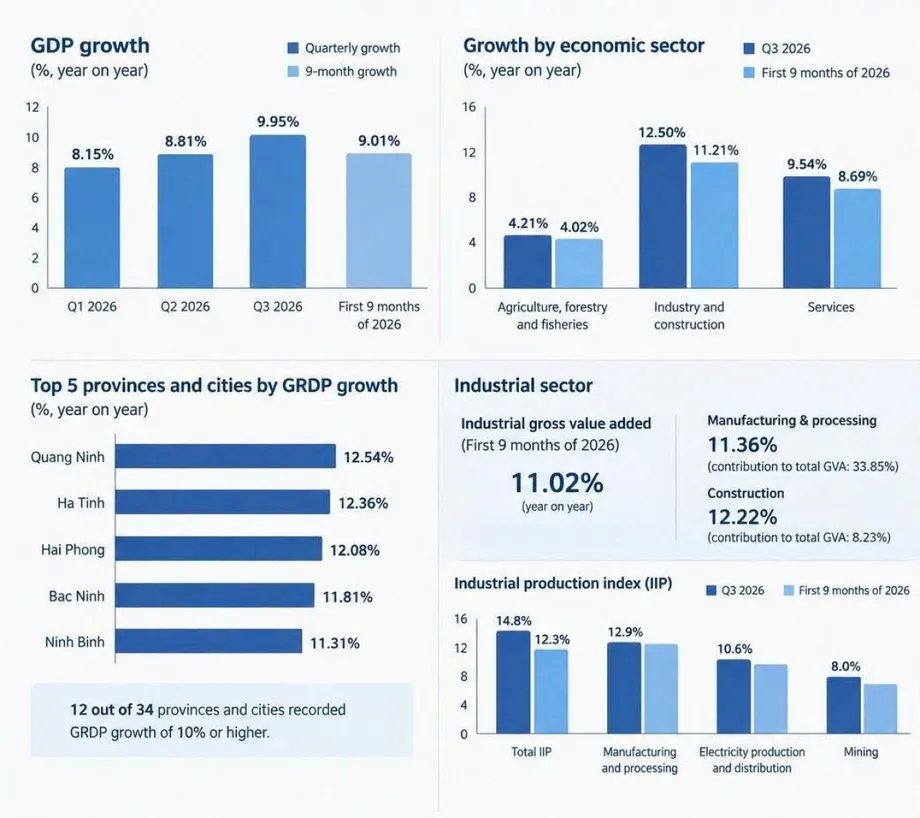
Growth strengthened across the first three quarters: 8.15% in the first, 8.81% in the second and 9.95% in the third. The increase between the first and third quarters was 1.80 percentage points. Compared with third quarter growth of 8.13% in 2025, the latest quarterly expansion was 1.82 percentage points faster.
Industry and construction grew 12.50% in the third quarter, services 9.54%, and agriculture, forestry and fisheries 4.21%. For the full nine months, their respective growth rates were 11.21%, 8.69% and 4.02%.
Some reports give nine month GDP growth as 9.04% and third quarter services growth as 9.45%. Both official releases give 9.01% and 9.54%, respectively. Those official figures provide the consistent basis for assessing the expansion.
The expenditure figures reveal a faster investment cycle. Asset accumulation, which includes investment in buildings, equipment and inventories, rose 17.88% over nine months, compared with 8.51% growth in final consumption. In the third quarter alone, asset accumulation increased 21.39%, while final consumption rose 8.96%.
Factories and construction provide the strongest lift
Manufacturing value added grew 11.36% over nine months and contributed 33.85% of the increase in the economy’s total value added. Construction expanded 12.22%, contributing another 8.23%. Value added measures what a producer contributes after subtracting purchased inputs, rather than simply counting the full selling price of its products.
The statistics office attributed industrial gains to large projects entering operation, recovering export orders and faster public investment. Its industrial production index rose 12.3% over nine months, compared with 9.0% in the same period of 2025, the strongest comparable increase since 2019.
Industrial production increased in all 34 provinces and cities. Manufacturing output rose 12.9%, electricity production and distribution 10.6%, and mining 8.0%. Manufacturing sales increased 12.8%, while inventories at September 30 were 11.9% above their level a year earlier.
The inventory increase does not by itself establish that factories are producing more than they can sell. Sales were also rising strongly. However, inventories climbed another 4.3% from August to September, making the balance between new orders, production and deliveries a useful measure to watch in the final quarter.
Foreign firms dominate exports as imports climb faster
Goods exports reached $434.30 billion over nine months, against imports of $453.72 billion. Total merchandise trade was $888.02 billion, up 30.4%. The resulting $19.42 billion deficit represented a $36.29 billion deterioration from the $16.87 billion surplus recorded in the corresponding period of 2025.
Foreign invested businesses, including crude oil operations, generated $350.41 billion in exports, or 80.7% of the total. Their shipments grew 29.4%, compared with 7.5% growth for domestic enterprises, whose exports reached $83.89 billion. Separate figures for 2025 put the foreign sector’s export share at 75.5%, suggesting its dominance has increased, although the annual and nine month periods are not identical.
The two business groups also had very different trade balances. Domestic enterprises recorded a $34.28 billion deficit, while foreign invested firms posted a $14.86 billion surplus. These figures show why rapid national export growth can coexist with a less buoyant experience for many local businesses.
Production goods accounted for 94.1% of imports, or $426.92 billion. Machinery, equipment, tools and spare parts represented 58.3% of total imports, with raw materials and fuels accounting for 35.8%. Reported computer, electronics and component imports reached $188.9 billion, up 71.7%.
Those purchases can support future production capacity, but they also require foreign currency and expose manufacturers to international prices. Crude oil import volumes fell 13.5% while their value rose 14.4%. Refined fuel imports increased 11.5% in volume but 79.3% in value, indicating a much heavier import bill relative to the quantities purchased.
September’s surplus does not erase external exposure
September brought a $1.27 billion goods trade surplus, with exports of $59.48 billion and imports of $58.21 billion. Exports rose 39.1% from a year earlier and imports 45.8%. The monthly improvement narrowed, but did not reverse, the accumulated deficit.
The United States remained Vietnam’s largest export destination, taking $140 billion in goods. China was its largest import source at $187.34 billion. Calculated from total exports and imports, those markets accounted for approximately 32.2% of outbound shipments and 41.3% of inbound purchases, respectively.
Vietnam’s reported trade surplus with the United States reached $122.6 billion, up 23.8%, while its deficit with China widened 43% to $121.5 billion. This combination reflects an economy buying substantial production supplies from China and selling substantial finished output to American customers.
Negotiations with Washington remained consequential as US Section 301 trade investigations continued. These investigations examine foreign trade practices and can lead to trade measures. Outstanding negotiating issues included goods routed through third countries to avoid tariffs and other trade barriers.
To Lam, Vietnam’s Communist Party general secretary and president, said in late September that an agreement with the United States was "very close". No completed agreement or signing date was identified in the October reports. Proposed purchases of more American technology products were part of efforts to address the bilateral imbalance.
Investment commitments and actual spending tell different stories
Total investment carried out across the economy reached VND3,109.6 trillion over nine months, up 15.1%, compared with growth of 11.6% a year earlier. State sector investment increased 17.3% to VND931 trillion, private domestic investment rose 14% to about VND1,650 trillion, and investment by foreign enterprises grew 14.5% to VND529.4 trillion.
Registered foreign investment reached $50.36 billion, up 76.4%, but actual FDI disbursement was $21.07 billion, up 12.1%. Registered investment covers new commitments, adjustments and capital contributions or share purchases. Disbursement measures investment actually carried out. The figures are not interchangeable, nor necessarily tied to the same projects.
Manufacturing received $17.40 billion of disbursed FDI, or 82.6% of the total. Property activities received $1.59 billion, and electricity, gas and related utilities $723.4 million. The concentration in manufacturing reinforces the link between foreign capital, factory output and exports.
Reported public investment disbursement reached approximately VND643 trillion, up 12.9%. This is a narrower measure than total state sector investment. Similarly, the official 16.7% increase in total investment applies to the third quarter, not the full nine months, despite some reports assigning it to the longer period.
Budget execution leaves substantial work for the final months. Revenue reached VND2,187.3 trillion, or 86.5% of the annual estimate, while expenditure reached VND1,873.7 trillion, or 59.3%. Credit expanded 10.89% from the end of 2025 through September 28, below the 13.37% increase at the comparable point a year earlier.
Services and agriculture broaden the expansion
Services contributed 45.03% of the increase in total value added over nine months. Transport and warehousing grew 11.03%, wholesale and retail trade 9.85%, finance, banking and insurance 9.45%, and accommodation and food services 8.83%.
International arrivals reached 17.7 million, up 14.5%. Service exports increased 18.5% to $26.10 billion, with tourism generating $13.06 billion, half the total. Nevertheless, service imports reached $34.31 billion, leaving a separate $8.21 billion services deficit. Transport services made up the largest share of service imports.
Agriculture, forestry and fisheries supplied 5.35% of the increase in total value added. Summer and autumn rice output reached nearly 11 million tonnes, an increase of 71,200 tonnes despite a reduction in planted area. Average yields rose to 5.89 tonnes per hectare.
Fisheries output increased 3.9% to 7.89 million tonnes. Aquaculture grew 5.9%, much faster than the 0.9% increase in wild catch. These gains provided support outside the major industrial centres, although agriculture’s share of the economy fell from 11.33% to 10.65%.
Household gains face rising essential costs
Retail sales and consumer service revenue reached VND5,925.7 trillion over nine months, up 13.4% at current prices. After removing price changes, growth was 7.8%, slightly above the 7.2% increase in 2025. That 7.8% figure measures spending growth after price adjustment, not an increase in retail prices.
Household final consumption was reported to have risen 9.75%, contributing 6.88 percentage points to GDP growth, while state final consumption increased 1.22%. This more detailed breakdown helps explain why total final consumption grew 8.51% without implying that household demand was stagnant.
Official average worker income was VND9.1 million a month over nine months, VND752,800 above a year earlier. Third quarter income averaged VND9.2 million. Another report gives a national average of VND8.4 million without establishing a matching reference period. A separate claim of 9.9% income growth also differs from the approximately 9.0% increase implied by the official nine month figures.
Average consumer inflation was 4.52% over nine months, slightly above the government’s annual ceiling of 4.5%. September inflation reached 5.08%. Food and dining costs, housing and utilities, and transport together contributed 3.81 percentage points to the nine month CPI increase, about 84% of the total.
Core inflation averaged 4.26%. This measure excludes several volatile or regulated categories to help identify more persistent price pressure. Average income growth exceeded broad inflation, but household experiences can differ greatly according to wages, family size, housing costs and spending needs.
Business exits and regional gaps qualify the boom
Nearly 149,700 businesses were newly registered, up 3.2%, with registered capital increasing 32.7% to VND1,884 trillion. Their registered employment fell 16.1%, however, showing that larger capital commitments did not bring an equivalent increase in proposed hiring.
More than 223,900 businesses were established or resumed operations, down 3.2%. About 172,000 withdrew from the market through temporary suspension, pending dissolution or completed dissolution. Within that total, completed dissolutions exceeded 48,700, up 118.8%.
Manufacturing surveys showed 34.2% of firms experiencing better business conditions than in the second quarter, 45.7% reporting stability and 20.1% facing difficulties. Separate survey findings showed 80.2% of manufacturing and construction businesses reporting rising or stable orders, but 53.3% reporting higher unit production costs. A household business survey found 81.5% reporting lower revenue in 2025 and 33% planning to shrink operations. Those earlier revenue findings indicate existing strain, not a direct measure of 2026 performance.
The National Statistics Office’s October 3 briefing recorded growth of at least 10% in 12 of 34 localities. Quang Ninh led at 12.54%, followed by Ha Tinh at 12.36%, Haiphong at 12.08%, Bac Ninh at 11.81% and Ninh Binh at 11.31%, slightly above the rounded 11.3% figure in other accounts.
Seventeen localities exceeded 10% growth in the third quarter alone. Hanoi grew 10.02% that quarter and 8.85% over nine months; Ho Chi Minh City recorded 9.86% and 9.06%. Son La’s nine month growth was 5.59%, while Vinh Long, Ca Mau and Dong Thap ranged from 7.32% to 7.44%.
Nguyen Thi Mai Hanh, head of the National Accounts Department, attributed weaker local results partly to larger agricultural shares, limited service markets and fewer large industrial projects. She linked stronger results to accumulated production capacity, investment, exports and supporting services. Six localities were reported to have exceeded targets under Resolution 180/NQ-CP.
The final quarter requires more than another strong result
An estimate accompanying the GDP analysis puts required fourth quarter growth at approximately 12.5% to achieve annual growth of at least 10%. That would exceed the third quarter result by 2.55 percentage points. Annual growth depends on each quarter’s economic weight, so it cannot be calculated simply by averaging four quarterly percentages.
The policy sequence illustrates how the government has organised the push:
- April 16: Resolution 109/NQ-CP established an action programme for implementing national development decisions.
- April 29: Eight resolutions targeted reductions of more than 50% in administrative compliance time and costs.
- May 20: To Lam called for a different growth model centred on productivity, technology and better use of resources.
- June 27: Resolution 169/NQ-CP assigned specific growth targets to localities.
- October 3: The statistics office released the latest results, while Prime Minister Le Minh Hung called the final quarter a "sprint".
Conclusion 18-KL/TW sets a target of growth in double digits for 2026 to 2030. At the May meeting, To Lam, speaking as general secretary and president, rejected simply scaling up existing methods.
double-digit growth cannot result from merely extending the old growth model.
The statistics office’s priorities include faster infrastructure execution, reliable energy supplies, stronger domestic exporters and closer links between foreign investors and Vietnamese suppliers. These are recommendations and targets, not proof that the necessary additional output has already been secured.
The Asian Development Bank raised its 2026 growth forecast from 7.2% to 7.8%, citing manufacturing, consumption and FDI. Its forecast remains below the government’s ambition. Laura Schwartz, senior Asia analyst at Verisk Maplecroft, also warned about inflation, possible economic overheating and electricity shortages.
The next decisive period is October through December. Full year growth, final inflation and the outcome of US trade negotiations remain unsettled. Faster spending will help only to the extent that it becomes completed construction, functioning capacity and services delivered, rather than higher costs or unexecuted commitments.
Key Points
- GDP grew 9.01% over nine months and 9.95% in the third quarter.
- Industry and construction supplied 49.62% of the increase in total value added.
- Foreign invested firms generated 80.7% of goods exports.
- The goods trade balance shifted from a $16.87 billion surplus to a $19.42 billion deficit.
- Registered foreign investment reached $50.36 billion; actual FDI disbursement was $21.07 billion.
- Average inflation was 4.52%, rising to 5.08% in September.
- Twelve of 34 localities achieved growth of at least 10% over nine months.
- Estimated fourth quarter growth of about 12.5% would be needed to meet the annual target of at least 10%.