
Seven formal rounds leave a few technical issues unresolved
Vietnam says negotiations on a reciprocal trade agreement with the United States are nearly complete, with only a handful of technical issues still requiring discussion. The update comes as Vietnam's National Statistics Office puts the country's trade surplus with the United States at $122.62 billion for the first nine months of 2026, up 23.8% from a year earlier.
Contents
- Seven formal rounds leave a few technical issues unresolved
- A framework preceded the latest push by almost a year
- How the negotiations reached this stage
- What the 20% tariff means for exporters
- A growing surplus raises the stakes
- Market access extends beyond tariffs
- Ministerial decisions fed into technical work
- Technology and energy form part of the wider bargain
- What still needs to be settled
- Key Points
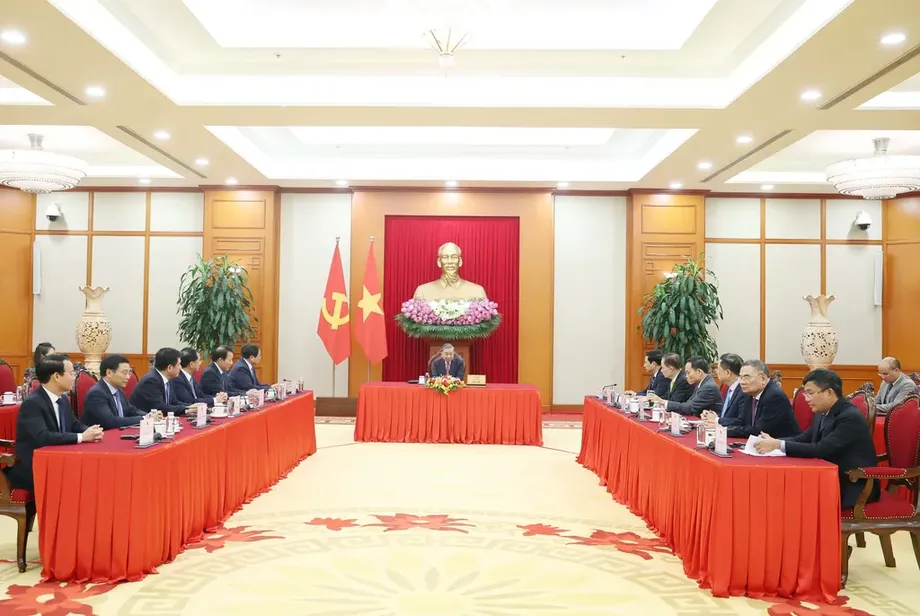
At the Ministry of Industry and Trade's regular third quarter press briefing in Hanoi on October 7, Ngo Chung Khanh, deputy director of the Department of Foreign Market Development and Multilateral Trade, said the countries had held seven formal negotiating rounds since April 2025, alongside numerous ministerial and technical sessions.
Khanh described the extent of agreement reached by the negotiating teams:
basically completed almost all negotiating contents
The ministry is coordinating with American agencies, particularly the Office of the United States Trade Representative, to settle the remaining issues and move toward signing and implementation. Khanh described the United States as a major trading partner with paramount importance to Vietnamese exports.
The announcement indicates substantial progress, but it does not establish that a final agreement has been signed or entered into force. No specific signing date was announced, and the outstanding technical issues were not identified. Those distinctions matter because the countries had already reached a framework in October 2025, when completion of the detailed agreement was expected before the end of that year.
A framework preceded the latest push by almost a year
The countries concluded the Framework for an Agreement on Reciprocal, Fair, and Balanced Trade on October 26, 2025. That framework set out the intended direction of the pact rather than completing every detailed commitment.
Baker McKenzie's November 2025 legal update said Vietnam's Ministry of Industry and Trade expected the countries to finalize commitments in the following weeks for signing and domestic ratification. The update anticipated a final agreement by the end of 2025.
The October 2026 announcement therefore describes negotiations continuing beyond that earlier expectation. It does not explain why the timetable extended or which provisions required additional work. The distinction between a framework and a completed agreement helps explain how officials could announce a major milestone in 2025 while still negotiating in 2026.
A framework records the broad bargain that governments intend to pursue. Detailed commitments determine how that bargain will operate, including the products covered, regulatory obligations and implementation arrangements. Signing and domestic approval are further steps before an agreement can take effect.
How the negotiations reached this stage
The talks began after Washington announced a 46% reciprocal tariff on Vietnamese imports in April 2025. The measure was subsequently postponed for 90 days to allow dialogue. A US executive order signed on August 1, 2025, reduced Vietnam's announced rate to 20%.
The main dated developments show that negotiations continued after both the tariff reduction and the framework announcement:
- Late April 2025: Vietnam and the United States began reciprocal trade negotiations.
- August 1, 2025: President Donald Trump signed an order reducing Vietnam's reciprocal tariff rate from 46% to 20%.
- October 26, 2025: The countries concluded their framework for reciprocal, fair and balanced trade.
- November 10, 2025: Minister Nguyen Hong Dien and US Trade Representative Jamieson Greer held an eighth ministerial negotiation in Washington.
- November 12 to 14, 2025: Technical teams held discussions following the ministerial meeting.
- Late September 2026: Vietnamese leader To Lam and Greer discussed progress during a meeting in New York.
- October 7, 2026: Vietnam's trade ministry said almost all negotiating contents had been completed.
The numbering needs care. The latest announcement counts seven formal negotiating rounds, while accounts of the November 2025 meeting describe an eighth ministerial session. These are different descriptions of negotiating activity, and they should not be combined into a single count. Officials have not explained how the two sequences correspond.
What the 20% tariff means for exporters
The 2025 framework retained a 20% US reciprocal tariff for goods originating in Vietnam. Compared with the initially announced 46% rate, that is a reduction of 26 percentage points. It is still a substantial tariff rather than unrestricted access to the American market.
The framework also allowed possible zero reciprocal tariff treatment for certain commodities under Annex III of Executive Order 14346, dated September 5, 2025, as identified by both countries. Baker McKenzie's legal assessment cautioned that restrictions on the eligible commodity list could exclude most of Vietnam's major exports, limiting the practical benefit.
The latest announcement does not identify the products selected for that treatment or announce a new general tariff rate. A business therefore cannot infer from the near completion of negotiations that its goods will qualify for an exemption. The product coverage remains a central detail to establish in the final arrangements.
The commitments described for the two markets are also different. Vietnam agreed in the framework to provide preferential market access for substantially all US industrial and agricultural exports, while Vietnamese goods would generally face the stated US reciprocal tariff, subject to possible exceptions. The description of the pact as balanced does not mean both countries have promised identical tariff treatment.
A growing surplus raises the stakes
Vietnam's statistics agency reported bilateral trade of $157.3 billion in the first nine months of 2026. Vietnamese exports to the United States were approximately $140 billion, up 24.2%, while imports from the United States were $17.3 billion.
Those rounded figures put exports at about 89% of bilateral trade and roughly eight times the value of imports. Subtracting the rounded import figure from exports produces a surplus of about $122.7 billion, close to the agency's more precise reported figure of $122.62 billion. The small difference is consistent with the use of rounded component totals.
The reported surplus rose 23.8% from a year earlier. Using that growth rate, the corresponding surplus for the first nine months of 2025 was approximately $99 billion. The increase was therefore about $23.6 billion, showing the scale of the imbalance that officials are seeking to address.
These are Vietnamese statistical figures. No corresponding US dataset is cited in the announcement, so the totals should not be presented as a reconciliation of both governments' trade accounts. They nevertheless show why the negotiations are consequential for Vietnam: the American market absorbs a large export flow, while purchases of American goods remain much smaller.
During the late September 2026 meeting in New York, General Secretary and State President To Lam described economic, trade and investment cooperation as a key pillar of bilateral relations. He said Vietnam was working to increase purchases of US goods and promote more balanced trade. Greer praised Vietnam's efforts and said the teams were close to a final result.
Market access extends beyond tariffs
The proposed agreement addresses regulatory barriers as well as import duties. The framework identifies US motor vehicle safety and emissions standards, import licenses for American medical devices, approvals for US pharmaceutical products, intellectual property treaty obligations and procedures for assessing product conformity.
These requirements can determine whether a product enters a market even when its tariff is low. A medical device may need an import license, a medicine may require regulatory approval, and a vehicle may need to meet accepted safety and emissions rules. Conformity assessment is the process used to establish that a product satisfies applicable standards.
The intended changes therefore concern the administrative conditions of trade, not just its price. Vietnam's review of licenses, import permits and quality controls could affect access for agricultural goods, pharmaceuticals and vehicles. The announcement does not specify the final legal language, which requirements will change or when any new procedures would begin.
The broader negotiating agenda includes digital trade, services and investment, intellectual property, labor, the environment, customs procedures and regulatory practices. The 2025 framework also anticipated provisions concerning conduct by state owned enterprises that distorts trade.
These subjects extend the pact beyond the movement of physical goods. Digital trade concerns commercial activity conducted through digital systems, while services and investment commitments can affect how businesses operate across borders. No detailed rules on those subjects were disclosed in the latest update, so their scope and enforceability cannot yet be assessed.
Ministerial decisions fed into technical work
The November 10, 2025, meeting in Washington offers a view of how the countries have handled unresolved provisions. Nguyen Hong Dien, then identified as Vietnam's minister of industry and trade, and Greer discussed directions for resolving major remaining issues after adoption of the joint framework statement.
Dien proposed measures to accelerate the process and called for a practical, flexible approach. Greer welcomed the proposals and asked the American technical team to study them for further discussion. That response indicated continuing consideration, rather than acceptance of every Vietnamese proposal.
On November 12, Deputy Minister Nguyen Sinh Nhat Tan met Deputy US Trade Representative Rick Switzer to launch the technical sessions. Their discussion focused on carrying out the ministerial decisions and setting priorities for the negotiating teams. Working groups then began detailed discussions on the agreed items.
Switzer welcomed Vietnam's progress in trade policy, institutional reform and international integration commitments. Both sides agreed to maintain coordination between their technical groups. The October 2026 announcement uses similar language about cooperation with US agencies, although it does not identify whether the remaining issues are the same ones discussed in Washington in 2025.
Technology and energy form part of the wider bargain
Vietnam has paired its request for an early agreement with proposals to buy more American technology and deepen industrial cooperation. During a meeting held alongside the sixth negotiating round, Acting Minister of Industry and Trade Le Manh Hung told US Under Secretary of State for Economic Growth, Energy, and the Environment Jacob Helberg that Vietnam was open to US exports and wanted greater imports of advanced technology products.
The areas discussed included artificial intelligence, digital technology, manufacturing, energy, aerospace and supply chains. Hung also expressed support for proposals involving American investment in Vietnam's technology industries. Helberg indicated Washington's interest in these sectors and in Vietnamese support for upcoming American investment projects.
Energy discussions accompanied the November 2025 negotiations as well. Dien met representatives of Louisiana based Gulf of America Energy Sourcing LLC and encouraged participation in Vietnam's liquefied natural gas infrastructure and energy markets. The talks described potential cooperation, not a confirmed procurement contract or completed investment.
The industrial setting gives these proposals practical relevance. Vietnam's expansion of industrial zones has brought new manufacturing investment alongside pressures on labor and infrastructure. Foxconn Industrial Internet's Vietnam revenue target of $20 billion for 2026 also illustrates the scale of ambitions in AI server production. That figure was a company target, not a reported revenue result.
Trade rules, technology purchases and investment could support the same industrial objectives, but they are not interchangeable. An agreement can establish conditions for commerce; it does not by itself guarantee that proposed purchases or factory investments will occur.
What still needs to be settled
The immediate task is to resolve the remaining technical issues, finalize the agreement and establish the steps for signing and entry into force. Vietnam's ministry says it wants that process completed as soon as possible, but no new deadline or scheduled signing ceremony has been announced.
Several consequential details remain undisclosed: the precise unresolved provisions, the goods eligible for zero reciprocal tariff treatment, the final regulatory commitments and the implementation timetable. The earlier expectation of completion by the end of 2025 was not a confirmed signing date, and it should not be treated as the timetable for the current stage.
The strongest conclusion from the latest announcement is that Vietnam considers substantive negotiations largely complete. The final document will determine whether that progress translates into predictable tariff treatment and workable market access rules for businesses in both countries.
Key Points
- Vietnam says almost all negotiating contents are complete after seven formal rounds, with a few technical issues unresolved.
- The countries reached a trade framework on October 26, 2025, but no final signing date was announced in the latest update.
- The framework retained a 20% US reciprocal tariff on Vietnamese goods, with possible zero treatment for selected commodities.
- Vietnam reported $157.3 billion in bilateral trade and a $122.62 billion surplus for the first nine months of 2026.
- The proposed pact covers regulatory barriers, digital trade, services, investment, intellectual property, labor and environmental commitments.
- Technology purchases, energy cooperation and industrial investment are part of the wider economic discussions.