
VND200 Million a Year for a Plot Valued at VND100 Billion
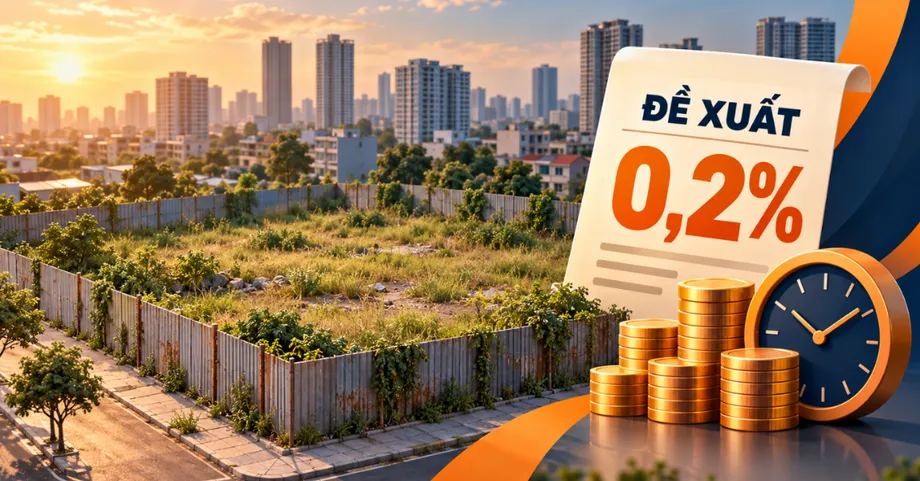
Vietnam's Ministry of Finance is proposing an annual tax of 0.2% on abandoned, unused or delayed development land, a charge that would amount to VND200 million for a plot with a taxable value of VND100 billion. The proposal would apply to the entire qualifying area, without the lower tax bands currently available for residential land within statutory limits.
Contents
- VND200 Million a Year for a Plot Valued at VND100 Billion
- What the Proposed Rate Would Change
- How Much Would Owners Pay?
- The Missing Definition of Abandoned Land
- Why Economists Want a Rate That Rises Over Time
- Household Land Is Not Always a Speculative Holding
- Coastal Resorts Show Why Planning Status Matters
- Paying Tax Would Not Buy Unlimited Time
- Data Problems Could Produce the Wrong Taxpayer
- Can a Developer Transfer a Stalled Project?
- Vacant Buildings and Foreign Taxes Widen the Debate
- The Decision Still Depends on Criteria and Timing
- Key Points
The ministry discussed the measure at its October 6, 2026 press conference. It forms part of a draft bill amending the Law on Corporate Income Tax, the Law on Non-Agricultural Land Use Tax and the Law on Personal Income Tax. The proposed land provision would add paragraph 8 to Article 7 of the Law on Non-Agricultural Land Use Tax.
The rate is about 6.7 times the existing 0.03% rate for residential land within the statutory quota. Yet economists, lawyers and lawmakers are focusing on two unresolved issues: whether the charge would outweigh the benefits of holding land for price gains, and how authorities would distinguish deliberate speculation from projects blocked by planning or administrative procedures.
The tax has not been enacted. January 1, 2027 has been reported as its intended starting date if the National Assembly approves the amended tax legislation at its year end session. Criteria for identifying qualifying land are still being developed, and several participants in the debate want a longer preparation period.
That distinction matters for everyone from developers holding stalled coastal resorts to households keeping a single plot for a future home. An empty site would not, by appearance alone, establish its tax treatment. The legal classification, the reason for nonuse and the applicable taxable value would determine the result.
What the Proposed Rate Would Change
Vietnam's existing residential land tax uses progressive area bands. Land within the statutory quota is taxed at 0.03%, the next band at 0.07%, and land in the highest excess area band at 0.15%. These rates apply to the relevant portions of land rather than automatically charging the highest rate on an entire holding.
Other categories already receive different treatment. Nonagricultural production and business land is taxed at 0.03%. Land used for an improper purpose, or left unused contrary to regulations, is described in the detailed accounts of existing legislation as subject to 0.15%. Encroached or illegally occupied land attracts 0.2%.
The proposal would create a separate 0.2% category for abandoned land, land not brought into use and land brought into use late. Having no quota allowance means the whole area classified under that category would face the proposed rate. It does not mean there would be no rules defining which land qualifies.
Reports differ on the existing category used to justify the rate. Most describe 0.2% as matching the tax on encroached land; some accounts of the ministry briefing describe it as matching the rate for improperly used land. That discrepancy needs clarification, particularly because the more detailed descriptions put improperly used land at 0.15%.
How Much Would Owners Pay?
The basic calculation is land area multiplied by the legally determined taxable value per square meter, then multiplied by 0.2%. Taxable value is not automatically the purchase price or current market price. The following examples assume the entire plot qualifies and no exemption or reduction applies:
- A plot with a taxable value of VND1 billion would incur VND2 million annually.
- A 200 square meter plot valued for tax at VND10 million per square meter would incur VND4 million annually.
- The same area valued at VND20 million per square meter would incur VND8 million annually.
- A 500 square meter plot valued at VND20 million per square meter would have a taxable value of VND10 billion and incur VND20 million annually.
- Five qualifying plots, each with a taxable value of VND10 billion, would together incur VND100 million annually.
On an identical taxable base, the proposed rate is approximately 6.7 times 0.03%, 2.9 times 0.07% and 1.3 times 0.15%. Those are comparisons between rates, not forecasts of how much every owner's existing bill would rise.
The Missing Definition of Abandoned Land
Truong Ba Tuan, a deputy director responsible for tax, fee and charge policy at the Ministry of Finance, said classification would follow land legislation. The ministry's draft therefore refers to land law rather than creating an independent tax definition.
The draft amended Land Law describes abandoned land as land allocated or leased by the state that has not been used continuously for a specified period. However, reports on that definition say it does not yet specify the period. The Land Law 2024 and current tax laws are also reported not to contain a separate definition of abandoned land, although they already regulate failures to use project land on schedule.
Tuan said the Ministry of Agriculture and Environment had been assigned to clarify the concepts and criteria. Reports agree that the relevant government instruction was dated September 28, but disagree on its number: some identify Notice No. 54, others Notice No. 289, and another Notice No. 574. The document number cannot be treated as settled without confirmation.
The proposal is linked to Resolution No. 21-NQ/TW, reported as adopted on July 28, 2026, which calls for studying higher taxes on unused land. Accounts also connect the policy to a goal of addressing land waste by 2030. Some describe the bill as submitted to the Government, while others say its dossier was submitted to the Ministry of Justice for appraisal. Neither description establishes that the measure has passed.
Why Economists Want a Rate That Rises Over Time
Economist Le Ba Chi Nhan argues that 0.2% can create an initial cost for holding land without using it, but may not change the decisions of financially strong owners expecting substantial price gains. He proposes increasing the rate to 0.3%, 0.5% or higher when land remains idle longer without a legitimate reason.
Nhan describes the intended incentive in these words:
"The policy should create a kind of 'cost clock,' where the longer land remains unused, the more expensive it becomes to hold," Nhan said.
At an unchanged taxable value of VND100 billion, a 0.3% rate would produce an annual charge of VND300 million, while 0.5% would produce VND500 million. Those calculations illustrate his suggested alternatives, not rates adopted by the ministry.
Professor Dang Hung Vo, a former deputy minister of natural resources and environment, similarly argues that taxation should be assessed against expected market gains. He cites an example of inexpensive commercial housing rising from around VND11 million to VND33 million per square meter between 2014 and 2024, a threefold increase, or 200% over the decade.
That housing example is not a national land price index, and a decade of appreciation cannot be compared directly with one annual tax bill. It nevertheless explains his concern: if expected gains remain much larger than holding costs, owners may simply pay the tax. Vo also supports trying 0.2% and reviewing whether it is strong enough after implementation.
Household Land Is Not Always a Speculative Holding
Pham Duc Toan, chief executive of EZ Property, suggests a different progressive structure, ranging from 0.1% to 0.5%, with higher rates for people holding more plots. His proposal would distinguish a household with one plot from an investor holding ten, rather than relying only on the length of nonuse.
Toan also proposes considering a household allowance based on area or the number of plots relative to family size. He argues against treating rural land saved for children in the same way as unused urban development plots. These are recommendations, not exemptions established in the draft tax measure.
The household concern extends to resettlement land. People displaced by development may receive plots but lack money to build, while others may retain land for children to establish a home later. National Assembly Cultural and Social Committee deputy chair Ta Van Ha has called for explicit treatment of these cases and land affected by prolonged planning restrictions.
Hanoi's land auctions illustrate the other side of the debate. Auctions in suburban districts including Dan Phuong, Hoai Duc and Thanh Oai attracted winning bids sometimes above VND100 million per square meter in August 2024. Many auction plots were subsequently reported to remain unbuilt. However, an auction price is not automatically the taxable value, and buying legally at auction does not settle whether later nonuse falls within the proposed category.
Coastal Resorts Show Why Planning Status Matters
Two stalled coastal projects in Da Nang illustrate why authorities would need to examine project histories rather than simply identify empty land. Hon Ngoc A Chau covers roughly 12 hectares, received an investment certificate in July 2009 and had planned investment of VND4.8 trillion. Construction began in early 2010, but a later account described most of the site as still vacant after 16 years.
The city's plans also changed. In 2018, Da Nang directed discussions about recovering part of the site for public space. In 2020, it agreed to recover part of the southern area for a beach, access to the sea and a public park.
The approximately 3.77 hectare Non Nuoc tourism site was allocated to I.V.C in 2014. In 2018, the city adopted a policy of recovering the project, with the land subsequently planned as a coastal park. Neither case has been identified as definitively liable for the proposed tax.
Lawyer Pham Thanh Tuan of the Hanoi Bar Association argues that assessments must examine investors' obligations, approved schedules and the causes of delay. Economist Vo Tri Thanh also warns against rules that owners could evade by constructing one or two temporary structures while leaving most land unused. Planning approval should neither guarantee exemption nor automatically establish liability.
Paying Tax Would Not Buy Unlimited Time
The proposed charge would operate alongside existing duties to bring investment project land into use. Lawyer Truong Anh Tu, chairman of TAT Law Firm, argues that meeting a tax obligation would not purchase a right to retain land indefinitely.
Under the existing mechanism described in paragraph 8 of Article 81 of the Land Law 2024, investment project land can face action after 12 consecutive months of nonuse following physical handover, or a delay of 24 months against the project's land use schedule. An extension of up to 24 months carries additional financial obligations. Continued failure can lead to recovery under the statutory conditions, subject to the force majeure exception in paragraph 9.
Article 31 of Decree 102/2024/ND-CP, amended by Decree 226/2025/ND-CP, addresses extension timing, the area affected and handling procedures. An extension is not automatic. Tax, additional payments during an extension and land recovery are separate mechanisms.
Proposed Land Law amendments would alter parts of that framework. Reports describe annual progressive payments for unused or delayed investment project land, with recovery possible after 60 months of continued nonuse. They also describe recovery provisions for agricultural land unused for more than 24 months after an administrative penalty and failure to resume use by the stipulated deadline. These draft provisions must not be confused with current law or the proposed 0.2% tax.
Data Problems Could Produce the Wrong Taxpayer
Accurate classification would require connected land, tax, investment and construction records. Lawyer Pham Thanh Tuan recommends identifying the taxpayer, qualifying area, actual land status and period of nonuse for each parcel, with electricity and water information used where appropriate.
Existing errors show the practical risk. Le Long, a deputy director of the Tax Department, attributed some unexpected land tax arrears displayed through eTax Mobile to incomplete information sharing and delayed updates. Former owners can remain listed after selling property, while payments not yet reconciled can trigger debt or duplicate notices. Deputy Finance Minister Nguyen Duc Chi has called for accurate, complete and connected housing, land and tax data.
The scale of stalled resources is substantial, but the categories must remain separate. Figures discussed on June 18, 2026 included 3,896 public property sites identified through a Government Inspectorate conclusion as vacant, deteriorated or inefficiently used. They do not represent all abandoned private property.
Authorities also reported resolving obstacles for 1,531 delayed projects, of which 273 had entered use, covering more than 4,000 hectares and around VND286 trillion in investment. The 273 represent about 17.8% of the 1,531 projects. By July 31, System 751 recorded 4,619 projects and land parcels facing difficulties, with 3,984 reviewed and classified. That register is not a list of confirmed speculative holdings.
Can a Developer Transfer a Stalled Project?
Lawyer Hoang Ha argues that higher holding costs should be paired with workable transfers to investors capable of completing projects. Otherwise, a struggling developer could face pressure to exit without meeting the conditions needed to sell.
Article 40 of the 2023 Law on Real Estate Business requires conditions including approved project documentation, completed compensation and resettlement support, land free of disputes and seizure, release of mortgages, and fulfilled land related financial obligations. A project must also remain within its implementation period and not be subject to a recovery decision.
Those safeguards can be difficult for financially distressed projects to satisfy. Ha proposes studying arrangements in which a buyer pays established obligations as part of the transfer, or coordinates debt repayment and mortgage release with the developer, bank and authorities. These are suggested mechanisms, not an existing general right to bypass transfer requirements.
Article 42 gives provincial authorities 30 days to appraise and decide on transfers within their powers after receiving a complete, valid application. For transfers requiring the Prime Minister's decision, the provincial review and submission period is 45 days. Decree 96/2024/ND-CP sets out documentation and related procedures. National Assembly Economic and Financial Committee member Phan Duc Hieu argues that developers should plan for failure, exits and portfolio restructuring rather than retain land they cannot develop.
Vacant Buildings and Foreign Taxes Widen the Debate
Dang Hung Vo argues that a policy focused on empty land could miss completed but unused villas, townhouses and shophouses. He recommends examining vacant buildings while avoiding automatic treatment of agricultural land as equivalent to valuable urban sites. Agricultural nonuse can be hard to establish, and inspection costs may be large relative to receipts.
The proposal concerns nonagricultural land taxation, not an automatic charge on every unused field. It is distinct from the agricultural tax exemption extension approved in June 2025 through the end of 2030.
Foreign examples show different approaches, but their percentages are not directly comparable. Reports describe Saudi Arabia charging up to 10% of land value in priority areas and Victoria, Australia, using rates from 1% to 3% for vacant residential property. Accounts of South Korea differ on the starting rate after two years, giving either 2% or a range of 2% to 5%, while citing rates up to 10% after ten years.
France's reported rates of 17% and 34% are based on rental value, not full property value. Ireland uses a multiple of local property tax. Canada combines a federal 1% measure mainly directed at certain foreign owners with local taxes such as Vancouver's 3% charge. Other examples include property tax surcharges in Spain, withdrawal of housing tax concessions in Japan, ordinary tax on empty homes in Italy, and higher rates for property not occupied by its owner in Singapore. Different tax bases, exemptions and definitions make headline rates an unreliable guide to Vietnam's likely results.
The Decision Still Depends on Criteria and Timing
The debate is moving along two tracks: tax amendments setting a rate, and land legislation defining the circumstances that trigger it. A short timeline captures the main reported steps:
- July 28, 2026: Resolution No. 21-NQ/TW was adopted, calling for study of higher taxes on unused land.
- September 28, 2026: Government leaders assigned work on classification criteria, although reports disagree on the notice number.
- October 6, 2026: The Ministry of Finance discussed the 0.2% proposal at its quarterly press conference.
- Year end 2026: National Assembly consideration is anticipated, with approval still required.
- January 1, 2027: Reported intended commencement date, conditional on legislative passage and the final provisions.
Dinh Minh Tuan, southern regional director at property platform Batdongsan, recommends at least a year to build data and classification rules. He suggests initially examining projects with no implementation activity over five years. National Assembly member Tran Hoang Ngan recommends publishing current local plans, removing outdated plans and allowing residents and businesses one to two years to complete procedures.
The final rules have not settled the nonuse threshold, exemptions, transitional arrangements or treatment of overlapping existing tax categories. Appeals and opportunities to correct inaccurate parcel information will also matter. A higher rate alone cannot resolve a planning restriction, transfer barrier or incorrect ownership record.
Key Points
- Vietnam proposes an annual 0.2% tax on qualifying abandoned, unused or delayed development land.
- A taxable value of VND100 billion would produce a VND200 million annual bill.
- The rate would apply across the qualifying area without the usual residential quota bands.
- Definitions and implementation criteria remain unfinished, and the tax is not yet law.
- Economists recommend considering rates that rise with time, while protecting cases delayed by outside circumstances.
- Paying tax would not replace project obligations or prevent recovery where legal conditions are met.
- January 1, 2027 is a reported intended start date, subject to approval and final legislative terms.