
A 168 million user milestone changes the video contest
ByteDance’s Red Fruit short drama app reached 168 million daily active users in July 2026, up 107% from a year earlier, exceeding the combined daily totals reported for Tencent Video, iQIYI, Youku and Mango TV. The comparison puts an app launched in August 2023 ahead of four established services that spent more than a decade building their audiences.
Contents
- A 168 million user milestone changes the video contest
- How quickly did Red Fruit reach this scale?
- A large app inside an even larger market
- Free viewing changes what platforms sell
- Viewing time is high, but the measures differ
- The audience extends beyond younger viewers
- AI increases supply and exposes quality problems
- Tencent is building around WeChat’s existing audience
- Audience leadership is not yet a profit verdict
- Regulation adds another test for high volume platforms
- Key Points
QuestMobile monitoring put Tencent Video at about 50 million daily users, iQIYI at 45 million, and Youku and Mango TV at roughly 30 million each. Their combined total of approximately 155 million was 13 million below Red Fruit, a gap of about 8.4%.
That is a striking measure of how frequently people open the app, but it is not proof that Red Fruit has more paying customers, higher revenue or a larger audience watching actual programs. Daily active users count people who open an app that day. Some Red Fruit visitors may be checking in, watching advertisements for coins or collecting credits toward withdrawals rather than following a drama.
The comparison also adds together four separate platform totals. People who use more than one of those services can appear more than once in the sum, so the 155 million figure is not a count of distinct viewers across the four apps.
Even with those qualifications, the growth shows a major change in how entertainment reaches Chinese audiences. Free viewing, recommendations borrowed from Douyin and a steady supply of short episodes have turned Red Fruit into a daily destination. The next contest is whether that reach can generate durable advertising income while meeting stronger content standards.
How quickly did Red Fruit reach this scale?
The expansion was already visible in QuestMobile’s 2026 industry report, which recorded 304 million monthly active users for Red Fruit in February. That represented a net increase of nearly 140 million people from a year earlier.
Monthly active users measure how many people use a service at least once during a month. They describe a broader audience than daily figures, so the two measures should not be treated as interchangeable.
- August 2023: Red Fruit launched.
- June 2025: Monthly active users exceeded 200 million, surpassing Youku for the first time.
- November 2025: Monthly active users reached 257 million.
- January 2026: Daily active users passed 100 million, making Red Fruit ByteDance’s fifth standalone app to reach that threshold.
- February 2026: QuestMobile recorded 304 million monthly active users.
- May 2026: Monthly active users reached 356 million, up 79.1% from a year earlier.
- June 2026: A later account citing industry tracking put monthly active users at 368 million, up 73.7%.
- July 2026: Daily active users reached 168 million.
The February and May figures imply an increase of 52 million monthly users in three months, or about 17.1%. The reported June total adds another 12 million. Those figures describe successive months, rather than conflicting estimates for the same period.
A large app inside an even larger market
Red Fruit’s rise has accompanied rapid growth across short drama distribution. QuestMobile recorded an industry audience of 718 million in February 2026, including 335 million users of dedicated apps and 427 million users of WeChat mini programs. Those channels grew by 74.3% and 59.9%, respectively, from a year earlier.
By May, the reported audience after removing duplicate users across measured channels had reached 851 million. Dedicated apps accounted for 402 million users, WeChat mini programs for 508 million and Douyin mini programs for 14 million. The channel totals cannot simply be added because the same person can use several routes to watch.
Short drama content also reached 472 million users through the main Douyin and Kuaishou platforms in May, up 27.1%. That is a measure of content reach within broader services, not the audience of standalone drama apps.
Red Fruit’s 304 million monthly users equaled about 90.7% of the dedicated app audience in February. Its 356 million in May equaled about 88.6% of that month’s 402 million app audience. These ratios support the description of Red Fruit as the dominant app, but they are audience comparisons, not shares of industry revenue or exclusive customers.
Free viewing changes what platforms sell
Red Fruit removes the subscription or episode payment barrier and earns money from advertisements, sharing revenue with content partners. The viewer supplies attention rather than an upfront payment. For the platform, the commercial task becomes bringing people back and creating enough viewing time to support advertising.
Reports differ slightly on the timing of the free model’s wider breakthrough. One account puts free short dramas at about 11% of the market in early 2024 and more than 50% by the end of that year. Another cites a China Netcasting Association report showing an increase from 11% in January to 50% in October. Both describe a rapid shift, but they do not give precisely the same date for crossing half the market.
Recommendation technology helps make that model work. Red Fruit uses viewing history, watch time and interactions to personalize its content selection, drawing on technology shared with Douyin. Short drama clips on Douyin can also direct viewers to complete episodes in the Red Fruit app.
The result is a different route into a series. A viewer does not always arrive looking for a particular title. The app presents something to watch, then uses the continuing story and further recommendations to keep the session going. Check ins and rewards provide another reason to return, although their presence also makes raw activity figures harder to interpret commercially.
Viewing time is high, but the measures differ
Red Fruit’s average daily usage per monthly user reportedly reached 125 minutes in February 2026. Across dedicated short drama apps, users averaged 26.9 hours and 125.6 sessions during May, exceeding online video on both monthly measures.
Dividing 26.9 hours by May’s 31 days gives roughly 52 minutes per calendar day. That should not be presented as contradicting Red Fruit’s February figure: one measure concerns a single app in February, while the other covers the wider app category in May. A direct comparison would require matching periods, populations and calculation methods.
QuestMobile’s official report describes particularly strong short drama activity during scattered daytime breaks and late at night. Traditional video remained dominant during evening prime time. Later tracking nevertheless reported a 0.9 percentage point annual increase in Red Fruit’s activity rate in the 6 p.m. to 8 p.m. window in May.
Longer video services therefore retain a strong viewing period even as Red Fruit expands into it. The reported 24% to 47% annual declines in monthly usage time across the four established platforms suggest pressure on attention, with Youku recording the largest decline and Mango TV the smallest. They do not, by themselves, establish how much viewing moved directly to Red Fruit.
The audience extends beyond younger viewers
The official QuestMobile report counted about 46.53 million monthly short drama app users aged 50 or older, with annual growth of approximately 50%. It also described WeChat mini programs as an accessible route for older audiences, aided by their low entry barrier and circulation within the WeChat network.
By May, people born in the 1970s and 1980s made up 47.2% of dedicated short drama app users. Residents of cities classified in China’s second, third and fourth tiers accounted for 63.1%. Those figures show why the market cannot be understood simply as a youth entertainment trend.
The audience reached through larger content platforms differed. People born in the 1990s and 2000s represented 41.6% of short drama viewers on those services, while 53.5% lived in cities classified in the third tier or below.
Content interests also varied. Across short dramas, reported interest was 39.9% for romance, 35.7% for conflict and confrontation, and 34.8% for fantasy. For AI short dramas, fantasy reached 81.7%, comeback stories 35.8%, and conflict 19.5%. These are overlapping interest categories, not slices that should add up to 100%.
AI increases supply and exposes quality problems
Red Fruit reportedly releases more than 200 episodes a day, spanning urban romance, family conflict, stories of sudden wealth, historical fantasy and rural life. These are episode releases, not necessarily 200 separate series.
AI production has widened the supply pipeline. Reported estimates put production costs 70% to 90% below those of conventional dramas filmed with actors, with some projects taking days instead of one or two months. Those estimates do not mean every AI production achieves the same savings.
In April 2026, Red Fruit’s creation service platform and Douyin Group’s Short Drama Copyright Center were reportedly combined into the Short Drama Creator Center. The unified portal brings together intellectual property selection, submissions, production matching, finished content management, performance review and payment. That gives ByteDance a role in the process before a drama reaches viewers, as well as in its distribution.
The associated comics business demonstrates the value of existing traffic. QuestMobile recorded 24 million users for Red Fruit’s free animated comics app four months after launch, with average daily use exceeding 1.5 hours. Nearly half its new users came from the short drama app. By May, its reported monthly audience had reached 39 million.
Quantity has not resolved complaints about repetitive plots and weak productions. Industry figures cited for the first quarter of 2026 put releases at about 128,000 micro dramas, more than 95% made with AI, with a hit rate below 0.1%. The criteria behind those release and hit counts are not specified, limiting their comparability with episode counts or audited commercial results.
Tencent is building around WeChat’s existing audience
Tencent’s response has developed through several products rather than a single challenge to Red Fruit. Tencent Video introduced its short drama brand on December 22, 2021. One series, Zhao Re, generated more than 20 million yuan in revenue sharing in 2023. WeChat subsequently expanded distribution infrastructure, followed by Mars Short Drama Society in January 2025 and an official short drama mini program in June 2025.
The scale of promotion varied. Advertising tracking put Mars Short Drama Society’s peak at 652 sets of promotional material. Over the comparable period, iQIYI’s Lite app increased from about 1,000 sets to more than 5,000. Those are counts of advertising material, not advertising spending or audience figures.
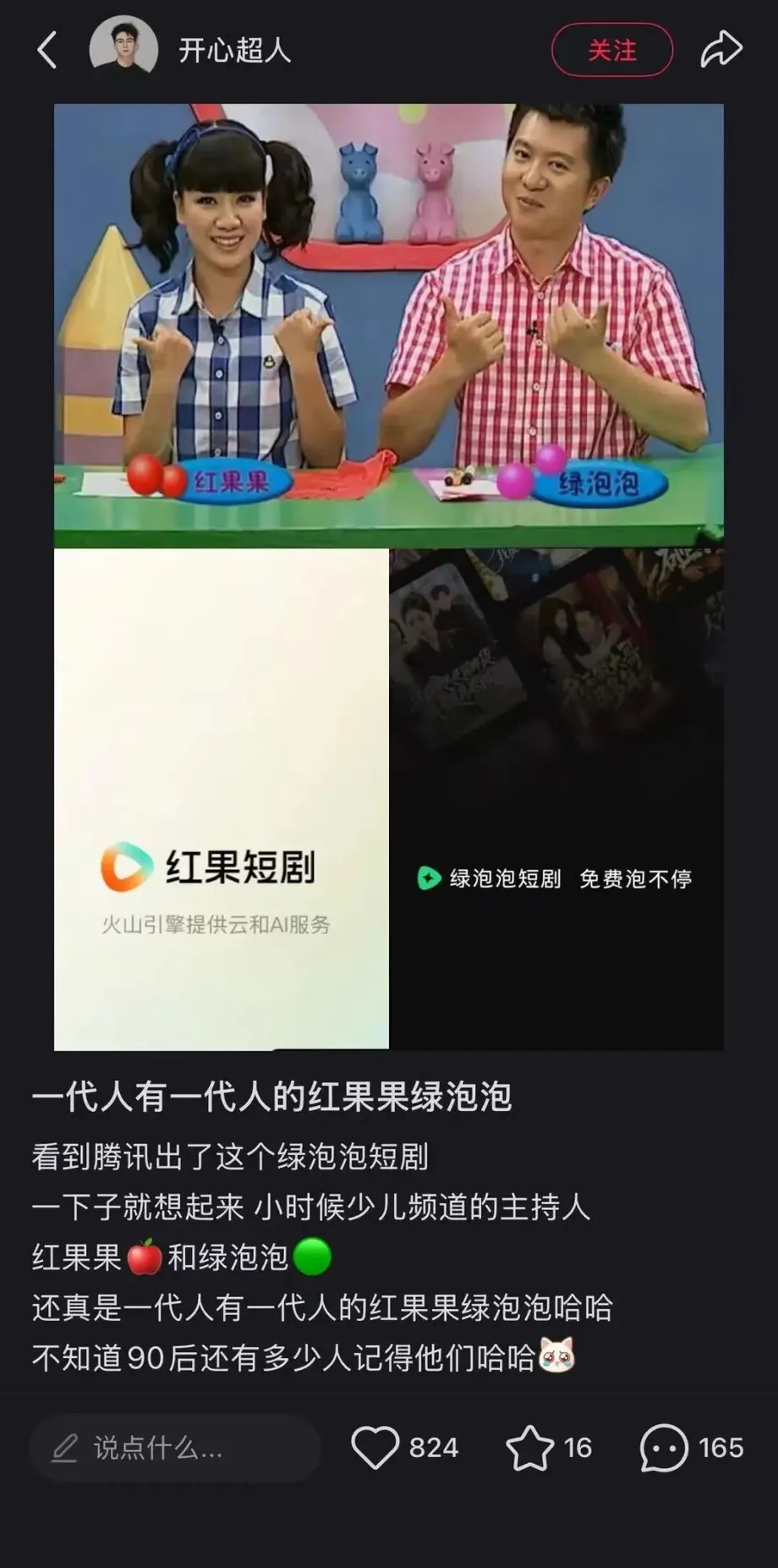
Tencent’s Green Bubble service, introduced inside WeChat in September 2026, takes a different approach from launching another standalone app. It creates an official viewing entry within an ecosystem that already has hundreds of millions of short drama users.
A reported WeChat joint distribution incentive runs from October 16 through December 31, 2026. Qualifying new dramas with average viewing time of at least 10 minutes can receive incentives of up to 100%, comprising 90% cash revenue sharing and 10% advertising credits. The basic incentive is 85%, falling to 50% when the viewing threshold is not met.
This makes viewing duration part of the reward structure. It does not establish whether Green Bubble can match Red Fruit’s audience, and no comparable daily user total is given for the new service.
Audience leadership is not yet a profit verdict
The established video businesses still have substantial paying operations. Reported iQIYI figures for the second quarter of 2026 put revenue at 6.29 billion yuan, including 4.01 billion yuan from memberships, against content costs of 3.82 billion yuan. Membership revenue therefore represented about 63.8% of the total.
Mango TV’s reported internet video revenue for the first half of 2026 was 4.462 billion yuan. These financial figures describe different businesses and reporting periods, and should not be ranked against each other without further adjustments.
No corresponding Red Fruit revenue, advertising yield or profit figure establishes how its audience lead translates into earnings. The share of visits driven primarily by rewards is also unknown. Advertisers need more than app openings to judge value, including how much attention their advertisements receive and whether viewers respond.
DataEye estimates put the 2026 micro drama market above 121 billion yuan, including about 57.3 billion yuan for free micro dramas. The free segment would represent roughly 47.4% of that forecast total. That is a projection of market value, not an observed audience share or Red Fruit’s revenue.
Regulation adds another test for high volume platforms
China’s National Radio and Television Administration reviewed and approved the Micro Drama Development and Management Measures on July 27, 2026, with the measures taking effect on September 1. The framework covers filing, classification and enforcement across the production and distribution process.
For platforms built around frequent releases, those requirements mean content checks must operate at the same scale as the production pipeline. Lower production costs do not remove filing obligations or the need to assess what reaches viewers.
The financial effect on Red Fruit has not been quantified. Neither has the extent to which tighter oversight will change release volumes, the proportion of AI productions or spending on better scripts and production.
The concrete forthcoming deadline identified in the competition is December 31, when WeChat’s reported incentive period ends. Red Fruit enters that contest with a commanding app audience, while Tencent has a large distribution network and a reward system tied to viewing duration. The unresolved commercial issue is how successfully each can turn repeat visits into valuable viewing without letting rapid production weaken the catalog.
Key Points
- Red Fruit reached 168 million daily active users in July 2026, compared with about 155 million across four major video apps when their totals are added.
- QuestMobile recorded 304 million monthly Red Fruit users in February and 356 million in May.
- China’s short drama audience reached a reported 851 million distinct users by May.
- Free viewing, Douyin recommendations and rapid production support Red Fruit’s growth, but app openings do not prove drama viewing or profitability.
- Tencent’s Green Bubble uses a WeChat entry, with a reported viewing based incentive period ending December 31, 2026.
- New micro drama management measures took effect September 1, adding filing, classification and enforcement requirements.