
Most submissions arrived online, not by phone
A dispute over TOP登陆少年组合 concert arrangements generated 48,795 submissions to Xuzhou's 12345 government service platform between midnight on August 21 and 8 a.m. on August 31, prompting extra overnight staffing and action against accounts on Weibo. The central disagreement was whether performances featuring two or more members of the boy group should be changed or retained.
Contents
The channel breakdown gives a more precise picture than descriptions of fans making more than 48,000 calls. According to figures attributed to Xuzhou 12345's September 1 public account post, 42,430 submissions came through online channels and 6,365 came by telephone. Those figures add up to 48,795, with online submissions accounting for about 87% of the total.
The post was published on the evening of September 1 and described the collection window as 10 days. Its reported wording said online channels were the main route for submissions, most people submitting requests were fans and a smaller number were fans' parents. The available accounts reproduce portions of the post, not its full text.
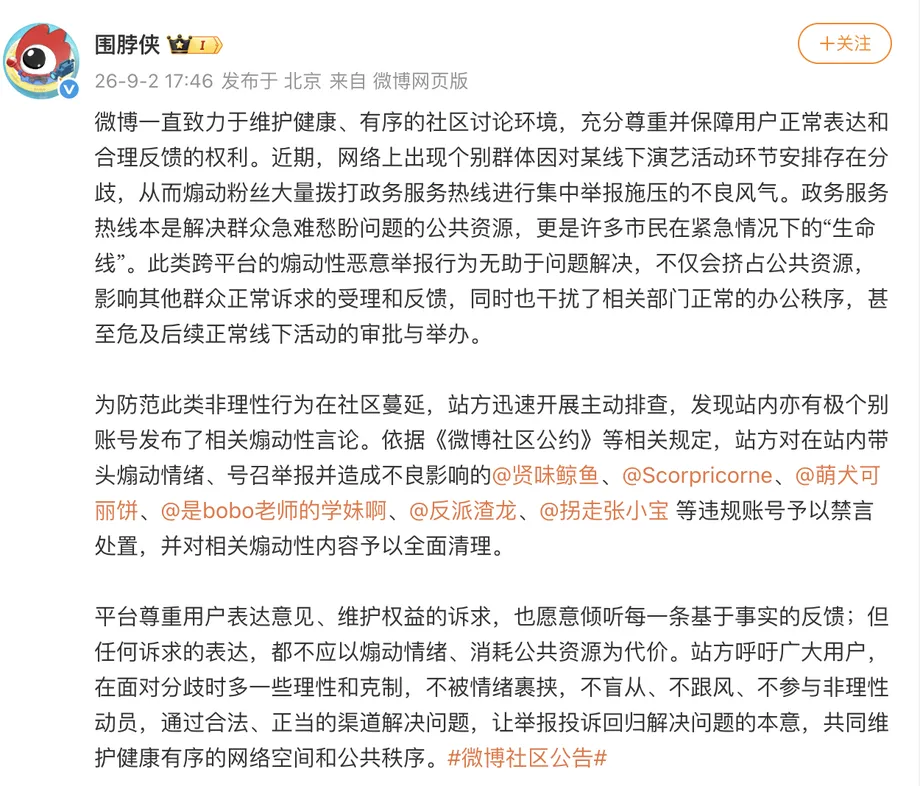
On September 2, Weibo's community monitoring account said it had found posts encouraging fans to contact government service hotlines in large numbers over disagreements about an offline performance. The platform said it silenced accounts that encouraged the campaign and removed related content.
The incident shifted a commercial entertainment dispute into a municipal service system. Xuzhou 12345 reportedly formed a special working team, introduced continuous human staffing and increased its overnight telephone staff from 15 to 43. Yet the submission count does not establish how many individual people participated, how many submitted repeatedly or how long other callers waited. Most people submitting requests were described as fans, with a smaller number identified as their parents.
Two opposing demands dominated the workload
The largest category, accounting for 47.54% of submissions, sought changes to performances featuring two or more members. Another 33.81% demanded that those performances be retained in full. Here, a duet or group stage means a segment performed by a particular combination of members, rather than necessarily the entire group.
Together, the two categories represented 81.35% of all submissions. That is more precise than the rounded description of about 80% used in some accounts. The share seeking changes exceeded the share seeking retention by 13.73 percentage points, but those figures measure submitted requests, not a verified vote among concertgoers.
The distinction matters because reports describe opposing fan groups organizing repeated complaints and circulating instructions for keeping the hotline busy. Without a count of unique participants, the percentages cannot establish what proportion of the group's audience supported either position.
The remaining complaints included issues involving security, noise and access around the venue. These subjects have a more direct connection to public services than preferences about which performers appear together. The published breakdown therefore supports distinguishing between types of requests, rather than treating every concert complaint as misuse. It does not establish whether any particular security, noise or transport complaint was substantiated.
How the dispute developed
TOP登陆少年 is a five member boy group launched by Beijing Times Fengjun Entertainment in August 2024. The Xuzhou concert schedule listed four performances at the Xuzhou Olympic Sports Centre stadium on August 25, 26, 28 and 29. The complaint collection period began before the first performance and continued after the final one.
The sequence shows that the surge was not confined to calls made during a single show. It covered advance objections, the four performance dates and the immediate aftermath, followed by publication of the hotline's workload figures and Weibo's moderation announcement.
- August 21, midnight: The reporting period for concert related submissions began.
- August 25 and 26: The first two Xuzhou performances were scheduled.
- August 28 and 29: The remaining two performances were scheduled.
- August 31, 8 a.m.: The reporting period ended with 48,795 submissions recorded.
- September 1: Xuzhou 12345 published an account of its response.
- September 2: Weibo announced that it had silenced accounts and removed content encouraging mass contact with government hotlines.
- September 3: A check of the hotline's public account could no longer locate the post.
Reports subsequently described the hotline article as deleted. No explanation for its disappearance was given. Its removal should not be treated as proof that the statistics were withdrawn or corrected, but it means readers can no longer check that public post in its original location.
Night staffing nearly tripled
Xuzhou 12345 reportedly established an internal working team and began human staffing 24 hours a day, seven days a week. To address peaks in overnight submissions, it increased night shift telephone staffing from 15 people to 43. The continuous human staffing began on August 23 and continued for eight days and nights, with all telephone operators participating. The hotline described activating an "emergency wartime working mechanism."
That was an increase of 28 staff members, or about 187% above the previous night shift level. The new staffing figure was almost 2.9 times the old one. This is the clearest numerical indication of the extra operational response, although it is not a measure of the total cost.
The fact that most submissions arrived online does not mean they required no work. The hotline's account described receiving requests, analyzing them, routing them to responsible departments and following up on their handling. Digital submissions can therefore create administrative work even when they do not occupy a telephone line.
On September 2, a hotline staff member confirmed that many requests were repeated submissions and said: "We register and process issues raised by residents by telephone or through online platforms as usual, and they receive timely replies. Previously raised issues of the same kind are answered directly on the telephone, but we do not make telephone callbacks for work orders of the same kind."
Requests concerning performance content were handled by Xuzhou's cultural market comprehensive administrative law enforcement team. The team said it required the organizers to follow the approved performance plan, prevent legally prohibited content and strengthen management of stage programs without unauthorized additions, changes or improper interactive segments. Enforcement officers recorded video and audio throughout the performances and said any unlawful performance conduct would be dealt with under the applicable rules.
Still, there are limits to what the figures show. No spending total, overtime bill, waiting time data or count of unrelated requests delayed by the campaign was disclosed. Concerns about pressure on public services are supported by the staffing expansion, but claims about specific residents being denied assistance would go beyond the reported evidence.
What Weibo and the entertainment company did
Weibo's September 2 statement focused on posts that encouraged large numbers of fans to contact government service hotlines over performance arrangements. Its announced response was to silence the accounts involved and remove the relevant content. Reports described some affected accounts as influential fan accounts that had helped organize or encourage the campaign.
The exact number of accounts, the length of the restrictions and a complete account list were not given. There is also no disclosed police finding or court ruling establishing that the conduct amounted to a crime. Platform moderation and legal punishment are separate matters.
Beijing Times Fengjun Entertainment was also reported to have taken measures against a small number of fan accounts associated with serious disruption. These measures included blocking accounts and restricting access to ticket purchases and related activities. A complete list of affected accounts and the duration of those restrictions were not disclosed.
Criticism of the company's response has centered on whether it communicated the performance arrangements clearly, discouraged pressure on public services and provided a suitable channel for fan feedback. Those are arguments about its responsibility to manage relations with its audience. They do not establish that the company directed the complaints, and no evidence described in the reports shows that it organized or instructed the mass submissions.
A large concert audience required real public services
The hotline's account put attendance across the concerts at about 100,000 fans. Separate reports described more than 250,000 additional visits around the Xuzhou Olympic Sports Centre associated with the four performances. These figures measure different things and should not be treated as competing estimates of ticketed attendance.
A count of visits or movements around a venue can include repeated trips and people who did not enter a concert. The reported city urban visitor flow on August 29 was 329,666, described as the highest figure during the observation period. That city figure cannot be attributed entirely to the concerts, and the length of the observation period was not specified.
The available reports repeat both visitor-flow figures from earlier coverage but do not identify the underlying data provider or explain the counting method. They therefore do not establish how visits were measured, what geographic boundaries were used or how repeat visits were counted.
Xuzhou arranged extended bus and metro operating hours and 100 free shuttle vehicles. A digital tool helped spectators find their seats. Police and venue staff also established a reunion area for children and parents, alongside an area where parents could wait for young concertgoers.
These arrangements show why public agencies had a legitimate role around the performances. Transport, crowd management and the safety of young spectators required coordination. The dispute arose when a service platform handling those practical concerns also became a channel for competing demands about artistic arrangements. Separating those categories would allow genuine safety and consumer concerns to be assessed without turning complaint volume into a contest over stage choices.
The unresolved questions behind the restrictions
The episode has renewed debate about organized fan campaigns and their effects on young people, online communities and public services. A 2021 notice from China's Central Publicity Department called for stronger management of celebrity fan club accounts and action against online feuds. It also urged families, schools and society to guide young people toward sound values.
That policy context helps explain the concern about influential accounts mobilizing followers, but it does not establish the ages of those who submitted complaints in Xuzhou. Reports say most requests came from fans and some from parents. The city's arrangements for young spectators confirm that minors were among the intended audience, not that minors were responsible for most of the campaign.
Several practical questions are still unanswered. It is not clear whether the disputed performances were changed, whether organizers issued a detailed explanation of the arrangements or whether the entertainment company created a dedicated feedback process afterward. There is no disclosed breakdown of how the 48,795 submissions were resolved or how many represented repeated requests from the same people.
No date has been announced for a further hotline report, a review of Weibo's restrictions or a public accounting of the company's measures. The immediate actions are documented more firmly than the longer term outcome: extra staffing was reported, online accounts were restricted and content was removed, but the effect on future fan conduct has not been measured.
The central distinction is between raising a concern and organizing repeated submissions to gain an advantage over another fan group. Xuzhou's figures show how quickly a disagreement about entertainment can become a substantial public workload. They also show why the response needs precision: genuine complaints about safety, transport or consumer treatment should not be dismissed simply because they concern a concert.
Key Points
- Xuzhou 12345 recorded 48,795 concert related submissions between August 21 and August 31.
- Of those, 42,430 arrived online and 6,365 by telephone, so the total was not a count of phone calls.
- Requests to change or retain duet and group performances accounted for 81.35% of submissions.
- Overnight telephone staffing increased from 15 to 43 people.
- Weibo announced account restrictions and content removal on September 2.
- The entertainment company reportedly restricted some fan accounts from ticket purchases and activities.
- The hotline's public post was no longer accessible when checked on September 3; no reason was disclosed.
- The number of unique complainants, the total administrative cost and any resulting changes to the performances have not been established.