
A new credit threshold, with limits on who can invest
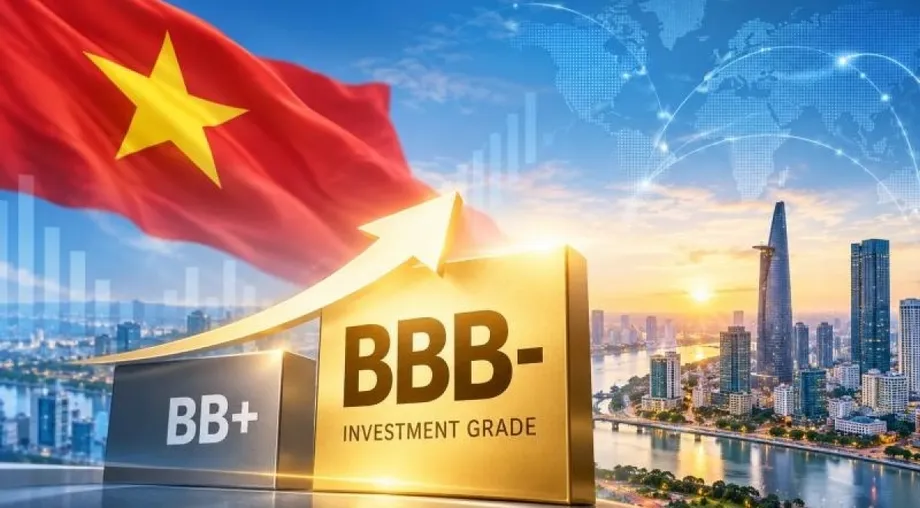
Japan's Rating and Investment Information (R&I) raised Vietnam's foreign currency issuer rating from BB+ to BBB- on October 8, 2026, giving the country its first investment grade issuer rating from the agency. The outlook changed from positive to stable. The immediate opportunity is access to some Japanese institutions whose investment rules previously excluded Vietnamese government debt, rather than an automatic surge of capital from every international market.
Contents
- A new credit threshold, with limits on who can invest
- Why growth and fiscal capacity supported the upgrade
- Which Japanese investors can now participate?
- A financing requirement far larger than one rating change
- Samurai bonds offer an established route into Japan
- Indonesia shows the possibilities and the pricing caveats
- Japan's existing investment ties provide a foundation
- Banking and reserve weaknesses still need attention
- The remaining ratings gap and the policy timetable
- Key Points
The distinction matters as Vietnam seeks funding for rapid economic expansion and major infrastructure projects. Maybank Investment Bank Vietnam estimates that total investment needs will reach US$1.45 trillion between 2026 and 2030. Japanese investors, banks and the yen bond market could help meet part of that demand, although borrowing terms, currency exposure and individual investment mandates will determine how much financing actually becomes available.
The Vietnamese government's rating upgrade announcement says R&I's decision rests on strong growth, relatively low public debt, continuing foreign direct investment and reforms intended to make economic expansion more durable. The Ministry of Finance described the move as recognition of prudent debt management and extensive reforms.
BBB- is the lowest investment grade level on R&I's scale. It marks an improved assessment of repayment capacity, but it is not a guarantee against losses or a commitment by investors to purchase bonds. Vietnam still falls below investment grade at S&P Global Ratings, Moody's and Fitch Ratings, leaving many international investment restrictions in place.
The financing opportunity therefore has two parts: using R&I's assessment to reach eligible Japanese capital now, while addressing the weaknesses that continue to constrain broader sovereign ratings.
Why growth and fiscal capacity supported the upgrade
Vietnam's real GDP grew 8% in 2025 and roughly 9% during the first nine months of 2026. R&I expects full year growth could remain around 9%, below the government's target of at least 10% but still strong relative to other Southeast Asian economies.
The agency's assessment looks beyond the current growth rate. It expects expanded public investment, sustained foreign direct investment and a gradual shift toward productivity and innovation to support continued expansion. The reform programme known as Doi Moi 2.0 includes streamlining government, promoting private business, improving institutions and developing capital markets.
Fiscal figures help explain why R&I believes Vietnam can increase development spending without immediately threatening debt sustainability. The combined central and local government deficit was 3.3% of GDP in 2025. The projected 2026 deficit is 4.2%, an increase of 0.9 percentage points, within a medium term framework allowing an average deficit of about 5%.
Public debt is reported at slightly above 30% of GDP in the October assessment. R&I expects both the deficit and debt ratio to rise, but judges debt sustainability risks to be limited. Its reasoning depends partly on new public investment supporting future growth and the government maintaining control over recurrent expenditure, such as routine operating costs.
That is a conditional endorsement of additional borrowing. Infrastructure must create productive capacity, rather than simply increase debt. Consistent implementation of reforms is also part of the agency's case for growth becoming more stable.
Which Japanese investors can now participate?
FiinRatings, a Vietnamese credit rating institution, says Japanese investors are likely to be the first source of new international capital following the upgrade. Its investment grade assessment points to R&I's recognition by Japan's Financial Services Agency as the reason some institutions may now become eligible to invest.
Nguyen Quang Thuan, chairman of FiinRatings and FiinGroup, explained that eligibility depends on the exact wording of an institution's investment rules:
“Institutions whose investment rules require ‘BBB- or higher from at least one designated agency’ can now include Vietnam in their portfolios,” Thuan said in written comments.
Other institutions use the lowest rating assigned by recognised agencies, or require a sufficient second rating. Those rules can still exclude Vietnam because the other major agencies have not granted investment grade sovereign status. The upgrade opens selected channels, not every pension fund, insurer or bond portfolio.
FiinRatings also says qualifying banks using the Basel III standardised approach could apply a 50% regulatory risk weight to certain Vietnamese foreign currency government bond exposures, instead of 100%. A risk weight determines how much of an exposure counts when calculating regulatory capital requirements. Halving that weight can reduce the capital needed to hold an otherwise identical eligible exposure, but it does not halve the probability of default or guarantee lower bond yields.
A financing requirement far larger than one rating change
Maybank Investment Bank Vietnam's US$1.45 trillion estimate covers investment across the economy during 2026 to 2030. Its projected funding structure assigns 53% to private sector sources, 32% to the state and 15% to foreign direct investment.
Applied to that total, those shares imply approximately US$768.5 billion from private sources, US$464 billion from the state and US$217.5 billion from FDI. These are calculations from the estimate, not announced financing commitments. They show why improving government borrowing access alone cannot satisfy the country's investment ambitions.
Quan Trong Thanh, head of research at Maybank Investment Bank Vietnam, argues that offshore financing will become increasingly necessary. He said the government should lead capital raising for major infrastructure, while banks continue financing private enterprise:
“In our view, one sure thing is that Vietnam must mobilise more offshore funds, especially from 2028,” Thanh said.
Thanh also cautioned that domestic corporate bond and equity markets may not develop quickly enough to meet the investment timetable. Ho Chi Minh City is seeking feedback on a proposal to issue municipal and project bonds, including foreign currency debt, through Vietnam's international financial centre. That remains a proposal, with pricing central to whether investors would participate.
Japan's development lending is another channel. JICA has announced plans for more than 100 billion yen, approximately US$630 million, in annual official development assistance loans to Vietnam. Reports differ on the announcement date, placing it on October 7 or October 8. Those loans are separate from commercial bond financing and should not be treated as capital generated by the rating upgrade.
Samurai bonds offer an established route into Japan
Samurai bonds are yen denominated bonds issued in Japan by borrowers from outside the country. They give foreign governments and companies access to Japanese investors, but require suitable issuance arrangements and a plan for managing repayment in yen.
Vietnam's interest predates the upgrade. In 2019, the Ministry of Finance's Debt Management and External Finance Department compiled experience with Samurai issuance. Around that period, the Japan Bank for International Cooperation operated its GATE programme, which could support foreign government issues through partial guarantees or bond purchases. That history does not establish whether support would be available for a new Vietnamese transaction.
On December 15, 2025, Vietnam's Ministry of Finance met Daiwa Securities in Tokyo to discuss Japan's capital market and possible Samurai issuance. R&I's decision provides a stronger credit reference for revisiting those discussions, but no Vietnamese issuance date, size or coupon has been announced in connection with the upgrade.
Tyler Manh Dung Nguyen, chief market strategist at Ho Chi Minh City Securities Corporation, identified potential benefits for the government and major entities linked to the state, including VietinBank, Agribank and Vietnam Electricity. Their individual access and borrowing terms would still depend on their own credit position and transaction structure.
A possible phased strategy would begin with government issuance to establish a pricing reference, then extend access to eligible banks, companies and projects. This is a financing option, not a confirmed government programme.
Indonesia shows the possibilities and the pricing caveats
Indonesia provides a regional example of sustained access to the Samurai market. It has issued regularly since 2015 and raised 200 billion yen in 2024 across maturities from three to 20 years. That transaction included 25 billion yen of Blue Bonds, instruments intended to finance marine economy and sustainability projects.
The 2024 coupons ranged from 0.99% to 2.55% annually, with Blue Bond coupons between 1.57% and 2.55%. In April 2026, Indonesia raised another 172.1 billion yen across three, five, seven and ten year maturities, including 6.5 billion yen in Blue Bonds with seven and ten year terms. Coupons for the later issuance ranged from 2.35% to 3.23%.
The Blue Bond component represented 12.5% of Indonesia's 2024 issuance, compared with approximately 3.8% in April 2026. The later coupon range was also higher. These figures show that Japan can supply financing across several maturities, while the price and composition of borrowing change between transactions.
Vietnam cannot assume that it would obtain Indonesia's terms. Nominal yen coupons are only one part of the cost. Creditworthiness, interest rates, issuance expenses, market conditions and currency hedging all affect the final bill. Hedging means arranging protection against exchange rate movements, which itself carries a cost.
Blue or other green instruments could be considered for qualifying Vietnamese ports, logistics, offshore energy and marine ecosystem protection. Resolution 20-NQ/TW of July 28, 2026 calls for diversified funding, green finance and priority resources for key projects supporting Vietnam's development as a strong maritime nation. A sustainability label would still need to be supported by credible project selection and reporting.
Japan's existing investment ties provide a foundation
Japan already has a substantial investment presence in Vietnam. At the end of the first quarter of 2026, it had 5,760 active projects with investment exceeding US$79 billion, making it Vietnam's third largest foreign investor.
A JETRO survey found that 56.9% of Japanese businesses in Vietnam planned to expand within one to two years, compared with 46.8% across ASEAN. Vietnam's figure was 10.1 percentage points higher, indicating stronger expansion intentions among the surveyed businesses, though intentions do not guarantee completed investment.
Japanese financing is already visible in infrastructure. The Hanoi railway project began construction with Japanese equipment, expertise and concessional yen loans. The 12 kilometre route carries an estimated cost exceeding 35 trillion dong, approximately US$1.3 billion, illustrating the scale of individual transport investments that require durable funding.
Investor outreach in Tokyo, Osaka and other financial centres could match different needs with different providers: government and infrastructure bonds with fixed income investors, equity with suitable listed companies, and trade or project financing with banks. Energy, ports, railways, electronics, semiconductors and data centres are among the sectors identified for potential investment.
The policy objective is also to improve investment quality. Politburo Resolution 10-NQ/TW on the foreign invested economy seeks stronger links with domestic businesses so that foreign capital brings technology, management expertise, production standards and market networks. The sovereign rating can support confidence, but those business benefits require more than cheaper borrowing.
Banking and reserve weaknesses still need attention
R&I's positive assessment comes with substantial cautions. Outstanding bank loans exceeded 140% of GDP at the end of 2025. Credit growth has outpaced deposit growth, tightening banking liquidity, while lending related to real estate remains large and capital buffers are limited.
VinaCapital economists Michael Kokalari and Thai Thi Viet Trinh identified similar concerns in their January 29, 2026 credit rating study. They reported a banking sector capital adequacy ratio of 12.5% in late 2024 and bank assets approaching twice GDP. The capital adequacy ratio measures regulatory capital relative to assets adjusted for risk, indicating the buffer available to absorb losses.
That study put government debt at approximately 35% of GDP and external debt at about 33%. The government debt estimate differs from the slightly above 30% figure reported in October. Because the figures come from different dates and their measurement bases are not established here, they should not be presented as a confirmed decline.
External finances also contain a contrast. The current account surplus has exceeded 6% of GDP since 2023, and continuing FDI supports foreign currency inflows. Yet reserves cover less than three months of imports. R&I expects the surplus to narrow as investment expands and higher energy prices increase import costs.
The State Bank of Vietnam's Circular 50, issued in September, introduces a phased transition toward Basel III liquidity standards, with mandatory implementation beginning in October 2028. Its liquidity coverage and net stable funding requirements address banks' ability to meet immediate cash needs and maintain more durable funding. Implementation is a concrete next step in reducing financial vulnerabilities.
The remaining ratings gap and the policy timetable
Vietnam's next objective is investment grade status from the three major global agencies. S&P and Fitch sovereign ratings remain BB+, one notch below BBB-. Moody's rating is Ba2, two notches below its investment grade threshold of Baa3, with its outlook raised from stable to positive in May 2026.
Some reports describe all three agencies as assigning BB+. That description conflicts with the stated Moody's Ba2 rating and overlooks the different Moody's scale. Vietnam's position should therefore be described separately for each agency.
Fitch's January 2026 BBB- action also requires care. VinaCapital explains that it applied to legacy secured Brady bonds maturing in 2028, which benefit from collateral and structural protections. Vietnam's unsecured sovereign debt remained BB+. An investment grade rating for protected instruments is not equivalent to an investment grade issuer rating.
Key steps in the financing and ratings timetable include:
- December 15, 2025: The Ministry of Finance discussed Japan's capital market and potential Samurai issuance with Daiwa Securities in Tokyo.
- January 2026: Fitch raised ratings on certain secured debt instruments to BBB-, without upgrading the unsecured sovereign rating.
- April and May 2026: The Ministry of Finance coordinated with other agencies and held direct sovereign review discussions with R&I.
- October 2, 2026: Prime Minister's Decision 1919/QD-TTg updated the target of reaching investment grade at the major agencies by 2030.
- October 8, 2026: R&I raised Vietnam's foreign currency issuer rating to BBB- with a stable outlook.
- October 2028: Mandatory implementation of the new banking liquidity standards begins.
Decision 1919/QD-TTg targets at least Baa3 from Moody's or BBB- from S&P and Fitch by 2030. R&I's action does not require another agency to follow, since methodologies and the weight assigned to institutional, banking and external risks differ.
Funding cost forecasts also differ. VinaCapital estimated that broader investment grade status could lower borrowing costs by up to 150 basis points. Maybank Investment Bank Vietnam estimated a reduction of 150 to 300 basis points. One hundred basis points equals one percentage point, so these forecasts imply possible savings of up to 1.5 percentage points or a range of 1.5 to three percentage points, respectively. Neither is a measured saving from the R&I decision.
VinaCapital identifies financial sector protection, policy and legal predictability, and data transparency as remaining priorities. It points to Resolution 66, effective April 2025, and the new Law on Data as institutional reforms, while calling for fuller disclosure of external obligations, state enterprise and public private partnership liabilities, and standardised bank asset quality information.
The Ministry of Finance and other agencies say they will continue providing rating organisations with timely economic, fiscal and debt information. No date for the next sovereign upgrade or Vietnamese Samurai transaction has been announced. The practical test is whether stronger credit recognition becomes financing at acceptable cost while fiscal discipline, bank resilience and external buffers improve.
Key Points
- R&I raised Vietnam's foreign currency issuer rating to BBB- with a stable outlook on October 8, 2026.
- Some Japanese institutions can now consider Vietnamese debt, while stricter rating mandates still limit access.
- Qualifying banks may apply a 50% rather than 100% risk weight to certain government bond exposures.
- Samurai bonds are a potential funding channel, but no Vietnamese issue has been announced.
- Maybank Investment Bank Vietnam estimates US$1.45 trillion in investment needs for 2026 to 2030.
- Rapid credit growth, real estate exposure and limited foreign exchange reserves remain concerns.
- Vietnam continues targeting broader investment grade ratings by 2030, with new banking liquidity requirements mandatory from October 2028.