
A new heart without dividing the breastbone
Surgeons at the First Affiliated Hospital of Xi'an Jiaotong University performed China's first robot assisted minimally invasive heart transplant on October 5, replacing an elderly man's failing heart through an incision of about 8 centimeters between his ribs. The patient had a left ventricular ejection fraction of just 19%, alongside coronary artery disease, previous small cerebral infarctions and emphysema.
Contents
- A new heart without dividing the breastbone
- Why the patient faced unusually high surgical risks
- How the team prepared for a smaller opening
- Five connections restored circulation
- What the early recovery does and does not show
- The Saudi operation provides a different point of comparison
- How the milestones fit together
- Further results will determine the technique's place
- Key Points
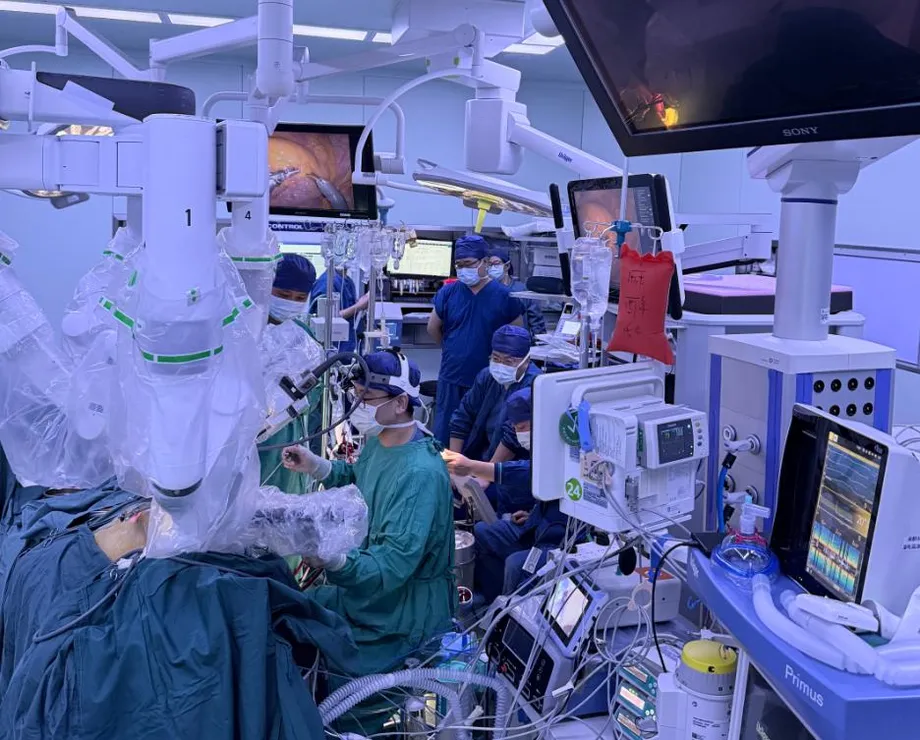
The hospital announced the operation at an October 9 briefing, describing it as the world's third transplant of this kind and China's first. The team included cardiovascular surgeons Yan Yang and Li Yongxin. Unlike a conventional transplant performed through a divided breastbone, the procedure used the small main incision and two additional openings for robotic instruments.
The donor heart began beating after its blood supply was restored. The patient returned to the cardiac surgical intensive care unit and was taken off mechanical ventilation on the day of surgery. A separate account gives the interval as 12 hours and says he was receiving rehabilitation treatment.
The achievement establishes that this approach was feasible for this patient. It does not yet establish how its risks or recovery results compare with conventional transplantation across a larger group. The hospital has described an encouraging early recovery, but has not disclosed a discharge date or results from longer follow up.
Why the patient faced unusually high surgical risks
The man's condition had deteriorated over several months. He had experienced chest tightness and breathlessness after activity, followed by a continuing decline in heart function over six months. During the final month before treatment, his symptoms became much worse: he could no longer lie flat comfortably and had severe swelling in both legs.
His ejection fraction of 19% measured the proportion of blood expelled by the left ventricle with each contraction, not the percentage of his heart that remained functional. The very low reading, together with his symptoms, pointed to severely impaired pumping. Tests also found substantial leakage through several heart valves.
Other conditions complicated the decision. Coronary artery disease affected the vessels supplying his heart; multiple lacunar cerebral infarctions indicated previous small areas of brain injury; and emphysema added a serious lung condition. The team concluded that medical treatment could no longer reverse his deterioration and that transplantation was his only remaining rescue option.
The patient was registered in the China Organ Transplant Response System to await a donor heart. Choosing a smaller surgical opening did not remove that requirement: the operation still depended on organ allocation and the arrival of a suitable donor heart.
Yan, deputy head of the hospital's cardiovascular hospital and director of cardiac surgery, explained that conventional transplantation involves a central chest incision exceeding 20 centimeters and division of the breastbone. For this patient, the team considered bleeding, breastbone infection and delayed healing particularly serious concerns.
How the team prepared for a smaller opening
The decision to use robotic assistance required preparation across several departments. Cardiovascular surgeons worked with the organ procurement organization, anesthesia and operating room staff, ultrasound specialists and the cardiac surgical intensive care unit. Their planning covered the operation itself, donor heart protection and care immediately afterward.
Using three dimensional image reconstruction and models, the team rehearsed where to place the incision, how instruments would move and how to introduce the donor heart. These details matter because a smaller opening limits access even while the robot provides a magnified view and controlled instrument movement.
The clinicians also developed several contingency plans for protecting the donor organ, joining its vessels and establishing extracorporeal circulation. That term refers to circulation supported outside the body, allowing blood flow to be maintained while surgeons work on the heart.
Once the donor allocation notification arrived, the team began the operation overnight. The preparation was intended to make the sequence workable within the confined space while protecting a donor heart that could not remain indefinitely without a blood supply.
Five connections restored circulation
The main opening was made between the ribs and measured approximately 8 centimeters. Two smaller chest wall ports allowed the robotic arms to enter. The surgeons did not divide the breastbone, and the approach was intended to preserve the structure of the chest rather than open it through the usual central route.
This was still major surgery inside the chest. Descriptions of the procedure as a transplant without opening the chest refer to avoiding a conventional sternotomy, the operation that splits the breastbone. They do not mean that the heart was replaced without incisions or surgical access to the chest cavity.
Under a magnified three dimensional view, the surgeons controlled the robotic instruments to separate and remove the diseased heart, introduce the donor heart and complete five surgical connections. These joined the left atrium, pulmonary artery, aorta, superior vena cava and inferior vena cava.
The connections restored the routes through which blood enters and leaves the transplanted heart. The venae cavae return blood from the body, the pulmonary artery carries blood toward the lungs, and the aorta carries blood out to the body. The left atrial connection links the donor heart to blood returning from the lungs.
The team maintained cold protection of the donor heart during the procedure. When flow through the aorta was restored, the organ resumed beating. Robotic assistance in this account means that surgeons operated the instruments; it does not describe an autonomous machine performing the transplant.
What the early recovery does and does not show
The hospital's announcement describes removal of the breathing tube on the day of surgery. Another account specifies 12 hours after the operation. Those descriptions are compatible, although only the latter supplies an exact interval. Both point to a relatively prompt end to mechanical ventilation, not completion of recovery.
Avoiding breastbone division removes the need for that bone to heal after being cut. The main incision was also much shorter than the conventional opening Yan described: about 8 centimeters compared with more than 20 centimeters. On those figures, the main opening was less than two fifths as long, although the robotic approach also required two additional ports.
Incision length alone cannot measure the total burden of a transplant. The patient still underwent removal and replacement of his heart, complex surgical connections and intensive postoperative monitoring. A smaller opening should not be read as evidence that all transplant risks have disappeared.
At the October 9 briefing, Yan described preservation of the chest structure as the central benefit. His statement, translated from Chinese, was:
The core advantage of robot assisted minimally invasive heart transplantation is preserving the intact structure of the chest, greatly reducing surgical trauma, shortening the recovery period and reducing the risk of breastbone infection.
Those are the team's stated benefits and aims. For the Chinese patient, the disclosed results support successful completion and encouraging early recovery. No figures have been released for hospital stay, postoperative pain, bleeding or infection that would allow a direct comparison with conventional transplantation.
The Saudi operation provides a different point of comparison
The earlier Saudi procedure was performed at King Faisal Specialist Hospital and Research Centre in Riyadh. An academic account, published online on February 25, 2025, describes it as a totally robotic orthotopic heart transplant. Orthotopic means that the donor heart replaces the recipient's heart in its usual anatomical position.
The hospital team's robotic transplant study identifies the recipient as a 16 year old boy with refractory failure of both ventricles caused by nonischemic dilated cardiomyopathy. In accessible terms, both main pumping chambers were failing despite treatment, with an enlarged, weakened heart muscle whose disease was not caused by inadequate coronary blood supply.
That patient differed substantially from the elderly Chinese recipient with coronary, brain and lung conditions. The two operations demonstrate use in different clinical circumstances, but they do not provide a controlled comparison of outcomes or establish which patients benefit most.
The Saudi team practiced the approach on multiple cadavers using timed technical training. Its academic abstract says limiting donor organ ischemic time was essential to patient safety. Ischemic time is the period during which the donor organ lacks its normal blood supply. This focus helps explain why preparation for a smaller incision must address speed and organ protection as well as access.
The Saudi study reports a short ischemic time, ventilation lasting less than 24 hours, rapid mobilization, reduced postoperative pain and a shorter hospital stay. Its abstract does not give exact values for ischemic time or hospital duration. Those reported outcomes therefore cannot be compared numerically with the Chinese case beyond the limited ventilation information.
How the milestones fit together
The sequence places the Chinese operation within a very early stage of robotic transplantation. The hospital describes China as the third country to perform the technique, following Saudi Arabia and the United States. The terminology is not identical across the cases: the Saudi academic publication describes a totally robotic transplant, while the Chinese operation is described as robot assisted and minimally invasive.
- 2024: Saudi Arabia performed the procedure described as the world's first totally robotic heart transplant.
- February 25, 2025: The academic account of the Riyadh operation was published online.
- 2025: The United States performed the procedure described as North America's first.
- October 5: The Xi'an team performed China's first robot assisted minimally invasive heart transplant.
- October 9: The hospital announced the operation and early recovery at a news briefing.
The Chinese announcement gives October 5 and October 9 without specifying the year in the account presented here. The Saudi publication date is also distinct from the date of surgery. Keeping those dates separate avoids treating the release of an academic paper as the surgical milestone itself.
Further results will determine the technique's place
Yan said the approach could offer another option for elderly patients and people with several underlying illnesses who face substantial risks from conventional surgery. The Chinese case supports that possibility in one carefully selected patient, rather than proving that robotic transplantation is suitable for everyone in those groups.
The remaining information gaps are concrete. The hospital has not disclosed the recipient's exact age, total operating time, donor organ ischemic time, discharge date or longer term graft function. No comparative patient series has been presented in the announcement. These details would help assess whether the smaller access route produces consistent gains without compromising transplantation itself.
The team says it intends to refine its minimally invasive transplant program. No date for another procedure, a clinical study or a further results release has been announced. For now, the strongest conclusion is a specific one: surgeons replaced a severely failing heart without dividing the breastbone, and the recipient came off ventilation soon afterward.
Key Points
- The Xi'an operation took place on October 5 and was announced on October 9.
- The elderly recipient had an ejection fraction of 19% and several serious accompanying illnesses.
- Surgeons used an approximately 8 centimeter incision and two robotic ports, avoiding breastbone division.
- Five surgical connections restored circulation through the donor heart.
- The patient came off ventilation the same day; a separate account specifies 12 hours.
- The hospital describes the procedure as China's first and the world's third of its kind.
- Longer term recovery results and comparative evidence have not been disclosed.