Topology survives where its usual protection disappears
Scientists have experimentally observed topological states at a phase transition where the energy gap, a feature usually central to their description, has closed. Published in Nature on October 7, 2026, the research used engineered sound wave structures to identify critical topology in both one and two dimensions and directly image boundary modes within a gapless interior.
Contents
- Topology survives where its usual protection disappears
- What an energy gap usually does
- A printed acoustic system stands in for a quantum problem
- Reading topology through an entanglement spectrum
- The boundary remains visible inside a continuum
- Two experiments test different forms of critical topology
- How theory and measurement came together
- Topology can distinguish the transitions themselves
- Why this differs from a topological semimetal
- What the result establishes and what comes next
- Key Points
The study, Experimental observation of critical topology, was led by Jianhua Jiang of the University of Science and Technology of China, working with researchers at the University of Hong Kong, Eastern Institute of Technology in Ningbo, Soochow University and other institutions. Its central finding is that a system can retain identifiable topological properties at the boundary between phases, rather than only within a phase protected by an energy gap.
The experiments were conducted in a classical acoustic platform, not an electronic quantum material. That distinction matters: the researchers mapped the mathematical properties of the quantum problem onto sound waves, then measured the acoustic system to recover the corresponding topological information.
A separate Nature study led by Baile Zhang at Nanyang Technological University in Singapore also observed critical topological phenomena using a different experimental strategy. Together, the two studies bring a theoretical prediction into laboratory observation, while leaving the realization of equivalent behavior in quantum materials as a further research goal.
What an energy gap usually does
A familiar example of topological matter is a topological insulator, whose interior does not conduct electricity while its boundary can. Its unusual behavior depends on global properties of its states, rather than simply on the arrangement of atoms at one location.
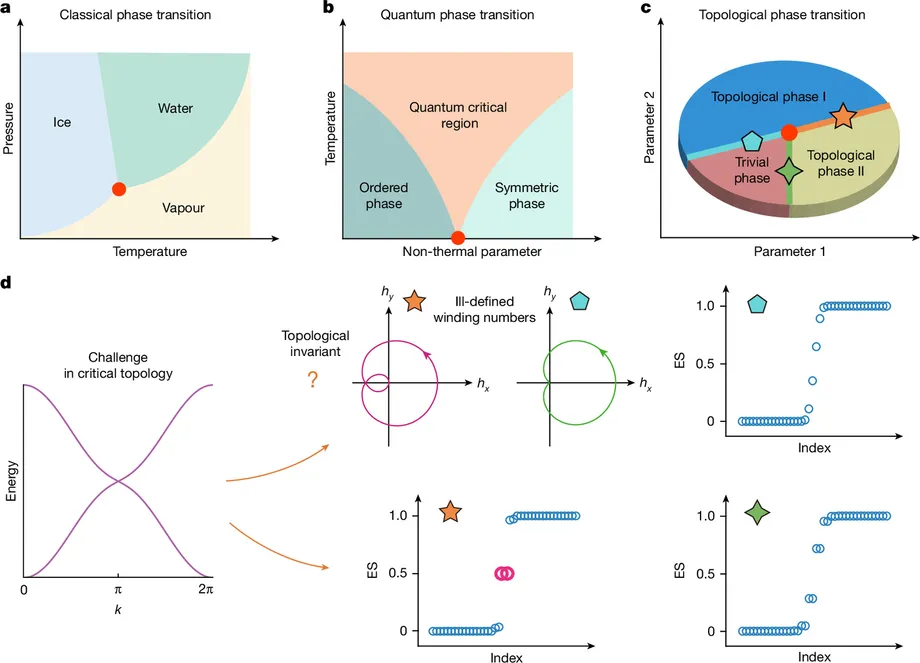
An energy gap is a range of energies separating groups of allowed states. In conventional descriptions of topological insulators, that separation helps define a topological invariant, a discrete mathematical label that distinguishes one phase from another. When the gap closes at a transition, the standard description can lose the separation it needs.
The new work addresses precisely that situation. It does not claim that every gapless system is topological or that conventional topological theory is invalid. It shows that specially designed critical states can possess topology that remains measurable even when the usual energy gap is absent.
The conceptual change is therefore specific: closing a gap need not erase every topological distinction. With the right diagnostic, researchers can distinguish different kinds of critical states at the phase boundaries themselves.
A printed acoustic system stands in for a quantum problem
Jiang and his collaborators built artificial phononic crystals using resin structures produced by three dimensional printing. A phononic crystal is an engineered structure that controls how sound waves travel, allowing researchers to arrange wave behavior that represents a particular physical model.
Here, the structures provided a visible, macroscopic platform for a problem normally expressed through quantum states. The mapping preserved the key mathematical quantities needed to examine critical topology. Sound supplied an accessible way to excite the system and measure its response.
The authors of the Nature paper explicitly describe the relationship between the platform and the quantum problem:
Although implemented in a classical platform, our experimental approach gives results equivalent to those in the quantum limit and is in fact readily extensible to quantum systems.
That statement concerns the quantities represented by the experiment. It should not be read as evidence that the printed resin itself became a quantum material, or that the researchers demonstrated a quantum computer. The achievement was an acoustic realization and measurement of the relevant topology, backed by the correspondence between the classical and quantum descriptions.
Reading topology through an entanglement spectrum
The main obstacle was measurement. Without an energy gap, boundary signals can overlap with the states extending through the interior. A technique designed to identify a boundary mode isolated inside a gap cannot simply be applied unchanged.
The team instead used entanglement spectra and entanglement wavefunctions. In a quantum description, an entanglement spectrum is obtained by mathematically dividing a system and examining the correlations between its parts. It can expose structural information that is not obvious from the ordinary spectrum of allowed energies.
In the acoustic experiment, the researchers reconstructed the corresponding information from measured wave responses. They excited the sound field and recorded its response to obtain a Green function, a mathematical description of how a disturbance travels through the structure. Decomposing that response into its spectral components allowed them to recover the entanglement information.
Jiang's team had developed an experimental method for measuring entanglement entropy and entanglement spectra in 2024, publishing that work in Nature Communications. Although initially applied to conventional topological states with a gap, the method supplied the tool needed for the harder critical case. The new study also used a generalized Li–Haldane correspondence linking entanglement information to boundary behavior.
The boundary remains visible inside a continuum
The Nature paper reports both an entanglement based diagnosis and direct imaging of topological boundary modes in a gapless bulk continuum. These are complementary observations: one identifies the topology mathematically, while the other shows the associated wave behavior at the physical boundary.
A continuum here means that states extending through the interior are available in the same spectral region as the boundary mode. The boundary signal is therefore not sitting alone inside an otherwise empty gap. It remains localized near the edge even though the interior supports waves in that region.
The researchers describe these boundary states as topological localized states within a continuum. Their observation is important because it connects the abstract classification to an actual spatial pattern, rather than relying solely on a calculated label.
The study also extended the experimental characterization from one dimension to a two dimensional system with time reversal symmetry. That symmetry relates a physical process to its time reversed counterpart. Demonstrating critical topology under this condition broadened the result beyond the one dimensional settings that had dominated earlier theoretical predictions.
Two experiments test different forms of critical topology
The Eastern Institute of Technology's October 7 announcement describes two independent Nature studies. Jiang's paper examined critical topology through entanglement measurements in one and two dimensions. Zhang's separate paper, Observation of critical topological phase transition, examined a one dimensional Floquet critical point.
A Floquet system is one whose governing conditions repeat periodically in time. Its states are described using quasienergy, which accounts for that repeating cycle. Zhang's experiment observed topological modes at zero quasienergy and at the distinct value conventionally labeled π.
These are not two descriptions of the same apparatus. The teams used different designs and measurement approaches to test critical topological phenomena. Jiang's study carries DOI 10.1038/s41586-026-11099-x; the separate Floquet study carries DOI 10.1038/s41586-026-11067-5.
Xuejia Yu of Eastern Institute of Technology was a corresponding author on both papers and provided theoretical guidance. Although the account of Jiang's work describes a first experimental observation, the institutional announcement presents both studies as establishing the first experimental evidence. It does not establish a priority order between their experiments, so the broader development is best understood as two independent demonstrations.
How theory and measurement came together
The Eastern Institute of Technology's research account traces the work through several theoretical milestones. Yu and collaborators developed a classification of topology at quantum critical points in 2022, followed by a generalized correspondence between interior topology and boundary states in 2024. In 2026, they extended the theory to dynamics outside equilibrium.
Those developments supplied ways to define and recognize topology where a conventional gap based description was insufficient. Jiang's earlier measurement technique supplied an experimental route to the information needed for that recognition. The sequence shows why the new result depended on both theory and instrumentation.
- 2022: Yu and collaborators proposed a theoretical classification of topology at quantum critical points.
- 2024: A generalized correspondence between interior topology and boundary states was proposed, while Jiang's team published its entanglement measurement method.
- February 17, 2026: Nature received Experimental observation of critical topology.
- August 27, 2026: Nature accepted the paper.
- October 7, 2026: The study was published, and Eastern Institute of Technology announced the two Nature experiments.
Yu also coauthored a review of critical topology in Physics Reports with Limei Xu of Peking University and Haiqing Lin of Zhejiang University. The institutional announcement identifies Zhikang Lin, Liwei Wang and Zelin Kong as joint first authors of Jiang's paper, and Yu, Shuang Zhang and Jiang as joint corresponding authors.
Topology can distinguish the transitions themselves
The experiment did more than identify an unusual boundary state. It also examined what happens when phase boundaries carry different kinds of critical topology. The authors found that transitions between such boundaries lead to multicritical points, where several critical boundaries meet.
This introduces an additional level of organization into a phase diagram. Conventional phases can carry different topological labels; the critical boundaries separating phases can also carry distinctions. Changes between those boundary classifications then produce a further structure at their meeting points.
The authors of the Nature paper state the result directly:
Through entanglement-based analysis, we illustrate that transitions among phase boundaries with distinct critical topology lead to multi-critical points in the phase diagram, evidencing topology-driven multi-criticality and a hierarchical structure of topological phases.
The practical scientific value is a more detailed way to classify transitions. Two states may both be gapless and critical yet differ topologically. Recognizing that difference can reveal organization that would be missed by treating the closing of the gap as the end of the topological description.
Why this differs from a topological semimetal
Gapless topological systems were not unknown before these experiments. Topological semimetals already combine a lack of a full energy gap with topological properties. Jiang's account makes a narrower distinction between those established systems and the critical states investigated here.
In the semimetal comparison, topology is defined using a suitable subspace that remains gapped. A subspace is a selected portion of the full mathematical space of states. That separation allows a topological definition even though the complete system has no full gap.
The critical topology experiment instead probes topology in the genuinely gapless state space at a phase boundary. Its novelty is therefore not simply that sound waves reproduced something gapless. It is that the researchers characterized the relevant topology without relying on the gapped subspace invoked in the semimetal comparison.
This distinction also limits broad claims that topology and gaplessness were previously incompatible in every setting. The new evidence challenges a conventional requirement for a particular class of topological states and their critical transitions, rather than erasing the existing body of research on gapless topological matter.
What the result establishes and what comes next
The clearest established outcome is experimental evidence for critical topology in engineered acoustic systems, supported by entanglement measurements and direct boundary imaging. The extension to two dimensions and the observation of topology linked multicriticality make the result broader than a single boundary mode demonstration.
The researchers identify possible uses in acoustic and optical devices because localized states can coexist with a continuum of interior states. Jiang also points to topological classification of quantum critical states as a direction for fundamental research. The institutional announcements discuss further work on quantum systems, periodically driven phases and topological quantum computation.
These are research prospects, not demonstrated products. The announcements do not give device performance figures, a commercial timetable or a scheduled date for an equivalent experiment in a quantum material. The Nature paper describes the method as extensible to quantum systems, but the reported measurements themselves remain classical acoustic experiments.
The immediate advance is a new experimental way to examine the transition point itself. Instead of treating the disappearance of an energy gap as the disappearance of all accessible topology, researchers can now investigate which topological distinctions persist and how those distinctions organize the boundaries between phases.
Key Points
- A Nature study published on October 7, 2026, reported critical topology in one and two dimensional acoustic systems.
- The team used printed phononic crystals, reconstructed entanglement information and directly imaged boundary modes within a gapless continuum.
- The experiments modeled quantum topological properties through classical sound waves; they did not demonstrate a new electronic quantum material.
- A separate team led by Baile Zhang observed zero and π modes at a one dimensional Floquet critical point.
- Xuejia Yu provided theoretical guidance and was a corresponding author on both studies.
- Changes between critical boundaries with different topology produced multicritical points, adding structure to the classification of phase transitions.
- Applications in acoustic, optical and quantum systems remain research directions without an announced implementation timetable.