An old gene with a changing role in brain development
A single DNA letter in a regulatory sequence helped raise the activity of an ancient gene in experiments investigating how primate brains became larger and more folded. Researchers led by Shi Lei at the Kunming Institute of Zoology, Chinese Academy of Sciences, identified CCNB1IP1 as a contributor to this process, connecting changes in gene regulation with faster growth of cells that produce neurons.
Contents
- An old gene with a changing role in brain development
- Comparing developing brains across five species
- Why the cells that produce neurons matter
- CRE1 acts as a regulatory switch
- How CCNB1IP1 speeds up the cell cycle
- Some modified mice developed cortical folds
- Learning and memory results need careful interpretation
- An evolving explanation, with a publication timeline
- What still needs to be established
- Key Points
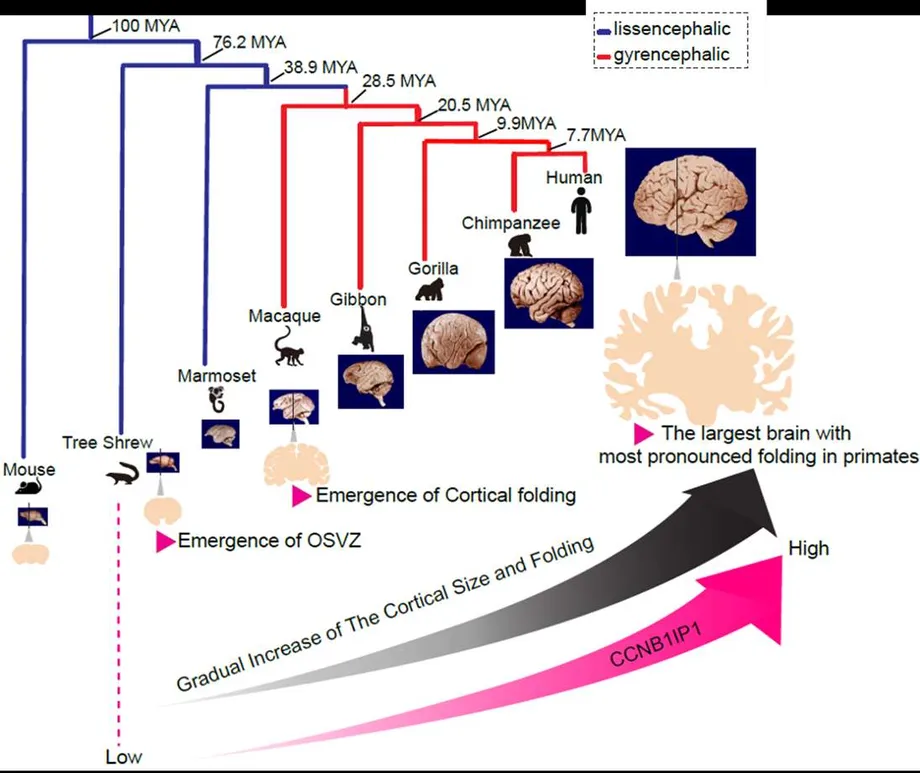
The team, working with international collaborators, found that CCNB1IP1 expression was higher in macaques than in tree shrews and marmosets, and highest in humans. Experiments then traced a possible causal chain: stronger regulatory activity increased gene expression, the gene accelerated part of the cell division cycle, and neural progenitor cells multiplied more rapidly. Some genetically modified mice developed folds in their normally smooth cerebral cortex.
The findings, published in Nature Genetics, broaden an explanation of brain evolution that has often focused on genes newly acquired in the human lineage. CCNB1IP1 is an older gene conserved across mammals. The research suggests that changing when and how strongly such a gene operates can also contribute to the gradual expansion of the primate neocortex.
The distinction matters. A gene does not have to appear for the first time to take on a larger developmental role. Changes in nearby DNA that controls its activity can alter how much of its protein a cell makes, with consequences for the number and types of cells produced during brain development.
Comparing developing brains across five species
The researchers compared transcriptomic data from different layers of the embryonic cerebral cortex in mice, tree shrews, marmosets, macaques and humans. Transcriptomic analysis measures RNA produced by active genes, allowing researchers to compare patterns of gene expression across tissues and species.
Tree shrews served as an outgroup, a close relative outside the primate group that helps researchers investigate which features may predate primate evolution. CCNB1IP1 was already active in the tree shrew brain, supporting the conclusion that its brain expression did not originate exclusively in humans or even in primates.
The pattern was not a uniform increase between every species. Marmosets, which have largely smooth cortices, showed expression similar to tree shrews. Expression was higher in macaques, whose cortices have folds, and reached its highest level in humans. The researchers also found positive associations between expression, brain weight and the degree of cortical folding.
Shi Lei, the researcher who led the team at the Kunming Institute of Zoology, described the relationship between gene activity and brain structure:
The expression level of this ancient gene is closely correlated with the degree of cortical folding,
Those comparisons establish an evolutionary pattern, but a correlation alone cannot show that greater gene activity causes a larger or more folded cortex. The study therefore moved from comparing species to altering regulatory DNA and testing the gene in developing cells and mice.
Why the cells that produce neurons matter
The cellular focus was the population of neural progenitors, immature cells that divide and produce neurons. In the mouse cortex, which normally remains smooth, neurons arise mainly from apical progenitors in the ventricular zone, a developmental region beside the brain's fluid cavities.
In primates, another region called the subventricular zone is much larger. It contains basal progenitors, cells capable of expanding their own population and generating additional neurons. Increasing this population is one route by which a developing cortex can grow.
The study connected higher CCNB1IP1 expression with increased basal progenitor proliferation and greater neuron production. This provides a cellular explanation for the association seen across species: a change in gene activity could alter the supply of cells available to build the cortex.
Expansion and folding are related, but they are not interchangeable measurements. Folds allow a larger cortical surface to fit inside the skull. The study examined how a molecular change could contribute to both tissue growth and folding, without establishing that this gene alone determines either feature.
CRE1 acts as a regulatory switch
The researchers identified a regulatory sequence called CRE1 that helps drive elevated CCNB1IP1 expression. It is a cis regulatory element, meaning a stretch of DNA that influences the activity of a gene on the same DNA molecule rather than encoding the protein itself.
Comparisons of a core segment within this sequence showed progressively stronger regulatory activity from tree shrews through monkeys and apes to humans. That pattern matched the broad rise in CCNB1IP1 expression, directing attention to the gene's controls rather than simply to the existence of the gene.
One position in the core sequence proved especially informative. The human sequence carried the DNA base G, while chimpanzees and other primates carried A. Replacing G with A in the human sequence reduced its regulatory activity. Making the opposite substitution in the chimpanzee sequence increased activity.
These reciprocal experiments provided evidence that the single base difference affected the sequence's function. Predictions and validation experiments indicated that the change altered the binding of two transcription factors, proteins that attach to DNA and help control gene activity.
Deleting the entire regulatory sequence through gene editing also reduced CCNB1IP1 expression. Together, the substitution and deletion experiments support a role for CRE1 in controlling how strongly the gene is expressed. They do not establish that one human DNA change explains all the regulatory differences accumulated across primate evolution.
How CCNB1IP1 speeds up the cell cycle
CCNB1IP1 encodes a ubiquitin ligase, an enzyme that attaches ubiquitin tags to target proteins. Such tags can direct a protein toward destruction by the cell's disposal machinery. Here, the researchers found that CCNB1IP1 promoted the degradation of a transcription factor involved in regulating the cell cycle.
The resulting effect was a shorter G1 phase in neural progenitors. G1 is the interval during which a cell grows and prepares before copying its DNA. Shortening that interval can allow progenitor cells to move through the division cycle more quickly.
The authors' CCNB1IP1 study preprint, posted on December 9, 2024, specifically describes increased neural progenitor numbers through shortening G1. Its abstract connects this mechanism with the evolutionary increase in gene expression and with learning and memory traits in the mouse model.
The proposed sequence is therefore more specific than an association between a gene and brain size. Increased CCNB1IP1 activity promotes degradation of a cell cycle regulator, shortens a preparatory stage of division and increases progenitor proliferation. More progenitors can then produce more neurons, supplying a potential mechanism for cortical expansion.
Some modified mice developed cortical folds
To test whether the gene could change brain development in an animal, the team created mice that expressed the human version of CCNB1IP1 in neural progenitor cells using a conditional knock in approach. This introduces a gene into the genome while controlling the cells in which it becomes active.
Some of these mice developed cortical folding structures despite the normally smooth appearance of the mouse cortex. The researchers also observed an increase in the local gyrification index, a measure of folding, and more neurons in the upper cortical layers.
The distinction between some animals and all animals is important. The findings demonstrate that the intervention could produce folds under the experimental conditions, not that every modified mouse developed the same anatomy or that its brain became equivalent to a primate brain.
The increase in upper layer neurons also adds information beyond the visible folds. It links the anatomical result to altered neuron production, consistent with the earlier experiments on progenitor proliferation. Together, these results strengthen the case that CCNB1IP1 can influence cortical development rather than merely mark differences between species.
Learning and memory results need careful interpretation
The modified mice were reported to perform better in learning and memory tests. The preprint uses a more cautious description, saying that the model exhibited traits associated with enhanced learning and memory abilities. The broader account of the experiments describes differences in particular cognitive tasks and calls for further investigation.
These descriptions support a behavioral effect, but they differ in how strongly they frame it. Without numerical scores, sample sizes or a detailed account of each task here, the size and range of the reported improvement cannot be assessed. Better performance on selected mouse tests is not evidence that the animals acquired human cognitive abilities.
Cortical folding alone does not determine intelligence. The study links gene regulation, cell proliferation, anatomy and behavior, but it does not isolate which developmental change caused the behavioral differences. Establishing that would require further work on neural connections and the function of the altered circuits.
An evolving explanation, with a publication timeline
The research adds an ancient gene to the set of mechanisms considered in primate cortical evolution. It does not displace findings about genes specific to humans. Instead, it supports an explanation in which newly evolved genes and changes in the regulation of older genes can both contribute.
The distinction fits the comparative results. Cortical expansion occurred across primate lineages, not solely after the human lineage emerged. A regulatory system whose activity differs among tree shrews, monkeys, apes and humans offers a way to investigate that broader pattern.
The publication record also separates the initial manuscript from its later journal publication:
- December 9, 2024: The preprint was posted with DOI 10.1101/2024.12.08.627376. It had not yet undergone peer review.
- Later publication: The preprint page records that a version reviewed by peers was subsequently published in Nature Genetics.
The preprint's status at posting should not be confused with the status of the later journal article. Its central claim is that changes in CCNB1IP1 expression may have contributed to gradual primate brain evolution, a narrower conclusion than identifying a single cause of human intelligence.
What still needs to be established
Several questions remain unresolved. The causal roles of the transcription factors associated with CRE1 need further testing during primate cortical development. The effects of CCNB1IP1 on neural connectivity and specific cognitive functions also require closer investigation.
The findings may offer clues for research into disorders of neural development because they identify a mechanism affecting progenitor division and neuron production. That is a research direction, not evidence of a treatment, a diagnostic test or a demonstrated role in a particular disorder.
No next experiment date or clinical timetable has been announced in these accounts. The immediate contribution is a chain of evidence connecting regulatory DNA, gene expression, cell division and cortical anatomy. How much this mechanism contributed to the differences between particular primate species remains to be established.
Key Points
- Researchers led by Shi Lei linked the ancient gene CCNB1IP1 to primate cortical expansion and folding.
- Expression was similar in tree shrews and marmosets, higher in macaques and highest in humans.
- The regulatory sequence CRE1 controls expression, and an A to G difference affected its activity in experiments.
- CCNB1IP1 shortened the G1 phase of neural progenitors and increased their proliferation.
- Some modified mice developed cortical folds and produced more upper layer neurons.
- Learning and memory effects were reported, but folding alone does not determine intelligence.
- A preprint posted in December 2024 preceded publication in Nature Genetics.