A wider partnership without a nuclear pledge
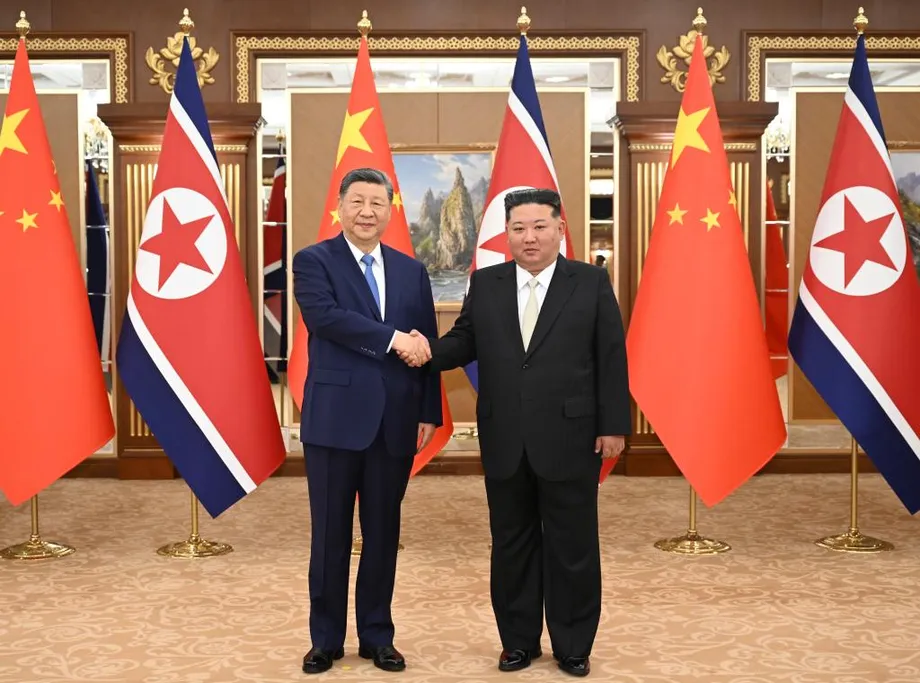
Chinese President Xi Jinping and North Korean leader Kim Jong Un agreed to expand cooperation at a June 8, 2026, summit in Pyongyang, bringing military exchanges, border connections and economic development into a relationship increasingly shaped by competition with the United States. Their public summit accounts left out denuclearization, renewing doubts about how forcefully Beijing intends to pursue its longstanding goal of a Korean Peninsula without nuclear weapons.
Contents
- A wider partnership without a nuclear pledge
- What Beijing says its policy remains
- How the diplomatic language changed
- Military exchanges reveal a gap between accounts
- Trade and transport could deliver the clearest gains
- Russia gives Kim options and China reasons to act
- Pyongyang set nuclear limits before the visit
- Seoul is separating its ultimate goal from immediate limits
- Sanctions and regional coordination remain active
- Key Points
The meeting at the Kumsusan State Guest House was their first since September 2025 in Beijing and Xi's first visit to North Korea in seven years. It came ahead of the July 11 anniversary marking 65 years since the signing of the Treaty on Friendship, Cooperation and Mutual Assistance, the foundation of their mutual defense relationship.
The omission matters because cooperation could bring Kim practical benefits without requiring concessions on his arsenal. Xi proposed closer ties across diplomacy, law enforcement and military affairs, alongside trade, agriculture, construction, science, healthcare and public exchanges. Days before the visit, Kim inspected a newly operational nuclear material facility and promised further expansion of the arsenal.
Yet Beijing has not publicly announced that it has abandoned denuclearization. Asked directly on June 8 whether the nuclear program would be discussed and whether China still supported denuclearization, its Foreign Ministry said its policy remained consistent. The distinction between that assurance and the summit's public language is central: China is rebuilding its relationship with Pyongyang while avoiding an explicit nuclear demand in its account of the talks.
What Beijing says its policy remains
China's Foreign Ministry spokesperson Lin Jian addressed the issue in the ministry's June 8 briefing. Responding to a question about Xi's visit and North Korea's weapons program, Lin gave an assurance of continuity rather than a direct restatement of the denuclearization goal.
China maintains continuity and consistency over its position and policy on the Korean Peninsula issue. We will release information on President Xi Jinping's ongoing state visit to the DPRK in due course. Please stay tuned.
That answer does not establish what the leaders discussed privately. It also does not announce recognition of North Korea as a nuclear weapons state. Descriptions of Beijing's stance as tacit acceptance remain interpretations of its conduct and wording, rather than a declared change in policy.
Yang Moo Jin, president of the University of North Korean Studies, had cautioned after the September Beijing meeting that it was too early to conclude China had abandoned denuclearization. His assessment was that Beijing might instead see little realistic prospect of progress under current conditions. The June summit strengthens the evidence of a change in public priorities, but Lin's statement remains a direct official counterweight to claims of a formal reversal.
How the diplomatic language changed
The shift is broader than the disappearance of one word. A comparison of Chinese summit accounts found that references to the peninsula appeared nine times in Xi's remarks and six times in Kim's remarks during their June 2019 meeting in Pyongyang. In the September 2025 Beijing account, the respective counts were two and one. In the June 2026 account, neither leader's remarks included the term.
Those figures amount to a decline from 15 references in 2019 to three in 2025 and none in 2026. They measure the published accounts, not the full private conversations. Still, they show how the public framing moved from managing a regional security problem toward presenting an expanding bilateral partnership.
Denuclearization had already disappeared from China's account of Kim's September 2025 visit. A subsequent summary of talks between Chinese Foreign Minister Wang Yi and North Korean Foreign Minister Choe Son Hui also omitted it, focusing instead on governance exchanges and socialist solidarity. The June summit therefore extends a pattern rather than introducing a wholly new silence.
The concern over China's diplomatic silence had already become a focus of debate in April. The latest evidence supports a narrower conclusion than outright abandonment: Beijing is willing to publicize cooperation without attaching its traditional nuclear objective to the same message.
Key developments trace that progression:
- June 2019: Xi visited Pyongyang, and China's summit account explicitly addressed denuclearization.
- September 2023: North Korea incorporated its nuclear policy into its constitution.
- March 2024: Russia vetoed renewal of the United Nations panel monitoring North Korean sanctions; China abstained.
- September 3, 2025: Kim appeared alongside Xi and Vladimir Putin at China's military parade, followed by separate diplomatic meetings.
- June 8, 2026: Xi and Kim met in Pyongyang and announced expanded cooperation without public mention of denuclearization.
- July 11, 2026: The mutual defense treaty's 65th anniversary offers an early opportunity to assess further commitments.
Military exchanges reveal a gap between accounts
Xi's proposal for closer exchanges in diplomacy, law enforcement and military affairs drew particular attention in Seoul. A South Korean unification ministry official described military cooperation as a subject not previously raised publicly between the two sides and said the government was watching for substantive developments.
That claim is disputed. Rachel Minyoung Lee, a senior fellow with the 38 North Program, notes in the Stimson Center's regional summit assessment that Kim and Xi had agreed to expand military exchanges at their January 2019 summit. Her assessment is that such a public proposal by a Chinese leader is rare, not unprecedented.
Lee also identifies a difference between the latest accounts. China's version included Xi's military affairs proposal, while North Korea's version described political, economic and cultural exchanges without mentioning it. That omission does not prove rejection, since Pyongyang often withholds details, but it prevents treating the Chinese proposal as a fully documented joint military program.
The two governments also used different language about their agreement. North Korea said the leaders reached a satisfactory consensus of views, while Beijing described a series of new important points of agreement. Lee sees progress compared with September 2025, when Pyongyang's account lacked similar language of alignment, but warns against equating warmer rhetoric with complete agreement.
No detailed timetable, named exercise or new operational arrangement was disclosed in these accounts. The practical test will be whether officials, military representatives and institutions begin sustained exchanges, rather than whether summit language alone sounds more ambitious.
Trade and transport could deliver the clearest gains
Xi organized his proposals around four areas: senior leadership exchanges, practical cooperation, exchanges among the public and strategic coordination. Economic measures could provide the most visible early results, especially if they restore routine movement across a border central to North Korea's access to China.
He called for expanding travel through the full reopening of border crossings and the resumption of civilian flights and international passenger trains. Proposed cooperation also covered education, culture, tourism, sports, youth activities and local exchanges. These commitments build on reported preparations for renewed exchanges and resumed flights and cargo deliveries.
The distinction between a pledge and a completed project is important. Possible subjects identified in reporting include the new Yalu River bridge between Sinuiju and Dandong, a 10 year use arrangement at Rajin port, the Greater Tumen Initiative and access to the sea through the Tumen River. None was established as a confirmed summit agreement.
Lee Hee Ok, an emeritus professor at Sungkyunkwan University, argues that China could avoid publicly endorsing North Korea's claim to nuclear status while allowing trade that eases sanctions pressure through quiet tolerance. That is a forecast of possible Chinese behavior, not evidence that particular transactions have been approved or sanctions formally removed.
For Kim, restored transport and expanded trade offer benefits he can present domestically as diplomatic achievements. Jenny Town, senior fellow and director of the 38 North Program, notes that some activity was already developing before Xi arrived. Packaging it as a summit result could strengthen Kim's public standing even where the meeting accelerates an existing process rather than starts a new one.
Russia gives Kim options and China reasons to act
The rapprochement follows North Korea's expanding military relationship with Russia. At the September 2025 parade in Beijing, Putin sat to Xi's right and Kim to his left. A South Korean unification ministry official described that arrangement as exceptionally high diplomatic honors for Kim. Such protocol bolstered his status, although it did not constitute formal recognition of his nuclear arsenal.
Hours after the parade, Kim held separate talks with Putin. North Korea's official Korean Central News Agency said they discussed plans for lasting cooperation and regional issues. Kim pledged support for Russia's defense of its sovereignty after Putin praised North Korean troops fighting alongside Russian forces.
The relationship carried visible costs before those meetings. In August 2025, Kim publicly offered support to families of fallen soldiers, acknowledging losses from North Korea's involvement in Russia's war against Ukraine. That military commitment helps explain both Moscow's praise and the concern in Beijing about Kim's additional powerful patron.
Hong Min, a researcher at the Korea Institute for National Unification, argues that China wants a clearer understanding of the extent of Russian military cooperation with North Korea and seeks to draw Pyongyang closer again. Michael Cunningham, a senior fellow in Stimson's China Program, offers a more qualified interpretation: Beijing is uneasy about Kim gaining another major patron, but Russia cannot replace China's role as North Korea's principal economic partner.
Cho Han Bum, a senior researcher at the Korea Institute for National Unification, identifies a possible limit from Kim's perspective. If the Ukraine war ends and Russia's demand for North Korean troops or weapons falls, Pyongyang's value to Moscow could diminish. Rebuilding relations with China gives Kim another source of support without requiring him to sever Russian ties.
Pyongyang set nuclear limits before the visit
North Korea's preparations made its negotiating position unmistakable. Kim's inspection of a newly operational nuclear material facility shortly before Xi arrived linked the visit to a promise of further weapons expansion. His sister, Kim Yo Jong, then declared that the country's nuclear status was a line of no retreat.
The constitutional change in September 2023 placed nuclear policy within North Korea's basic legal framework. At the 2025 United Nations General Assembly, Vice Foreign Minister Kim Son Gyong argued that demands for denuclearization amounted to demands that Pyongyang surrender sovereignty. North Korea has also rejected dialogue with Washington when the stated purpose is eliminating its arsenal.
Lim Eul Chul, a professor at Kyungnam University, interprets Xi's support for North Korea's socialist cause as tacit support for its nuclear program because Pyongyang presents the arsenal as a major achievement of that political project. Hong similarly warns that Chinese support may validate Kim's pursuit of strategic status through nuclear development.
Town offers a different explanation for the summit's agenda. Because the visit centered on the treaty anniversary and restoration of ties, she judges that highly sensitive matters such as denuclearization or relations with Washington were unlikely to be discussed. These interpretations differ over what the silence means, but agree that no public nuclear concession emerged from the meeting.
Seoul is separating its ultimate goal from immediate limits
South Korean President Lee Jae Myung used a June 8 press conference to argue that denuclearization should remain the destination while negotiations pursue more limited, achievable restrictions. His proposals included stopping additional nuclear material production and transfers abroad, imposing a moratorium and halting intercontinental ballistic missile development.
Lee, speaking as South Korea's president, described those steps as immediate negotiating objectives rather than substitutes for the ultimate goal.
We have to set this as a short-term goal and negotiate (with the North).
A freeze would seek to stop further growth or specified activities, rather than immediately dismantle existing weapons. Such an agreement could reduce some risks while leaving the arsenal in place. Lee's remarks did not establish agreed verification procedures, the precise scope of a moratorium or North Korean acceptance.
Donald Trump's expressed interest in another meeting with Kim adds a diplomatic possibility, not a confirmed negotiating schedule. Yang argues that Beijing may want to shape any future talks. Cunningham similarly sees an incentive for China to strengthen its position before possible engagement between Washington and Pyongyang.
The September parade also produced an indirect contact with Seoul: Putin asked National Assembly Speaker Woo Won Shik what message he should convey to Kim. Woo expressed hope for peace and possible exchanges during a UNESCO related event in 2026. No resulting agreement or specific date for such exchanges was established.
Sanctions and regional coordination remain active
Closer cooperation with Beijing and Moscow does not erase existing United Nations sanctions. The March 2024 Russian veto ended renewal of the Panel of Experts' mandate, weakening an international mechanism for investigating sanctions violations. China's abstention helped distinguish its position from Russia's veto, but neither action repealed the underlying restrictions.
Andrew Oros, senior fellow and director of Stimson's Japan Program, points to the May 29 Joint Statement on DPRK Sanctions Accountability, issued by 10 European and Indo Pacific states and the European External Action Service, as evidence that other governments continue coordinating enforcement. He also notes that Japan's Foreign Ministry listed five telephone meetings among the Japanese, South Korean and United States foreign ministers in 2026.
Oros describes a parallel approach: retaining complete denuclearization as a goal while strengthening deterrence against the weapons North Korea already possesses. The distinction mirrors Seoul's effort to separate its ultimate objective from immediate risk reduction, although deterrence and negotiated limits are different instruments.
Regional military coordination was already under discussion before Xi's visit. In April, U.S. Forces Korea commander Gen. Xavier Brunson proposed a trilateral defense network linking allied capabilities. Cunningham argues that closer Russian and North Korean cooperation is itself encouraging stronger defense coordination among Washington, Tokyo and Seoul, an outcome Beijing views with concern.
The next concrete marker is July 11, when treaty anniversary events may reveal whether the new pledges become regular institutional exchanges. Japan is also expected to announce updated security policies by the end of 2026. What remains unknown is whether expanded Chinese cooperation will be conditioned on any nuclear restraint, how the military proposal will be implemented and whether Kim will accept negotiations on a freeze.
Key Points
- Xi and Kim met in Pyongyang on June 8, 2026, and pledged wider economic, diplomatic and public exchanges.
- Public summit accounts omitted denuclearization, continuing a pattern visible in 2025.
- China's Foreign Ministry said its Korean Peninsula policy remained consistent and announced no formal reversal.
- China included a military exchanges proposal that North Korea's account omitted; its implementation is undecided.
- President Lee proposed immediate nuclear and missile limits while retaining denuclearization as South Korea's ultimate goal.
- The July 11 treaty anniversary offers an early test of whether summit commitments produce concrete action.