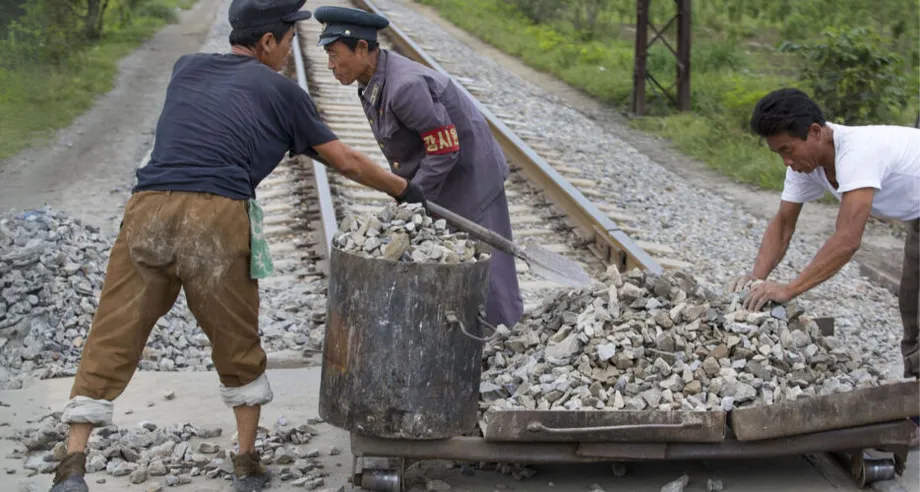
A global workforce financing Pyongyang
North Korea generated an estimated US $450 million to $800 million from overseas workers in 2025, according to an assessment released by 11 governments on September 16, 2026. Most of that revenue came from information technology workers, a finding that puts digital employment alongside factories and construction sites at the center of the country's sanctions evasion network.
Contents
- A global workforce financing Pyongyang
- What the sanctions require
- Why IT workers dominate the revenue
- China's departures were followed by new arrivals
- Russia's student visas conceal a labor pipeline
- Drone production connects labor to the war in Ukraine
- Workers can lose their wages and their freedom
- How earnings move through the network
- Pyongyang rejects the findings as governments seek action
- Key Points
The Multilateral Sanctions Monitoring Team (MSMT) estimates that 35,600 to 101,280 North Korean workers are deployed across at least 17 countries, almost all in China and Russia. Its overseas labour report says their earnings support government priorities, including nuclear weapons and ballistic missile programs prohibited by United Nations Security Council resolutions.
The investigation describes a network sustained by student visas, supposed training programs, foreign intermediaries and financial channels that allow earnings to be spent abroad rather than sent directly to North Korea. It also identifies North Korean workers producing military drones in Russia for use against Ukraine.
The financial gains come at a severe human cost. The report says North Korean authorities confiscate 80 to 90 percent of wages, sometimes more, while workers face long hours, restrictions on movement and threats against relatives if they escape. Additional charges can leave them with no pay or debts to the government.
North Korea rejected the assessment on September 21, calling its overseas economic relationships legitimate and challenging the authority of both the monitoring team and UN sanctions. China has also denied hosting illegal North Korean workers. The dispute concerns a labor network that continues years after the UN required countries to repatriate North Koreans earning income abroad.
What the sanctions require
The report identifies two Security Council resolutions as the legal basis for restrictions on overseas employment. Resolution 2375, adopted in 2017, prohibits member states from providing work authorizations to North Korean nationals. Resolution 2397, also adopted in 2017, required countries to repatriate North Koreans earning income in their jurisdictions by 2019.
Those measures sought to cut off foreign earnings that Pyongyang could use for its weapons programs. The monitoring team argues that allowing workers to earn income under another visa category does not resolve the violation. A student or trainee designation can conceal employment rather than change its substance.
The chronology shows how the employment network outlasted both the repatriation deadline and the UN body responsible for monitoring compliance:
- 2017: The Security Council adopted resolutions 2375 and 2397, restricting work authorizations and requiring repatriation.
- 2019: The deadline for returning North Koreans earning income abroad passed.
- March and April 2024: Russia vetoed renewal of the UN sanctions Panel of Experts, and the panel was disbanded.
- October 2024: Eleven governments established the MSMT to monitor sanctions implementation.
- 2025: Overseas labor generated an estimated $450 million to $800 million for the North Korean government.
- September 16, 2026: The MSMT released its overseas labor report.
- September 21, 2026: North Korea's foreign ministry rejected the findings.
Why IT workers dominate the revenue
The distinction between worker numbers and earnings is central to the assessment. Although the report describes large groups employed in manufacturing and construction, it attributes a majority of the estimated 2025 revenue to overseas North Korean IT workers.
Drawing on an October 2025 MSMT assessment of cyber and IT activities, the report gives average earnings for overseas IT workers of $10,000 a month. That is $120,000 over a full year, compared with estimated annual wages of $7,500 for a North Korean laborer in Russia. On those figures, annual IT earnings are about 16 times the Russian labor average.
These are estimates for different employment categories, not a uniform pay scale. They nevertheless explain why counting factory or construction workers alone would give an incomplete picture of the government's foreign revenue. A smaller group of highly paid technology workers can generate a disproportionate share of the money.
The report does not identify how much of the $450 million to $800 million was spent on particular weapons projects. It says earnings fund state priorities, including nuclear and missile development, as well as procurement. The total should therefore not be read as an audited figure for direct spending on nuclear weapons alone.
China's departures were followed by new arrivals
China remains the largest destination, with an estimated 20,000 to 70,000 North Korean workers. The report says approximately 10,000 to 20,000 returned to North Korea between 2023 and 2025, but about 10,000 new workers arrived between January 2025 and January 2026. Repatriations did not bring the network to an end.
The report associates renewed deployments with an improvement in relations between Beijing and Pyongyang beginning in 2025. It describes factory workers entering on training visas valid for six months and restaurant employees receiving student visas. Some training visas can reportedly be renewed without requiring a return to North Korea.
Workers are concentrated in Liaoning and Jilin provinces, particularly the border cities of Dandong and Hunchun. Clothing production, food processing and IT are major activities. The assessment also identifies factories and seafood processing plants in more remote parts of Heilongjiang province, where workers may have less contact with outsiders.
Specific deployments show the scale beneath the national estimate. The report says more than 2,900 workers were dispatched to garment factories through Dandong Customs from September 2025. It also attributes approximately 4,600 deployments to Kaishantun Industrial Park in Longjing to O-il Trading Corporation from that month, and estimates that the company had dispatched about 5,000 workers to Hunchun Industrial Park by December 2025.
Those local figures describe different deployment records and periods and should not simply be added together as a separate national total. The broad range of 20,000 to 70,000 remains an estimate. China denies hosting illegal North Korean workers, while investigations and human rights groups have documented their presence in factories, processing plants and fishing fleets.
Russia's student visas conceal a labor pipeline
Russia hosted an estimated 15,000 to 30,000 North Korean laborers at the end of 2025, affiliated with 70 to 80 North Korean companies. The report describes oversight through North Korea's embassy in Moscow and offices in St. Petersburg, Vladivostok and Khabarovsk.
The sharp growth in student visas is one of its strongest indicators of disguised employment. Russia issued 8,617 student visas to North Koreans in 2024 and 35,839 in 2025, an increase of about 4.2 times. Student visas accounted for more than 98 percent of the 36,413 visas issued to North Koreans in 2025.
The report contrasts those numbers with a senior Russian official's statement that only 96 North Korean students were enrolled in Russian universities in 2024. That is about 1.1 percent of the 8,617 student visas issued that year. Visa issuance and university enrollment are different measures, but the gap supports the monitoring team's assessment that many arrivals were not genuine students.
According to Russian government figures cited in the report, work visas issued to North Koreans fell to zero in 2020 and remained there. The monitoring team describes a parallel system involving changes to Russian law, payments to universities and intermediaries who arrange deployment under the guise of practical training.
Workers are sent to construction sites, farms, logging operations and processing facilities. Costs for tuition, visa arrangements and bribes may be deducted from their wages, placing them in debt before they can retain any earnings. Russia's appeal to Pyongyang is also financial: depending on the industry, monthly wages may be up to five times those in China.
Drone production connects labor to the war in Ukraine
The report says North Korean workers have been deployed to Russian drone manufacturing, including at the Alabuga Special Economic Zone in Tatarstan. It presents this as an expansion of military cooperation into weapons production, rather than simply the provision of general industrial labor.
The scale of the Alabuga deployment is uncertain. The assessment cites reports of as many as 25,000 North Korean workers at a drone factory there. Separately, Ukrainian Defence Intelligence estimated in November 2025 that up to 12,000 could be dispatched to Alabuga that year. These accounts refer to different claims and cannot be treated as an agreed count.
Information from an MSMT participating state confirms that workers were deployed for drone production, but says the numbers sent were lower than existing estimates. The report therefore supports the presence of North Korean labor in that industry more firmly than it establishes a precise workforce total.
Ukrainian officials also reported that Russia committed to paying approximately $2.50 an hour, with workers expected to work at least 12 hours a day. The report identifies Jihyang Trading Company as involved in recruiting North Koreans for Russian drone manufacturing.
The concern extends beyond wages. The monitoring team warns that employment in defense industries, including possible work connected to armored vehicles and fighter jets, risks transferring technical knowledge to North Korea. It says such activity could violate the arms embargo, although it does not establish that every potential deployment has occurred.
Workers can lose their wages and their freedom
The report describes working days of 12 to 18 hours, six or seven days a week. Alongside the government's confiscation of 80 to 90 percent of earnings, workers can face a fee of up to 30 percent on funds sent to relatives and further charges for travel, food and lodging.
These deductions can consume all earnings. In some cases, demanded payments exceed wages, leaving workers indebted to North Korean authorities. The report says even people who initially volunteer to work abroad can experience forced labor once surveillance, restrictions and financial obligations prevent them from leaving freely.
Authorities restrict movement and contact with outsiders to prevent defections. Workers who escape risk reprisals against family members in North Korea. The assessment also cites reports of sexual harassment, rape and sex trafficking by North Korean managers against women in Russia and China, as well as unexplained disappearances.
Lara Strangways, head of business and human rights at Global Rights Compliance, said the findings confirmed the organization's investigations into recruitment and control through Russian labor brokers:
North Korean workers are being channelled through Russian labour brokers into a system built on debt bondage, confiscated documents and constant surveillance, generating hard currency for Pyongyang.
Strangways called for action against the intermediaries and businesses involved:
The labour brokers facilitating these arrangements, and the companies profiting from this exploitation, must be identified and sanctioned.
How earnings move through the network
Money does not always travel straight from a worker's employer to North Korea. The report says earnings in Russia are paid in rubles and can be used to purchase goods there or transferred to China for procurement. Smaller amounts move through overseas offices of designated North Korean entities, including Foreign Trade Bank.
China serves both as a labor destination and a purchasing hub. Workers' wages are often transferred to North Korean authorities based there and used to pay for goods. Earnings from other countries also flow to China, where North Korea buys materials for domestic projects.
The report says tighter monitoring by Chinese banks and action against illegal money exchange brokers have made some transfers more difficult, increasing reliance on physical cash. It describes couriers using diplomatic cover, vehicles, pouches and embassy premises, as well as smaller amounts carried by returning workers.
Another route remains unresolved. Korea Kwangson Banking Corporation, sanctioned by the Security Council in March 2016 for financing weapons programs, has pursued access to Russia's System for Transfer of Financial Messages, or SPFS. This is an alternative to SWIFT, the messaging network banks use to communicate payment instructions. The report says approval would allow transactions in rubles; it does not confirm that access has been granted.
Beyond China and Russia, the assessment lists smaller workforces in Asian and African countries. Estimated deployments include 200 to 300 workers in Equatorial Guinea and 150 to 200 in Guinea. Work in Asia centers on IT, manufacturing and construction, while medical and construction jobs feature in Africa. A separate reported count of about 38 countries hosting North Korean workers since 2019 concerns the period since the deadline, rather than the current estimate of at least 17 destinations.
Pyongyang rejects the findings as governments seek action
In a statement carried by North Korea's official Korean Central News Agency on September 21, an unnamed foreign ministry spokesperson argued that overseas cooperation was protected by international agreements:
The DPRK's relations of exchange and cooperation with other countries cannot be subject to interference or investigation of a third party in any case as they are the exercise of legitimate rights under bilateral and multilateral treaties and agreements.
The ministry also rejected the legitimacy of UN sanctions and accused the United States and Western governments of violating sovereignty and noninterference principles. Its response challenged the legal basis of scrutiny rather than supplying an alternative workforce or revenue estimate.
The MSMT's members are Australia, Canada, France, Germany, Italy, Japan, the Netherlands, New Zealand, South Korea, the United Kingdom and the United States. Their joint statement urges accountability for employers and intermediaries and calls on the Security Council to restore the 1718 Committee Panel of Experts in its previous strength and structure.
The governments did not announce new sanctions against Russian or Chinese companies with the report. They also set no date for a Security Council vote or other enforcement decision. Their stated next steps are continued monitoring, wider awareness and domestic action against those responsible for violations.
Key Points
- Overseas North Korean labor generated an estimated $450 million to $800 million for the government in 2025, with most revenue attributed to IT workers.
- The MSMT estimates 35,600 to 101,280 workers across at least 17 countries, predominantly China and Russia.
- Student and training visas are used to disguise employment despite UN restrictions and a 2019 repatriation deadline.
- Authorities confiscate 80 to 90 percent of wages, while additional charges can leave workers unpaid or indebted.
- North Korean workers are involved in Russian drone production, but deployment numbers remain disputed.
- North Korea rejects the findings. The 11 monitoring governments seek accountability and restoration of the UN expert panel, without announcing new sanctions or a decision date.